





Make investment decisions with full context.
Give asset management teams an AI coworker that helps them analyze opportunities, prepare faster, and deliver more relevant guidance.
Get a demo


Give asset management teams an AI coworker that helps them analyze opportunities, prepare faster, and deliver more relevant guidance.

Better investment decisions with full portfolio context

Unify research and portfolio context
Bring together research, market signals, client information, and portfolio knowledge so teams can evaluate opportunities with greater confidence.

Create decision-ready deliverables faster
Create polished analyses, research briefs, and account summaries grounded in cross-system data.

Support more informed client coverage
Give teams the context they need to prioritize relationships, tailor guidance, and act on opportunities faster.

%201.webp)
%201%20(1).webp)
Client relationship
Prioritize the right client relationships.
Identify underserved relationships, uncover growth opportunities, and focus coverage where it can have the most impact.
Portfolio analytics
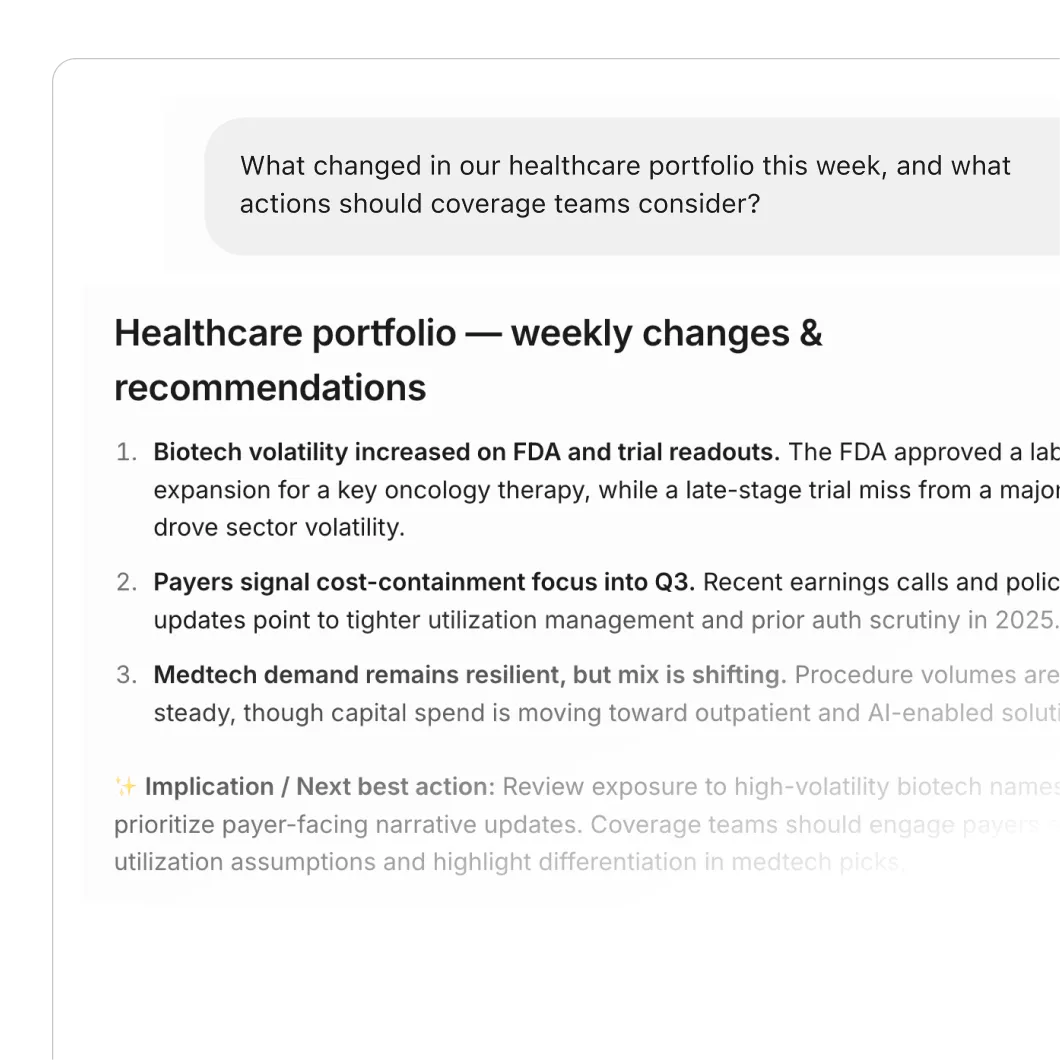
Turn portfolio and market insight into action.
Combine internal knowledge and market research so teams can assess positions, evaluate opportunities, and respond faster to change.
Investment workflow automation
Reduce time spent on prep and follow-up.
Draft meeting prep, summaries, and follow-up materials faster so teams can spend more time on investment decisions and client relationships.
Personalized financial guidance
Deliver more informed client coverage.
Make targeted recommendations with access to client history, preferences, product guidance, and compliance requirements.
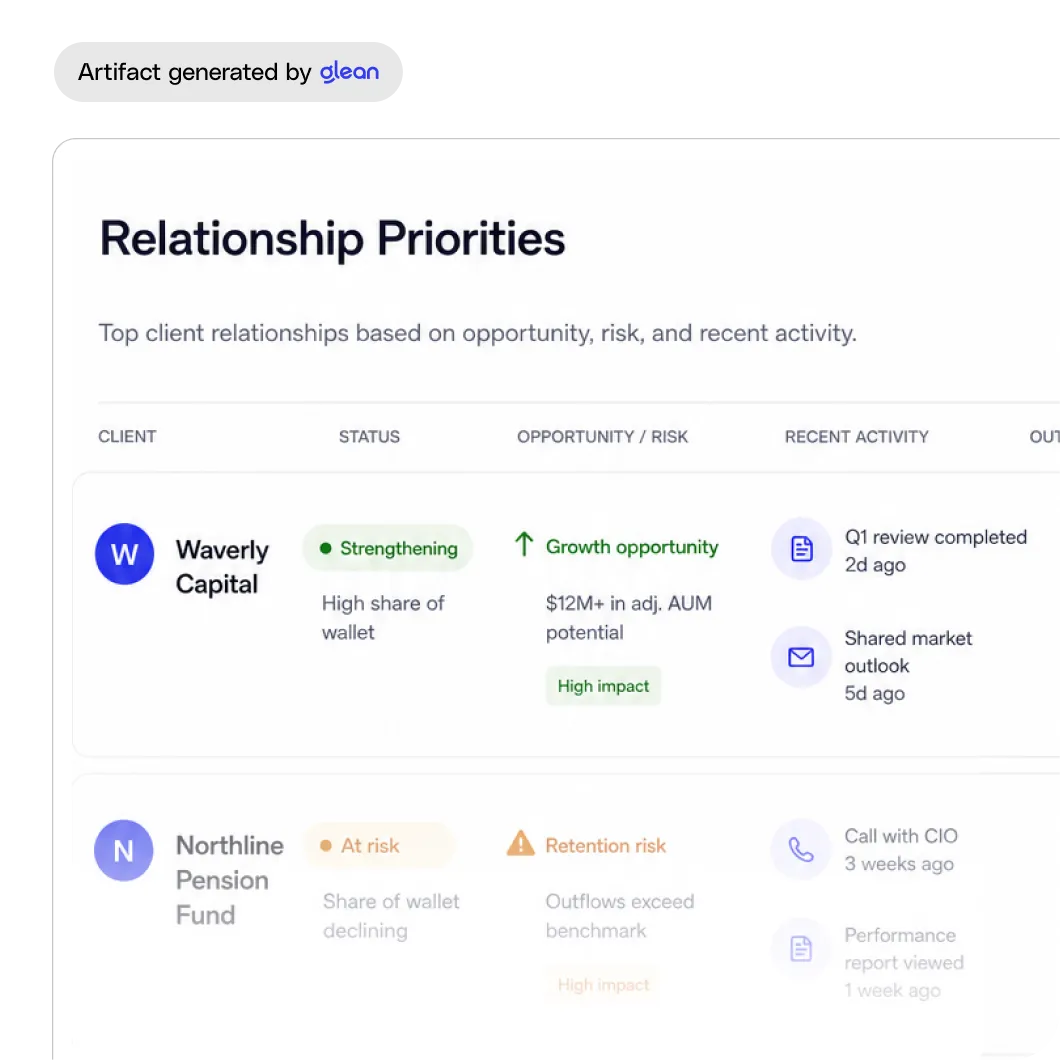
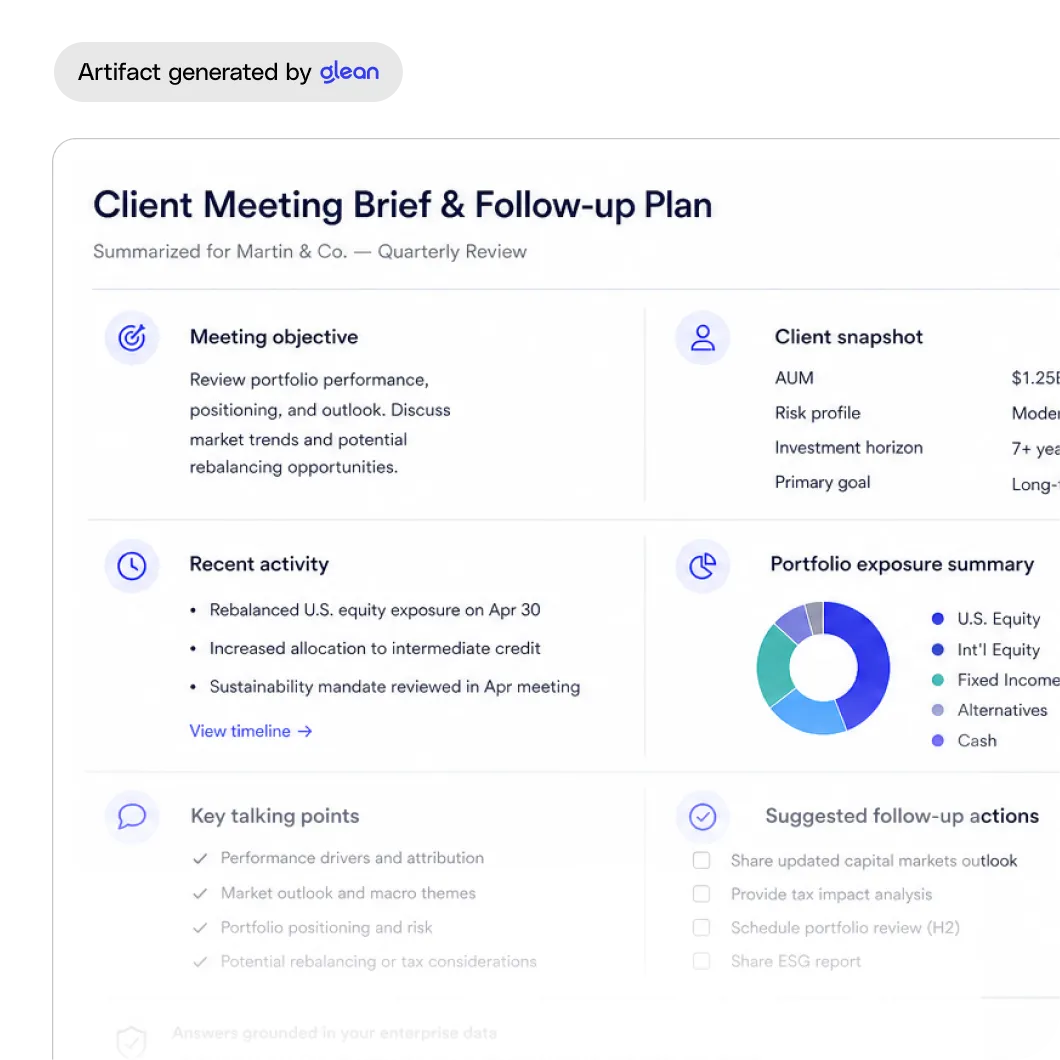
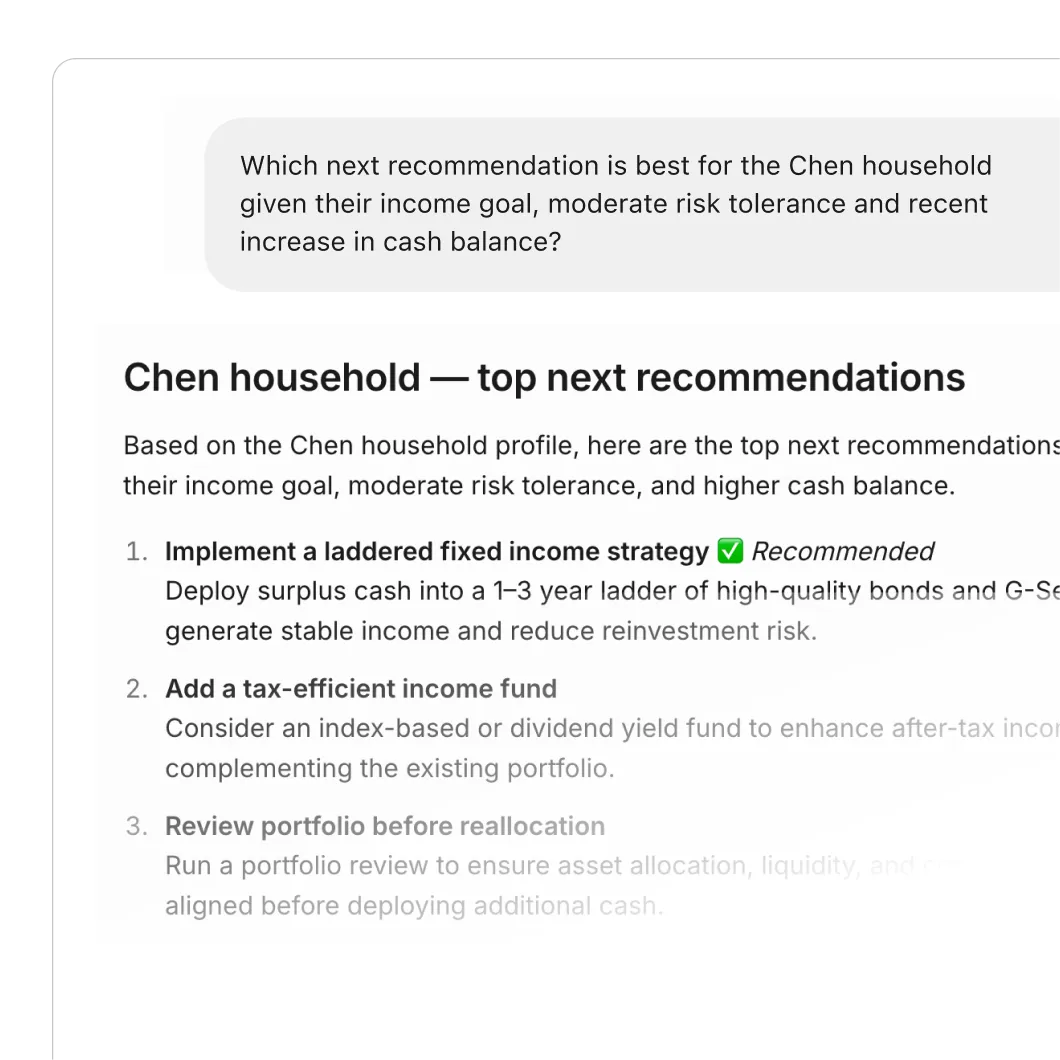

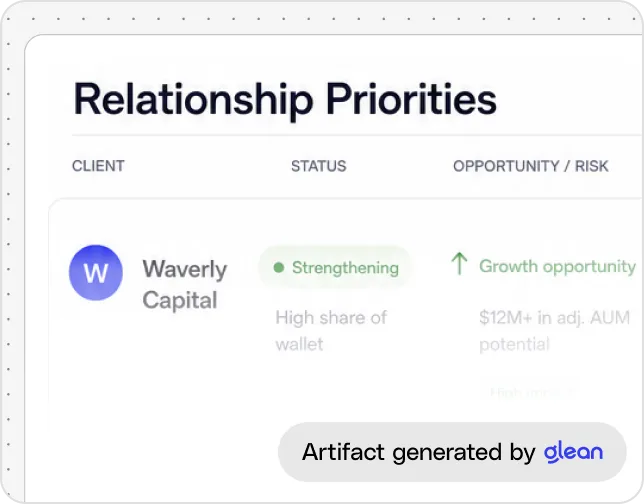
Identify underserved relationships, uncover growth opportunities, and focus coverage where it can have the most impact.
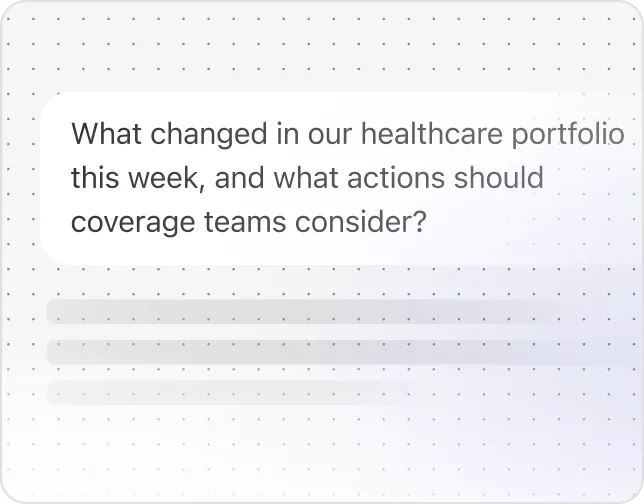
Combine internal knowledge and market research so teams can assess positions, evaluate opportunities, and respond faster to change.
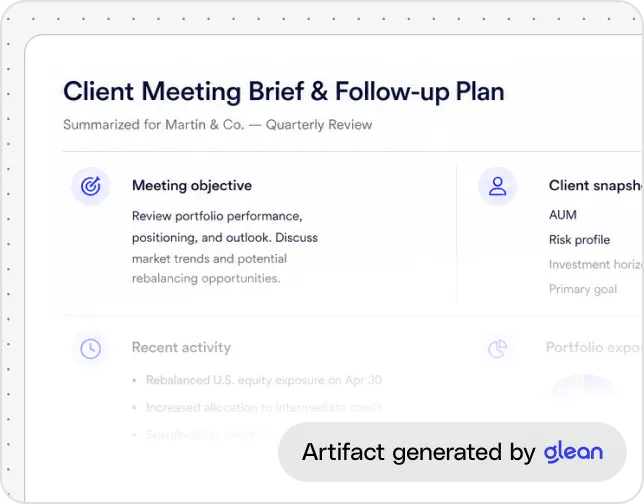
Draft meeting prep, summaries, and follow-up materials faster so teams can spend more time on investment decisions and client relationships.
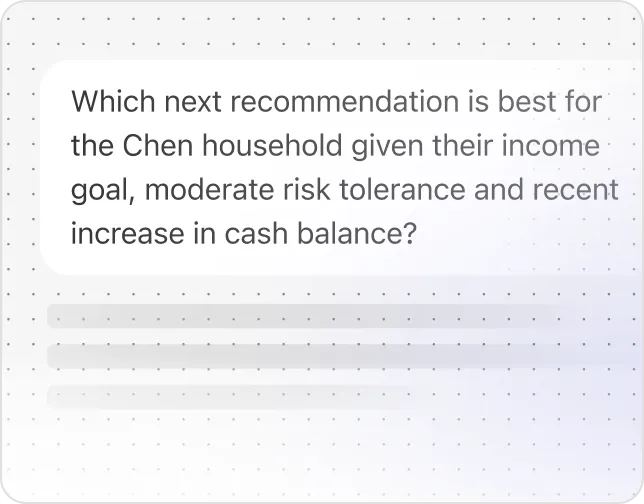
Make targeted recommendations with access to client history, preferences, product guidance, and compliance requirements.
Explore ready-to-use agents
Consistently utilize the most up-to-date company information to brainstorm ideas, summarize documents, and create deliverables.


Explore more resources

How AI helps financial advisors bridge the knowledge problem and better prioritize clients
How AI helps financial advisors bridge the knowledge problem and better prioritize clients

Discover how AI is reshaping financial services operations
Discover how AI is reshaping financial services operations

Financial services teams are under pressure to do more with less.
Financial services teams are under pressure to do more with less.
How AI helps financial advisors bridge the knowledge problem and better prioritize clients
How AI helps financial advisors bridge the knowledge problem and better prioritize clients
Discover how AI is reshaping financial services operations
Discover how AI is reshaping financial services operations
FAQs
Asset managers get more value from AI when teams can work from the full context behind an investment or client decision. Glean connects research, portfolio context, client information, product guidance, and internal knowledge across the tools teams already use. That reduces manual assembly and gives teams a stronger foundation for analysis, coverage, and follow-through.
The strongest use cases reduce repetitive synthesis work while keeping judgment with the team. Firms use AI search and agents to summarize research, prepare for meetings, support diligence, draft documentation, and coordinate follow-up. When AI is grounded in governed enterprise context and paired with human review where needed, teams can move faster without treating automation as a substitute for professional judgment.
In financial services, usefulness depends on control. Glean respects source-system permissions so employees only see what they are already allowed to access, and it adds governance, sensitive data protection, and enterprise security controls on top. That helps firms extend access to research, client, and operational knowledge in a way that supports real work without exposing sensitive information to the wrong users.
The most credible ROI comes from repeated workflows where teams spend time searching, assembling, and rewriting information. Firms can measure faster research prep, reduced documentation effort, quicker responses to internal or client requests, fewer repeated questions, and less duplicated work across teams. Over time, the larger value is more capacity for client coverage, investment work, and operational execution.
If a firm already has AI investments, the key question is whether teams can use AI across the full enterprise context behind investment and client workflows. Glean can complement existing tools by providing a governed layer for context, retrieval, permissions, and enterprise knowledge. The goal is not to replace every AI investment. It is to make trusted, cross-system work easier to scale.
Asset management firms should evaluate permissions, data residency, auditability, model governance, and control over sensitive information. They need to know where the platform runs, how access is enforced, what information can be used by models, and how activity can be reviewed later. Glean is designed to support regulated enterprise environments with permission-aware retrieval, governance controls, deployment flexibility, and strong security practices.
Chat assistants help employees find, summarize, and explain information. AI agents go further by planning multi-step work, using tools, and helping automate repeatable workflows that depend on enterprise context. For asset managers, good starting points include first-pass meeting prep, recurring documentation, internal follow-up, RFP support, and other bounded workflows where the process is clear and the right guardrails are in place.
Adoption improves when the rollout is tied to specific team workflows, not broad AI messaging. Start with use cases where employees already feel the pain of fragmented information, show how Glean fits into existing tools and processes, and make early wins visible. For asset management teams, trust, relevance, and control matter as much as speed.
Start with a narrow set of high-frequency workflows where teams lose time to search, prep, and repeated manual work. That gives the firm a practical way to prove value, learn what adoption looks like, and expand with confidence. A platform approach also helps smaller teams avoid spending scarce resources rebuilding connectors, permissions, and governance before they can get to a useful first deployment.
Avoiding AI sprawl starts with giving teams a shared foundation for context, permissions, governance, and measurement. Different teams can still use assistants and agents for their own workflows, but the underlying approach should be consistent. That helps firms scale what works, reduce disconnected pilots, and keep AI tied to business value.
Work AI that works.