




Enterprise AI is entering its accountability era. In 2025, the industry proved the technology works. In 2026, it gets judged on what actually matters: ROI, reliability, and scale. The question isn’t “can it generate?” It’s who can deploy AI across real teams and real systems, with real guardrails, and make it measurably useful.
The winners won’t be the ones with the flashiest model. They’ll be the ones who can connect AI to the reality of work: context that reflects how things get done, governance that matches the risk, and data that compounds over time. Human judgment and expertise will become more valuable, not less.
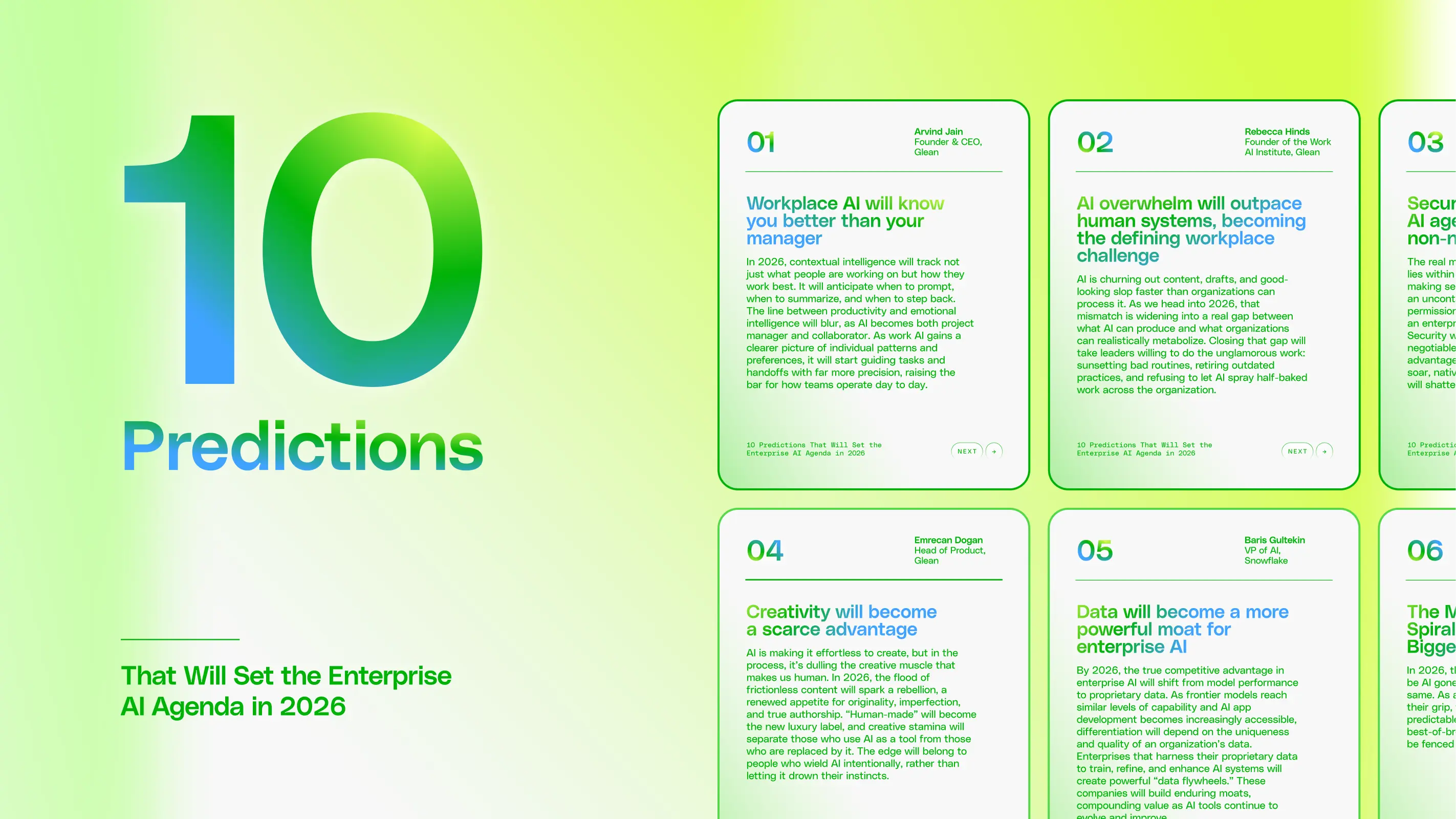
To help separate what’s durable from what’s loud, we gathered predictions from the leaders shaping enterprise AI and the academics who study how work really happens. Here are the 10 predictions that will set the enterprise AI agenda in 2026:
Workplace AI will know you better than your manager
In 2026, contextual intelligence will track not just what people are working on but how they work best. It will anticipate when to prompt, when to summarize, and when to step back. The line between productivity and emotional intelligence will blur, as AI becomes both project manager and collaborator. As work AI gains a clearer picture of individual patterns and preferences, it will start guiding tasks and handoffs with far more precision, raising the bar for how teams operate day to day.
- Arvind Jain, Founder & CEO, Glean
AI overwhelm will outpace human systems, becoming the defining workplace challenge:
AI is churning out content, drafts, and good-looking slop faster than organizations can process it. As we head into 2026, that mismatch is widening into a real gap between what AI can produce and what organizations can realistically metabolize. Closing that gap will take leaders willing to do the unglamorous work: sunsetting bad routines, retiring outdated practices, and refusing to let AI spray half-baked work across the organization.
- Rebecca Hinds, Founder of the Work AI Institute, Glean
Securing enterprise AI agents will be non-negotiable
The real monetization potential for generative AI lies within enterprise and workforce data, making security and compliance the top risk. Yet an uncontained agent operating with excessive permissions, unmonitored and unconstrained in an enterprise environment is the ultimate threat. Security will become the essential, non-negotiable accelerator for sustainable AI advantage. With the number of AI agents set to soar, native, end-to-end security partnerships will shatter a major adoption roadblock.
- Anand Oswal, Executive VP, Palo Alto Networks
Creativity will become a scarce advantage:
AI is making it effortless to create, but in the process, it’s dulling the creative muscle that makes us human. In 2026, the flood of frictionless content will spark a rebellion, a renewed appetite for originality, imperfection, and true authorship. “Human-made” will become the new luxury label, and creative stamina will separate those who use AI as a tool from those who are replaced by it. The edge will belong to people who wield AI intentionally, rather than letting it drown their instincts.
- Emrecan Dogan, Head of Product, Glean
Data will become a more powerful moat for enterprise AI:
By 2026, the true competitive advantage in enterprise AI will shift from model performance to proprietary data. As frontier models reach similar levels of capability and AI app development becomes increasingly accessible, differentiation will depend on the uniqueness and quality of an organization’s data. Enterprises that harness their proprietary data to train, refine, and enhance AI systems will create powerful “data flywheels.” These companies will build enduring moats, compounding value as AI tools continue to evolve and improve.
- Baris Gultekin, VP of AI, Snowflake
The Monopoly Death Spiral Will Become AI’s Biggest Threat
In 2026, the biggest threat to innovation won’t be AI gone wrong, but instead AI that’s all the same. As a few dominant ecosystems tighten their grip, the industry will start to feel eerily predictable. Real progress will come from the best-of-breed holdouts - the teams refusing to be fenced into a single company’s sandbox.
- TR Vish, Co-Founder & CTO, Glean
Collaboration will depend on pairing AI with real human expertise:
As AI makes everything look more polished and confident, genuine expertise becomes harder to spot. When AI offers polished recommendations or convincing explanations, humans often defer to it - especially under cognitive load. This is why 2026 will push leaders to rethink who does what: what can be reliably handed to AI, and what must remain human. AI can generate authoritative-sounding answers efficiently and at scale. Humans provide what AI cannot: context, scar tissue, and the instinct to challenge the tidy solution when it doesn’t survive contact with real-world conditions that only hard-won expertise can navigate.
- Jackie Lane, Assistant Professor, Harvard University
Code will become the new Latin: historic, but mostly obsolete:
Natural language has replaced syntax as the interface of creation. In the next 5 years, developers will stop typing functions and start describing intent. Agents will build, test, and validate systems on their own, communicating in their own compressed dialects. Humans will design outcomes, not loops - and the last person who can actually read the code will sound like a historian.
- Tony Gentilcore, Co-Founder, Engineering, Glean
AI will drive work intensification - in subtle, easy-to-miss ways:
Because AI makes many tasks feel effortless, it can pull people into doing more work than they realize. A pattern we identified - “voluntary work intensification” - will ripple through organizations in 2026, where people take on extra work not because anyone asked, but because AI makes everything feel lighter and more doable. This ease will pull people into adjacent tasks they’d never touched before. AI won’t just speed up work; it will expand the borders of what people feel capable of doing.
- Aruna Ranganathan, Associate Professor, UC Berkeley
AI will erode the thinking work that keeps teams aligned:
AI isn’t just sanding down content, it’s also erasing the critical engagement teams need to stay aligned. “Rich work trails” are essential: the messy context, back-and-forth debate, and visible history behind decisions that help teams stay coordinated when they aren’t working synchronously. When AI wraps everything in a polished veneer, it strips out the grappling and questioning that create real alignment. The result is debate that looks settled but isn’t and work trails that look sturdy but collapse under pressure.
- Jen Rhymer, Assistant Professor, University College London
