








Software engineering leaders are under sustained pressure to ship and fix faster without compromising quality, reliability, or security. Codebases are larger, teams are more distributed, and institutional knowledge is increasingly fragmented across tools like GitHub, Jira, Slack, and internal documentation systems. At the same time, expectations around developer productivity and accountability keep rising.
While AI has entered engineering workflows, most teams are still experimenting at the edges. Point solutions handle isolated tasks like code completion or static analysis, yet core engineering workflows remain manual and context-heavy. Fixing bugs, handling CI/CD failures, onboarding to new projects, preparing launch documentation, and resolving tickets still depend on human memory and time-intensive coordination.
The next phase of AI adoption in engineering is all about velocity. It’s about reducing cognitive load across the workflows that slow teams down. That shift requires AI that understands engineering context tools and artifacts over time.
Where engineering teams lose time
Engineering time rarely disappears in one big way. It gets lost in small, repeatable moments where context is scattered, handoffs are frequent, and progress depends on someone knowing where to look. The biggest gaps tend to show up in a few consistent areas.
Review and delivery bottlenecks
Pull request reviews remain one of the most common sources of delay. Reviewers need to understand code changes in context, assess alignment with design intent, and ensure consistency with existing standards. As teams scale, review quality becomes uneven and feedback cycles lengthen.
Launch readiness presents a similar challenge. Release docs, change logs, and rollout notes are often pulled together late in the process. Important context lives in Jira tickets, design documents, and pull request histories which are rarely consolidated in one place.
Knowledge gaps and onboarding friction
Engineering teams experience constant change. New hires join, engineers rotate between projects, and ownership shifts over time. Onboarding to a new codebase or project often depends on informal knowledge transfer. Key documents, Slack channels, and subject matter experts aren’t always easy to identify.
Performance reviews and self-evaluations introduce another layer of friction. Engineers are expected to reflect on their impact, yet relevant artifacts are spread across months of work. Managers face the same challenge when preparing reviews and feedback.
AI agents for the work that slows engineering teams down
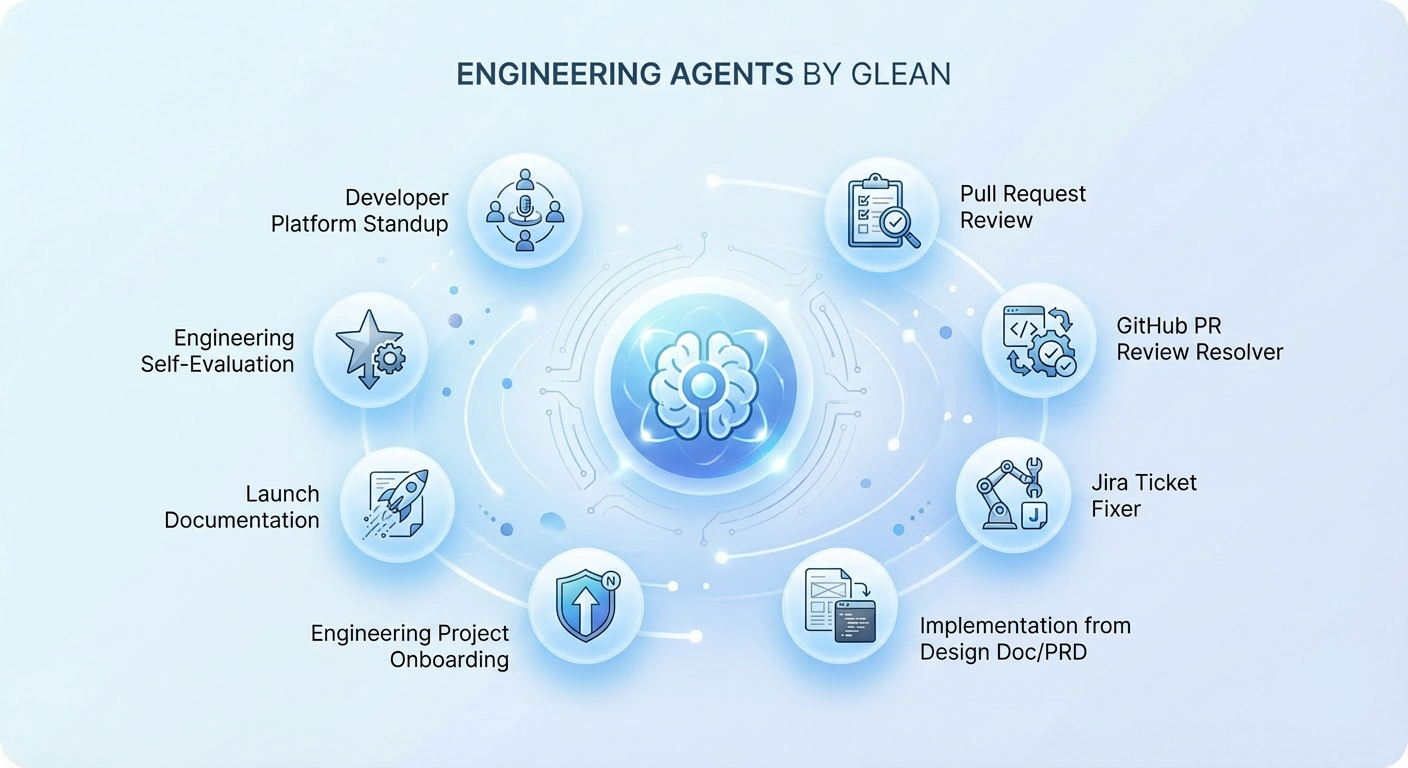
Glean accelerates software engineering workflows with context-aware agents that work across the systems engineers already use — repositories, tickets, documents, and communication tools. The following eight agents target high-friction areas where teams consistently lose time and clarity.
- Pull request review
Code reviews are essential but time-consuming. The pull request review agent scans code changes, suggests improvements, and flags areas that may need closer attention to support faster, more consistent reviews.
- Resolve GitHub PR feedback
Addressing review feedback often requires tracking open threads, identifying what’s blocking merge, and context-switching between comments and code. The resolve GitHub PR feedback agent aggregates unresolved comments, classifies them by priority, and generates an actionable checklist with file references and relevant context so engineers can close out reviews faster.
- Resolve Jira ticket
Ambiguous or incomplete tickets can stall work and create back-and-forth. The resolve Jira ticket agent analyzes ticket context, related code, and linked documentation to propose next steps and resolution paths, helping teams unblock progress and reduce stalls.
- Spec to implementation PR
Translating design intent into working code requires understanding scope, constraints, and expected outcomes before implementation starts. The spec to implementation PR agent pulls from design docs or product requirements to guide implementation and provide codebase-aware context as engineers write.
- Engineering project onboarding
Ramping up on a new codebase often means tracking down docs, Slack channels, key contacts, and tribal knowledge across multiple tools. The engineering project onboarding agent accelerates onboarding by surfacing what matters: project purpose, key documents, relevant tickets, important areas of the codebase, and domain experts.
- Launch documentation
Launch prep pulls engineers away from delivery work. The launch documentation agent assembles release notes and supporting documentation by pulling from specs, tickets, and merged changes to create a consistent, complete launch record.
- Engineering self-evaluation
Self-assessments require digging through months of work to pull together evidence of impact and contributions. The engineering self-evaluation agent generates structured evaluations based on an engineer’s contributions, artifacts, and outcomes over a review period, making performance reviews more accurate and less stressful.
- Engineering standup
Daily standups take time to prepare and can still miss important details. The engineering standup agent generates standup updates from the previous working day’s work, pull requests, and tickets, giving teams a clear, consistent snapshot of progress.
Conclusion
AI in software engineering is moving from experimentation to infrastructure. The teams that benefit most will apply AI to the workflows that already slow them down, instead of layering new tools on top of existing complexity.
For engineering leaders, the opportunity is to use AI for clarity and consistency. By grounding AI agents in real engineering context, teams can spend less time coordinating work and more time building reliable software.
If you’re evaluating how AI can support your engineering organization, start by identifying where context is lost today. That’s where meaningful impact begins.
The engineering agents are available in the Glean agent library as part of the February Drop. Explore what’s new, or get a demo to see how they fit into your team’s existing workflow.
