







.webp)
If you skim through recent 'State of Sales Enablement' reports, you'll notice an alarming amount of Enablement leaders labeling 'Content Management' as a strategic priority for the year. You'd think we'd have solved this by now, but most organizations are still stuck in their old ways-—with knowledge, assets, and data siloed across hundreds of SaaS applications.
At Sigma, we don't view Content Management as a silver bullet for building best-in-class enablement, but rather a force multiplier as you move up the maturity curve. It's essential that this system has the modern tools to tackle the complexity of democratizing company knowledge without sacrificing content governance. That's why, rather than relying on separate offerings that create enablement bottlenecks, extra processes for content creators, and outdated mechanisms for organizing content, we've moved into using Glean to unlock the value of our content. This way, GTM teams stop spending hours searching and focus on what truly matters—driving real impact.
A fresh approach to old problems
As LLMs and Al tools continuously improve, SaaS verticals like Business Intelligence, and Content Marketing are met with a variety of new solutions and possibilities. Every improvement to Al accuracy and cost efficiency should encourage companies to ask themselves:

These very same questions led the Sigma Sales Enablement team to ask ourselves: "Assuming that Al will continue to improve, what facet of Enablement can yield more ROI with Al?" That's how we landed on GTM Content Management—a necessary but often troublesome task in the enablement process filled with outdated approaches and tool stacks.
The great knowledge-sharing disconnect
Traditional Content Management Systems (CMS) make effective knowledge-sharing dependent on human adherence to new processes. This is particularly true for organizations that are scaling quickly. Soon enough, it becomes harder than ever to share what's working, most recent, or highly relevant-leading to a need for better documentation and sources of truth for finding information. They're essential to helping new representatives be as successful as they can, as early as possible.
However, purchasing and rolling out a CMS to fix the knowledge-sharing disconnect leads to its own set of problems. For example, every manager and IC has to learn:
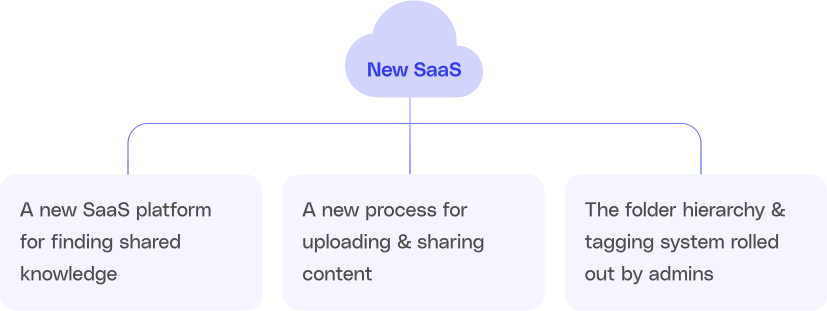
Regardless of how good the CMS is, employees will be forced to significantly change their individual processes, reducing the likelihood of adoption while hurting the quality of content in the CMS. At Sigma, we recognized this and turned to Glean to combat the knowledge-sharing disconnect instead.
Seamless, intuitive knowledge-sharing through Glean
Onboarding Glean enabled us to significantly ease the learning curve for end-users, while simultaneously reducing administration overhead for managers, content creators, and enablement teams.
Here's how Sigma leverages Glean to deliver better results and experiences for our GTM organization:
1. Reduced learning curve for end-users
A traditional CMS typically forces your end-users to learn folder hierarchies, unique naming conventions, and a new UI/UX. Glean meets them where they already work—-particularly if they spend a lot of time using chat-based or search bar interfaces. From a content discovery perspective, end-users can search in Slack, via a Chrome extension, or a web app with federated search, browse, and a chat interface. It's a streamlined, comprehensive experience that anyone can pick up instantly.
2. Reduces disruption for content creators
In previous CMS rollouts, enablement spent significant time developing training & documentation for content creators. A lot of calories were spent on defining processes for who can build what in which folder and where to upload content as an SME (Subject Matter Expert).
This is hard to maintain at scale due to different teams documenting knowledge in different places. Some teams prefer Confluence, others prefer Notion, others have scattered Google Docs, and CMS super admins prefer to build natively within the CMS. Optionality can be confusing for stakeholders, especially when they have to change their behavior to follow the process forced by your CMS.
With Glean, content creators can focus on shipping and sharing from any knowledge source. As long as there is a Glean integration and the asset has "sharing" turned on, then Glean will do the rest and make it discoverable to the appropriate content consumers.
3. Reduced admin overhead
Al Sigma, Glean has effectively cracked the bottom-up content curation process. Content discovery and findability are no longer dependent on content creators following the right "content submission process." Instead, they can spend more time doing their jobs and know that Glean will automatically surface the right knowledge when people are looking for it.
For Admins, this lets us spend more time on more advanced use cases like curating content for specific workflows or behaviors via Glean Collections, building niche Glean Apps trained on internal company knowledge, and/or creating query rules inspired by search analytics and user behavior.
4. Enablement is no longer the bottleneck
With other tools, content creators had to ping Enablement to "add" things to a CMS. Sometimes, integrations would auto-upload content, but content creators were always concerned about whether the content ended up in the right place.
With Glean, no one has to wait for Enablement. Teams can build where they want to build, and the content will be automatically discoverable in Glean. This might feel unbelievable for some Enablement teams with no processes, but Glean automatically integrates all of the necessary "must-haves" for content verification, curation, and lightweight feedback loops between end-users and admins.
5. Glean has "must-have" traditional CMS functionalities
Glean (and this whole Al thing in general) is still pretty new, and it can be uncomfortable for teams to shift from past behaviors. Thankfully, Glean makes this shift a bit more palatable with functionalities that mimic those of a traditional CMS without over-indexing on the usual red tape processes and workflows that slow knowledge sharing down:
- Content governance: Glean inherits all of your connected app permissions to ensure employees only see content they are meant to see
- Curation layer: Glean has Collections that operate as landing pages or resource hubs for your teams to aggregate resources in one place
- Content verification & deprecation: Glean makes it easy for admins and content owners to verify or deprecate their content at scale. Verified assets get boosted in search results, ensuring that your end users are interacting with the latest & greatest
- Feedback loop: There are multiple functionalities in Glean that allow for feedback. Whether it's the upvote or downvote feature that lets users provide feedback to Glean teams, or the ability to request verification/deprecation from the content owner, this ensures that your Enablement team is always getting input from end users
These are just some of the ways Glean has elevated our Content Management process, bringing Sigma's enablement into the moder age. Discovering and sharing relevant data has become just a step in our workflows, not a journey. It's enabled reps, both new and experienced, to get up to speed and deliver better results faster than ever before.
