






Modern customer service is at a breaking point. Expectations keep rising—customers want answers faster, with zero hassle, on every channel. But as the pressure mounts, so does the complexity. The volume of emails, chats, tickets, and internal documentation continues to grow, forcing agents to piece together context while scrambling to meet ever-higher standards. It’s a perfect storm: more information to sift through, more urgency, and less margin for error.
If your teams feel like they’re barely treading water, they’re not alone. Traditional customer service workflows—jumping across fragmented systems, validating the latest process, and manually stitching background details together—just can’t keep up. Valuable time is lost. Details get missed. Customer satisfaction slips.
Transforming the way customer service works through AI
AI helps alleviate these issues through transformative tools and automation. However, the right AI agents don’t just automate busywork—they empower every support agent to deliver better outcomes, faster, with less strain. Here’s how solutions like Glean, integrated with popular ticketing systems like Zendesk, ServiceNow, and ServiceCloud, can enable service teams to deliver on time with better results:
1. Ticket overview: Instantly see the full picture
The moment a new ticket arrives, support agents can get a concise, AI-generated summary of the full support context: the customer’s history, relevant products, previous issues, and key context—no searching required. This is powered by an AI agent: the Summary agent. Instead of wading through records, agents see what matters up front and can start resolving the issue without leaving the flow of work.
.webp)
2. Suggested next steps: Turbocharge problem-solving
The next Glean agent analyzes the specifics of each case and recommends the best next step—whether that’s a suggested reply or a troubleshooting workflow. Even for complex issues, support agents can have a reliable starting point supported by historical, contextualized information sourced from past cases and internal documents.
.webp)
3. Generate responses: Write high-quality replies instantly
With Glean, support agents can draft refined, personalized responses in seconds using the Draft a Response AI agent. These AI-powered replies draw on ticket context, product documentation, customer history, and brand tone—helping teams respond faster while staying clear, accurate, and on-message.
.webp)
4. Add your own AI agents: Delivering high impact
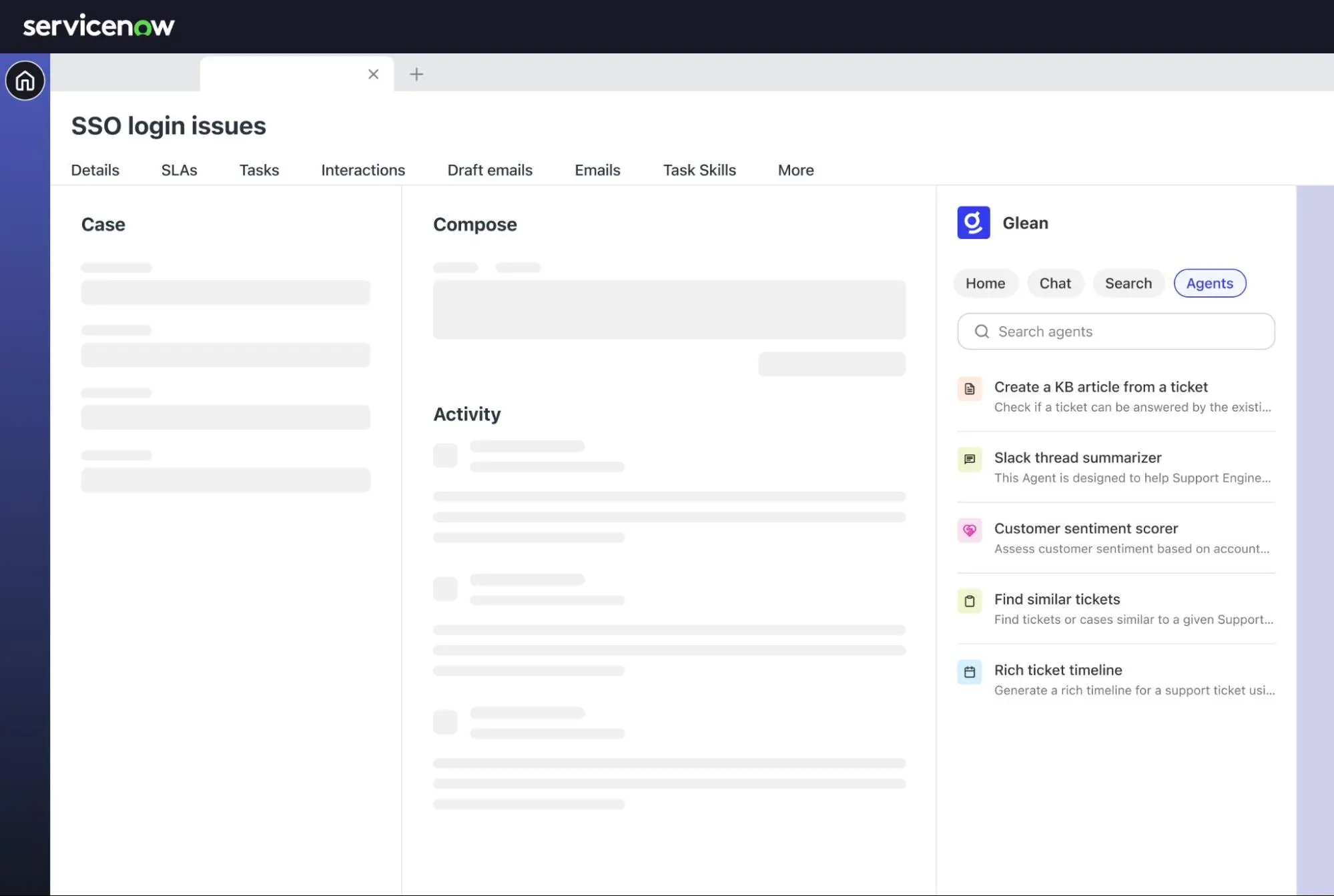
The Glean Agents tab makes it easy to access and integrate the AI agents your team relies on most.
Admins can create new AI agents, or adjust quickstart agents from templates, and bring them directly into the teams’ workflow. At Glean, our support team held a hackathon-style event where support staff created agents to solve their own pain points. The best ones found their way into daily workflows, increasing ownership and adoption on the part of the team.
Transforming Customer Service workflows with AI agents
By integrating these AI-powered workflows directly into support tools, teams no longer have to choose between speed and quality—they get both. AI agents help reduce the time agents spend chasing context, recommending validated next steps, and drafting customer-ready replies. This also leads to fewer escalations and repeated tickets, as proposed actions and validated steps help minimize errors and oversights.
This results in better customer satisfaction as customers receive contextual, accurate, and personalized replies right from the start. Furthermore, AI agents create a better experience for service teams by alleviating the pressure of managing disconnected data, thereby helping to reduce burnout and support retention.
Best of all, introducing AI tools like Glean for customer support doesn’t require massive overhauls or disruptive workflow changes—and value from integrations can be seen immediately. Here’s a practical path:
- Identify your top bottlenecks: Which parts of your customer workflow drain time or lead to avoidable errors?
- Pilot AI agents against measurable KPIs: Deploy targeted AI agents—like ticket summarization or response generation—to the channels where impact can be clearly tracked.
- Iterate, learn, and expand: Use feedback from your team to continuously fine-tune agent prompts and roll out successful solutions more broadly.
The result? Support teams that move faster, work happier, and deliver the customer experience that today’s market demands.
A smarter, faster, and more human customer service
Delivering standout customer experience is only getting trickier—with ever-more sophisticated customers, tighter resources, and growing data sprawl. But customer service teams don’t have to fight uphill battles alone. With AI agents for support, organizations can turn mountains of support data into grounded answers, recommended next steps, and faster follow-through.
If you’re looking to get started with AI customer service workflows for your team, get a demo of Glean today—and check out our complete guide on how AI is shaping the face of modern customer service.
