






Marketing teams already move fast. Now, AI is raising expectations across the board — for speed, quality, and consistency. It’s no longer enough to produce content quickly. Marketers need their work to reflect what customers are saying, how the product is evolving, and how the business actually operates.
That context already exists. It lives in your sales calls, product and engineering updates, technical documentation, white papers, and the templates teams rely on every day. The challenge has been turning those scattered inputs into clear, usable outputs.
That’s what day 3 of the January Drop is built for. Today, we’re introducing seven new Marketing agents in the Glean agent library. Each one focuses on a specific job and produces a clear, reviewable output your team can use right away.
The seven new marketing agents
- SEO keyword research from sales calls
- SEO article evaluation
- Customer testimonials from calls
- Customer reference summary
- Persona-based event messaging
- Marketing event description
- LinkedIn post draft
Below is a quick guide to what each agent does, the output you can expect, and where it fits into your team’s day-to-day.
SEO keyword research from sales calls
Strong SEO starts with understanding how buyers describe their problems. The SEO keyword research from sales calls agent analyzes call transcripts for a specific industry to surface recurring pain points, themes, and language prospects use most. It then clusters those insights into keyword ideas and content angles.
What it does
- Pulls recurring pain points and common phrases from industry-specific sales call transcripts
- Checks top themes and phrases against live web search signals to validate interest
- Produces a structured document with pain points, keyword opportunities, and topic recommendations
How it helps marketing teams
- Grounds SEO strategy in buyer intent
- Surfaces language you can use directly in content
SEO article evaluation
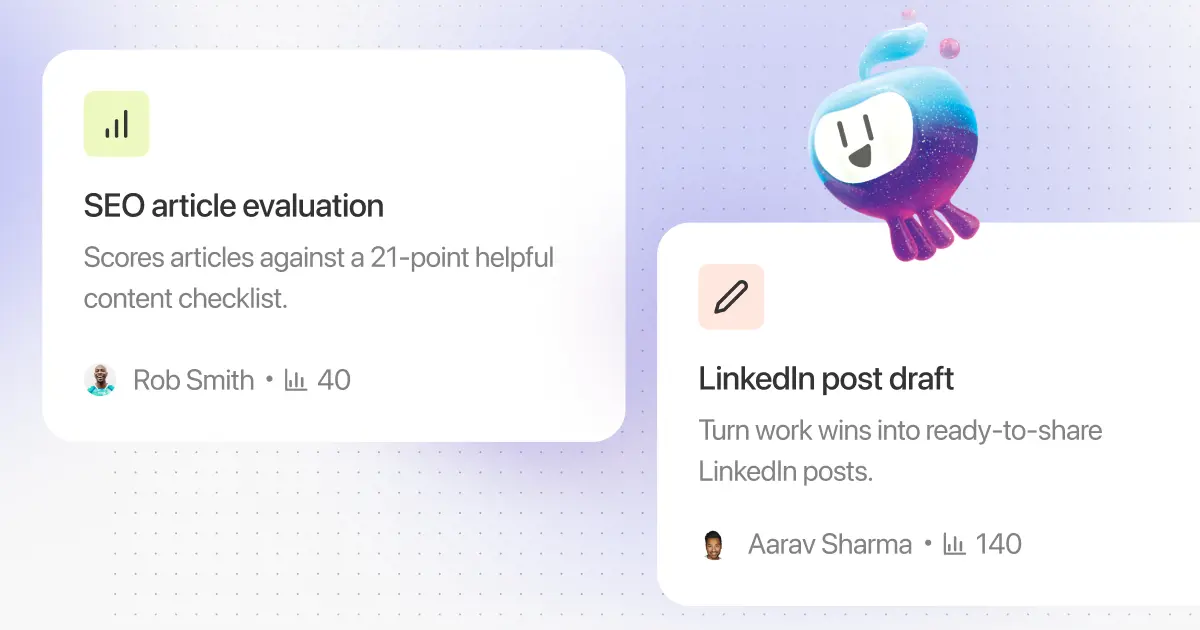
Editing is easier when everyone agrees on what “good” looks like. The SEO article evaluation agent reviews any blog article you provide and evaluates it against a 21-question helpful content checklist. The output is a clean true/false scorecard you can use to spot gaps, guide revisions, and track improvements across drafts.
What it does
- Retrieves and reads the full text of an article from a URL
- Evaluates the article against a predefined 21-question checklist
- Returns a structured table with one row per question and a true/false answer only
How it helps marketing teams
- Helps teams assess depth, clarity, and originality consistently
- Flags issues that can undermine trust, like thin coverage or unclear purpose
- Creates a repeatable standard across drafts and contributors
Customer testimonials from calls
Great proof points often show up in live conversations, then disappear into recordings. The customer testimonials from calls agent reviews recent call transcripts to find specific, positive statements about product impact and customer success. Each quote is enriched with ownership details so teams know who to contact for follow-up or approvals.
What it does
- Searches recent customer conversations to extract positive, standalone quotes about value, improvements, efficiency gains, or adoption
- Produces a structured table with customer name, account owner, quote text, speaker, call date, and a link to the recording
How it helps marketing teams
- Makes customer proof easier to find and reuse
- Preserves context and traceability for every quote
- Reduces time spent scrubbing recordings
Customer reference summary
Great customer stories rarely live in one place. Notes, decks, emails, feature requests, and call transcripts all hold a piece of the puzzle. The customer reference summary agent brings those pieces together. Starting from a single customer name, it compiles a standardized, reference-ready summary that marketing, sales, and leadership can reuse across materials.
What it does
- Searches internal systems for documents and conversations related to a specific customer
- Pulls together key details like industry, teams involved, challenges, deployment approach, and outcomes
- Produces a standardized customer reference summary teams can reuse across decks and go-to-market materials
How it helps marketing teams
- Eliminates manual hunting across scattered systems
- Creates a consistent customer story teams can reuse across assets
- Strengthens credibility with clear outcomes and proof points
Persona-based event messaging
Booth and event teams do their best work when they walk in with a clear, consistent story for the audience in front of them. The persona-based event messaging agent prepares teams with persona-specific messaging grounded in existing positioning frameworks, customer stories, and partner materials.
What it does
- Searches internal messaging documents and persona frameworks to identify relevant themes
- Surfaces customer examples from similar industries or challenges, and includes partner and event host context when relevant
- Produces a concise “event pitch brief” teams can skim before stepping on the floor
How it helps marketing teams
- Keeps conversations focused on what matters most to the audience
- Makes it easier to share credible proof points in the moment
- Reduces last-minute prep for field teams
Marketing event description
Successful event promotion depends on getting the details right and making sure the message is clear. The marketing event description reads your event brief and supporting materials, then turns them into a polished description that’s ready to share across channels.
What it does
- Reviews the event brief and any related materials to understand logistics, goals, restrictions, and audience details
- Extracts essentials like date, time, venue, rules, and core value
- Generates multiple description options with different angles and refines the strongest version
How it helps marketing teams
- Gets teams to a promotion-ready event description faster
- Keeps messaging aligned with the source brief and event details
- Reduces back-and-forth edits before promotion begins
LinkedIn post draft
Employees want to share launches, work wins, and learnings, but writing a strong LinkedIn post still takes time. The LinkedIn post draft agent helps employees turn existing content and ideas into clear, on-brand posts that are ready to publish.
What it does
- Drafts a concise post grounded in the provided sources
- Adds standardized UTM tracking when an applicable blog URL is detected
- Produces a LinkedIn share link with the draft pre-filled and ready to publish
How it helps marketing teams
- Makes it easier for employees to share consistent, on-brand updates
- Improves attribution through standardized CTAs and tracking links
How Glean agents work together
You can use these agents on their own, depending on what your team needs. They also work well together to support end-to-end marketing workflows.
- Use SEO keyword research from sales calls to identify themes, then SEO article evaluation to guide revisions
- Pull proof points with Customer testimonials from calls, then expand them with Customer reference summary
- Move from planning to promotion with Marketing event description, prep teams with Persona-based event messaging, and support amplification with LinkedIn post draft
A practical way to scale marketing work
Great marketing work depends on context. The challenge is that context is often scattered — across calls, drafts, briefs, and internal notes — making it harder than it should be to reuse what already exists.
These seven agents are designed to close that gap. Each one takes inputs marketing teams already rely on and turns them into something usable: clearer insights, more consistent assets, and outputs that don’t need to be rebuilt from scratch every time.
You might use one agent to strengthen an article, another to prepare for an event, and another to capture customer proof while it’s still fresh. Over time, those small improvements add up to marketing work that’s more consistent, easier to repeat, easier to scale, and easier to trust.
The Marketing agents are available now in the Glean agent library as part of the January Drop. Explore what’s new, or get a demo to see how they fit into the way your team already works.
