



Enterprise AI software: what it is, how it works, and how to choose a platform
Enterprise AI software helps organizations apply artificial intelligence to real work:
finding information, making decisions, and automating tasks across
systems, teams, and workflows.
What is enterprise AI software?
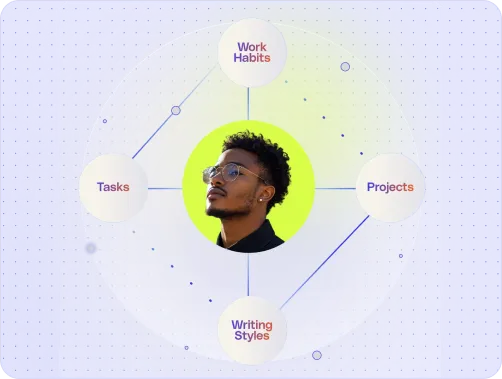
Enterprise AI software is a category of platforms and tools that connect to your existing data and applications, use AI models to understand that data, return answers and recommendations grounded in company context, and automate tasks across systems.
Two things distinguish enterprise AI from consumer AI:
- Context: Enterprise AI systems use your policies, data, and workflows, not generic web content.
- Governance: Enterprise AI systems work within existing security, compliance, and audit requirements.
Most platforms combine three layers:
- Data & connectors – integrating email, documents, chats, tickets, code, CRM, and more
- Understanding & reasoning – search, knowledge graphs, and AI reasoning over that data
- Applications & agents – assistants and agents that employees interact with day to day
Glean is a leading enterprise AI platform, combining search, assistant, agents, and governance on top of a shared system of context.
Benefits of an enterprise AI strategy
Enterprise AI technologies deliver measurable impact to business functions across four key areas.
- Boost productivity
Automating routine tasks and eliminating information bottlenecks improves operational efficiency. Teams spend less time on status updates, manual data gathering, data analysis, and business process coordination, allowing employees to focus on strategic initiatives. - Lower costs
Consolidating AI on one platform reduces the "AI tax" of fragmented tools, duplicate integrations, and inconsistent governance. Centralized platforms make it easier to maximize AI investments and drive AI adoption by lowering IT overhead and training costs. - Competitive advantage
AI that understands your business accelerates digital transformation and creates differentiation competitors can't easily copy. Faster response times, personalized customer experiences, and data-driven decisions compound into market advantage. - Employee satisfaction
Removing friction from daily work reduces frustration. Employees find answers themselves instead of interrupting colleagues. AI handles tedious tasks, freeing people for engaging work. Glean customers report 93% adoption in just two years.
Examples of enterprise AI use cases and outcomes
Across vendors and industries, enterprise AI advances business operations.
Knowledge discovery and enterprise search
Natural language search across documents, tickets, chats, and code with AI-generated answer snippets. Outcome: employees save dozens of hours per person per year on information access.
Summarization and context-building
Turning long threads, specs, and timelines into concise summaries with generative AI. Pulling together the "story so far" for accounts, projects, or topics. Outcome: faster iteration and smoother collaboration across teams.
Content drafting and review
Drafting emails, briefs, PRDs, and updates using generative AI and enterprise content as context. Adapting tone for different audiences while enforcing brand consistency. Outcome: higher-quality drafts, fewer review cycles, more consistent messaging.
Agentic AI and process automation
AI agents that assemble data, generate outputs, and take actions like creating tickets or scheduling follow-ups. Multi-step flows tailored for sales, support, finance, human resources, or operations. Outcome: repetitive work shifts from manual effort to workflows that optimize resource allocation over time.
How to evaluate enterprise AI platforms
The right platform transforms how work gets done. Look for these five capabilities:
- Check for pre-built connectors and real-time data sync
Pre-built connectors to major SaaS tools mean faster setup. Support for structured and unstructured data — from internal documents to customer data — ensures nothing falls through the cracks. Real-time sync keeps AI answers current. - Evaluate the knowledge graph and retrieval approach
Vector search alone isn't enough. Advanced platforms maintain a knowledge graph that uses machine learning and AI models to understand entities and relationships. Hybrid retrieval blends keyword, semantic, and graph-based ranking to surface what matters most. - Understand which models and reasoning methods the platform uses
Platforms use large language models and generative AI to interpret questions, generate summaries, and plan multi-step workflows. Key questions: Which models does it support? How does it ground generations? How do you monitor quality? - Verify security, governance, and compliance capabilities
Governance is not optional. Look for platforms that follow responsible AI practices: permissions enforcement, compliance certifications (SOC 2, HIPAA, GDPR, ISO 27001), data residency options, machine learning-powered sensitive content controls, and AI-specific guardrails against prompt injection and misuse. - Test how assistants and agents fit into your workflows
Search should feel like "Google for work." Chat assistants work where your team already does. AI agents run repeatable workflows. The challenge is fitting into existing workflows and giving users confidence.
How Glean delivers enterprise AI
- Horizontal platform
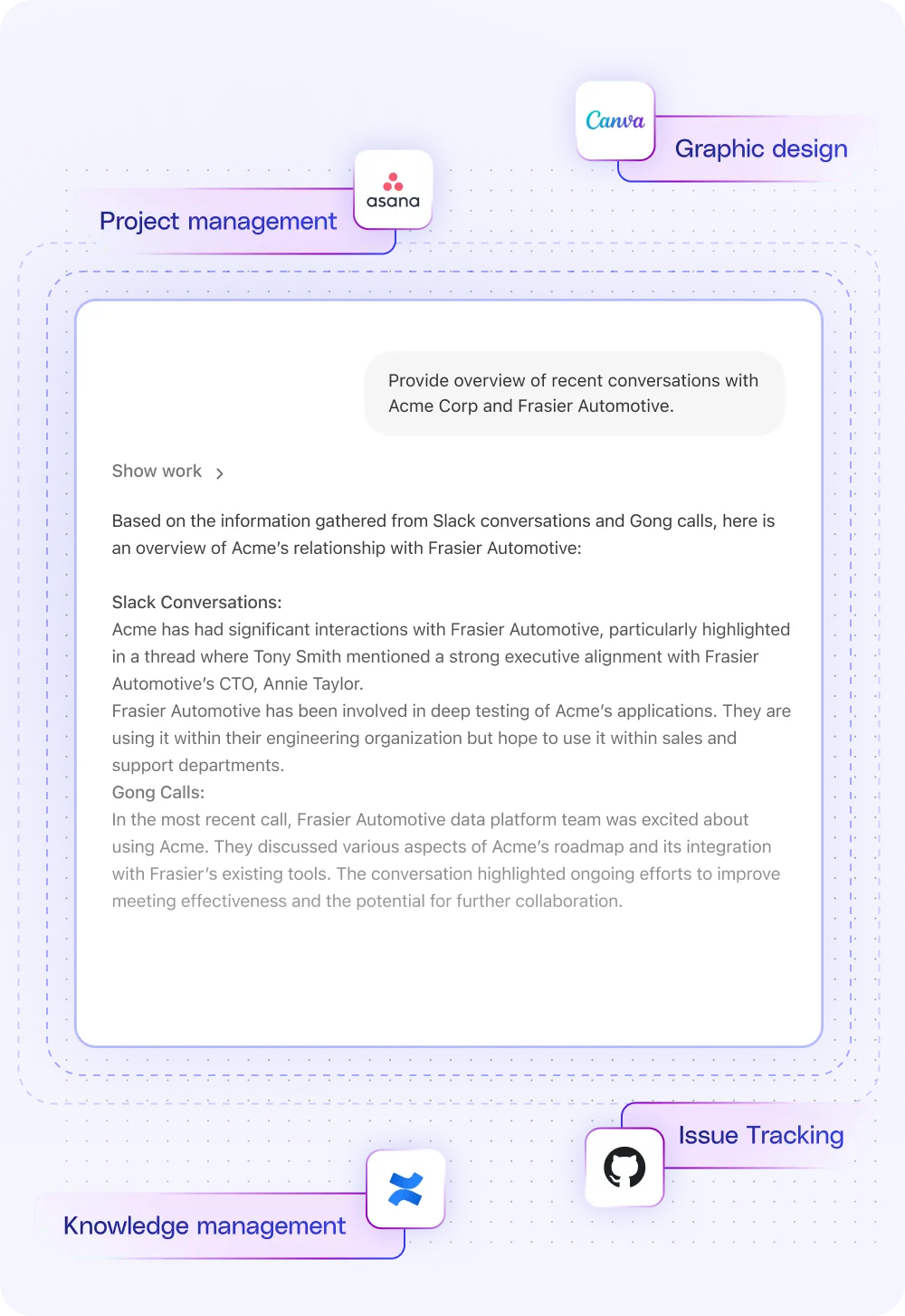
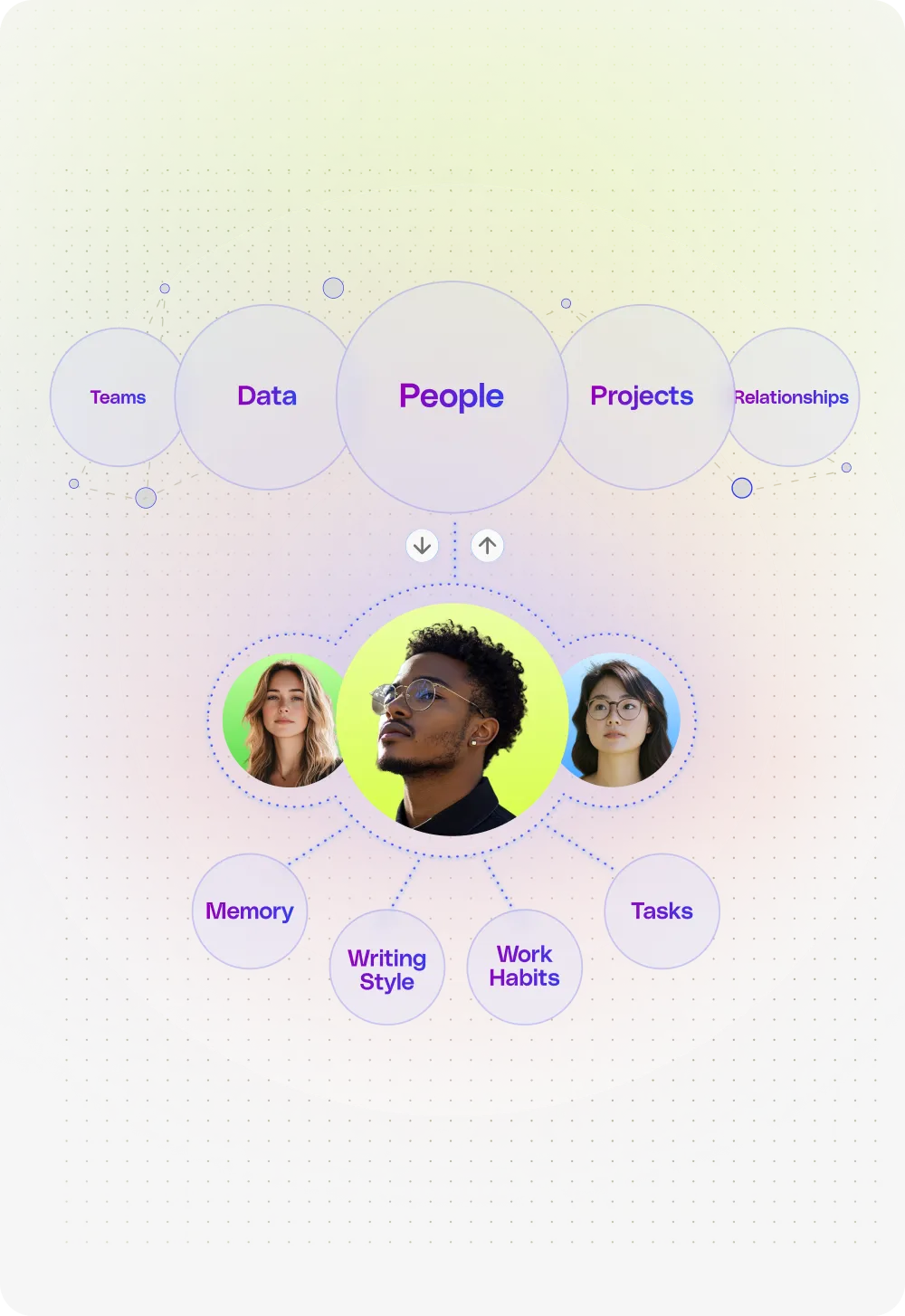
Connects to 100+ apps and indexes billions of documents into a customer-specific knowledge graph that understands your organization's unique context, relationships, and workflows. - System of context
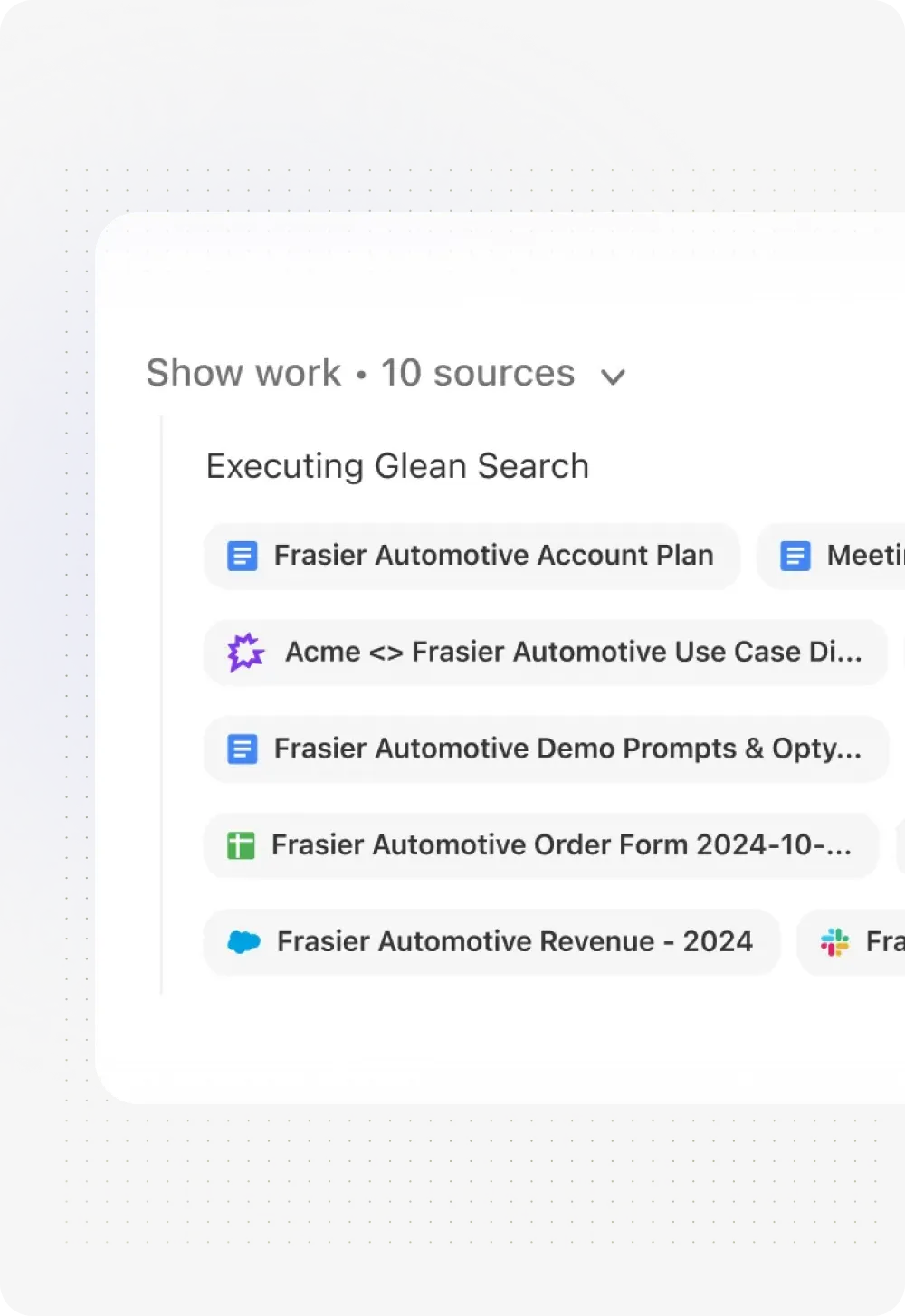
Combines connectors, indexes, knowledge graphs, memory, and AI models to assemble task-ready context for AI assistants and agents, ensuring responses are grounded in accurate enterprise data. - Governance and security
Glean Protect uses machine learning models to provide sensitive content controls, real-time permissions enforcement, AI-specific guardrails, and partnerships with security vendors to safely deploy enterprise scale AI across your organization. - Assistant and Agents
An evolving suite of AI technologies that uses enterprise context to answer questions, summarize work, automate multi-step workflows across departments, and adapt to how your teams work.
FAQs
See how Glean’s enterprise AI works
Glean connects 100+ apps into a unified knowledge graph, powering Assistant and
Agents with enterprise-grade security and no professional services required.