




AI agent builder: a no‑code tool
to automate real enterprise work
AI is only as useful as the agents you can actually put to work. An agent builder turns your ideas into
governed, reusable agents that understand your company and get real work done.
What is an AI agent builder?
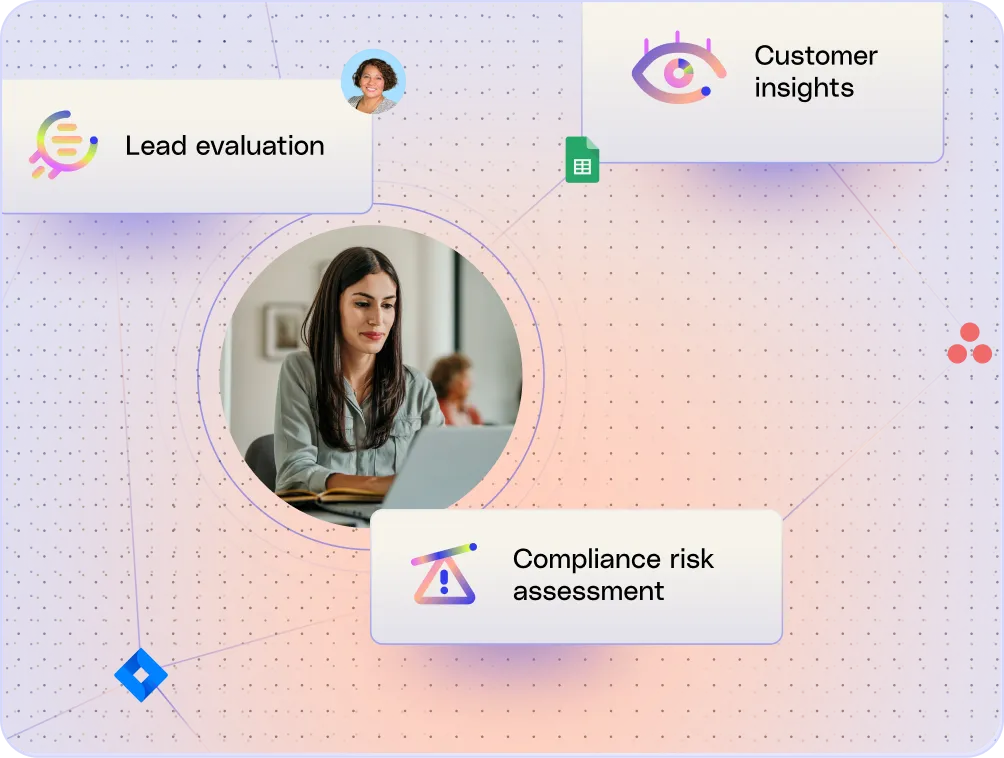
An AI agent builder is a tool for creating production-ready AI agents that can reason, act, and automate complex tasks across business systems. It connects to your apps and data, gives AI the context it needs to follow your processes, and lets you design, test, and govern agents — all in one place.
Instead of scattering one-off bots and AI tools across your stack, an agent builder platform provides:
- Shared context: a single knowledge base across diverse data sources — documents, messages, tickets, code, and more — so every agent works from the same trusted information.
- Agent engine: planning, reasoning, retrieval, and tool execution enable agents to break down tasks, search your data, and run complex workflows.
- Security and governance: permission-aware access, compliance controls, and active data protection so agents behave safely and stay auditable.
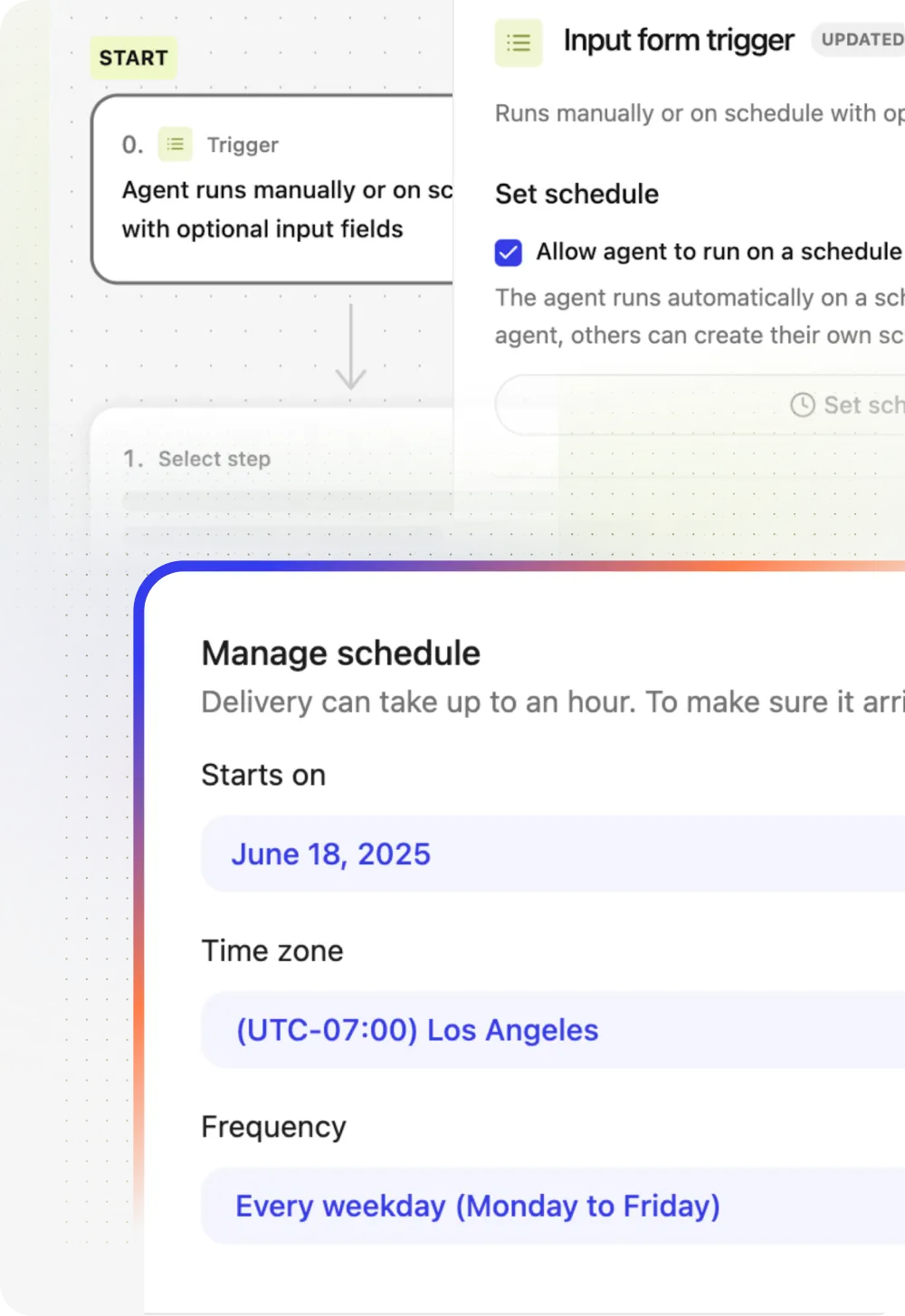
- Builder and orchestration tools: visual editors, natural-language setup, triggers, and scheduling to create AI agents and orchestrate multi-agent workflows across teams.
Glean’s Work AI platform combines search, Assistant, Agents, and governance on top of a shared system of context, so every agent you build is grounded in the same enterprise truth.
Benefits of an AI agent builder
A strong agent builder standardizes how everyone builds and operates agents — and how quickly they deliver value.
Faster time to value
Teams go from idea to agents that execute tasks in minutes — accelerating agent development with plain-language instructions, templates, and a drag-and-drop canvas.
Higher-quality agents
Builders connect agents to a rich system of context that keeps agent workflows grounded in current, authoritative data — not brittle prompts or stale copies.
Access for everyone
Subject-matter experts build specialized agents without writing code. Developers still get APIs and SDKs when they need more control.
Safer iteration
Built-in versioning, testing, and rollback let you improve agent performance without disrupting live agent workflows.
That adds up to faster agent development, fewer one-off bots, and a clear path from prototype to governed automation of complex tasks.

Examples of agent builder use cases and outcomes
Because builders connect to all your enterprise data sources, you can create specialized agents that work across teams:
- Support triage and resolution
Agents classify incoming tickets, route them to the right queue, suggest answers, and open follow-ups in Jira or ServiceNow. Teams see faster response times and lower handling time. - Sales and account briefs
Agents pull CRM data, notes, emails, and past decks into a concise account brief, then recommend next actions. Your sales team spends less time prepping and more time selling. - Release notes and documentation
Agents scan completed Jira tickets, summarize features, and draft formatted release notes or documentation PRs — turning hours of manual work into a single automated run. - Internal content and workflows
Agents draft briefs, assemble onboarding plans, or compile status updates from distributed systems — improving consistency and reducing repetitive work.
Across these use cases and many others, organizations move from scattered automation experiments to governed agent systems — built, reviewed, and improved in one place.
How to evaluate agent builders
- Check data and context integration
The best builders connect to a real system of context — not just a handful of APIs — to build powerful agents. Look for 100+ pre-built connectors, knowledge graphs that understand people and entities, and hybrid search so agents retrieve the right information before they act. - Test no-code and code-friendly building
Building AI agents should start with plain language: business users describe a workflow and the builder proposes steps automatically. A no-code visual canvas makes it easy to build custom agents with logic, conditions, and error handling — while developers can call APIs when needed. - Assess lifecycle and version control
A builder needs more than just a canvas. Look for drafts, test runs, version history, and safe rollback — plus the ability to compare variants and track agent performance. That lifecycle support turns standalone prototypes into durable, governed agent systems that teams can depend on. - Verify security and governance
Builders must inherit enterprise-grade security from the platform: permission-aware access, SOC 2 Type II, GDPR, HIPAA, ISO 27001, and governance to detect oversharing of sensitive data. Look for protections against prompt injection, jailbreaks, and unsafe agent behavior. - Confirm workflow fit and model flexibility
Agents should show up where people work — Slack, Teams, browser, line-of-business apps — and let you choose AI models from providers like Azure OpenAI, Vertex AI, or Amazon Bedrock. Per-step model selection and observability help you balance cost, speed, and quality as usage scales.

How Glean delivers a better way to build agents
- A unified platform
One platform for search, Assistant, and Agents, powered by the Enterprise Graph and Personal Graph so every experience — and every agent — runs on the same trusted company context. - Grounded in a system of context
100+ connectors, hybrid search, and rich knowledge graphs enable agents to act on live, permission-aware context across documents, tickets, code, and analytics. - No‑code builder for every team
A natural-language, drag-and-drop interface makes building AI agent workflows fast for non-technical users. Developers plug in via APIs and open frameworks when they want more control. - Built‑in security and governance
Glean Protect enforces permissions on every request, adds active data and AI governance, and integrates with AI security partners — allowing agents to scale without opening new backdoors for attackers.
FAQs
See how Glean’s agent builder works
Move from one-off experiments to agents that get work done. Glean’s agent builder empowers you to design, deploy, and scale AI agents grounded in your company’s knowledge.