







How AI can help marketing teams create campaigns faster
AI helps marketing teams create campaigns faster by automating the slowest parts of the process: finding past work, building briefs, generating content variations, and pulling performance data. According to McKinsey, generative AI can cut time spent on idea generation and content drafting by 50% to 70%.
Most campaign timelines slip before creative work even starts. Teams lose days searching across tools for approved messaging, audience research, and past campaign results. That scattered context makes brief creation slow, stakeholder alignment painful, and review cycles longer than they need to be.
The shift underway is significant. An AgileSherpas survey found that only 7% of marketers are not considering AI at all. The rest are actively exploring how to fold it into their workflows — not to replace creative judgment, but to remove the friction that sits between a good idea and a live campaign.
How can AI help marketing teams create campaigns faster?
AI speeds up campaign creation by handling the work that happens around the creative work. It finds the right inputs — past briefs, performance benchmarks, audience segments, brand guidelines — and assembles them so marketers start from context instead of a blank page. It generates content variations, automates repetitive coordination tasks like status updates and approvals routing, and surfaces performance insights days sooner than manual reporting.
Consider brief creation, one of the most common bottlenecks. A marketing team preparing a product launch might spend a full day pulling together competitive positioning, approved messaging, audience research, and campaign performance data from the last launch. AI grounded in a company's own knowledge can compile that context in minutes — and with AI content drafting delivering 3.2x ROI on average, the investment pays for itself quickly. The team refines a draft brief rather than builds from scratch. The same pattern applies to content production: instead of writing six ad variations from zero, a marketer reviews and edits AI-generated drafts that already reflect the brand's voice and approved claims.
The most effective AI for marketing combines three capabilities in one workflow: connected knowledge that pulls from every tool the team already uses, grounded generation that produces content rooted in approved facts and messaging, and automation that moves work across systems without manual handoffs. When those capabilities work together, teams spend less time on logistics and more time on the strategy and creative decisions that actually move results.
1. Centralize campaign knowledge before drafting anything
Campaign timelines don't slip during writing. They slip during the search for what to write about. Before a single headline gets drafted, someone is digging through Google Drive folders, scrolling Slack threads, checking last quarter's dashboard, re-reading product update emails, and asking around for the latest approved messaging.
A 2023 Forrester study found that knowledge workers spend 12 hours per week searching for and consolidating information across applications. For marketing teams running multi-channel campaigns, that number compounds. Every brief requires inputs from audience research, positioning docs, legal guidance, CRM notes, analytics reports, and project management systems — each living in a different tool.
AI marketing tools improve efficiency when they can search across all of those sources in one query. But access matters as much as speed. Output is only useful when the AI respects existing permissions and pulls from sources the marketer is authorized to see. A campaign manager working on a product launch shouldn't accidentally surface confidential pricing data meant for the sales team.
Starting with the right inputs changes everything downstream. When you begin with approved claims, prior performance data, and lessons from past campaigns, you spend less time rebuilding context and fewer errors slip through review. Strong enterprise knowledge management is the foundation: before copy requests begin, gather last quarter's launch recap, winning headlines, segment performance notes, product FAQs, and approved messaging into one source pack.
Glean Search makes this possible by providing unified enterprise search across 100+ connected tools. It returns cited, permission-aware results — so a marketer searching for "Q1 product launch messaging" gets the approved positioning doc from Google Drive, the launch recap from Confluence, and the performance summary from the analytics dashboard, all in one place, filtered to only what they're allowed to access.
2. Turn scattered research into a campaign brief faster
Every campaign starts with research scattered across formats no one designed to work together. Customer interview transcripts sit in one folder. Product feedback lives in a support ticket system. Competitive intel is buried in a shared doc last updated three months ago. Turning all of that into a coherent campaign brief is slow, manual, and different every time.
AI can compress that work. It summarizes long documents, extracts themes from customer feedback, clusters common objections, and converts unstructured inputs into a first-pass brief with audience definitions, message pillars, goals, channel recommendations, risks, and dependencies. The right AI prompts for marketing make this even more effective — tasks that used to take a full day of reading and synthesizing become starting points instead of starting lines.
The key distinction: AI should organize and accelerate strategic thinking, not replace it. A generated brief is a draft, not a decision. Marketers still define priorities, choose tradeoffs, and approve the final plan. The value is in starting from a structured first pass instead of a blank template.
One best practice that pays off quickly: use a standard campaign brief template so AI outputs are consistent across projects. When every brief follows the same format — audience, objectives, key messages, channels, timeline, dependencies — review cycles get shorter because stakeholders know where to look.
Trustworthiness matters here. Require that AI outputs include citations or source references back to the underlying documents. If a brief claims "customers ranked onboarding as the top pain point," you should be able to click through to the interview transcript that supports it.
Glean Assistant serves this role as a conversational interface for asking questions, exploring topics, and creating content grounded in company knowledge. Ask it to "summarize the top five customer objections from Q1 support tickets" or "draft a campaign brief for the June product launch using last quarter's positioning doc," and it returns cited, permission-aware responses drawn from your company's actual data — not generic suggestions.
3. Generate campaign ideas and content variations without starting from zero
With an approved brief in hand, the next bottleneck is production volume. A single campaign might need headline sets, email drafts, landing page copy, paid social variations, nurture sequences, webinar promotions, and launch FAQs — all aligned to the same core message but adapted for different formats and audiences. A no-code agent builder can help teams create purpose-built agents for each of these production tasks.
AI produces those variations from the brief itself. With 94% of marketers now planning to use AI in their content creation processes, this approach has moved from experimental to standard practice. Start with one core message and ask for alternative angles organized by audience pain point. Narrow to the strongest concepts for testing. Then expand: turn each winning concept into channel-specific drafts.
The workflow for AI agents for campaign ideation follows a practical pattern. You feed in the approved brief, specify the output format, and review what comes back. One webinar recording becomes a recap blog post, three email snippets, a set of social cards, and a sales enablement one-pager — all grounded in the same source material.
AI for content creation works best when it reuses approved inputs rather than generating from scratch. A product update announcement already contains the positioning, feature details, and customer value prop. AI restructures and adapts that material for each channel instead of inventing new claims — and the results speak for themselves, with 68% of businesses reporting increased content marketing ROI from AI.
Human review still matters at every stage. Differentiated claims, pricing references, compliance language, tone, and factual accuracy all require a person to sign off. AI gets you from zero to a reviewable draft faster. It doesn't get you from draft to published without oversight.
Glean Agents handle multi-format production by automating work with agents that plan, adapt, and act safely and at scale. An agent can take a single campaign brief and produce structured outputs across formats — draft emails, ad copy, landing page sections — each grounded in the approved source material and ready for human review.
4. Personalize campaigns at scale with less manual rewriting
Personalization is where campaign timelines break down most visibly. The strategy says "tailor messaging for six segments across three regions." The reality is that every variant needs new copy, a separate review cycle, and coordination across teams. A Salesforce State of Marketing report found that 73% of customers expect personalized experiences, but most marketing teams lack the capacity to deliver them consistently.
Modern AI work assistants adapt one approved strategy into multiple versions — by segment, industry, geography, funnel stage, persona, or channel — without starting each version from scratch. Rewrite the same product message for executives focused on ROI, practitioners evaluating features, current customers exploring advanced use cases, and prospects comparing options. The core positioning stays consistent. The framing shifts.
Speed gains are real because personalization usually slows teams down at the copy stage. When shared source material generates structured variations for email, paid media, landing pages, enablement decks, and in-product messaging, the bottleneck moves from "write it" to "review it." That's a better bottleneck to have.
For teams managing large segment counts and short creative refresh windows, like B2C marketing campaigns, AI-generated variants become a production necessity rather than a nice-to-have. When you're refreshing ad creative weekly across 20 audience segments, manual rewriting doesn't scale.
Personalization with AI should still follow guardrails. Approved audience definitions, messaging guidelines, and regional restrictions set the boundaries. AI operates within them — generating variants that stay on-brand and on-policy without requiring a compliance review for every individual edit.
Glean Agents support this by generating personalized variants grounded in your company's audience definitions, product positioning, and approved messaging. Because Glean respects existing permissions, the agent only draws from sources the marketer has access to — keeping sensitive roadmap details or unreleased pricing out of customer-facing copy.
5. Automate reviews, handoffs, and repetitive campaign operations
The slowest parts of a campaign often aren't the creative tasks. They're the operational ones. Content needs product validation. Design needs clean source inputs. Legal needs proof points with citations. Operations needs metadata, tagging, and approvals. Each handoff introduces waiting time, context loss, and rework.
Teams that automate marketing tasks start with internal coordination rather than external delivery. Routing drafts to the right reviewer, generating pre-launch checklists, assigning follow-up tasks, updating status documents, answering the same stakeholder questions about timeline and scope — these are high-frequency, low-judgment tasks that consume hours every week.
A Workfront survey found that marketers spend only 36% of their time on the work they were hired to do. The rest goes to meetings, emails, status updates, and administrative tasks. Automating even a fraction of that coordination work reclaims capacity for the decisions that actually affect campaign performance.
The best tools for this connect to business systems, understand workflow context, respect permissions, and trigger actions with human oversight. An agent can package campaign materials for a review meeting, summarize feedback from multiple reviewers into a single action list, create follow-up tasks in the project management system, and keep launch plans updated as approvals come in.
Governance matters here especially. Campaign workflows touch sensitive roadmap details, pricing, regional restrictions, and unreleased messaging. Permission-aware workflows keep the right information visible to the right people at each stage.
Glean Agents, built on Glean's Agentic Engine, handle multi-step planning and orchestration across these operational workflows. An agent can monitor a campaign's progress across systems — pulling status from the project tracker, flagging overdue reviews, generating a stakeholder summary, and routing the next approval — all while respecting the permissions and governance rules your organization already has in place.
6. Use AI analytics to optimize campaigns faster after launch
Campaign optimization traditionally follows a slow cycle: export data, build a report, schedule a meeting, discuss findings, agree on changes, implement them. By the time adjustments go live, the performance window may have already closed.
AI shifts the model from reporting to action. With 93% of marketers now using AI to generate content and analyze results faster, the old cycle of manual dashboards and scheduled meetings is giving way to real-time summaries of what changed, what's working, and what needs attention.
A Harvard Business Review analysis noted that companies using AI analytics in marketing see 20% to 30% improvement in marketing efficiency — largely because decisions happen faster, not because the data is fundamentally different. The advantage is speed of interpretation, not volume of information.
Data-driven marketing improves when AI combines performance signals with context from briefs, customer feedback, and prior launches. Tools for structured data analytics make this accessible to non-technical marketers. Knowing that email variant B outperformed variant A is useful. Knowing that variant B used the same headline structure that won last quarter's A/B test — and that the audience segment receiving it matches the persona your brief prioritized — is actionable.
Faster decisions follow naturally. When you can quickly see which headline, audience, or channel outperforms others, you shift budget, adjust creative, and launch new variants sooner. Closed-loop learning matters too: feed win themes, post-launch notes, and metrics back into a shared knowledge base so the next campaign starts from better information.
AI surfaces recommendations clearly, but marketers decide what to scale, pause, rewrite, or retire. The goal is faster access to insight, not automated decision-making.
Glean Assistant supports AI analytics in marketing by letting you ask performance questions in natural language — "Which email subject line had the highest open rate last month?" or "Summarize the top-performing ad variants from the spring campaign" — and receive cited answers drawn from your connected analytics tools, campaign reports, and internal documents.
7. Build AI into the marketing workflow instead of treating it like a side tool
Many AI projects stall because they sit outside the actual campaign workflow. A team might use AI to draft copy faster, but research still happens in five different tabs, approvals still route through email, and performance data still lives in a separate dashboard. Faster drafts in isolation don't fix a fragmented process.
The teams that see real cycle-time improvements use AI across the full campaign lifecycle — from research and briefing through production, launch, and optimization. A 2024 Gartner survey found that marketing organizations embedding AI into existing workflows reported 25% shorter campaign development cycles compared to those using standalone AI tools.
Start with one repeatable use case. Choose a workflow with clear inputs and outputs: campaign briefs, launch summaries, content repurposing, or performance readouts. Connect trusted internal sources. Define human review points. Measure the time from brief to launch before and after.
Governance defines the boundaries. Decide who can use which sources, when citations are required, which outputs need review, and what never publishes without a human check. These aren't restrictions — they're the rules that make AI outputs trustworthy enough to act on.
Team adoption depends on practical skills, not enthusiasm. Train marketers to ask better questions, inspect outputs critically, compare AI-generated drafts against approved messaging, and treat AI as an enterprise AI assistant that supports their workflow rather than a shortcut. The teams that treat AI as a workflow layer — not a magic button — get the most consistent results.
The clearest pattern across high-performing marketing teams: they use AI to remove friction across the entire campaign lifecycle, not just to write content faster. Research, briefing, production, coordination, and optimization all get faster when the underlying knowledge, permissions, and workflow context are connected.
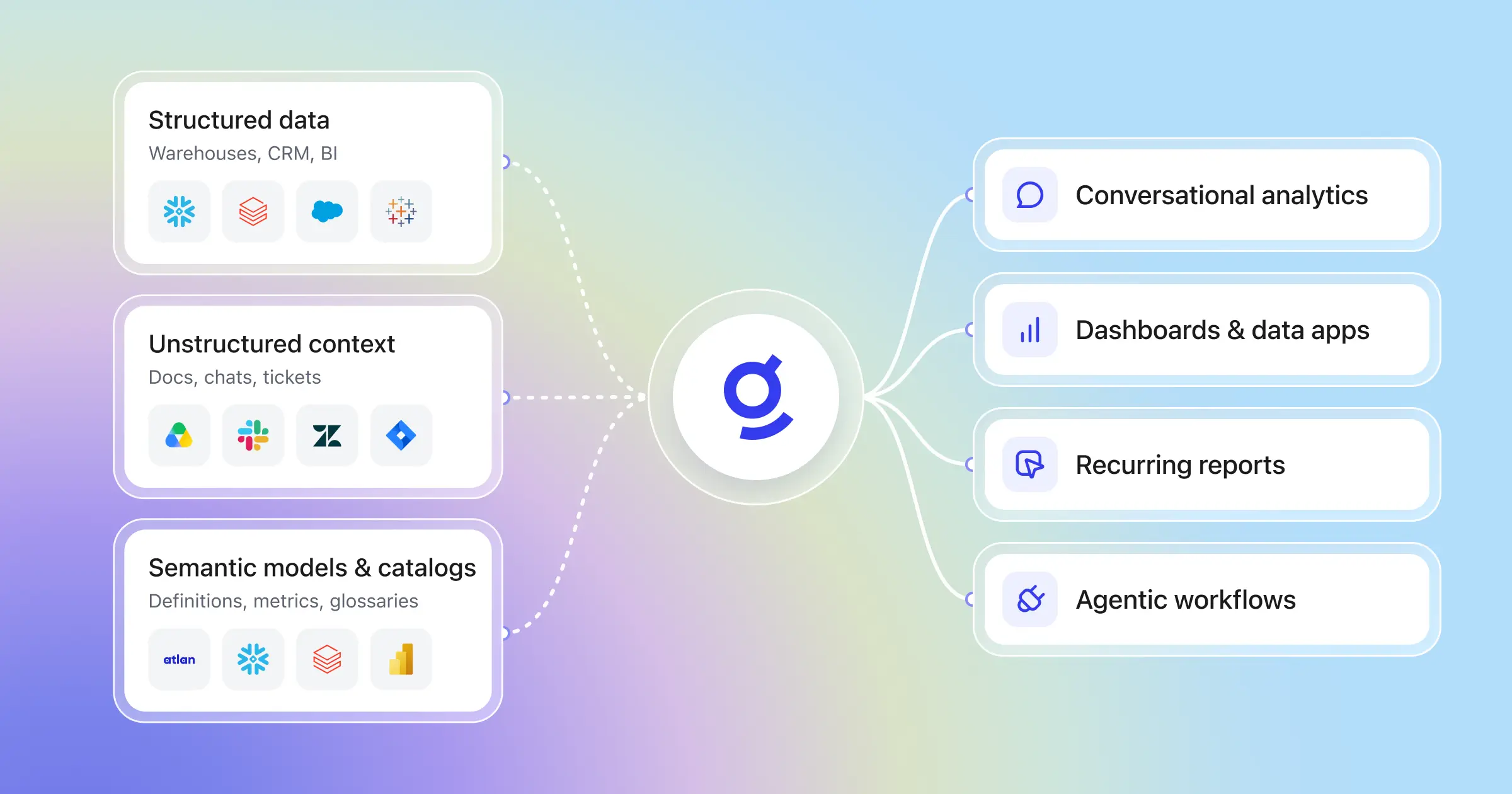
Glean brings this together as the Work AI platform that connects your company's knowledge, actions, and AI into one secure layer. Glean Search finds the inputs. Glean Assistant builds the drafts and answers questions. Glean Agents automate the coordination. All three share the same Enterprise Graph, permissions model, and 100+ connectors — so AI works where your team already works, not in a separate tool.
How AI can help marketing teams create campaigns faster: Frequently asked questions
What specific tasks can AI automate in marketing campaigns?
AI automates research consolidation, brief drafting, content variation generation, personalization across segments, review routing, status tracking, and performance summarization. These are high-frequency tasks that consume time without requiring strategic judgment, and they compound across every campaign a team runs.
How does AI improve the speed of campaign development?
AI reduces the gap between having an idea and launching it by compressing research, drafting, and coordination steps. Instead of spending days gathering inputs from multiple tools, teams start from assembled context and AI-generated first drafts — cutting the brief-to-launch timeline significantly.
What tools help marketing teams use AI effectively?
Effective AI marketing tools connect to your existing business systems, respect permissions, and ground outputs in your company's actual data. Glean provides three surfaces — Glean Search for finding information, Glean Assistant for generating content and answering questions, and Glean Agents for automating multi-step workflows — all operating on the same secure, permission-aware platform.
How can AI enhance personalization in marketing campaigns?
AI generates message variants for different segments, industries, personas, and channels from a single approved strategy. This removes the manual rewriting bottleneck that makes personalization slow. The key requirement: AI should follow approved audience definitions and messaging guidelines rather than generating unconstrained variations.
What are the best practices for integrating AI into marketing workflows?
Start with one repeatable workflow that has clear inputs and outputs. Connect trusted internal knowledge sources. Define where human review is required. Measure cycle time before and after. Expand only after the first use case shows measurable improvement in speed or quality — and make sure governance rules are in place before scaling.
The fastest marketing teams don't just use AI to write more content — they use it to remove friction from every stage of campaign creation, from research and briefing through production, personalization, and optimization. When your AI is grounded in your company's actual knowledge, respects permissions, and works where your team already works, campaigns move from idea to launch with fewer bottlenecks and better results. Request a demo to explore how Glean and AI can transform your workplace.

.jpg)

.png)



.jpg)
.webp)

