



How cited AI outputs enhance security for finance teams
Permission-aware, cited AI for finance teams is AI that answers questions using only the information a person is authorized to access and traces every response back to its source documents. These two properties — access enforcement before retrieval and generation, and full source attribution in every answer — address the core tension finance teams face when adopting AI: the need for speed without sacrificing control.
Finance teams handle some of the most sensitive data in any organization. Payroll records, board materials, revenue forecasts, close checklists, audit support files, tax memos, and vendor contracts all carry strict access requirements. Cyberhaven's 2026 AI Adoption & Risk Report found that 39.7% of all AI interactions involve sensitive data, underscoring why AI that retrieves and synthesizes across these sources must respect the same permission boundaries that govern human access — otherwise it becomes a shortcut around the controls finance spent years building.
Cited outputs add a second layer of accountability. Rather than presenting a blended summary with no way to verify where a number or policy interpretation originated, cited AI links each claim to the underlying document. For finance professionals preparing board decks, responding to auditor requests, or interpreting procurement policy, that traceability is the difference between an answer they can defend and one they have to manually re-verify.
How to answer why permission-aware, cited AI outputs matter for finance teams
Finance teams need AI outputs they can trust, verify, and defend — and most current tools fall short on all three. The practical problem is fragmentation: finance knowledge lives across general ledger systems, shared drives, policy wikis, expense platforms, planning tools, Slack threads, and spreadsheets that only a handful of people maintain. Effective enterprise knowledge management solves part of this challenge, but when someone on the FP&A team needs to confirm a revenue recognition policy during close, they are not searching one system. They are opening four tabs, pinging a colleague, and hoping the Google Drive folder they found is current. That search-and-stitch pattern costs time and introduces risk every cycle.
A permission-aware, cited AI system closes that gap by connecting company knowledge across tools while preserving existing access controls and grounding every answer in source material. Consider a concrete example: a finance analyst preparing quarterly reporting support pulls data from the ERP, references an internal accounting memo on ASC 606 treatment, and checks a Slack thread where the controller clarified an edge case. With Glean, a single query can surface the relevant memo, the Slack clarification, and the linked ERP documentation — but only if the analyst already has access to each source. The answer arrives with citations pointing to each document, so the analyst can click through, confirm accuracy, and share a defensible response with the audit team.
The point is not to replace finance judgment. Close support, planning cycles, procurement questions, policy interpretation, and executive readouts all require human review and sign-off. Permission-aware, cited AI reduces the hours spent locating information, limits exposure by enforcing who sees what, speeds validation by linking answers to sources, and makes AI safer for the workflows where accuracy and access control are non-negotiable.
1. Restrict answers to what each finance user can actually access
Permission-aware AI enforces access rules before it retrieves content and before it generates an answer. That sequence matters. If the model pulls restricted documents into its context window first and filters later, traces of that information can still shape the response. For finance teams, where a single environment may contain salary data, equity compensation plans, acquisition diligence files, customer pricing, and board-level forecasts, the margin for access error is narrow. A controller asking about prior quarter close issues should never receive a response influenced by executive compensation files they are not authorized to view. An FP&A analyst reviewing expense trends should not inherit M&A diligence content simply because it sits in an adjacent folder.
The architecture behind this matters more than the label. Permission-aware means the system inherits and respects permissions from each connected source — document-level restrictions, group access rules, and inherited permissions from platforms like Google Drive, SharePoint, or Workday. Building and maintaining the right permissions structure is essential for ensuring those boundaries hold at retrieval time, so the AI output reflects only what the person could have found on their own, just faster. This is not a finance-only pattern. The same control logic applies when legal teams protect privileged communications and merger documents, and it applies whenever any function handles regulated data or confidential records.
The risk of skipping this step is concrete: a tool that loosely mirrors or ignores access rules can surface restricted details in summaries, suggested follow-ups, or auto-generated drafts. In finance, that kind of leak can trigger confidentiality issues, governance findings, or reporting complications that take weeks to unwind. A comprehensive approach to AI security requires enforcing permissions upstream of the LLM — access must be gated at retrieval time, before any answer is generated. Glean Search addresses this through the Enterprise Graph. Permission-aware AI benefits start here — with preventing oversharing before a single answer is returned.
2. Ground every finance answer in cited source material
Citations turn an AI response from a plausible summary into something a finance professional can actually check. The distinction is simple: a fluent answer sounds complete, but a cited answer shows where the information came from — a policy document, a spreadsheet, a Slack thread, a close memo — so the reader can verify whether the response is current, accurate, and relevant to the question at hand. The stakes are high: a 2025 Columbia Journalism Review study found that generative search tools gave incorrect citation information more than 60% of the time across 1,600 queries, which is precisely why enterprise AI must enforce citation accuracy at the system level.
That difference matters across nearly every finance workflow. In financial reporting, citations let a reviewer trace a narrative back to the underlying data source or accounting guidance note, rather than accepting a blended summary at face value. In audit support, cited outputs help teams move from question to evidence faster, cutting the back-and-forth that typically slows document requests. In planning and forecasting, citations help separate established assumptions from generated interpretation — a critical distinction when executives challenge a number in a board deck. And in procurement or vendor review, source links make it easier to verify contract terms, approval history, or payment policy without opening four systems.
The validation benefit compounds over time. When finance users can inspect evidence immediately, they spend less effort questioning whether an output is fabricated and more time assessing whether the conclusion fits the business context. McKinsey's 2025 Global Survey on AI found that 51% of organizations using AI have experienced at least one negative consequence, with nearly one-third reporting issues specifically from AI inaccuracy — making reviewability the threshold that determines whether a tool earns trust or gets abandoned. Glean Assistant delivers this by grounding every response in company knowledge through hybrid search and RAG, returning inline citations the reviewer can click through to the original document. Permission-aware answers protect who can see the data; cited answers prove what the answer is based on. Finance teams need both, because one without the other still leaves a gap.
3. Reduce compliance and control risk without slowing finance work
Finance teams are accountable for controls, consistency, and documentation. AI that cannot show its work or respect access boundaries makes those obligations harder to meet, not easier. The control value of permission-aware, cited outputs is specific: they create a clear path from question to source, make reviewer checks faster, reduce the need to copy sensitive data into external tools, and help keep AI usage inside governed environments. When a team member pulls together support for an internal review or summarizes changes in reporting guidance from approved internal memos, cited outputs mean the reviewer can confirm the basis of the answer in seconds instead of retracing the research from scratch.
To be precise about the claim: permission-aware, cited AI does not by itself make a workflow compliant. Compliance still depends on policy design, approval chains, human review, and system controls. What it does is support stronger control execution by making outputs more traceable and access-respecting. Consider a practical scenario: during close, a senior accountant uses AI to answer a policy question about lease accounting treatment. The response cites the internal policy document, the relevant ASC guidance memo, and a controller's clarification from a Teams message. The accountant can verify each source, confirm the answer, and document the basis — all without leaving the governed environment. That is a different risk profile than pasting the same question into a consumer chatbot and hoping the answer is close enough.
The same controls become even more important in financial services settings, where access, auditability, and policy adherence carry regulatory weight. The broader landscape of AI in financial services shows that organizations face heightened expectations around data handling and output traceability. Organizations implementing AI in banking face these expectations head-on. But the principle holds for any finance function: non-permission-aware tools create hidden exposure, and non-cited tools create hidden uncertainty. Glean's architecture addresses both — its Enterprise Graph maps permissions across connected sources so every cited answer from Glean Assistant reflects only authorized content. Managing both data risk and output risk is what AI compliance in finance actually requires.
4. Improve financial decision-making with answers that can be checked fast
Finance leaders do not just need faster answers. They need faster answers with enough context to support judgment — and that context has to be verifiable. Permission-aware, cited AI helps here by synthesizing information across planning files, policy documents, dashboards, project notes, and prior discussions, then showing the sources so a reviewer can assess quality without starting a separate investigation. Teams looking for practical starting points can explore AI prompts for finance professionals that demonstrate how to frame queries for maximum relevance. The time savings are real: instead of opening four tabs, messaging a colleague, and cross-referencing a shared drive, a finance professional gets a single response with links to the underlying material.
The kinds of decisions this supports well are the ones that depend on finding the right context before analysis can begin. Understanding why a metric moved last quarter. Locating the approved policy behind a specific reporting treatment. Reviewing prior quarter commentary before drafting a new executive summary. Comparing current planning assumptions with the source material used in earlier cycles. These are not tasks where AI replaces judgment — they are tasks where AI removes the friction that delays judgment. Yooz's 2026 AI in Finance Report found that roughly a third of finance respondents say their teams already use AI more than outsiders realize, and much of that usage centers on exactly this kind of research and synthesis work.
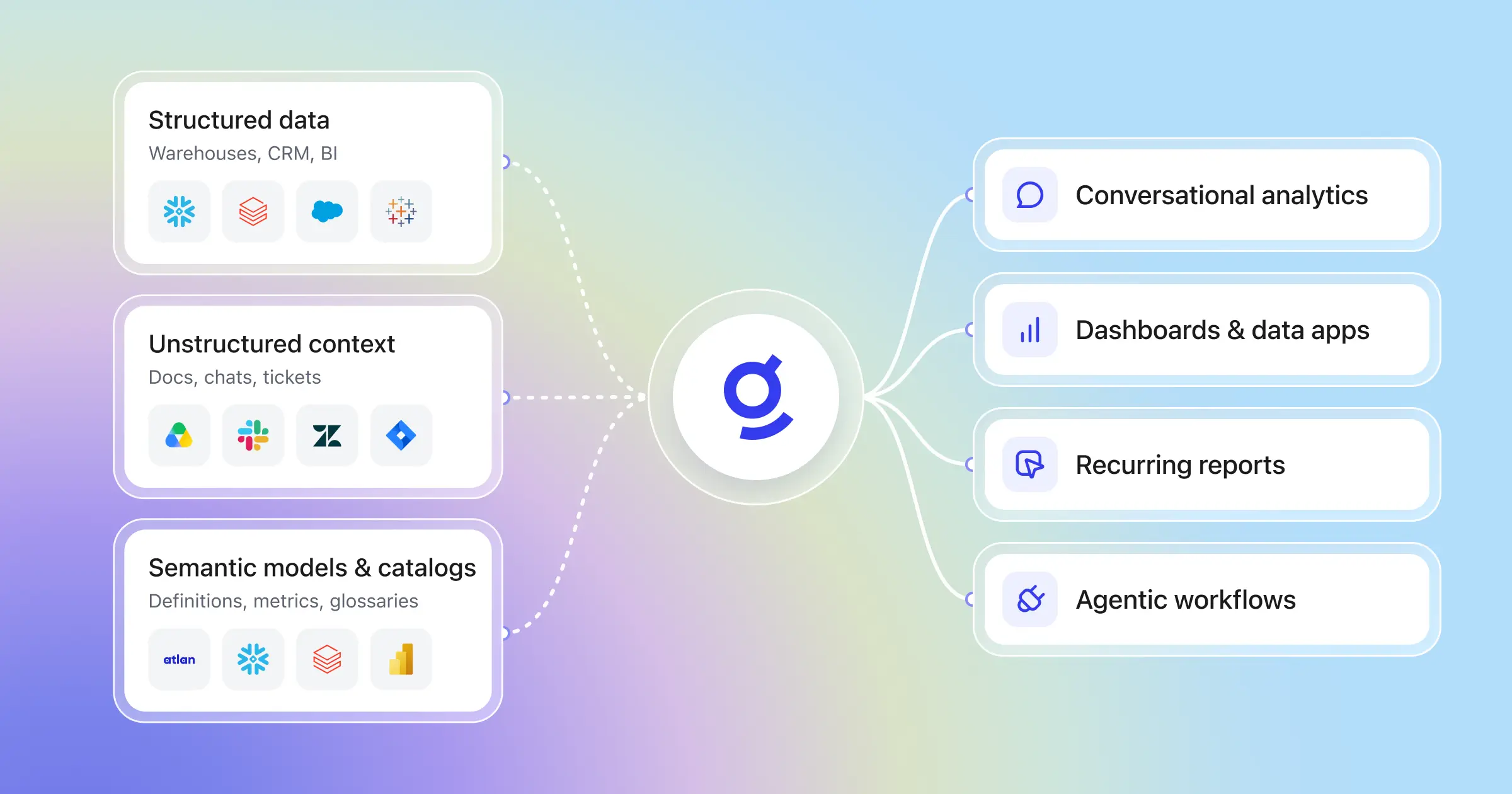
Citations improve judgment quality directly. When a reviewer can see the source quickly, they shift from questioning whether the output is fabricated to evaluating whether the conclusion fits the business context. Finance decisions often depend on both structured data and unstructured context — the number lives in a dashboard, but the meaning lives in a policy memo, a planning deck, or a message thread. AI is most useful when it connects both. And trust rises when people can challenge the output, inspect the evidence, and confirm that the answer came from the right slice of company knowledge. Glean Assistant supports this pattern by connecting both structured data and unstructured context through a single query — surfacing the dashboard reference alongside the policy memo and the planning thread, with citations on each. Permission-aware, cited AI improves decision speed not by bypassing review, but by making review faster and better informed.
5. Govern AI usage across finance workflows instead of relying on ad hoc habits
Even accurate, well-cited answers become risky if teams use different tools, inconsistent prompts, or unsanctioned workflows with no shared governance. The shift from individual output quality to organizational control is where many finance functions stall. PwC's 2024 Responsible AI survey noted that responsible AI in finance requires governance frameworks, clear accountability for AI-generated outputs, and ongoing monitoring of AI behavior against expectations — and that guidance applies whether a team is running a single assistant or deploying agents across multiple workflows.
The shadow AI problem is real and practical. Lenovo's 2026 Work Reborn Report, based on a survey of 6,000 employees, found that more than 70% of employees use AI weekly, with up to one-third operating beyond IT oversight. When approved tools are hard to use or disconnected from the systems where finance work actually happens, employees paste sensitive material into consumer tools to move faster. Governance fails long before a formal incident is discovered. A governed approach lowers that risk by bringing AI to the approved knowledge layer, connecting it to the tools finance already depends on, and making the safe path the easy path. What finance teams should look for in AI governance: central connection to company systems rather than manual copy-paste, consistent permission enforcement across sources, source citations on every answer, admin controls for rollout and access, logging and audit visibility for usage, and clear ownership across finance, IT, security, and risk teams.
Governance is not only an admin concern. It affects whether finance professionals trust the tool enough to use it for reporting, audit support, planning, and operational reviews. Implementing active data governance helps organizations flag and remediate accidentally overshared data before it becomes a problem. Glean, for example, provides admin controls, usage logging, and zero-day data retention contracts that prevent LLM providers from training on enterprise data — alongside permission-aware, cited answers from Glean Search and Glean Assistant. The broader principle holds regardless of the platform. Standardize the environment before standardizing every prompt. If permissions, citations, and data handling are consistent, teams can move faster without improvising security on their own. AI adoption in finance scales when governance is built in, not layered on after teams have already changed how they work.
6. Put trusted AI into daily finance work without breaking controls
The operational question most finance leaders arrive at is straightforward: what does good deployment actually look like? The safest pattern is to keep AI close to existing workflows and existing knowledge rather than asking users to export data into disconnected tools. That preserves context, lowers copy-paste risk, and keeps permissions and citations intact. A mature adoption path typically starts with search and question answering across finance knowledge — Glean Search connects to 100+ enterprise tools with permission-aware retrieval through the Enterprise Graph, so finance teams can query across systems without exporting data. From there, Glean Assistant adds cited summaries and research support for reporting, planning, and audit preparation, grounding each answer in the source material through retrieval-augmented generation. Workflow automation for repetitive tasks comes only where governance, approvals, and review thresholds are already defined.
Concrete use cases that fit this pattern are the ones finance teams already spend hours on manually. Finding the latest close checklist and supporting policy. Asking for a cited summary of prior variance commentary. Pulling source-backed answers on vendor approval steps. Retrieving the current policy on expense exceptions. Preparing a first draft of a finance update with links back to the source material. Organizations looking to automate further can explore AI agents for finance that streamline everything from reconciliation to audit prep without compromising security or control. Each of these tasks involves locating information scattered across multiple systems, and each benefits from an answer that can be verified against its sources. COSO's 2023 guidance on internal controls for technology-enabled processes reinforces this approach: who validates AI outputs, what source material supports them, and how review thresholds are set should all be defined before a workflow goes live.
A practical adoption sequence for AI tools for finance teams starts with high-frequency questions that already require document lookup. From there, define approved sources for each workflow, require citations for material answers, set human review thresholds for anything that informs reporting or policy interpretation, and measure time to answer, validation effort, and exception volume before expanding scope. AI should help teams find, summarize, and act on trusted knowledge — but it should not replace the system of record for calculations, approvals, or posted financial outcomes. Permission-aware, cited AI becomes valuable when it helps people ask, verify, and act inside the same governed environment.
How cited AI outputs enhance security for finance teams: frequently asked questions
1. What are permission-aware AI outputs and why are they important for finance teams?
Permission-aware AI outputs are answers generated only from content a user is authorized to access. For finance teams, this matters because sensitive materials — payroll files, board decks, forecasts, banking information — often have strict and varied access boundaries, even within the same department. The main benefit is reducing oversharing risk while still letting teams search across distributed company knowledge.
2. How do cited AI outputs enhance compliance and security in finance?
Cited AI outputs show the source behind each answer, making it faster to validate results, document the basis for a response, and confirm whether the information is current. They support stronger control execution because reviewers can move from answer to evidence quickly, rather than treating AI output as unverifiable.
3. What risks do finance teams face when using non-permission-aware AI?
The primary risks are accidental exposure of restricted information, inconsistent answers shaped by content the user should not have seen, and weak auditability when no one can tell what data influenced the response. In practice, these gaps can affect confidentiality, reporting discipline, and organizational confidence in AI-assisted workflows.
4. How can permission-aware AI improve decision-making in finance?
It gives finance professionals faster access to the right context without broadening access to the wrong information. When answers are also cited, teams can review the evidence quickly and apply judgment with more confidence — especially useful in reporting preparation, planning, policy interpretation, and audit support.
5. What best practices should finance teams follow when using AI outputs?
Keep AI connected to approved company systems, require citations for material answers, preserve existing permissions, and define human review thresholds for higher-stakes workflows. Start with search and validation-heavy use cases, then expand only after the team can measure accuracy, review effort, and governance consistency.
The value of permission-aware, cited AI for finance teams comes down to a simple standard: every answer should respect who can see the data and show where the information came from. When those two properties hold, finance professionals spend less time searching and verifying, and more time applying their judgment where it matters most.
Request a demo to explore how Glean and AI can transform your workplace.

.jpg)

.png)



.jpg)
.webp)