




How finance teams can use churn signals to mitigate forecast risks
Finance teams can use churn signals to mitigate forecast risks by combining usage decline data, seller performance metrics, and margin exposure into a single scored risk view reviewed on a weekly cadence. A single missed renewal rarely derails a quarterly forecast. A cluster of declining usage metrics, inconsistent seller follow-through, and eroding deal margins on the same accounts will.
Most FP&A teams already track churn indicators and pipeline coverage in separate dashboards, but the connection between customer health signals, execution context, and margin profile stays missing. When these inputs stay siloed, risk surfaces late — often after a deal slips or a renewal downsizes.
This article walks through a practical method for linking churn signals, seller performance metrics, and margin drivers into a single risk view. The goal is earlier visibility into forecast exposure so finance can act before the quarter closes, not after.
How to see forecast risk earlier using churn signals, seller performance context, and margin drivers
Finance sees forecast risk earlier when it stops reviewing churn, sales execution, and margin in separate systems and instead evaluates them together against the same set of accounts. The method is straightforward: connect your CRM, billing, and support data into a shared view, define the leading indicators that matter for your business, layer in seller execution context, and quantify the margin at stake for each at-risk account.
Start with signal combinations rather than single metrics. One late invoice is noise. A late invoice on an account that also shows declining product usage, a recent champion departure, and inconsistent seller follow-up is a strong early warning. B2B SaaS churn analysis consistently surfaces eight reliable warning signals — rising ticket volume, usage drops, negative sentiment in support conversations, billing irregularities, and champion turnover among them — but the real value comes from weighting these signals against the financial exposure they represent. An account worth $50K in ARR with 80% gross margin demands a different response than one worth $50K at 45% margin after service costs, discounts, and hosting.
Adding seller performance context sharpens the picture further. Attainment trends, renewal coverage ratios, discounting behavior, and pipeline aging by rep all affect when and whether revenue actually lands. A forecast built on pipeline alone misses the execution risk sitting underneath.
For each material account, build at least three scenarios: retain as planned, retain under pressure at lower margin, and churn or significant downsell. Review these scenarios on a recurring cadence — weekly for the top 20 accounts, biweekly for the next tier — so the risk picture stays current rather than static.
Glean Assistant can surface the contract terms, CRM notes, and support trends behind each account in one grounded view, replacing the manual dashboard reviews that finance teams run before each forecast cycle.
1. Connect the systems that hold customer, seller, and margin context
Churn analysis only works when the underlying data is trustworthy, and most finance teams do not start there. CRM records disagree with ERP totals. Contract terms live in PDFs that nobody indexed. Renewal dates in the billing system lag behind the actual agreement by weeks. Before building any predictive model, you need a common entity model that ties accounts, sellers, products, and cost centers across every source system.
A common entity model means one definition of each core object. "Logo churn" counts the customer that left. "Revenue churn" counts the dollars. "Net revenue retention" accounts for expansion. If your CRM calls a customer "Acme Corp" and your ERP calls it "Acme Corporation — West," every downstream churn signal analysis inherits that mismatch. Standardize the definitions first, then map the entities.
The systems that matter most for this work are CRM (pipeline and account health), ERP (billing and margin), contract repositories (terms and concessions), support platforms (ticket volume and escalation patterns), and product telemetry (usage and adoption). Finance also needs the unstructured evidence trapped in call notes, QBR summaries, and Slack threads — a core enterprise knowledge management challenge — the context that explains why a number changed.
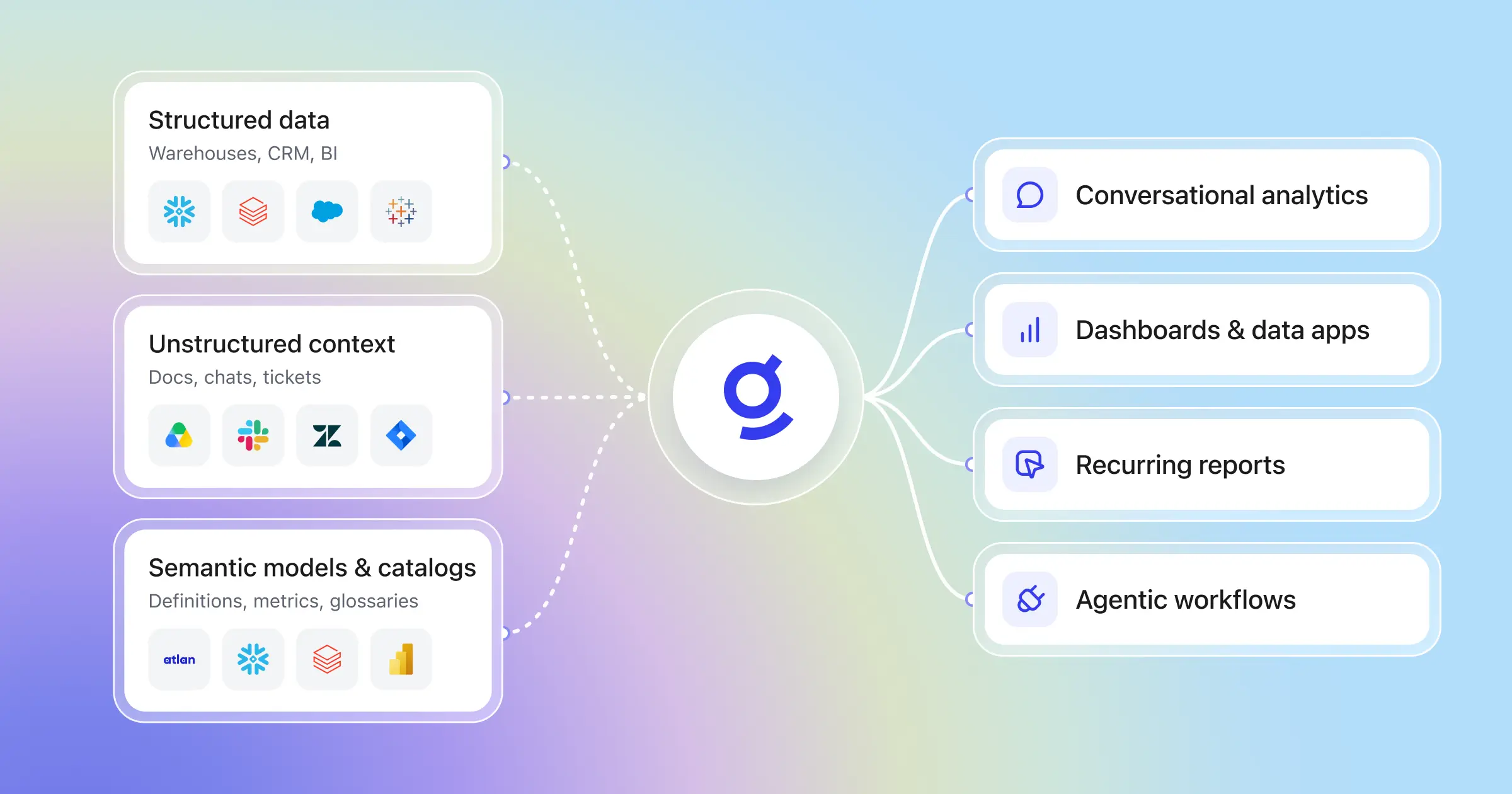
Glean Search connects to more than 100 enterprise tools and indexes both structured records and unstructured documents into the Enterprise Graph, maintaining existing access permissions. Instead of pulling a summary from memory, an analyst can trace a conclusion back to the specific contract clause, CRM note, or support ticket that supports it. Grounded retrieval like this matters because if a signal cannot be tied to a source record, it belongs in an investigation queue, not in the forecast.
Permission-aware access also solves a common political problem. Revenue data, margin detail, and seller performance metrics carry different sensitivity levels. A shared workspace that respects existing permission boundaries lets finance, sales ops, and customer success collaborate on the same risk picture without exposing data that should stay restricted.
2. Define the churn signals that actually change the forecast
The most useful churn indicators surface weeks or months before a cancellation request arrives. Finance teams that wait for formal non-renewal notices are reacting to lagging data. The goal is to identify the leading signals that correlate with real forecast exposure and build a scoring method that filters noise from genuine risk.
Leading signals worth tracking include declining product usage over 30, 60, and 90 days, reduced seat adoption relative to contract, rising unresolved support ticket volume, repeated escalation patterns, champion departure or role change, stalled expansion conversations, payment delays, and negative sentiment in account communications. Lagging signals — cancellation requests, non-renewal notices, contract expiration without renewal discussion — confirm risk that was already present.
Single signals are unreliable. A late invoice on its own is a collections issue, not a churn event.
Score signal combinations instead. A practical scoring approach assigns weighted points to each signal and triggers review when the composite score crosses a threshold:
| Signal | Weight | Why it matters |
|---|---|---|
| Product usage decline (60+ days) | High | Strong predictor of non-renewal |
| Champion departure | High | Removes internal advocacy |
| Support escalation pattern | Medium | Indicates unresolved friction |
| Payment delay (2+ cycles) | Medium | Financial stress or deprioritization |
| Expansion conversation stalled | Low-Medium | Signals flat or declining relationship |
| Negative renewal language in notes | Medium | Direct intent signal |
Roll scored accounts into forecast categories: renewal risk, expansion risk, collections risk, and margin-at-risk. Weight each category by the dollar exposure at stake, not just the number of flagged accounts. A churn risk tool built as a saved workflow in Glean Agents can run this scoring on a set cadence — weekly for high-velocity segments, biweekly for enterprise accounts — and surface the results directly in the tools your team already uses.
One caution: not every flagged signal warrants a forecast adjustment. Treat the composite score as a triage mechanism that identifies which accounts need investigation, not as an automatic input to the number.
3. Add seller performance context before changing the forecast
Seller execution quality affects forecast timing, operational efficiency, and probability even when customer demand stays constant. Two accounts with identical health scores can land differently depending on renewal coverage, follow-up discipline, and how well the rep has built relationships across the buying committee. Finance teams that skip this layer build forecasts on pipeline coverage alone and miss execution risk.
The metrics that matter span both activity and outcome. Attainment trends over the past four quarters reveal whether a rep is accelerating or decelerating. Renewal coverage ratio — booked renewals divided by renewals due — shows how far ahead the rep is working. Multithreading depth counts the number of active contacts per deal. Discounting behavior tracks whether the rep preserves margin or trades it for speed. Forecast category changes (how often a deal moves backward) and pipeline aging (days in stage relative to the team median) indicate deal velocity and accuracy.
Compare customer-side signals against seller-side signals for the same account. If the customer health score is stable but the rep's follow-up cadence has dropped and the deal has been in the same stage for 45 days, the risk is execution — not demand. Sort accounts into four risk lenses: demand risk (the customer is pulling back), execution risk (the seller is underperforming), timing risk (the deal will close but not this quarter), and mix risk (the deal will close at a different product or margin profile than forecasted).
Operational detail fills the gaps that metrics alone cannot explain. Call notes, CRM field updates, and QBR summaries contain the qualitative context behind a stalled deal or an unexpected acceleration. The Agentic Engine in Glean can pull these records across CRM, email, and meeting notes in a single grounded query, so finance does not have to ask sales ops to manually compile account histories before each forecast review.
Seller context also reveals upside. A rep with strong multithreading, rising attainment, and consistent follow-up on an account showing healthy usage is a credible expansion signal — one that pipeline data alone would underweight.
4. Quantify margin drivers so finance sees the real exposure
Revenue is only half the forecast story. Two accounts with $200K in ARR look identical on a top-line dashboard, but one carries 75% gross margin while the other sits at 40% after discounts, service costs, and hosting. When finance evaluates churn or downsell risk without margin context, the forecast reflects exposure in dollars but not in profit impact.
The margin drivers that matter most include pricing and discount levels, product mix, professional services mix, implementation cost, ongoing support burden, credits issued, hosting and delivery cost, commission expense, payment terms, and contractual concessions like extended ramp periods or early termination clauses. Each of these moves independently of revenue, and several can shift during a renewal negotiation without changing the top-line number.
For every material at-risk account, build three scenarios:
- Retain as planned at current margin.
- Retain under pressure with discounted pricing, added services, or extended terms — estimate the margin hit.
- Churn or significant downsell — calculate the full revenue and margin loss including any trailing obligations.
Instead of marking an account as "yellow," finance assigns a dollar range to each outcome and a probability to each scenario.
Segment-level patterns matter as much as individual accounts. SMB accounts often carry higher gross margins but churn at higher rates, putting customer loyalty at risk, so the margin at risk per cohort can exceed what a single enterprise loss represents. Enterprise accounts may retain better but absorb margin through custom terms, dedicated support, and negotiated discounts. Track which segments are compressing and why.
Glean Agents can assemble the contract history, discount approvals, credit memos, and service cost records for a set of flagged accounts into a structured summary, pulling from your ERP, contract repository, and CRM without manual data gathering. The key discipline is that every margin figure in the analysis should trace back to a source document. Estimates are acceptable for scenario modeling, but the inputs should be grounded, not recalled from memory.
5. Turn early warning signals into a weekly operating rhythm
Analysis without a recurring cadence decays quickly — a challenge that finance AI agents are designed to address. The signals, seller context, and margin drivers described above only reduce forecast risk when they feed a structured review process that repeats every week and assigns clear owners to every action.
Build a weekly forecast risk brief with four views:
- A summary of newly flagged accounts sorted by dollar exposure.
- Changes to existing risk scores since last week — which accounts improved, which worsened, and why.
- Seller-side risk: reps with declining attainment, aging pipeline, or backward forecast category movements.
- Margin alerts: accounts where concessions, credits, or service scope changed since the last review.
Saved workflows in Glean Agents can generate the first three views automatically by running churn scoring, seller metric comparisons, and pipeline aging calculations on a weekly schedule. Alerts trigger when a signal combination crosses a materiality threshold you define — not on every minor fluctuation. The weekly review then decides three things: which accounts need immediate outreach, which forecast line items change, and which risks to escalate to the executive review.
Every flagged account should carry four fields: owner, next action, target date, and review date. Without this structure, the same accounts appear on the risk list week after week with no resolution. An audit trail of past actions and outcomes also builds institutional knowledge about which signal patterns lead to real losses versus which resolve on their own.
Measure the process, not just the outcomes. Track how many days before close a risk was first identified, how often flagged accounts resulted in actual forecast adjustments, and the accuracy of the three-scenario estimates against final results. Over three to four quarters, these metrics show whether the early warning system is tightening forecast accuracy or just adding administrative overhead.
The core benefit is simple: finance reviews risk while there is still time to act on it, rather than explaining the variance after the quarter closes.
Frequently asked questions
What specific churn signals should finance teams monitor?
The highest-value leading indicators are declining product usage over 60 or more days, champion departure, rising unresolved support tickets, payment delays spanning two or more billing cycles, and negative sentiment in account communications. Score these in combination rather than reacting to any single metric, and weight by the financial exposure each account represents.
How can seller performance impact financial forecasts?
Seller execution determines whether pipeline converts on time and at the expected margin. Key metrics include attainment trends, renewal coverage ratio, multithreading depth, discounting behavior, and forecast category stability. A healthy account managed by a rep with declining follow-up cadence and rising discount rates carries execution risk that pipeline data alone will not reveal.
What margin drivers are most critical for forecasting accuracy?
Discount levels, product and services mix, implementation cost, support burden, credits issued, and contractual concessions each affect profit independently of revenue. Two accounts at the same ARR can differ by 30 or more points of gross margin once these drivers are applied. Finance should model margin scenarios alongside revenue scenarios for every material at-risk account.
What tools or methods can finance teams use to analyze these signals?
Start by connecting CRM, ERP, contract, and support data into a shared workspace with a common entity model. AI prompts for finance professionals can accelerate this analysis. Use composite signal scoring to flag accounts for investigation, and build three-scenario models for each material risk. Glean Search and Glean Agents can automate signal monitoring, pull grounded evidence from across connected systems, and deliver weekly risk summaries without manual dashboard scans.
How can early identification of risks improve financial decision-making?
Identifying risk weeks before close gives finance time to adjust forecasts, coordinate retention actions with customer success, and communicate exposure to leadership before the variance appears in actuals. Teams that measure their lead time — days between first flag and close — can quantify whether their early warning process is improving forecast accuracy over successive quarters.
The difference between a forecast miss and an early course correction is how quickly your team connects the right signals to the right financial exposure. When churn indicators, seller execution context, and margin drivers feed a single weekly review, you move from explaining what happened to deciding what to do next. Request a demo to explore how Glean and AI can transform your workplace.

.jpg)

.png)



.jpg)
.webp)