




How finance teams use ERP and CRM for margin analysis
Finance teams that connect ERP actuals, CRM pipeline data, and contract terms can trace every margin movement — from gross margin by customer cohort to churn signals and spend variance — without manual reconciliation across four separate exports. A connected view turns scattered financial data into actionable margin insights faster than any manual close process.
When those systems stay disconnected, finance teams lose the thread between revenue recognition, cost allocation, and renewal risk. Each tool holds a piece of the margin story, but no single view connects them. In fact, 46% of business leaders say disconnected document processes impair their ability to plan, forecast, and budget due to lack of visibility.
The sections below cover the specific workflows, metrics, and integration patterns that link ERP, CRM, spreadsheets, and contracts into a single operating model for margin analysis, churn rate calculation, and spend management.
What is connected margin analysis?
Connected margin analysis is the practice of linking ERP actuals, CRM activity, contract terms, and spreadsheet models so finance can trace margin movement across revenue, cost, and risk in one coordinated view. Rather than reconciling reports from four different systems after a quarterly close, finance teams build live connections between data sources. The goal: explain why gross margin changed this quarter without spending two weeks pulling exports.
A concrete example shows why the connections matter. Consider a SaaS company whose gross margin dropped 3% quarter-over-quarter. The ERP shows higher hosting costs, the CRM shows three large accounts moved to a lower-tier plan, and the contract management system reveals two vendor agreements auto-renewed at higher rates.
Without linking those systems, the FP&A team might attribute the entire margin shift to rising infrastructure costs — missing the churn signal in CRM and the spend drift buried in procurement contracts. Connected margin analysis surfaces all three drivers together, so the team can prioritize the right response: renegotiate vendor terms, address at-risk accounts, or adjust pricing.
Finance teams that connect these data sources can also calculate downstream metrics like net revenue retention, customer-level contribution margin, and contract-weighted cost of goods sold. Glean Search surfaces permission-aware results across connected enterprise systems, which means an analyst querying "Q1 margin variance by customer segment" can pull ERP cost data, CRM renewal status, and contract terms from a single search — without switching tools or waiting on data engineering to build a custom report.
How to use connected spreadsheets, ERP, CRM, and contracts to understand margin, churn, and spend
Most finance teams already have the data they need — it sits in NetSuite or SAP for actuals, Salesforce or HubSpot for pipeline signals, Google Sheets or Excel for planning models, and Ironclad or a shared drive for executed contracts. Each system answers a different slice of the same question, and no single interface lets you trace a number back to its source record.
A permission-aware search layer changes that dynamic. When an FP&A analyst asks "why did Q2 gross margin drop for the mid-market segment," the answer requires ERP cost actuals, CRM account health scores, spreadsheet budget assumptions, and contract pricing schedules.
Pulling those manually means four exports, a VLOOKUP chain, and a stale answer by the time the deck ships. A connected view lets the analyst ask the question once and see cited results from each source system — with links to the original records for audit.
The practical goal is not to replace any of these tools. ERP stays the system of record for financial actuals. CRM stays the system of record for customer and deal activity. When these systems are properly integrated, ERP and CRM integration eliminates manual handoffs between sales and finance — from automatic order creation to pricing validation and invoice sync.
Spreadsheets stay the flexible modeling layer finance teams rely on for scenario planning. Contracts stay the legal source of truth for pricing, obligations, and renewal windows.
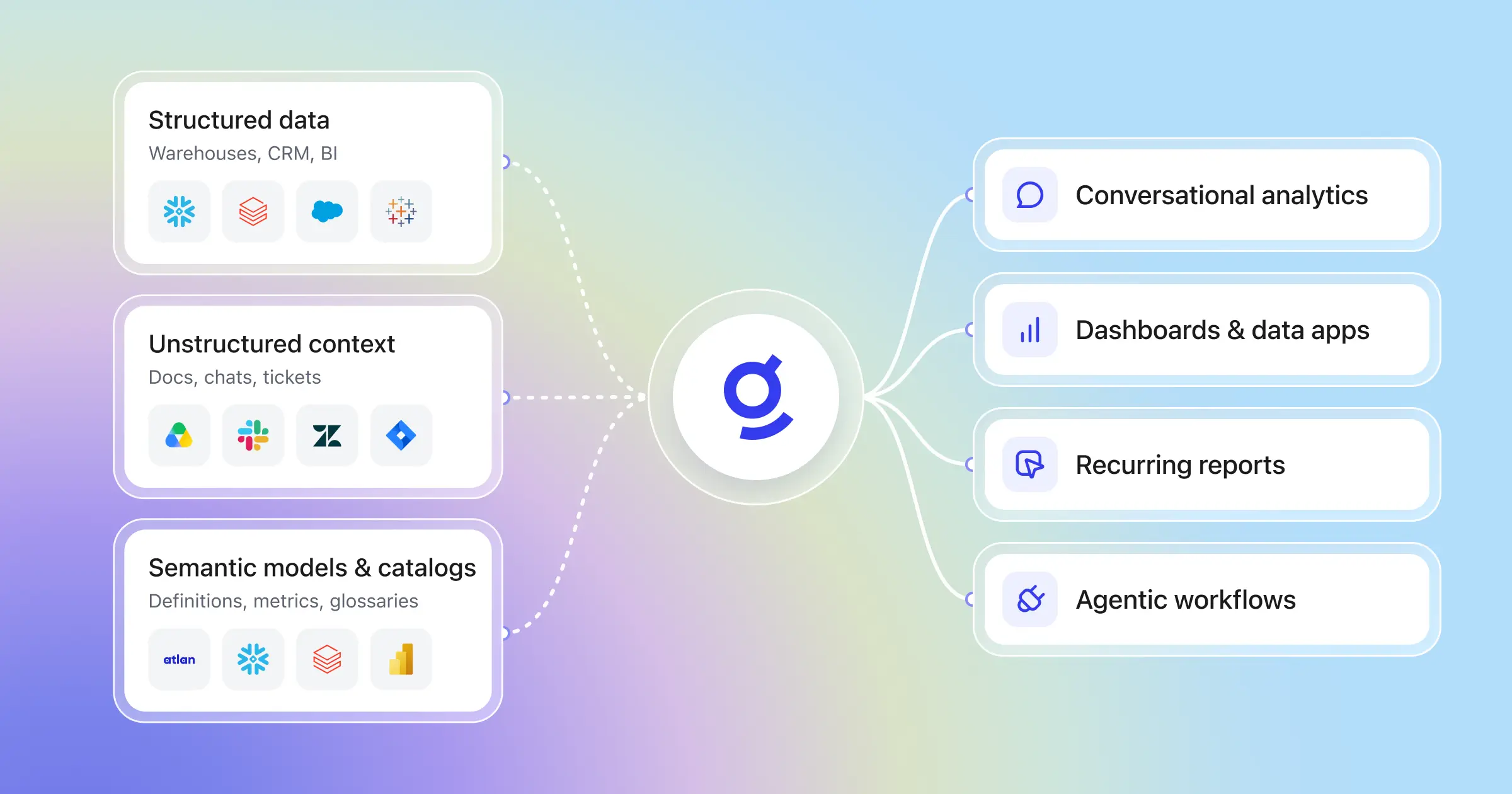
Glean Assistant lets analysts query across all four systems in natural language, returning grounded answers that cite the specific ERP journal entry, CRM opportunity, or contract clause behind each data point. The connection layer sits on top, preserving each system's permissions and data governance while giving finance a single place to start any question about margin health, churn exposure, or spend compliance.
1. Start with the business questions finance needs answered
The fastest way to waste an integration project is to connect systems before defining what you need to know. Start with decisions, not data models. Write the questions your CFO, controller, and FP&A leads actually ask during monthly reviews, board prep, and forecast cycles — then map each question to the metric, grain, and source system that answers it.
Separate your questions into three categories:
- Margin analysis: "What is gross margin by customer cohort for renewals versus new logos this quarter?" Metric: gross margin percentage. Grain: customer cohort. Source: ERP actuals and CRM deal data.
- Churn rate calculation: "Which accounts have a renewal within 90 days and showed declining product usage or open support escalations?" Metric: annualized churn rate. Grain: account. Source: CRM signals and contract renewal dates.
- Spend management: "Are we purchasing above contracted rates from any vendor, and by how much?" Metric: spend variance. Grain: vendor. Source: ERP invoices and contract terms.
Each question implies a metric, a grain, and a time frame. Writing questions in plain language first keeps finance teams from over-engineering the data model before they understand what it needs to support.
End this step with a metric dictionary — a shared document that defines each metric's formula, data source, update frequency, and owner. A mid-market fintech, for example, might define "customer-level gross margin" as recognized revenue minus allocated COGS minus allocated support cost, sourced from NetSuite GL entries and Zendesk ticket data, refreshed weekly by the FP&A team. Glean Agents can automate the assembly of a metric dictionary by scanning existing financial documentation, extracting metric definitions from past board decks and planning models, and compiling them into a single referenced document — replacing the manual process of searching through archived files and reconciling conflicting definitions across departments.
2. Connect the systems where margin, churn, and spend actually live
Connecting financial systems does not mean consolidating them into one platform. It means creating a searchable layer that reads from each source while keeping the original systems intact. According to Nucleus Research, cloud ERP deployments deliver 4.01 times the ROI of on-premises systems — largely because connected, cloud-based architectures enable faster cross-system queries.
Your ERP remains the ledger. Your CRM remains the customer record. Your contract repository remains the legal source. The connectors sit between these systems and a unified search or query interface, pulling data through APIs or pre-built integrations.
Start with the highest-value connections. ERP and CRM integration gives finance visibility into both the financial actuals and the customer signals that explain them. Add contract management next — contracts hold the pricing logic that neither ERP nor CRM captures cleanly.
Then layer in spreadsheet connections for planning models and ad hoc analysis. A B2B software company running NetSuite and Salesforce, for instance, might use pre-built connectors to sync account-level data nightly and surface contract PDFs alongside CRM renewal opportunities.
Permissions matter at every step. When a revenue analyst queries deal-level margin data, they should see the ERP cost lines they have access to — not the full vendor cost schedule reserved for procurement.
Glean Search connects to over 100 enterprise applications and indexes their content while respecting each source system's access controls. Source citations appear alongside every result, so an analyst clicking through to a margin figure can verify the underlying ERP journal entry or CRM opportunity record without asking a data engineer to trace it.
The goal is traceability, not just accessibility: every number finance sees should carry a link to the record that produced it.
3. Normalize customer, product, vendor, and contract context
Connected systems only produce reliable answers when the same customer, product, or vendor means the same thing across every tool. A single enterprise customer might appear as "Acme Corp" in Salesforce, "Acme Corporation Inc." in NetSuite, and "Acme Corp (MSA-2024-0412)" in the contract management system. Without a normalization layer, any cross-system query returns fragmented, duplicate, or missing results.
Build a common entity map that resolves these differences. Firms tackling this challenge can learn from how AI for financial advisory practices address fragmented data across client systems. At minimum, map four dimensions: account or customer name (with aliases), legal entity, contract ID, and product SKU or service line.
Standardize date logic — fiscal calendar versus calendar year, renewal date versus billing date versus revenue recognition date — so that margin, churn, and spend calculations all reference the same time frames. Align segment tags (industry vertical, size tier, geographic region) across ERP and CRM so a query for "enterprise healthcare accounts" returns consistent results regardless of the source system.
The output of this step is a finance-ready entity map that acts as a Rosetta Stone between systems. A medical device distributor, for example, might discover during normalization that its ERP tracks revenue by product SKU while its CRM tracks revenue by sales opportunity — and that the two never reconcile because one opportunity can include multiple SKUs with different margin profiles. Glean's Enterprise Graph handles entity resolution across connected applications, mapping relationships between people, accounts, documents, and records so that a search for a customer name returns the CRM account, the ERP billing record, and the associated contracts — all linked to the same normalized entity.
4. Tie contract terms to revenue, cost, and renewal data
Contracts hold the economic logic that financial statements summarize. A gross margin percentage tells you what happened; the contract tells you why.
Pricing schedules define the revenue ceiling. Discount clauses explain gaps between list price and recognized revenue. Auto-renewal terms determine whether a customer stays on the books or churns silently at period end.
Minimum commitments set the floor for expected spend. Without linking contracts to ERP actuals and CRM records, finance teams interpret margin movement without the document that caused it.
Extract the fields that matter most for financial analysis: effective dates, pricing tiers, volume discounts, annual escalators, payment terms, renewal notice windows, and termination rights. A logistics company, for instance, might find that its gross margin on a key account dropped 200 basis points — not because costs rose, but because a contract amendment from 18 months ago introduced a volume discount that only triggered after the account crossed a shipping threshold. That amendment sat in a PDF on a shared drive, invisible to the FP&A team running margin reports from NetSuite.
Link each contract to its corresponding CRM account and ERP billing entity. This connection sharpens churn analysis by surfacing accounts where renewal terms are unfavorable, notice windows are closing, or pricing resets are imminent. It also grounds spend analysis in negotiated terms rather than invoice-level snapshots. Glean Assistant can retrieve specific contract clauses in response to natural-language questions — an analyst asking "what are the renewal terms for our top 10 accounts by revenue?" gets cited answers pulled from the actual executed agreements, not summaries in a CRM notes field.
5. Calculate margin with both financial actuals and operating context
Margin calculations that rely on ERP data alone miss the operating context that explains them. Research from Nucleus Research found that ERP implementations deliver over 200% ROI on average, with payback in 16 months — underscoring the value of connecting financial actuals to operating context. Start with ERP actuals: recognized revenue, cost of goods sold, and allocated overhead by customer, product, or segment. These numbers are precise but narrow — they tell you the margin, not why it changed or what to do about it.
Layer CRM context on top. CRM data reveals which accounts expanded, which contracted, which changed pricing tiers, and which deals closed with non-standard terms.
A SaaS company calculating gross margin by customer segment might discover that its "enterprise" cohort shows 72% gross margin while "mid-market" shows 61%. The ERP explains the cost difference: enterprise accounts use shared infrastructure while mid-market accounts require dedicated support.
The CRM explains the revenue difference: enterprise deals included annual price escalators while mid-market deals locked in flat rates for three years.
Spreadsheet models bring in the forward-looking layer: what margin looks like under different renewal, pricing, or cost scenarios.
The key output is not a single company-wide gross margin number. It is a set of views that answer specific questions: margin by customer, product, segment, deal type, and versus negotiated contract terms. A variance decomposition might show that gross margin missed plan by 300 basis points, with the primary driver being raw material costs, the secondary being pricing concessions on three large renewals, and the tertiary being geographic mix shift toward lower-margin regions. Glean Agents can assemble these multi-source margin analysis tools by pulling ERP actuals, CRM deal data, and contract terms into a structured summary — and routing it to the right stakeholder with the underlying records attached.
6. Use CRM and contract signals to understand churn before it hits the forecast
Churn rarely arrives without warning — and the same signals that predict churn can also inform strategies for AI-driven customer loyalty programs. The signals exist weeks or months before a customer cancels — they just live in different systems. CRM shows declining engagement: fewer logins, stalled expansion opportunities, support escalations that shift from technical questions to complaints about value. Contract data adds a timing dimension: renewal dates, notice periods, and whether the customer negotiated a shorter commitment the last time around.
Build a churn exposure view organized by renewal cohort — an approach that aligns with how agentic AI in financial services is transforming operational workflows. Pull upcoming renewal dates from contract management, match them to CRM opportunity stages and account health signals, and layer in ERP billing data (payment delays, invoice disputes, credit memos).
A subscription analytics company, for instance, might flag accounts where three signals converge: the contract renews within 60 days, the CRM shows no expansion opportunity created in the past two quarters, and the ERP shows a credit memo issued in the last billing cycle. That convergence pattern predicts churn more reliably than any single metric.
Two questions matter in real time: "what happened?" and "what is likely next?" Retrospective churn analysis shows which cohorts, segments, or deal types churned and why. Prospective churn analysis scores current accounts against those same patterns. Glean Search surfaces the relevant account history, contract terms, and CRM activity for any flagged account in a single query, so the renewal team can see the full picture — cited from the source systems — without assembling a manual dossier for each at-risk customer.
7. Track spend against negotiated terms, budgets, and owners
Spend analysis is strongest when finance compares actual purchases against the terms the company already negotiated. Most organizations have contracted rates, volume commitments, and preferred vendor agreements in place — but procurement, finance, and budget owners rarely have a shared view of compliance against those terms.
Start with the contract layer: pull committed spend, rate cards, minimum purchase obligations, and rebate thresholds for each vendor. Match those to ERP purchase orders, invoices, and payment records.
A manufacturing company, for example, might discover that it paid a raw materials supplier $2.4 million against a $3 million annual commitment — triggering no rebate because spend fell below the contractual threshold, but also revealing $600,000 in unused commitment that could be redirected. Spreadsheet planning models add the budget dimension: compare actual spend against departmental budgets, project allocations, and quarterly forecasts to spot overruns before they compound.
Layer in ownership. Every spend exception — an invoice above contracted rates, a purchase from a non-preferred vendor, a budget overrun in a specific cost center — should tie to a named owner who can investigate and resolve it. Without ownership, exception reports pile up unaddressed. Glean Agents can route spend exceptions to the right budget owner automatically, attaching the relevant purchase order, contract clause, and variance calculation so the recipient has full context. The result is a spend management cadence where every anomaly has an owner, a deadline, and a paper trail — rather than a quarterly reconciliation exercise that surfaces issues too late to correct them.
8. Automate reporting, follow-up, and exception handling
Manual reporting cycles consume the time finance teams should spend on analysis. A Forrester Total Economic Impact study found that a manufacturing organization using ERP achieved $8.9M in productivity improvements by shifting from manual assembly to automated, connected reporting. Month-end close, quarterly board decks, weekly spend reviews, and renewal pipeline reports all follow predictable structures — same metrics, same data sources, same distribution lists.
When these outputs are automated, analysts shift from data assembly to reviewing the exceptions and judgment calls that actually require human attention. Teams building this kind of automation can draw on AI agents for finance workflows that handle everything from reconciliation to audit prep.
Build recurring report templates that pull from connected systems on a schedule. A weekly margin flash report, for example, might pull gross margin by segment from the ERP, overlay CRM renewal pipeline data, and flag any account where margin dropped more than 5% week-over-week.
Route the report to segment owners automatically, with each flagged item linking back to the source ERP entry and CRM account record. The automation handles the assembly and distribution; the analyst handles the interpretation and response.
Exception handling is where automation delivers the most value. Rather than reviewing every line in a spend report, finance teams define thresholds — invoices exceeding contracted rates by more than 10%, renewals within 30 days without an assigned owner, margin variances above a set tolerance — and route only the breaches for human review.
Glean Agents can monitor connected systems for these threshold breaches, compile the relevant records, and assign follow-up tasks with cited context from the source applications. Each exception arrives with the contract clause, ERP transaction, or CRM record that triggered it, so the reviewer acts on evidence rather than a summary.
How finance teams use ERP and CRM for margin analysis: frequently asked questions
How do finance teams integrate spreadsheets, ERP, and CRM systems?
Finance teams connect these systems through API-based connectors and middleware platforms that sync data between tools without replacing the source systems. The ERP stays the ledger of record, the CRM stays the customer record, and spreadsheets stay the modeling layer. A unified search interface like Glean sits on top, letting analysts query across all three with permission-aware, cited results.
What metrics can finance teams analyze using connected financial tools?
Connected systems support margin analysis at the customer, product, and segment level, churn rate calculation by renewal cohort, spend variance against contracted terms, net revenue retention, and forward-looking scenario modeling. The critical difference from siloed reporting is the ability to trace any metric back to the source record in the originating system. Finance professionals can accelerate this work with AI prompts for finance professionals tailored to budgeting, analysis, and decision-making.
What role do contracts play in financial analysis?
Contracts explain the economic logic behind financial results — pricing schedules, discount tiers, renewal mechanics, and minimum commitments. Without contract data, finance teams interpret margin changes and churn patterns without the document that caused them. Linking contracts to ERP actuals and CRM records closes that gap. According to World Commerce and Contracting's research across global enterprises, poor contract management costs organizations up to 9% of annual revenue.
How can finance teams automate data flows between these systems?
Automation starts with recurring report templates that pull from connected systems on a defined schedule, then adds exception-based routing for anomalies that exceed predefined thresholds. Threshold breaches — like invoices above contracted rates or renewals without an assigned owner — get routed to the responsible person with the source records attached. The goal is continuous monitoring with targeted human review, not batch reconciliation after the fact.
Connected margin analysis gives your finance team the ability to trace every number — margin, churn, spend — back to the source record that produced it. The shift from manual reconciliation to connected, cited workflows means fewer hours on data assembly and more time on the decisions that move the business. Request a demo to explore how Glean and AI can transform your workplace.

.jpg)

.png)



.jpg)
.webp)