



How to Choose the Right AI Platform for Finance Integration
The right AI platform for finance integration connects your ERP, CRM, contracts, spreadsheets, and communication tools through a single permission-aware layer, so finance teams can get cited answers and act on financial data without switching between systems or building custom pipelines.
Most finance organizations run on five to 10 core systems that rarely talk to each other. Controllers reconcile data across NetSuite and Salesforce. FP&A analysts copy numbers from spreadsheets into slide decks. Business partners dig through Slack threads and Gong recordings to understand why a deal closed at a discount. A 2025 Ledge benchmarks survey found that 50% of finance teams take longer than five business days to complete the month-end close, with account reconciliation ranking as the top time sink. The result is hours of manual coordination and a constant risk that reporting inputs are stale or incomplete.
Choosing a platform that unifies financial knowledge changes the workflow from "hunt and stitch" to "ask and act." The sections below break down what to look for in an AI platform built for finance integration, from connector depth and permission models to the specific capabilities that reduce manual effort in reporting, analysis, and audit prep.
What is an AI platform for finance integration?
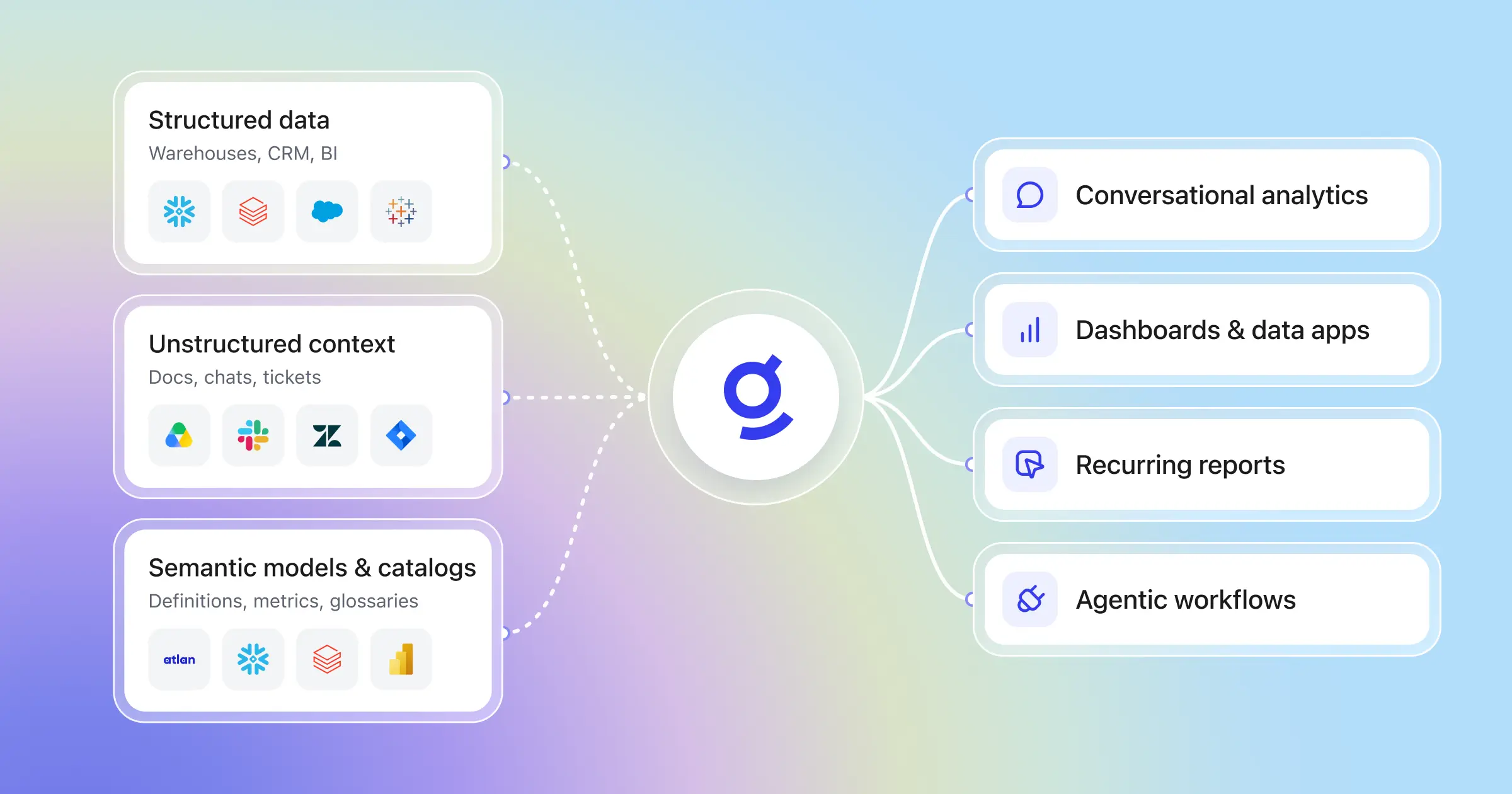
An AI platform for finance integration is a permission-aware intelligence layer that connects financial systems — ERP, CRM, contract repositories, spreadsheets, team chat, and meeting recordings — so finance teams can surface trusted, cited answers across all of those sources at once. Rather than creating another data silo, the platform indexes existing content in place and respects the access controls already defined in each source system.
What separates a useful platform from a basic connector is business context. A finance controller preparing for quarterly close needs more than a keyword search across NetSuite and Google Drive. They need the platform to understand that a specific contract amendment in Ironclad affects the revenue schedule in the ERP, and that the relevant Slack discussion between deal desk and legal provides the rationale. That kind of cross-system reasoning requires a knowledge graph for enterprise AI that maps relationships between people, documents, and transactions — not just a list of indexed files.
Glean's Enterprise Graph builds exactly that layer of context. It connects 100+ enterprise data sources through native connectors, then maps the relationships between content, people, and activity so that when an FP&A analyst asks "What drove the variance in Q1 EMEA services revenue?", the answer draws from CRM deal notes, ERP journal entries, and the recorded QBR where the regional VP explained the pricing change. Every result is permission-aware and cites its source, which means finance teams can trust the output for audit documentation without manually verifying access rights.
How to choose the right AI platform for finance integration
Finance teams should prioritize a platform that connects structured systems like ERPs and CRMs alongside unstructured sources — contracts, spreadsheets, chat threads, and call recordings — then returns cited, permission-aware answers that support governed automation across real finance workflows. The goal is not to replace existing tools but to make the data already inside them usable in seconds.
Too many AI evaluations start with a vendor demo and a features checklist. That approach misses the core question: does this platform fit the way your finance team actually works? A 2024 Gartner survey of 724 respondents found that only 34% of teams using generative AI reported high productivity gains — largely because organizations evaluated features in isolation instead of testing against real cross-system workflows.
A margin variance question might need ERP actuals, CRM pipeline data, contract terms stored in a CLM tool, and assumptions buried in a shared spreadsheet. If the platform cannot follow that chain across systems, it will produce a partial answer that still requires manual verification — which is the problem you are trying to solve. Glean Search addresses this by indexing content from 100+ enterprise connectors and returning cited, permission-aware results that reflect the full data chain.
A more useful evaluation follows a specific sequence. First, define the decisions and workflows you want to improve. Then verify whether the platform covers the data sources those workflows touch. Test the quality and traceability of its answers. Confirm that governance — permissions, audit trails, and access controls — holds up under finance-grade scrutiny. Evaluate whether it can automate recurring steps without removing human oversight. Finally, measure whether time-to-answer and reporting confidence actually improve. The sections that follow walk through each step.
1. Map the finance decisions and workflows you want to improve
Start with the questions your team struggles to answer each week — not with a product demo. Questions like "Which deals are creating forecast risk this quarter?", "What drove the change in gross margin between periods?", or "Which vendor contracts carry auto-renewal clauses we haven't reviewed?" reveal where current tools fall short. Those questions, not feature matrices, should shape your evaluation criteria.
Break your workflows into categories: analysis (variance deep-dives, spend pattern reviews), reporting (board decks, monthly commentary, audit schedules), approvals (vendor onboarding, contract sign-off, budget reallocation), and execution (collections follow-up, accrual entries, intercompany reconciliation). Each category has different data needs and different tolerance for automation. A budget prep cycle, for example, typically pulls from the planning system, last year's actuals in the ERP, department-level headcount plans in spreadsheets, and strategic priorities documented in presentation decks. No single system holds the full picture.
Glean Agents can orchestrate multi-step workflows that span these categories — a finance team at a mid-market SaaS company, for instance, could configure an agent to pull the latest pipeline changes from Salesforce, compare them against the current forecast model, and draft a variance summary with source citations before the weekly FP&A review. That orchestration only works if the platform already indexes the right sources, which is why mapping your workflows first matters. Pick two to three workflows with enough frequency and pain to serve as real evaluation tests, then define what success looks like: 60% less time preparing pre-reads, three fewer handoffs per reporting cycle, or commentary that arrives with linked source evidence instead of "per my analysis."
2. Check whether the platform can connect the full finance context, not just core systems
The platform you choose must reach beyond ERP and CRM records into the unstructured data that shapes finance decisions: contract clauses that define payment terms and liability caps, spreadsheet tabs where analysts maintain bridge schedules, email threads where budget holders approve exceptions, and call transcripts where sales reps explain why a customer pushed back on pricing. If the platform only connects to your accounting system, it answers the "what" but never the "why."
Evaluate connector depth, not connector count. A vendor listing 200 integrations may still offer shallow connections that only index file names or top-level metadata. What matters is whether the platform syncs document content, embedded attachments, threaded conversations, version history, and — critically — the permissions and access controls defined in each source system.
Finance data carries regulatory weight: SOX compliance requires that only authorized users see revenue figures, and a platform that bypasses source permissions to improve search results creates liability, not value. Building the right permissions structure for enterprise AI is essential to maintaining compliance while enabling productivity.
During evaluation, ask the vendor to answer a real cross-source question using your data. For example: "Show me the renewal risk for Acme Corp using CRM activity logs, the original contract terms, and any recent conversation signals from the account team." A platform with genuine connector depth will retrieve the specific Salesforce opportunity notes, the relevant contract section from your CLM repository, and the Gong call summary where the customer mentioned budget cuts — and cite each source. Glean Search handles exactly this kind of cross-source retrieval because its connectors index content at the document and field level, preserving metadata and permissions from each source system. If instead the vendor asks you to export data into a staging area or normalize it into a common schema first, that is not integration — that is another data pipeline to maintain.
3. Verify that the platform returns grounded answers with business context
A strong AI platform for finance integration does more than connect your systems — it returns answers grounded in the full operating context of your business, with citations pointing to exact source material so finance teams can verify every claim before acting on it.
The real challenge is whether the platform understands relationships across connected tools. When an FP&A lead asks why operating expenses spiked in a specific cost center, the answer should synthesize the vendor contract that triggered the increase, the purchase order in the ERP, and the budget approval thread in email — drawing from all three sources in a single response.
Finance terminology compounds the challenge: "accrual," "reserve," and "provision" can describe overlapping concepts depending on context, so retrieval must combine keyword matching with semantic understanding to surface the right records.
Look for cited, source-backed responses where every answer points to the exact spreadsheet row, contract clause, or discussion thread it drew from. Glean Assistant generates responses grounded in your company's indexed knowledge and attaches inline citations, so a reviewer can click through to the original document rather than taking the summary on faith. Permission-aware retrieval matters here too: the platform should check access rights before the model generates a response, not after, which prevents sensitive compensation or pricing data from surfacing to users who lack authorization.
The practical test is straightforward. Load your actual company data — messy, incomplete, with the naming inconsistencies every real finance org has — and ask the platform the same question a controller would ask during month-end close. If the answer cites real sources and reflects the relationships between your systems, the platform has business context. If it returns generic summaries or hallucinates figures, it does not. Grounded answers reduce the risk of building board commentary or investor materials on incomplete information, which directly improves confidence in planning, reporting, and review cycles.
4. Evaluate how well the platform handles finance analysis across numbers, documents, and conversations
The strongest AI platforms for finance teams go beyond summarization by connecting operating signals — contracts, customer communication, internal collaboration — to financial outcomes, enabling analysis that traces variance back to specific operational signals. A January 2025 World Economic Forum white paper found that the tasks consuming almost half of all time spent by financial services employees are well suited to either automation or augmentation by AI.
Finance analysis rarely lives in a single format. Explaining why gross margin dropped two points last quarter might require pulling unit economics from a spreadsheet model, reading a renegotiated supplier contract, and reviewing a Slack thread where procurement discussed raw material pricing. A platform that can only summarize documents or query a database handles part of the job. The real value appears when it traces a forecast miss back to specific pipeline changes in the CRM, connects those to the assumptions in your financial model, and surfaces the customer call where the deal timeline shifted. That chain of reasoning — from operational signal to financial impact — is what separates analysis from retrieval.
Evaluate output quality in the formats finance actually uses. Ask the platform to produce a source-backed variance summary, a comparison table, or draft commentary that a reviewer can inspect and annotate. Glean Agents can orchestrate multi-step analysis workflows that pull data from across your connected systems and assemble structured outputs with cited sources, so the analyst reviewing the work can trace each figure to its origin. Test with spend commitment tracking, churn driver identification, or margin movement explanations — tasks where the answer depends on linking numerical data to narrative context across multiple systems.
Be cautious of tools that produce polished prose but cannot back it with source references. A well-formatted paragraph explaining revenue variance is only useful if the reviewer can confirm that the underlying contract terms, booking dates, and pipeline notes are accurate. Static dashboards show what changed; a capable AI finance platform explains why it changed and points you to the evidence.
5. Inspect governance, security, and auditability before you inspect polish
Finance teams should not trade operational control for AI convenience. Before evaluating interface design or output quality, confirm that the platform preserves your existing access rules, provides admin controls, and meets the governance requirements finance operates under.
The governance checklist for finance includes:
- Permission-aware retrieval that enforces source-system access controls at query time
- Role-based administration for managing who can use which AI capabilities
- Audit logs that record queries and generated outputs
- Model governance policies that control which models process your data
- Workflow approvals for automated actions
- Clear data handling and retention policies
These are baseline requirements when the data flowing through the platform includes revenue figures, compensation structures, vendor pricing, and contract terms. A McKinsey Global Survey on AI, published in May 2024, found that 57% of finance leaders cited data governance as their top barrier to AI adoption, ahead of both cost and technical complexity.
Auditability deserves its own evaluation. When Glean Agents execute a multi-step workflow — pulling data, generating analysis, drafting commentary — each step logs the sources it accessed and the reasoning path it followed, so reviewers can trace the full chain during internal review or external audit. That source lineage is what lets a finance team defend a number in a board deck or an estimate in a regulatory filing. Robust active data governance capabilities are what separate enterprise-grade platforms from tools that treat security as an afterthought.
If a vendor treats governance as a premium add-on they surface after the product demo, treat that as a buying signal — a negative one. Finance teams that adopt a platform without enterprise-grade controls risk exposing sensitive data, losing audit trails, and creating compliance gaps that cost more to remediate than the productivity gains the tool delivered.
6. Prioritize platforms that can automate finance work, not just chat about it
The highest-value AI platforms for finance execute repeatable, multi-step workflows across your existing systems — assembling materials, routing tasks, and taking actions — with the right approvals at each stage and humans in control of sensitive decisions.
When evaluating workflow automation, look for specific capabilities:
- Event-based triggers (a new contract upload kicks off a review checklist)
- Scheduled runs (monthly spend summaries generated on the first business day)
- Multi-step planning (pulling data from three systems, comparing it against a threshold, and drafting a recommendation)
- Action-taking integrations that write back to source systems
- Human review checkpoints before any commitment posts or approvals execute
- Exception handling when data is missing or permissions block a step
- Monitoring dashboards that show what ran, what succeeded, and what stalled
These capabilities determine whether the platform removes manual work or just describes it.
Consider the practical finance use cases where orchestration creates measurable time savings. An FP&A team preparing forecast review packets currently pulls actuals from the ERP, gathers pipeline changes from the CRM, locates supporting commentary in email and chat threads, and formats everything into a slide deck — a process that routinely consumes the better part of a business day. According to Vena Solutions' analysis of AI statistics, 57% of finance teams already use AI for at least some operations, yet 89% still rely on Excel for key processes — a gap that governed automation is designed to close.
That same multi-step orchestration applies to pulling supporting evidence for variance commentary, routing contract questions to the appropriate legal or procurement owner, summarizing renewal risks ahead of a QBR, preparing category-level spend reviews, and drafting follow-up communications based on approved internal guidance. Glean Agents handle multi-system orchestration through the Agentic Engine, which plans and executes each step while enforcing the same permission model that governs search results — so an agent preparing a spend review for a regional controller only surfaces data that controller is authorized to see.
When evaluating any finance AI agent, verify that execution is governed (auditable logs, permission enforcement at every step), that reasoning is source-backed (cited evidence, not generated summaries), and that workflows coordinate across systems instead of operating inside a single application. Automation should layer on top of trusted retrieval and access controls. If the platform cannot reliably find the right context and respect permissions, it is too early to let it act on your behalf.
7. Run a finance-first pilot and choose the platform that earns trust fastest
Skip broad proof-of-concept programs with vague goals like "explore AI for finance." A strong pilot focuses on two to three finance workflows that happen often, cross multiple systems, and have visible business impact — quarterly close commentary, vendor spend reviews, or renewal risk preparation are good candidates because they involve structured and unstructured data, multiple stakeholders, and clear before-and-after metrics.
Staff the pilot with finance, IT, and security from the start. Finance owns the workflow pain and defines what a useful answer looks like. IT validates that connectors integrate cleanly with your existing stack and that administration does not require a dedicated engineering team. For a broader perspective on what CIOs should evaluate, see this guide on choosing an AI platform for enterprise workflows.
Security verifies that access controls hold up under real conditions — not just in a demo environment with sample data. A practical live test: ask the platform to answer the same question for two users with different permission levels. One user should see the full answer with all supporting sources; the other should receive a partial answer that excludes the data they are not authorized to access.
That permission test reveals whether access controls are enforced at the retrieval layer or just applied as a display filter after the fact. Glean Search enforces permissions at the index level, so results reflect each user's actual access rights across every connected source system — making this test straightforward to run during a pilot.
Measure outcomes that finance leaders and IT stakeholders both care about:
- Time to answer a cross-system question (from minutes or hours to seconds)
- Manual handoffs removed per workflow
- Answer verification rate (percentage of responses with cited sources users confirm as accurate)
- Reduction in context switching between applications
- Time saved preparing reporting commentary
- Adoption rate among finance business partners
Track deployment speed as well — how quickly the platform connects to your existing systems and produces value without a months-long custom integration project. The selection framework is sequential: choose the platform that helps teams find the right information first, get trusted answers next, and automate recurring work only after trust is established. Platforms that skip the trust-building steps and jump straight to automation create the same verification burden your team already faces, just with a different interface.
How to choose the right AI platform for finance integration: frequently asked questions
What features should an AI platform have for finance teams?
A finance-ready AI platform should connect to broad data sources — ERP systems, CRM tools, spreadsheets, contracts, and conversation threads — and return grounded answers with citations so analysts can verify every claim. It also needs permission-aware access controls, support for both structured and unstructured data, workflow automation for repeatable tasks, and strong governance features like audit trails and role-based visibility. Glean delivers these capabilities through its Enterprise Graph, which indexes across 100+ connectors while respecting existing permissions, giving finance teams the ability to understand what's behind the numbers rather than just surface them.
How can AI improve integration between ERP and CRM systems?
AI bridges ERP actuals with CRM pipeline activity, contract details, spreadsheet models, and internal conversations to explain changes in forecast, revenue, margin, or renewal risk. The goal isn't to replace either system but to connect them so finance teams get faster, more complete answers. Glean Assistant lets analysts ask natural-language questions that pull cited evidence from both ERP and CRM data — along with Slack threads, deal notes, and planning documents — so variance explanations that once took hours of tab-switching happen in minutes.
What are the benefits of using AI in financial workflows?
The biggest gains come from reducing context switching — the time analysts spend hunting through email, spreadsheets, and multiple systems to piece together a single answer. A Harvard Business School study found that professionals who incorporated AI tools completed tasks 25.1% more quickly and produced work rated over 40% higher quality. Glean Search unifies that fragmented research into one query, and Glean Agents can automate recurring data-pull workflows with built-in governance controls.
Which AI capabilities matter most for contract and reporting use cases?
For contract and reporting work, the capabilities that matter most are retrieving specific contract clauses, tying those clauses to spend or revenue questions, surfacing obligations and risks, and connecting contract data to the spreadsheet and system data used in reporting. Source citations and permission-aware retrieval are non-negotiable — reviewers need to trace every figure back to its origin. Glean Assistant provides cited answers grounded in your company's knowledge, so finance teams can pull contract terms alongside revenue data and verify the source of each detail before it reaches a report.
How does AI enhance data accuracy in financial reporting?
Accuracy improves when AI answers are grounded in current source systems, existing permissions are preserved, and reviewers can verify the evidence behind every answer before it's published. Glean's permission-aware architecture and cited-answer model link each response back to the original document, spreadsheet, or system record. To see how agentic AI in financial services drives these accuracy gains in practice, explore real-world implementation examples.
The right AI platform for finance doesn't just answer questions — it connects your ERP, CRM, contracts, and planning data so every answer is grounded, cited, and permission-aware. We built Glean to give finance teams that single source of truth without replacing the systems you already rely on. Request a demo to explore how Glean and AI can transform your workplace.

.jpg)

.png)



.jpg)
.webp)