







How to Leverage AI for Accurate Financial Forecasting
What is AI for accurate financial forecasting?
AI for accurate financial forecasting uses connected, permission-aware intelligence to analyze financial, operational, and unstructured company data together — so finance teams can model outcomes faster, explain forecast changes clearly, and act on answers grounded in trusted context.
Generic AI tools can summarize text or generate charts, but they lack access to a company's actual financial systems, planning models, and business discussions. Finance-ready AI — like platforms built for enterprise search and knowledge management — connects directly to these sources, respects data permissions, and returns cited answers that auditors and executives can trace back to their origin.
This article walks through a practical approach for finance leaders, FP&A teams, controllers, and operations partners. The core idea: speed comes from unifying data and workflows in one place, trust comes from grounding outputs in approved sources with citations and permissions, and accuracy comes from combining structured metrics with the business context that explains them.
How to use AI for accurate financial forecasting
AI helps finance teams plan faster with trusted context by connecting financial systems, business documents, conversations, and workflows in one place. The strongest results come from grounding AI in the company's actual knowledge: ERP data, planning models, CRM updates, board materials, close notes, policy documents, contracts, and current business discussions.
Finance teams that adopt this approach spend less time stitching together reports from disconnected tools and more time reviewing drivers and guiding decisions. McKinsey reported in 2025 that finance professionals using AI spend 20-30% less time on manual data work, and that 44% of CFOs now use generative AI for five or more use cases, up from 7% the prior year. In one case McKinsey documented, a global consumer goods company found that a generative AI assistant saves an estimated 30% of finance professionals' time on budget variance analysis.
Six steps to ground financial forecasting in AI
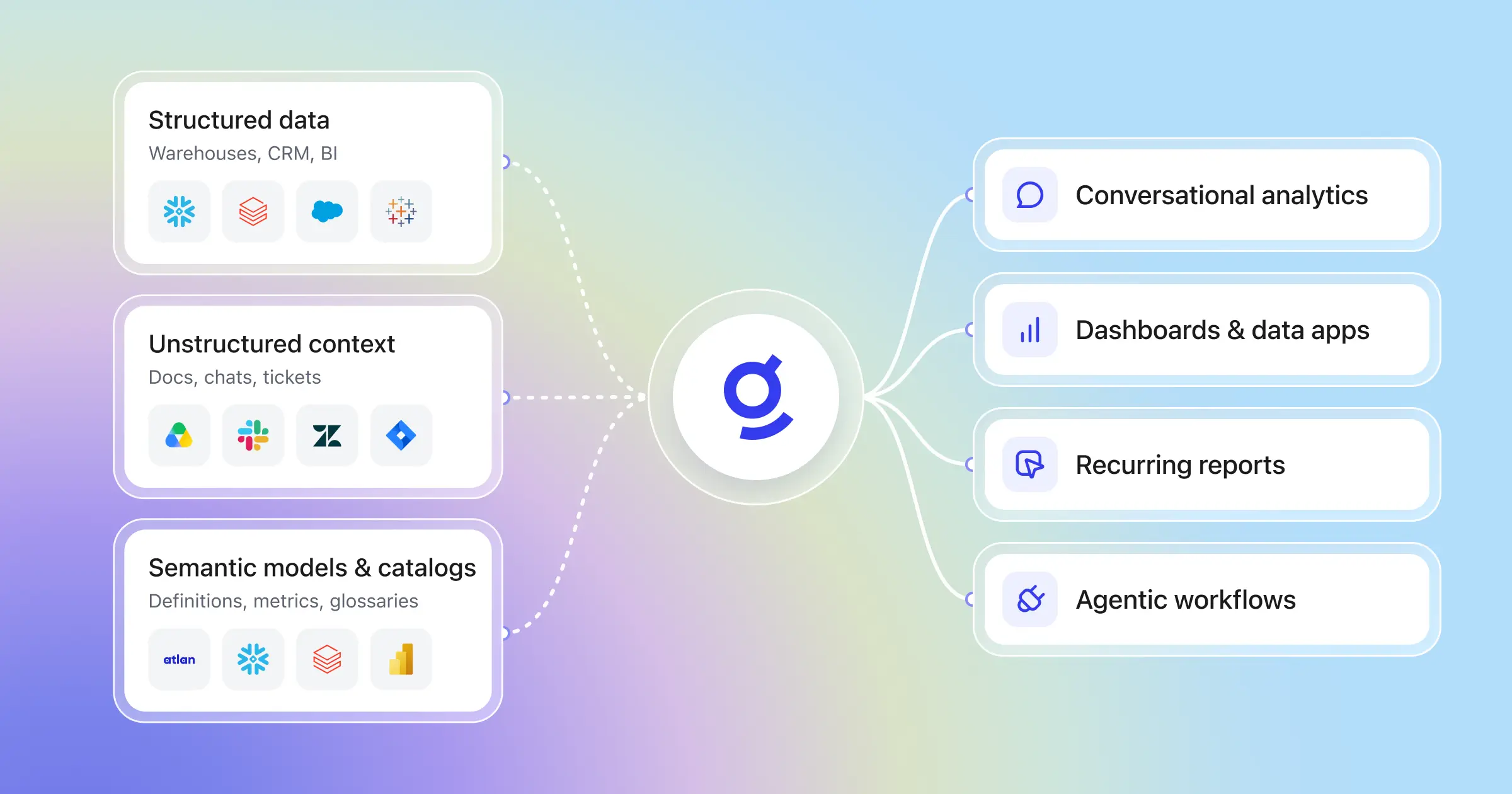
- Connect your financial data sources. Link ERP systems, planning tools, CRM platforms, and document repositories so AI can access real numbers and context without manual exports. Glean Search surfaces cited answers from connected financial tools like Salesforce, NetSuite, and Google Drive, pulling results that respect existing data permissions.
- Include unstructured context. Financial forecasts improve when AI can read board materials, earnings call notes, Slack discussions about pipeline changes, and policy documents alongside structured data. The gap between a spreadsheet forecast and reality often lives in these conversations.
- Ask questions in natural language. Instead of building a new report for every variance question, query your data directly. Ask "Why did EMEA revenue drop 8% versus plan?" and get an answer grounded in your company's actual close notes and CRM records. Teams looking for ready-made starting points can explore AI prompts for finance tailored to common planning and analysis workflows.
- Run real-time scenario models. Use AI to test assumptions — what happens to cash flow if a key customer delays payment by 30 days, or if raw material costs rise 12%? Speed here means finance teams can brief leadership with updated numbers the same day conditions change.
- Cite every output. Trust in forecasting built on AI depends on traceability. Every answer should reference the specific documents, data sources, and calculations behind it so controllers and auditors can verify the work.
- Review and refine with human judgment. As Arm Holdings CFO Jason Child told MIT Sloan, "I think of today's LLMs as mostly a first draft, but it can never be the answer." AI handles the data assembly and pattern detection; finance professionals apply judgment, context, and sign-off.
The practical outcome is a shift from reactive reporting — where FP&A teams spend days pulling data from five systems into a single deck — to proactive analysis, where the data is already unified and the team focuses on what the numbers mean.
1. Start with a planning question, not a model
Finance teams get the most from AI when they begin with a specific business question, not a tool selection. Questions like "What is driving the revenue miss in EMEA?" or "What happens to gross margin if we delay two open headcount by a quarter?" focus the analysis on a decision. Starting with a model or dashboard often produces outputs that look useful but don't connect to the judgment call the CFO needs to make this week.
Narrow your first use case to one planning workflow: quarterly re-forecasting, monthly variance review, cash planning, or board prep. Arm Holdings CFO Jason Child recommended this approach at the MIT Sloan CFO Summit, advising finance leaders to "pick specific areas, test, figure out where it breaks" before expanding. Trying to apply AI across every planning cycle at once is one of the most common failure modes McKinsey identified in its 2025 analysis of finance AI adoption.
Trusted context is the foundation. AI should understand your metric definitions, reporting calendar, approved plan version, and business assumptions before generating any output. A common mistake is asking AI to predict a number without specifying the planning grain, time horizon, business drivers, or source systems. The output may be precise and completely wrong because the model filled in assumptions the finance team never approved.
Stakeholder alignment matters before any AI touches the data. Agree on which numbers are authoritative, which source system is the record of truth, and what variance threshold triggers action. Without this, AI-generated forecasts become another version of the spreadsheet problem — more numbers, less clarity.
Glean Assistant lets finance teams ask planning questions in plain language and trace each answer back to the company's own data. Because responses are grounded in connected sources and include citations, the analyst can verify which plan version, CRM record, or close note informed the answer rather than trusting an opaque calculation.
2. Connect financial data to company context
Accurate financial forecasting depends on more than the numbers in a planning model. Every forecast is shaped by pipeline shifts, hiring timelines, vendor contracts, support volume trends, pricing changes, and product launch schedules. When these signals live in separate systems — Salesforce for pipeline, Workday for headcount, Google Drive for board materials, Slack for deal updates — the analyst becomes the integration layer, spending hours stitching context together manually.
Industry research consistently shows that 60-80% of time on data analytics projects goes to acquiring and cleaning data. For finance teams, that translates to days spent pulling exports, reconciling formats, and chasing down the latest version of a hiring plan or contract amendment. AI changes the equation when it can connect structured data from ERP and budgeting tools with unstructured knowledge from meeting notes, approval threads, policy documents, and planning memos.
The connections matter most when they cross departmental boundaries. A sales leader's pipeline note about a delayed enterprise deal changes the revenue forecast. A procurement contract with tiered pricing affects cost-of-goods projections. Financial advisory firms face similar challenges — fragmented data sources and rising client expectations make unifying context a strategic priority.
An HR plan shifting headcount timing from Q3 to Q4 moves OpEx between periods. A rising volume of customer support tickets may signal churn risk that belongs in the retention model. None of these signals appear in the general ledger until it is too late to act on them.
AI that connects financial planning to company context must also respect existing permissions. Not every analyst should see executive compensation details or pre-announcement M&A documents. In regulated industries, financial services AI must pair speed with auditability and permission enforcement so that every summary and recommendation links back to sources the reviewer is authorized to access.
Glean Search connects to more than 100 enterprise tools and returns permission-aware, cited results. When an FP&A analyst asks about the status of a vendor renegotiation, the answer pulls from the relevant contract, procurement thread, and approval email — without requiring the analyst to know which system holds each piece.
3. Prepare the data enough to move, then improve it as you go
Waiting for perfect data before adopting AI is one of the most expensive delays a finance team can make. McKinsey's 2025 research on AI adoption pitfalls specifically calls out "waiting for perfect data" and "trying to transform all at once" as patterns that stall projects indefinitely. The practical alternative is to establish a minimum data foundation, start generating value, and improve data quality iteratively as gaps become visible.
A minimum data foundation for financial forecasting requires four steps. First, confirm metric definitions for the numbers that matter most: revenue, spend, headcount, bookings, gross margin, and cash. If two teams define "bookings" differently, the AI will inherit that confusion. Second, separate approved plan data from draft versions so AI references the right baseline. Third, map business dimensions — region, product line, segment, cost center — consistently across source systems. Fourth, preserve document metadata so AI retrieval can filter by date, author, approval status, and document type.
Source hygiene is where AI transparency in finance begins. When an AI system memorizes data during training rather than fetching it at query time, the answer reflects whatever the model last absorbed, not the current state of the business. Retrieval augmented generation approaches pull live data each time a question is asked, which means the answer updates as the underlying records change. When AI-enabled forecasts automatically refresh as new data flows in, the lag between a business event and its appearance in the forecast shrinks from days to hours.
A practical starting point: have finance analysts log the questions they ask most often during close and planning cycles. Questions like "What drove the variance in APAC travel spend?" or "Where is the latest version of the Q3 hiring plan?" become the first prompts and templates for AI-assisted workflows.
Glean's Enterprise Graph maps relationships across connected systems — people, documents, projects, and data — so that retrieval reflects how information actually flows in the organization. When an analyst asks about Q3 hiring assumptions, the system fetches the current version from the connected HRIS or planning tool rather than relying on a stale snapshot.
4. Use AI to surface forecast drivers, anomalies, and real-time insights
Surfacing forecast drivers is where finance teams feel the speed difference. Instead of spending three days building a variance bridge in a spreadsheet, an analyst can ask: "What changed since the last forecast?" or "Which assumptions are driving the EBITDA delta?" and get a grounded answer within minutes. The time savings are significant. McKinsey's 2025 research found that organizations fully redesigning workflows around AI are seeing measurable impact on earnings — but only when they move beyond pilots to disciplined execution anchored in business priorities.
AI improves forecast accuracy not by guessing future numbers but by synthesizing more inputs than a human analyst can review in the same timeframe. The system compares current results with prior periods, surfaces documents that explain deviations, and identifies patterns across business units. The value is in the explanation, not the prediction. A variance summary that cites three specific sources — a CRM pipeline note, a procurement cost update, and a revised headcount plan — gives the controller something to act on. A number without context is just another cell in the spreadsheet.
Example outputs that finance teams find immediately useful: a variance summary by business unit with cited sources, an anomaly list highlighting cost centers where spend is rising faster than revenue, a driver tree connecting a top-line revenue change to shifts in pipeline, headcount, and pricing, and a plain-language executive summary with evidence for each claim. Each of these would take hours to assemble manually from disconnected systems.
Real-time monitoring adds another layer. As Shopify CFO Jeff Hoffmeister noted, "Every decision is done at a point in time with a certain amount of information and context. The very next day, that context changes." AI that monitors incoming data and surfaces material changes sooner gives finance teams the option to update the forecast before the monthly close, not after. Gartner predicts that by 2026, 90% of finance functions will deploy at least one AI-enabled technology solution — a signal that real-time, AI-driven monitoring is quickly moving from early adoption to mainstream expectation.
Glean Assistant generates cited responses grounded in the company's connected data, so when an analyst asks about a specific variance, the answer references the actual documents and records behind it. The analyst reviews a grounded first draft rather than starting from a blank page — and every claim links back to its source for verification.
5. Run scenario models that combine numbers with business assumptions
Scenario planning is where connected context becomes a strategic advantage. The goal is not only to predict a base case but to stress-test assumptions before committing resources, hiring, or capital. Finance teams that limit scenario analysis to the numbers in the planning model miss the operational signals that determine whether those numbers hold.
Consider three scenarios a finance team might run in a single quarter. If hiring in customer support slips by one quarter, OpEx drops in the near term but service levels may decline, creating downstream churn risk. If renewals soften in one segment, revenue, gross margin, and cash collections all shift — and the magnitude depends on the contract mix and timing that live in the billing system, not the planning model. If procurement costs rise in a specific region, the team needs to know where to adjust before the impact hits the P&L.
Each scenario depends on context that lives outside the forecast spreadsheet: commercial signals from the sales team, operational constraints documented in project plans, policy decisions recorded in leadership meeting notes. Rapid scenario modeling lets CFOs test a wide range of what-if situations, but the quality of those scenarios depends on whether the inputs reflect current business reality or outdated assumptions.
Natural-language planning collapses the time between question and answer. Instead of building a new model tab for each scenario, the analyst describes the assumptions in plain language — "Show me the margin impact if APAC renewals decline 15% and we delay two engineering hires" — and gets a response that draws on the latest data from connected systems.
Finance process automation turns one-off scenario exercises into reusable workflows. Six finance AI agents illustrates how automated workflows can gather assumptions from stakeholders, assemble scenario inputs from connected tools, notify reviewers, and prepare draft summaries — reducing the cycle from days to hours.
Glean Agents can orchestrate multi-step scenario workflows with enterprise-grade governance, pulling the latest data from connected systems, assembling inputs, and routing draft analyses to the right reviewers. Because each step respects existing permissions, the scenario output reflects only the data each stakeholder is authorized to see.
6. Automate financial reporting and commentary with controls built in
Automated financial reporting removes repetitive assembly work without removing accountability. The goal is to shift finance teams from spending 70% of their time collecting data and formatting slides to spending that time reviewing drivers and advising the business. McKinsey's 2025 research found that some finance teams have already automated a majority of their accounts payable workflows, freeing capacity for higher-value work.
The highest-value automation targets for finance reporting fall into four categories:
- First-draft narrative summaries. AI can generate the initial version of a board summary, monthly business review, or forecast-change memo by pulling data and context from connected systems.
- Repetitive variance explanations. The same format of "revenue was above or below plan by X due to Y and Z" recurs every period and follows a predictable structure.
- Source material collection. Gathering the latest numbers from the ERP, the updated pipeline from the CRM, and the revised headcount plan from HR before a reporting cycle begins.
- Draft routing. Sending commentary to the right reviewers with the relevant context already attached.
Review and approval stay with finance. AI drafts the narrative; the controller, FP&A lead, or CFO reviews, edits, and signs off. The consistency benefit is real — recurring reports use the same language, structure, and policy references each period, reducing the risk that a new analyst introduces inconsistent terminology or misses a required disclosure. Teams building these workflows from scratch can explore how AI agents for finance workflows streamline everything from reconciliation to audit prep without compromising security or control.
Finance teams should treat trust controls as requirements, not options. Every AI-generated statement in a financial report should include source citations so a reviewer can verify the claim. Approval workflows should route drafts through the same sign-off chain as manually prepared reports.
User permissions should restrict who can generate, edit, and publish financial commentary. Finance teams should also have the ability to inspect why a specific statement was generated — what data, documents, and logic informed it.
Glean Agents automate recurring reporting workflows — collecting source materials from connected tools, assembling first-draft commentary, and routing the output to designated reviewers — while preserving a full audit trail. Because each step produces cited outputs grounded in permission-aware data, the finance team reviews a traceable draft rather than an opaque summary.
AI for accurate financial forecasting: frequently asked questions
What specific AI tools can finance teams use for planning?
Finance teams use enterprise AI platforms that connect to their existing financial systems — ERP, CRM, budgeting tools, and document repositories — and return grounded, cited answers based on actual company data. The most useful planning tools combine enterprise search, conversational question answering, and workflow automation with permission-aware access controls. Many finance teams are still in early adoption, which makes now a strong time to build foundational AI workflows for planning.
How does AI improve the accuracy of financial forecasts?
AI improves forecast accuracy by synthesizing more data inputs — structured financials, pipeline updates, hiring plans, contract terms, and operational signals — than a human analyst can review in the same timeframe. Rather than predicting numbers in isolation, AI surfaces the drivers behind forecast changes and cites the specific sources behind each claim, giving finance teams both speed and traceability.
What are the benefits of using AI for financial reporting?
AI reduces the time finance teams spend on report assembly — collecting data from multiple systems, formatting variance commentary, and routing drafts for review. McKinsey's 2025 research found that finance professionals at organizations using AI for reporting spend significantly less time on data collection and formatting, redirecting that capacity toward analysis and decision support.
How can AI help with real-time scenario modeling for finance?
AI enables finance teams to describe scenario assumptions in plain language and get responses grounded in current company data within minutes rather than days. When new information arrives — a delayed deal, a cost increase, a hiring change — AI can incorporate the update and surface the impact on key metrics immediately. This speed matters because, as Shopify's CFO observed, the context behind every financial decision changes daily.
What measures help finance teams trust AI-generated insights?
Trust depends on four controls: source citations that let reviewers trace every claim to its origin, permission-aware access that restricts outputs to data each user is authorized to see, approval workflows that keep human review in the loop, and the ability to inspect why a specific answer was generated. Finance teams should treat AI outputs as a strong first draft subject to the same review standards as manually prepared analysis. The State of AI in Finance 2026 report found that 56% of finance leaders now use AI — double the rate from 2023 — yet only 17% have moved beyond limited pilots into core workflows, underscoring the importance of building trust controls early.
AI gives finance teams a faster path from scattered data to trusted answers — but only when every output is grounded in your company's actual knowledge, permissions, and sources. The shift from manual report assembly to evidence-backed planning is already underway, and the teams moving first are spending less time formatting and more time advising. Request a demo to explore how Glean and AI can transform your workplace.

.jpg)

.png)



.jpg)
.webp)

