








Enterprises don't have one AI front door, a single central entry point through which people access AI, anymore. They have many, and the mix keeps changing. The coding assistant that's popular today might be displaced by something newer in six months. Agents get added, internal apps get built, and new model providers enter the picture faster than IT can keep up. Every new front door that gets opened brings another direct line to a model provider, another set of permissions to configure, and another gap in visibility.
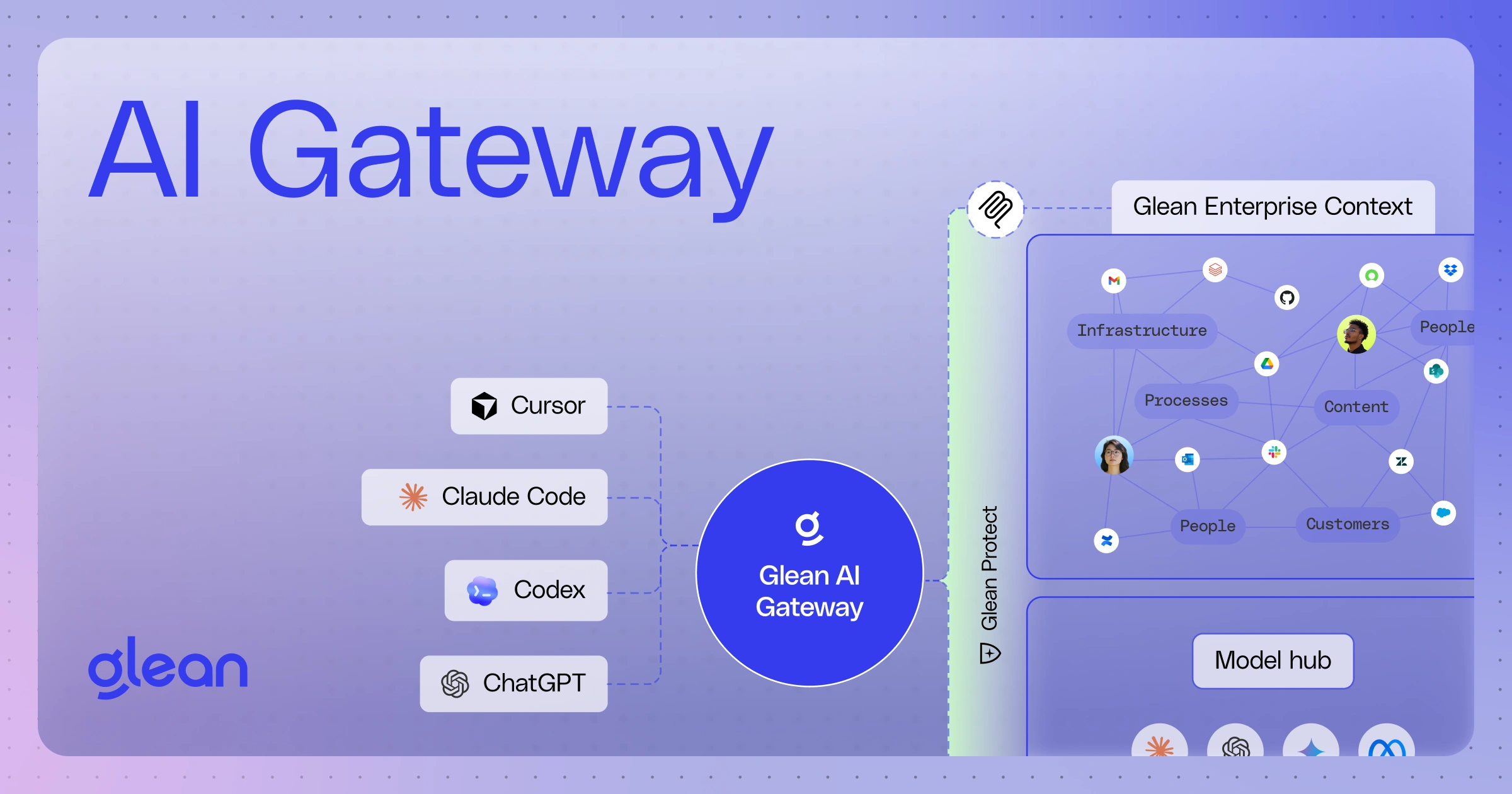
Glean AI Gateway is built to change that. It sits between your AI surfaces and the models and tools they use, giving IT and security one place to govern model and MCP access, token usage, and security regardless of which AI front door employees happen to walk through today or tomorrow.
Controlling costs across swinging AI front doors
Because frontier model costs are steep and compound quickly, the absence of shared spend controls is one of the first places the multi-front-door problem becomes painful. Without a governance layer, there's no reliable way to prevent expensive models from being used for lightweight tasks, or to stop token spend from running over budget before anyone notices.
Glean AI Gateway lets admins control spend by setting budget limits and quotas per user, per app. When someone approaches their limit, the system automatically falls back to a less expensive model so work continues without interruption. Because those controls live at the gateway rather than inside any individual front door, they apply consistently everywhere.
But the bigger lever is model choice. Glean AI Gateway is model agnostic, supporting 30+ models across open source and proprietary providers including Claude, Gemini, OpenAI, NVIDIA, and more. That means organizations are not locked into a single provider's pricing or roadmap. The right model can be matched to the right task, whether that's a frontier model for complex reasoning or a lighter open source model for high-volume, lower-stakes work. The flexibility to mix and match is itself a cost strategy, and having all of that available through one governed layer means the savings compound across every front door rather than accruing only where individual teams happen to make good choices.
Knowing where tokens and MCP tools actually go
Even with spend controls in place, most organizations are still in the dark when it comes to understanding which tasks are being tackled with AI. Knowing where tokens and MCP tools are actually going is what makes cost attribution, adoption tracking, performance monitoring, and threat detection possible.
Token spend broken down by model and app catches costs before they get out of hand. MCP tool usage shows which capabilities are getting real traction and which use cases are ready to be scaled. Model latency and error rates in the same operational view as the rest of the AI stack enables performance issues to be caught proactively. Visibility into MCP tool invocations and access patterns gives security the signal it needs to spot anomalies before they become incidents.
Without an observability layer that spans every surface, spend goes unattributed, adoption stays opaque, model degradation goes unnoticed, and security is left without the detection needed to act.
Applying governance that doesn't reset with every new front door
Visibility and cost controls matter, but they don't address the deeper question: whether AI is actually behaving consistently and safely across every front door. That requires governance that travels with the request rather than governance that has to be rebuilt every time a new front door appears.
Glean AI Gateway enforces existing data permissions so that models only ever operate on what a user is already allowed to see. On top of that, granular access controls let organizations go further, specifying exactly which users can access which models and MCP tools. AI security models also run uniformly across both MCP tools and model providers. This is especially important because neither MCP nor open source models come with security guarantees built in. The protocol does not enforce it, and open source providers leave it to the enterprise to figure out. Glean AI Gateway closes that gap, so prompt injection detection and content filtering apply consistently regardless of which front door a request comes from or which model handles it.
The result is that no matter which models and MCP tools are in use, they are governed the same way across every AI front door. Instead of security being retrofitted after adoption, it is built in from the start, letting the organization move faster with confidence.
Enterprise context that’s built in
Most gateways sit between AI front doors and models and stop there. Glean AI Gateway does something different: it connects that layer to Glean's enterprise graph, which indexes your organization's data and maps the relationships across your apps, people, and workflows. That means every front door is working from the same shared, accurate picture of your enterprise rather than a fragmented or incomplete one.
The difference in output quality is measurable. In benchmarking against off-the-shelf MCP tools, Glean's context was preferred 2.5x as often, and off-the-shelf MCP tools used 30% more tokens than Glean to arrive at a satisfactory answer. Better context doesn't just produce better answers. It produces them more efficiently, compounding the cost benefits of model choice and spend controls already built into the gateway.
The foundation AI front doors are built on
The AI front doors your employees use will keep changing. What should not change is the quality, security, and governance of what they run on. Glean AI Gateway gives enterprises a layer that controls costs through model choice and spend limits, surfaces where tokens and MCP tools are actually going, enforces consistent governance across every front door, and ensures every model works from the same shared, high-quality enterprise context rather than a fragmented view.
The organizations that move fastest with AI won't be the ones that adopt the most front doors. They'll be the ones that built the right foundation underneath them.
Availability: Glean AI Gateway is entering private beta. LLM support is available initially for Claude Code and Codex, with MCP supported across a broad set of AI front doors including Claude, ChatGPT, and more. If your organization is navigating a growing and shifting set of AI front doors, request a demo.
