





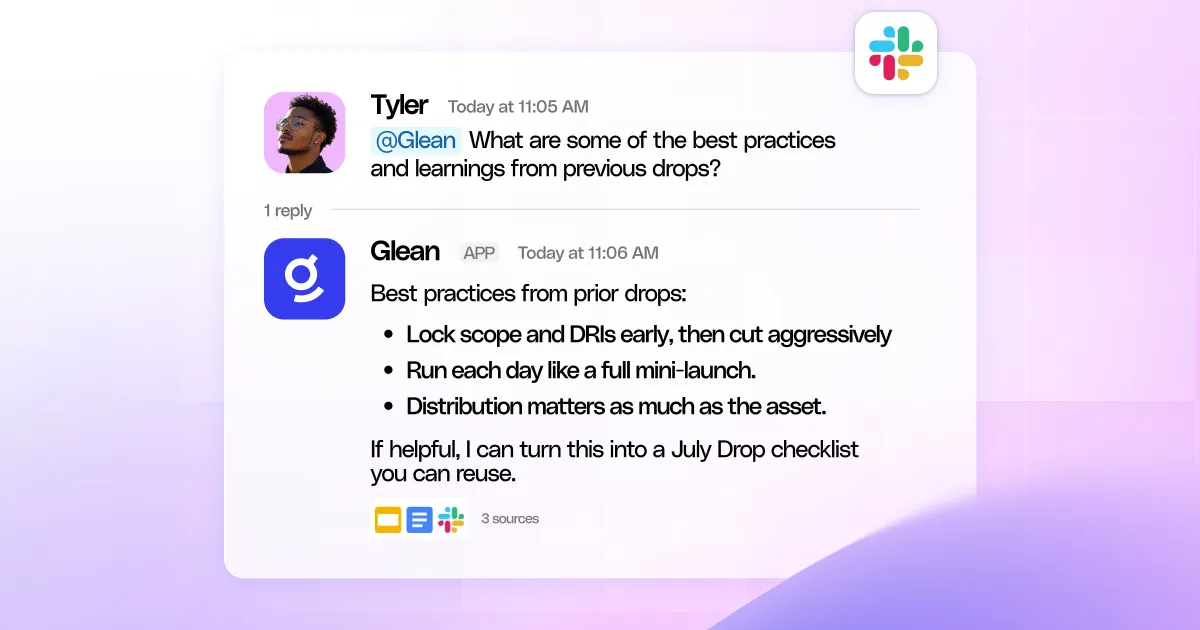
Embedding apps into the flow of work has long been a cornerstone of enterprise software. It helps employees stay productive by reducing context switching and automating tasks without forcing them to jump between tools. Consumer AI products have lagged here because they were originally built for personal use, with far less attention to how work actually gets done.
Glean released Glean in Slack in 2020, on a simple conviction: context should be available where you work, not stranded in a separate app you have to go find. As Glean evolved from enterprise search to your AI enterprise coworker, we have continuously brought context to support how your entire organization operates. Glean is a proactive, personalized, and collaborative coworker that can execute work on your behalf.
Andrej Karpathy called this the third redesign of how we work with language models. First, the model was a website you visited, then an app you installed, and now "a self-contained, persistent, asynchronous entity with org-wide tools and context, working alongside teams of humans." He also named the catch: it only works once you've done "all the under-the-hood engineering work to make this 'just work' — across tools, integrations, compute environments, memory, security." That clause is the actual job. Almost none of it is the model.
That’s why the more useful question is: what infrastructure does an AI coworker stand on? Here at Glean, we began building those foundational, complex components years ago.
What it knows, and on whose behalf
Before an AI coworker replies in a public channel, it has to answer a question a private chatbot never faces: what is it allowed to know, and who is it speaking for? A "coworker" who pastes a private comp doc into a public channel because the person who prompted it happened to have access isn't a coworker. It's a leak.
Glean prevents this entirely thanks to the years we’ve spent building a unified index of the company's knowledge that enforces the real permissions of every document at index time across more than 100 connected systems. From that index, Glean derives what any colleague could already see — the organization's shared knowledge — and grounds public answers in exactly that, and nothing else. No admin hand-assembles that scope; it follows from how the company already shares, and private content never enters the public corpus. So the answer is the same whether the question comes from you, your manager, or a hire on their first day because the coworker replies as the organization, not as whoever happened to type. That is what makes it safe to speak in front of the whole channel, and it isn't something you can add after the fact.
A coworker who already knows the company
It's tempting to think that attaching a few connectors to a channel agent makes it a capable model. It’ll survive the demo, but breaks on the first question involving a real workflow. That’s because real questions don't live in one system; they live across all of them. A true AI coworker needs context across your entire organization's knowledge in order to surface it right in Slack:
- "How's the ACME renewal tracking?" The answer spans the opportunity and stage in Salesforce, the call notes and exec sync from your meetings, the deal-room folder in Google Drive, and the open blockers filed in Jira. Glean pulls the thread together instead of pointing you at four tabs.
- "What actually changed in the auth service this sprint?" That means reading the relevant Jira tickets, the linked pull requests, and the design doc in Confluence — and summarizing what shipped, what slipped, and who owns the rest.
- "What's our updated parental-leave policy?" The current version sits in a Confluence page (and supersedes the older PDF floating around Drive). Glean answers from the source of truth, with the link, so nobody acts on a stale copy.
- "Did we ever decide on the pricing change we discussed last week?" The decision is buried in a meeting transcript and a follow-up thread. Glean recalls it, attributes it, and points to where it was made.
An agent that’s forced to rediscover all of this from scratch for every question is slow, expensive, and easy to mislead. That’s why Glean in Slack doesn't start cold. It walks into the channel already holding the organization's knowledge graph — the people, projects, documents, and how they connect — because that understanding is built into the index, not slowly accumulated from whatever it overhears. In a channel where every teammate inherits the same context, that depth is the difference between a coworker who's been here for years and one who started this morning.
It knows when to chime in and close the loop
Glean’s AI coworker doesn't wait to be asked; it knows when to chime in. It watches the channels it's in and speaks up on its own when it has something worth adding, whether that’s flagging the Jira blocker behind a stalled launch, surfacing the Confluence doc someone's reinventing, or pulling the Salesforce status into a deal thread before anyone goes looking. It’s also capable of closing the loop on its own by opening pull requests, filing and updating tickets, editing records, and running workflows. Every one of those actions runs under enforced permissions, with sensitive writes pre-checked and a full audit trail behind them, so "it did something for me" never quietly turns into "it did something I can't account for." Governance isn't a layer we added at the end; it's the same permission backbone the knowledge layer already runs on.
The category is having its moment now. But the hard part isn't the hype. The hard part is building knowledge that's safe to share from the start, permissions that hold up even when the AI acts on its own, and actions you can fully track. That's the part we've been building all along. It's why a Glean AI coworker doesn't feel like a clever bot. It feels like someone who actually works right beside you.
