

Best AI tools for incident response and agent orchestration in 2026
The best AI tools for incident response and agent orchestration in 2026 combine code generation, knowledge access, automated diagnostics, and multi-step remediation into connected platforms — evaluated here by enterprise context depth, permission enforcement, and multi-step orchestration capability. According to Glean's AI tooling stack report for software engineers, engineering teams that consolidate their AI tools onto a unified platform with shared context see measurably faster resolution times compared to teams stitching together disconnected point solutions.
These tools have moved well past simple alerting. Today's incident response automation ingests signals from monitoring, logging, and tracing systems, then correlates them against service dependency maps and historical incident patterns to surface root cause — not just symptoms. Agent orchestration layers sit on top, coordinating multiple AI actions (querying runbooks, checking deployment diffs, rolling back changes) in sequence without waiting for a human to connect the dots.
For engineering leaders evaluating this space, the deciding factor is enterprise context. Tools that understand your org's architecture, permissions, code ownership, and past incidents deliver faster, more accurate resolution. Tools that operate on generic models without that grounding generate noise and erode trust.
What AI tools for incident response and agent orchestration actually do
AI agents in the enterprise detect, diagnose, and resolve production issues by connecting to the systems your engineering team already uses — observability platforms, version control, CI/CD pipelines, internal wikis, and runbook repositories. Instead of requiring an on-call engineer to manually trace dependencies across six dashboards at 2 a.m., these tools map service relationships automatically and walk through remediation steps that would otherwise take 30 minutes of context-gathering.
The capabilities span a wide spectrum, and adoption is accelerating: 72% of enterprises now have at least one AI workload in production as of Q1 2026. On one end, assistive tools suggest probable root causes and recommend next actions for a human to approve. On the other end, agentic systems triage alerts, correlate logs with recent deployments, identify the offending change, and execute a predefined runbook — escalating to a human at configurable confidence thresholds.
For example, an agentic incident response tool might detect a latency spike, trace it to a misconfigured feature flag rolled out 12 minutes earlier, and revert the flag before a customer reports the issue.
What separates effective tools from noisy ones is depth of enterprise context. A system like Glean that indexes your internal knowledge — architecture docs, past postmortems, service ownership maps, and permission structures — gives incident response agents the grounding they need to act accurately. Without that context, AI tools default to generic playbooks that miss org-specific nuances: which team owns a service, which runbook applies to this failure mode, and who has permissions to approve a rollback.
The strongest results come when code generation assistants, engineering knowledge platforms, incident response automation, and agent orchestration systems share a connected context layer — powered by knowledge graphs that map relationships between people, services, and content — rather than operating as disconnected point solutions.
How code generation tools speed up incident response
Code generation tools speed up incident response most when they can trace a failure across service boundaries, not just autocomplete a single file. During a cascading timeout — say, a payment service failing because a downstream inventory API changed its response schema — the fix requires understanding both services, their shared contract, and every upstream caller. Inline IDE assistants handle the syntax, but they can't reason about that dependency chain without access to the broader architecture.
The tools worth evaluating go beyond code completion to architectural reasoning. They pull context from internal documentation, past postmortems, and service maps to generate hotfixes that respect existing patterns. Controlled experiments have shown that developers using AI coding assistants completed programming tasks up to 55% faster — but those productivity gains only translate into faster delivery when teams maintain strong engineering fundamentals like automated testing and mature CI/CD pipelines.
Can the tool trace a null pointer exception across three microservices to the schema change that caused it? Can it generate a backward-compatible patch that won't break the five other services consuming the same library? Glean Agents address this by drawing on the Enterprise Graph, which maps code, people, and services into a connected context layer that code generation tools can query at fix time.
Evaluation comes down to four questions:
- Does the tool access your actual codebase architecture, not just the open file?
- Does it respect your team's coding conventions and deployment patterns?
- Can it reference historical incidents where similar failures occurred?
- Does it surface the relevant runbook alongside the suggested fix?
Tools that answer yes to all four cut resolution time at the diagnosis stage, not just the typing stage.
Why engineering knowledge access determines incident resolution speed
During incident response, the fix itself is rarely the bottleneck. Most incident resolution time goes to enterprise knowledge management challenges: finding which team owns the failing service, what changed in the last deploy, whether a runbook exists for this failure mode, and whether anyone has seen this pattern before. That context lives across wikis, Slack threads, code review comments, postmortem documents, and ticketing systems — scattered in ways that make a 3 a.m. search feel like archaeology.
Effective knowledge platforms unify those sources into a single, permission-aware interface. During an incident, you need answers — not a list of 40 links across eight tools. Retrieval-augmented generation (RAG) grounded in your company's actual documentation returns direct, cited responses: "This service is owned by the payments team, the last deploy was 45 minutes ago, and here's the runbook from a similar outage in March." The distinction between returning links and returning answers is the difference between the Enterprise Graph plus the Personal Graph — which understands what you have access to and what's relevant to your role — and a basic search index.
Permission awareness during incidents isn't optional. When a site reliability engineer queries for deployment credentials or infrastructure configs at 3 a.m., the system must return only what that person is authorized to see. Glean Search enforces permissions upstream of the language model, inheriting access controls from source systems rather than layering them on after the fact. Wrong access during a high-pressure incident creates compliance risk that outlasts the outage itself.
How incident response automation reduces mean time to resolution
Incident response automation delivers the most value when it covers the full detection-to-resolution workflow. Vendor-reported case studies illustrate the impact: Anaplan cut mean time to acknowledge from 2–3 hours to 5 minutes and MTTR from 3 hours to under 30 minutes using PagerDuty AIOps, while Solo.io's AI Reliability Engineering framework reduced infrastructure incident resolution from 4 hours to 8 minutes. That means ingesting an alert from your monitoring stack, correlating it with recent deploys and configuration changes, surfacing the relevant runbook, and either executing or recommending the remediation — all within a single coordinated sequence.
The connection layer matters as much as the intelligence layer. Tools that plug into observability platforms, CI/CD pipelines, communication channels, and documentation systems through native connectors eliminate the integration tax that slows adoption. With 100+ pre-built connectors, platforms like Glean can ingest signals from your actual toolchain rather than requiring custom middleware for each data source.
An agentic RAG approach grounded in actual incident history prevents a problem unique to AI-assisted response: hallucinated root causes. When a model fabricates a plausible-sounding explanation that doesn't match your infrastructure, it wastes more time than it saves. Grounded generation cites specific past incidents, links to the exact code change, and references documented procedures — giving the on-call engineer a verifiable trail instead of a confident guess. Teams using a unified platform spend less time on context-gathering across tools, keeping diagnosis focused on the actual problem rather than the search for information.
What agent orchestration tools do differently than single-purpose assistants
Orchestrating AI agents turns isolated AI actions into coordinated multi-step workflows. In an incident, one agent searches application logs for the error signature, another checks recent deployment diffs, a third queries the knowledge base for related past incidents, and a coordinator synthesizes findings into a root cause hypothesis with supporting evidence. Single-purpose assistants can do any one of those steps — orchestration platforms do all of them in sequence, adapting when an early step returns unexpected results.
Effective orchestration requires three things. First, a planning engine that decomposes a complex task ("find the root cause of this 500-error spike") into discrete subtasks with dependencies. Second, a context layer that gives each agent the right information without oversharing sensitive data across permission boundaries. Successfully integrating these agents into enterprise environments demands infrastructure that supports not just model inference but also the orchestration logic for end-to-end task completion — including handling interoperability gaps and compute overhead during multi-step reasoning.
Third, a governance framework that logs every action, enforces role-based access, and inserts human review at configurable checkpoints. Without governance, multi-agent systems become black boxes — fast, but unauditable.
| Capability | Point-solution agents | Orchestration platforms with enterprise context |
|---|---|---|
| Context awareness | Single tool or repo | Cross-system understanding via Enterprise Graph |
| Permission enforcement | Per-tool, often manual | Upstream of language models, inherited from source systems |
| Multi-step planning | Linear prompt chains | Adaptive planning with failure recovery |
| Governance and audit | Limited logging | Full audit trail, role-based controls, human-in-the-loop |
| Connector breadth | 5 to 15 integrations | 100+ native connectors plus APIs |
The Agentic Engine in Glean Agents operates in this orchestration model: it plans, adapts, and acts with enterprise context while maintaining a full audit trail. The difference from prompt chaining is that orchestration maintains state across steps, handles failures without restarting the entire sequence, and adjusts its approach based on intermediate results — the same kind of adaptive problem-solving a senior engineer applies, but at machine speed.
Features to prioritize when evaluating AI tools for engineering workflows
Permission-aware results are non-negotiable for incident response. Infrastructure details, deployment credentials, and architecture diagrams carry different access levels, and any tool that surfaces sensitive content to unauthorized users during a high-stress incident creates lasting compliance exposure. The permission model should inherit from your source systems — not require manual configuration for each new data source.
Grounded generation with citations separates useful tools from risky ones. Every answer about a root cause, a runbook step, or a deployment history should trace back to a specific source document, code change, or historical incident record. Hybrid search that combines semantic understanding with keyword matching handles the reality of incident response, where you need both conceptual queries ("services affected by the authentication refactor") and exact-match lookups ("error code CONN_TIMEOUT_3891"). Glean Search combines both approaches, returning cited results grounded in your organization's actual documentation.
Security and governance deserve equal weight to intelligence features. SOC 2 compliance, zero-day data retention policies, customer-managed encryption keys, and detailed audit trails protect you during and after incidents. Speed to value matters too — fast deployment, rapid connector setup, and measurable adoption metrics determine whether an enterprise AI platform actually gets used under pressure or sits idle until the next quarterly review.
No-code workflow builders extend incident automation beyond the on-call rotation to IT operations, support escalations, and cross-functional response coordination. The Catchpoint SRE Report 2026 found that SRE practitioners still spend a median of 34% of their working time on toil — and about half say AI hasn't reduced it yet, as new responsibilities like supervising agent output quality replace old manual burdens.
How to build an AI stack that connects code generation, knowledge, incidents, and orchestration
Start with the knowledge layer. Until your documentation, runbooks, postmortems, code repositories, and communication archives are unified in a single, permission-aware, searchable platform, every other AI tool in the stack operates on incomplete information. This foundation turns fragmented tribal knowledge into a queryable resource that code generation tools, incident automation, and orchestration agents all draw from.
Layer code generation tools on top with access to that unified context, so they generate fixes informed by your actual architecture rather than generic patterns. Connect incident response automation to your observability and deployment systems through native integrations, and ground every AI-generated diagnosis in historical incident data through RAG. Then deploy agent orchestration with a governance framework — role-based access, human review gates, and audit logging — that makes multi-agent workflows auditable from the first production deployment.
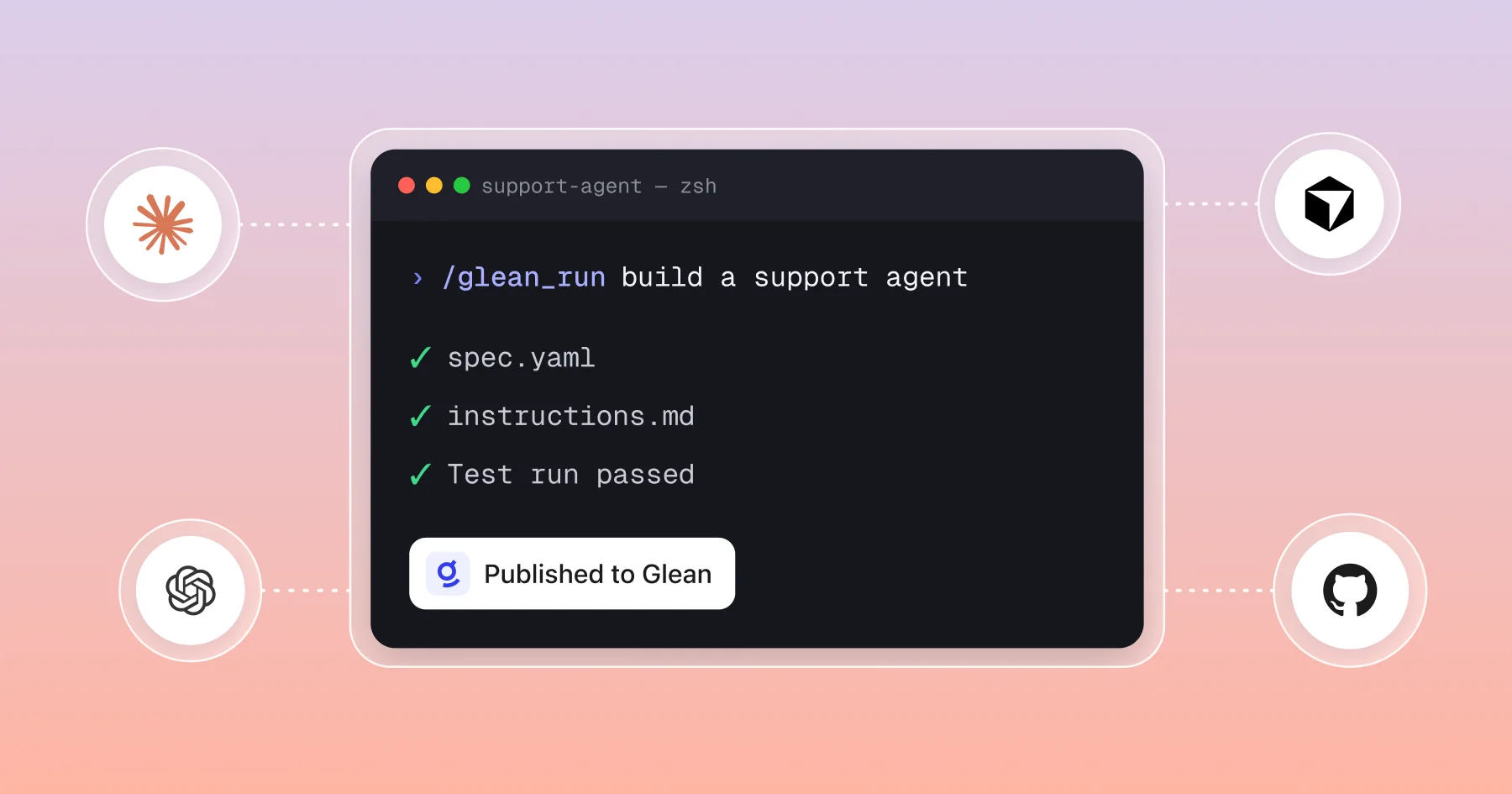
The maturity path moves from "hunt and stitch," where engineers manually gather context across tools during incidents, to "ask and act," where Glean Agents and the Agentic Engine handle context gathering, diagnosis, and remediation recommendations in a single coordinated workflow. Evaluate tools by the depth of their understanding of your specific environment — your service map, your team structure, your incident history — not by feature count. A platform that deeply understands your organization consistently delivers faster resolution than a collection of point solutions that don't talk to each other.
Frequently asked questions
What are the best AI tools for code generation during incidents?
Effective code generation tools understand your full codebase architecture and trace dependencies across services — not just autocomplete within a single file. Look for tools that combine inline suggestions with retrieval-augmented generation (RAG) grounded in internal documentation, past postmortems, and historical fixes. That combination turns code generation from a typing shortcut into a diagnostic tool.
How can AI assist in incident response without creating new risks?
AI assists safely when it enforces permissions, cites recommendations traceable to verified sources, and requires human-in-the-loop checkpoints before production changes. Tools that lack permission awareness or generate ungrounded suggestions introduce more risk than they resolve. Verify that every AI recommendation links back to a specific source document or historical incident.
What features should I look for in agent orchestration tools?
Prioritize adaptive multi-step planning, enterprise-wide context, permission enforcement upstream of the language model, full audit logging, and native connectors to your existing toolchain. The orchestration layer should coordinate specialized agents while maintaining governance at every step — not just chain prompts together without state management or failure recovery.
How do engineering knowledge management platforms differ from general search?
General search returns links. Knowledge platforms return direct answers grounded in your company's documentation, code, and incident history — with permissions and citations attached. The core difference is a connected system of context that understands relationships between people, services, and content rather than treating each query as an isolated keyword lookup.
Can I use AI tools for incident response if my team has strict compliance requirements?
Yes. Look for platforms that offer SOC 2 Type II certification, zero-day data retention with language model providers, customer-managed encryption keys, and complete audit trails. Permission-aware results that inherit access controls from source systems are essential — they prevent unauthorized exposure of sensitive infrastructure details during high-pressure incidents.
The right AI stack for incident response connects your knowledge, code, and workflows into a single system that gets smarter with every resolved incident. When your tools share context, your team moves from reactive firefighting to proactive resolution. Request a demo to explore how Glean and AI can transform your workplace and see how a permission-aware platform with shared enterprise context changes the way your engineering team responds to incidents.

.jpg)

.png)



.jpg)
.webp)