





This blog post was written with support from Glean Assistant.
How connected AI improves sales workflows
Enterprise sales teams are more AI-enabled than ever, and yet many reps still miss quota. New tools keep entering the stack. Budgets keep growing. Expectations keep rising. For many organizations, the results still feel underwhelming.
That gap is easy to explain away. It can sound like an adoption issue, a training issue, or a rep discipline issue. In many cases, it's none of those things. Sellers are already using AI. What they haven't solved is the structural problem underneath it all.
Most sales teams work across a web of disconnected systems: CRM, call recordings, email, messaging, enablement content, shared drives, BI dashboards, product updates, and customer support signals. When AI is layered onto that environment one tool at a time, it often creates more outputs without removing much friction.
That fragmentation is where the gap between AI adoption and sales performance starts to show. The real opportunity isn't adding more sales AI tools, but connecting AI to the context reps already work in so they can prepare faster, keep CRM data clean, and execute deals with less friction. Otherwise, teams risk adding more technology without improving the work that actually drives revenue.
AI in sales is not the problem. Fragmentation is.
The promise of AI for sales is real. Leaders are investing because they want more productive reps, better coaching, stronger forecasts, cleaner execution, and a clearer view of pipeline health. AI can support all of that.
But point solutions alone rarely deliver those outcomes.
The issue isn't whether AI can write an email, summarize a call, or draft meeting notes. It can. The issue is whether AI has access to the context that makes those outputs useful.
If an AI tool can't understand your CRM history, recent calls, open support issues, internal playbooks, competitive intelligence, product updates, stakeholder relationships, and account activity, it can only help in fragments.
That lack of context matters because sales isn't one task. It's a sequence of connected decisions. How a rep prepares for a meeting shapes the quality of discovery. Discovery shapes follow-up. Follow-up shapes momentum. Momentum shapes forecast confidence, deal velocity, and win rates.
If each part of that motion lives in a different tool with different context, the rep is still stuck stitching the story together manually.
Where AI creates real value in sales
The biggest opportunity in sales AI isn't doing one task slightly faster. It's reducing the drag around the work that drives revenue.
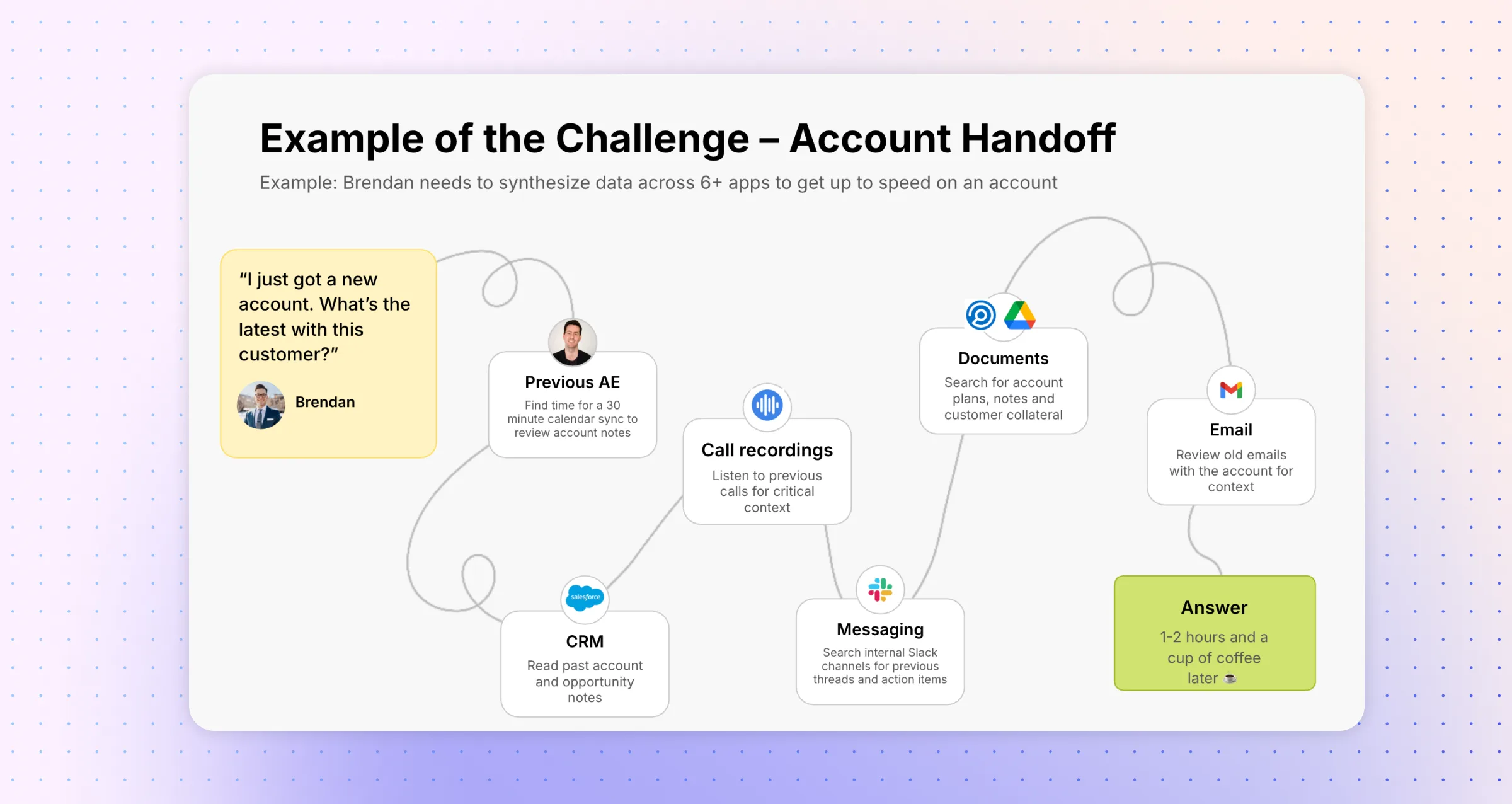
Research shows that sales reps spend 60% of their time on non-selling tasks: researching accounts, updating CRM fields, preparing follow-up, searching for content, coordinating internally, and gathering information before customer conversations. If you want to improve quota attainment, that’s the place to start.
This is where enterprise AI becomes practical. The strongest use cases are not novelty demos. They're workflow improvements that help teams move through everyday work with more speed and less friction.
Those workflow improvements include:
- Faster sales call prep with the right account context already assembled
- Better discovery follow-up informed by prior conversations and open issues
- Cleaner CRM data without relying on perfect rep habits
- Easier access to relevant decks, proof points, and internal expertise
- Stronger visibility into deal risk, momentum, and next steps
For sales leaders, that shift matters because the modern sales motion is more demanding than ever. Reps are expected to personalize outreach, manage multi-threaded buying groups, navigate procurement and security reviews, spot expansion opportunities, and maintain accurate data throughout the process. They’re often doing all of that across a stack of disconnected tools.
Why more AI tools can create more complexity
Most sales organizations didn't start from zero. They already have a CRM, a call intelligence platform, a sales engagement tool, messaging systems, file storage, dashboards, and enablement platforms. Then AI gets added on top, one purchase at a time.
That approach often makes the underlying problem worse. Sellers already use an average of eight tools to close deals. At the same time, 42% of sales reps say they feel overwhelmed by too many tools, and overwhelmed sellers are 45% less likely to attain quota.
A call summary tool may save time after meetings. An email assistant may help with first drafts. A chatbot may answer narrow questions. Each can be useful on its own. But if every tool only handles one slice of the workflow, the rep still owns the integration work:
- Comparing signals across systems
- Tracking down missing context
- Deciding what matters
- Updating records manually
- Translating insights into next steps
That manual stitching is where productivity disappears.
The same pattern shows up at the leadership level. More than half of sales leaders using AI say tech silos delay or limit AI initiatives. And 87% of data and analytics leaders believe unified data is key for meeting customer expectations.
In practice, disconnected AI often widens the gap between top performers and everyone else. Your best reps usually know the workarounds. They know where information lives, who to ask, and which signals matter most. Everyone else spends hours trying to recreate that same context from scratch. Having more tools doesn't automatically create leverage.
What separates AI-enabled teams from AI-advantaged teams
The teams seeing real value from AI are not simply using more applications. They’re building a connected operating model that brings together trusted context across the systems sellers already use. That model changes the game in three ways:
First, it reduces time to context. Reps shouldn't need to bounce between Salesforce, Gong, Slack, email, shared docs, and internal wikis to understand what's happening in an account. The faster they can get a complete picture, the faster they can act.
Second, it improves consistency. Teams perform better when methodology, coaching, and customer context don’t depend on tribal knowledge. Connected AI helps make strong selling habits easier to repeat.
Third, it makes AI useful inside real workflows. Instead of waiting for a rep to prompt a point solution, AI can respond to meaningful moments: a new meeting booked, a call completed, an opportunity changing stage, a renewal at risk, or a customer issue that couldn't stall a deal.
That’s the difference between being AI-enabled and being AI-advantaged. One means the team has tools. The other means the team has an operating model.
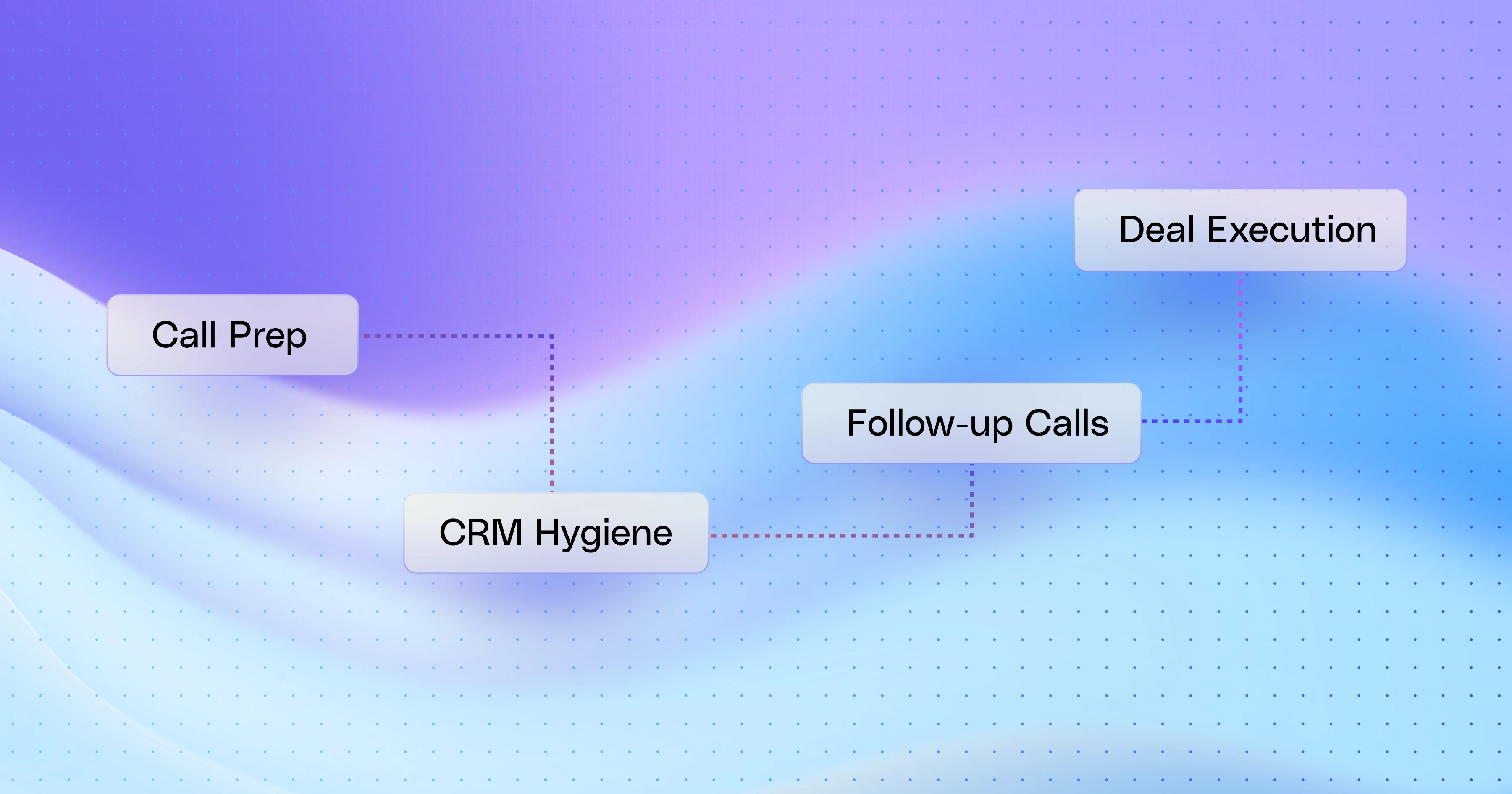
Three sales workflows where AI can reduce friction fast
If you want to see where sales AI creates value first, start with workflows that are both high frequency and high friction.
1. Sales call prep and account research
Call prep remains one of the clearest examples of how fragmented context creates friction in sales workflows. Many reps still spend valuable time gathering context from CRM notes, past calls, Slack threads, support tickets, stakeholder history, and recent company news before they can focus on the conversation itself.
Glean’s account snapshot agent is designed to bring together account and opportunity details, recent interactions, risks, open issues, and relevant supporting materials in one place.
.webp)
This agent helps reps spend less time searching and more time preparing to sell.
2. CRM hygiene and post-call follow-up
CRM accuracy has long depended on rep discipline at the exact moment they're busiest. That's often a system design problem more than a motivation problem.
Glean can use call transcripts, messaging context, and CRM data to suggest updates, generate summaries, and draft follow-up communication. Glean Agents can identify deal signals, surface next steps, and help prepare customer-ready follow-up faster.
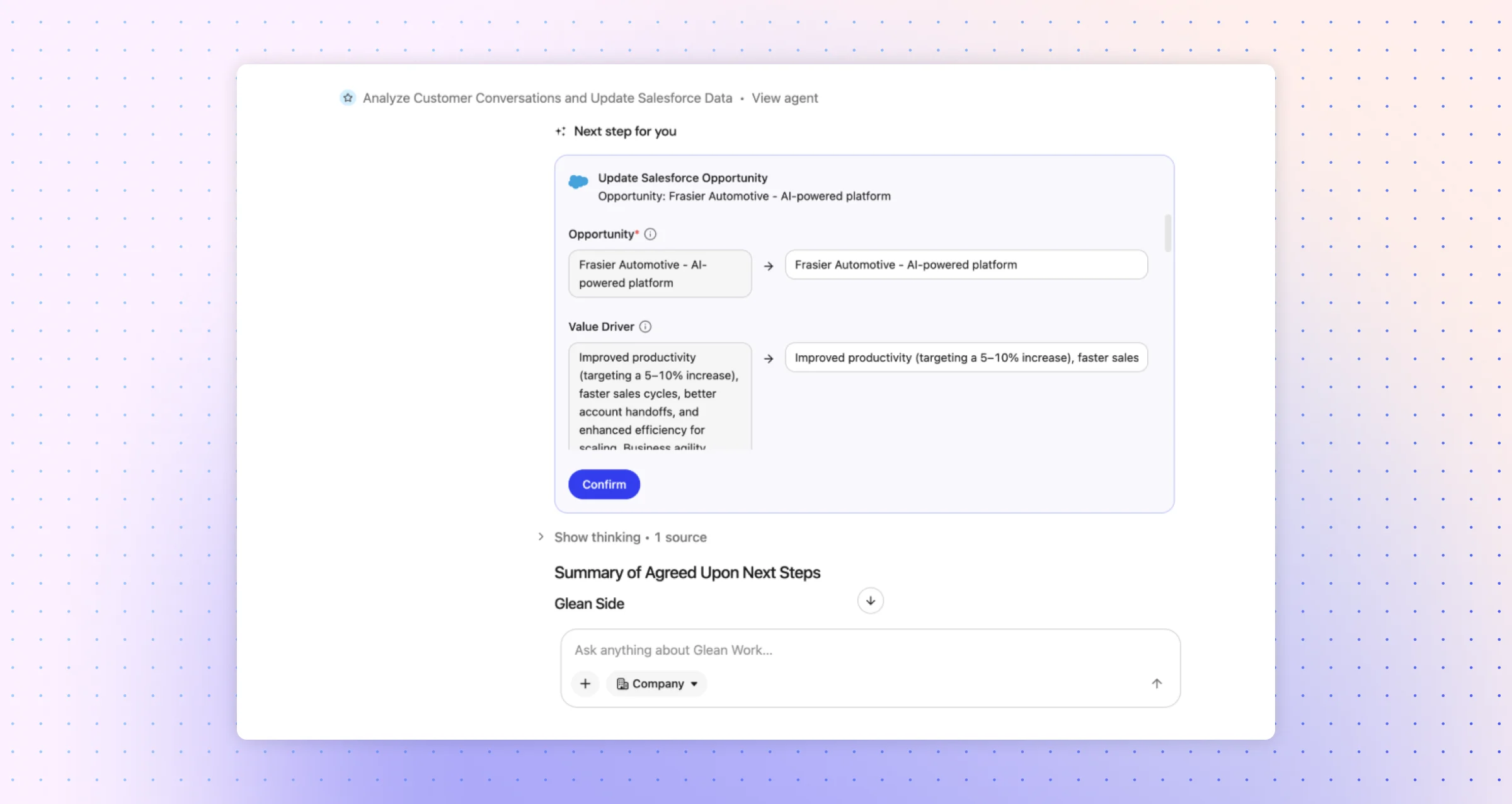
This process matters because cleaner data supports better forecasting, and timely follow-up helps preserve momentum.
3. Deal execution and expansion planning
Once an opportunity is active, sellers need a clear view of stakeholders, risks, business value, competitive pressure, product fit, and account health. Compiling that information often requires input from multiple systems and multiple teams.
Connected AI can help sellers move faster with the right context, whether they’re preparing a deal strategy, pulling together competitive briefs, or coordinating an account handoff.
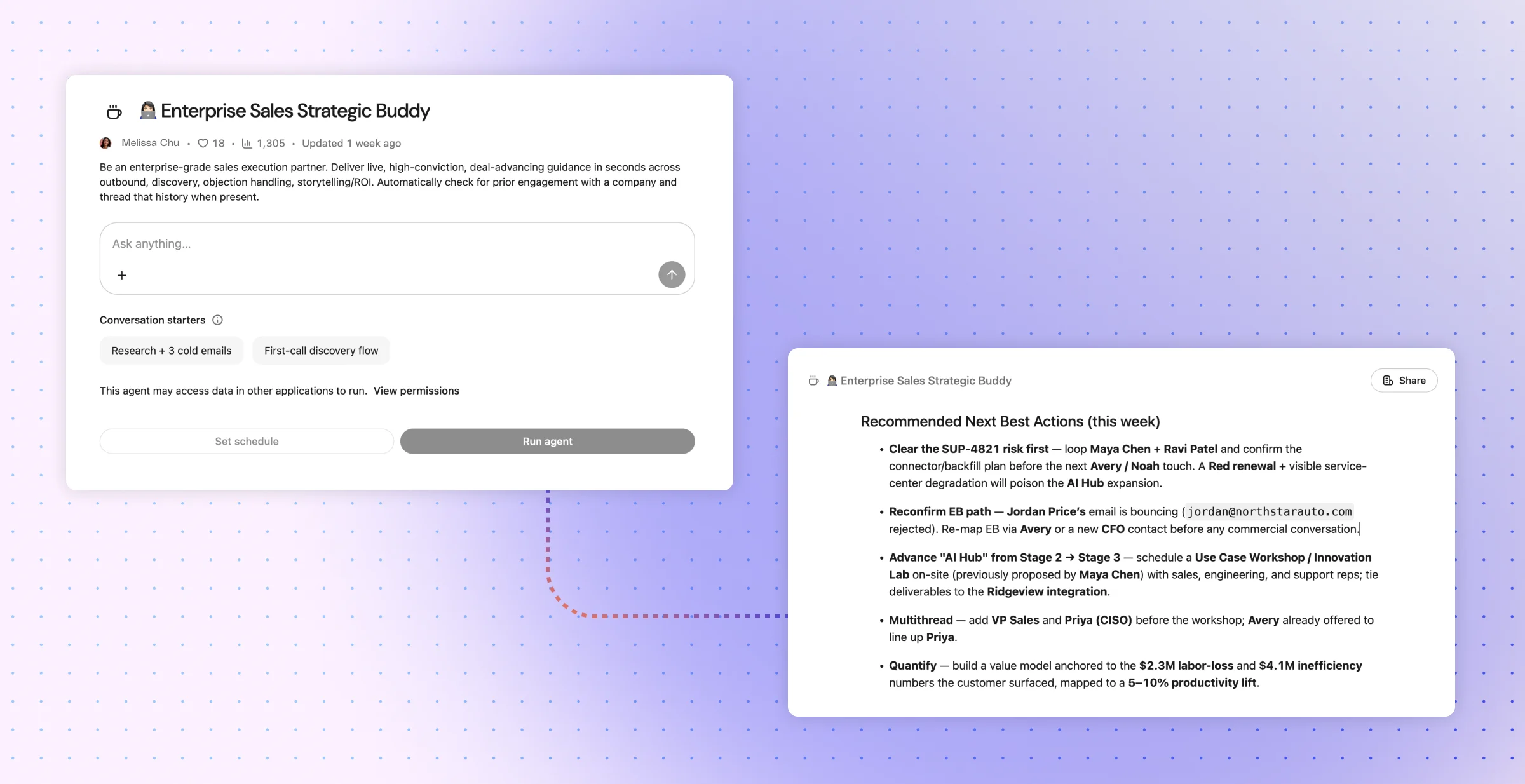
These are the workflows where AI begins to influence cycle time, win rates, and growth potential, not only rep convenience.
How Glean supports connected sales workflows
Glean's role isn't to add another disconnected tool to the stack. It's to connect company context across the systems sales teams already use, then make that context useful in the flow of work.
That approach aligns with what many leaders are asking for today: a way to unify account activity, calls, emails, content, internal knowledge, and customer signals with permission-aware access. The result is more practical AI for workflows like meeting prep, account research, CRM hygiene, follow-up, forecasting support, and deal execution.
Recently, our customer Motive reduced account plan creation time by 75%, from three days to two hours, using agents that synthesize CRM data, Gong history, and unstructured signals. That kind of value doesn't come from isolated outputs. It comes from reducing the distance between signal and action.
The next move for sales leaders
The next divide in sales orgs won't be between teams that use AI and teams that don't. It'll be between teams that have connected it to real selling work and teams that haven't.
The teams that pull ahead will be the ones that make it easier for reps to prepare, follow up, update systems, and move deals forward with the right context at every step. That's where AI starts to influence execution in a meaningful way.
If you want to see what a connected AI stack looks like in practice, get a demo today.
