





.png)
.jpg)
Skills package reusable capabilities that AI can discover and load on demand. These sets of capabilities then teach AI how to do a specific task, such as triaging a support ticket, drafting a customer escalation, reviewing a contract against a playbook, or generating a knowledge base article from a resolved case. Packaging capabilities as a skill enable AI to consistently repeat tasks instead of a user having to re-explain the steps and context every prompt.
The challenge with skills is that they're a frozen snapshot of how to perform a task. A skill can become out of date as expertise evolves, processes change, and underlying data shifts, much like static documentation goes stale within an organization unless someone is proactively managing it. However, that capability doesn't solve the problem of making sure you remember to update the skill in the first place.
That's why Glean built skill reflection, the ability for skills to learn and improve over time from AI interactions in a governed way.
Skill reflection in practice
Skill reflection identifies repeatable, skill-specific improvements based on how it’s being used. For example, a skill that writes product decision documents encodes a team's structure, style, and best practices in one place. In practice, though, document conventions evolve over time, and a user may want a different flow or new sections added. Skill reflection addresses this by analyzing how a skill is used across chat sessions, aggregating feedback, and surfacing suggested changes.
How skill reflection works
Skill reflection separates two operations:
- Learning: Collect possible improvements from the skill’s use
- Reflection: Update the skill with the suggested improvements to the skill after an explicit user confirmation
Skill learning
When a skill is invoked, skill learning watches for reusable, skill-specific signals: a repeated missing step, a correction that maps cleanly to an instruction, or a pattern in how users steer the work. Throughout a conversation, eligible events accumulate along with the surrounding conversation history. At the end of the chat session, skill learning evaluates that evidence for self-improvement. A skill can sometimes run constantly without any learnings emerging, while a few high-signal learnings can materially improve it.
When multiple signals emerge from an individual user session, they’re stored with the skill record along with metadata. As skill learnings accumulate over time, they can cue the Assistant to suggest skill reflection.
Skill reflection
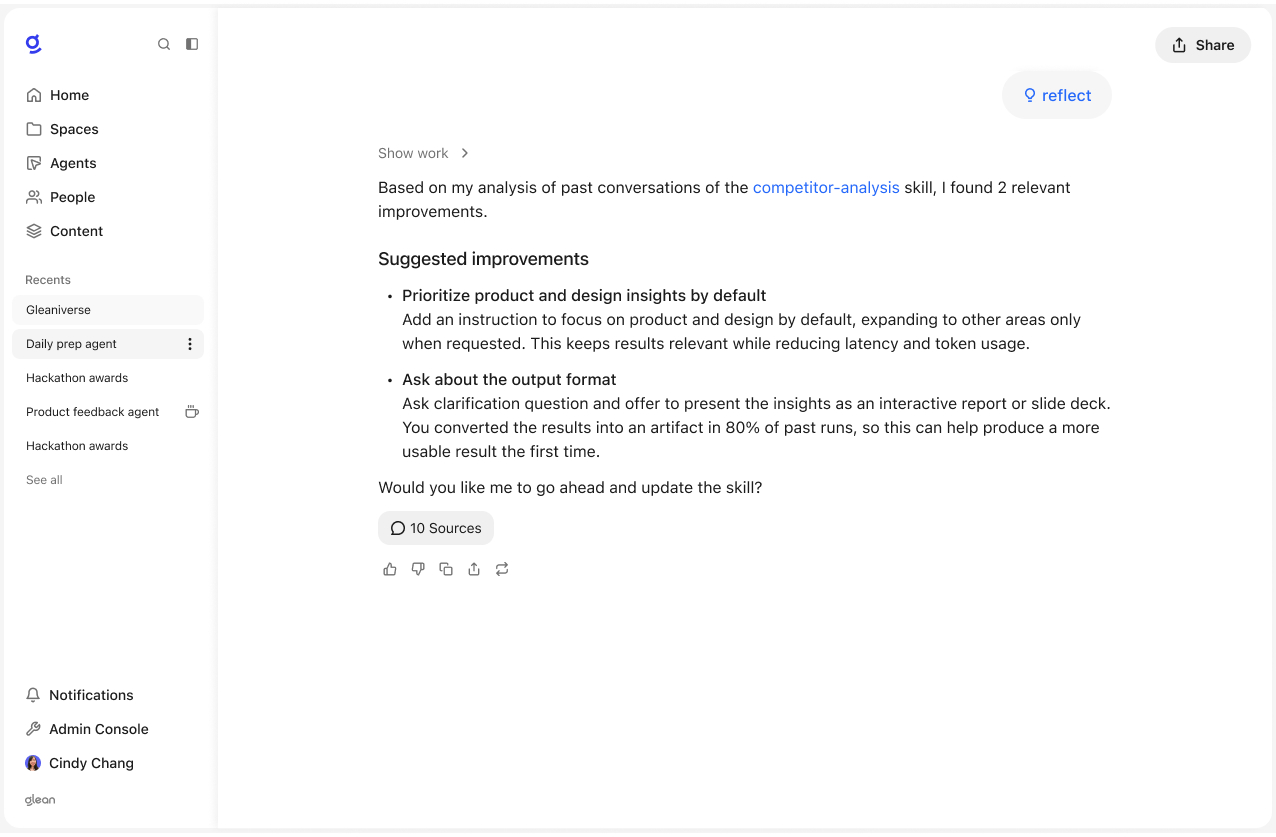
Skill reflection can be proactively cued by the Assistant or invoked directly by the user, with learnings previewed before being applied.
This creates a clear boundary: Glean can learn as work happens, but the user decides when that learning should change the skill. For example, there may be cases where the user is adapting a skill for one specific project, or experimenting with a different format, without wanting those one-off iterations folded permanently into the skill's instructions. A skill change only takes effect once the user explicitly approves it, allowing for reflection to be fully governed by the user.
Memory and skill reflection
The value of skill reflection is that skills can stay aligned to how work gets done in an organization, while remaining explicitly governed by the user. Its learnings draw on preferences surfaced in Assistant interactions, keeping skills relevant while being grounded in how work gets done.
At Glean, we see skills as the future of AI documentation in the enterprise, but that only holds if skills are a living representation of work rather than a static one. Give skill reflection a try in Glean Assistant today, or sign up for a demo to get started with Glean.
