





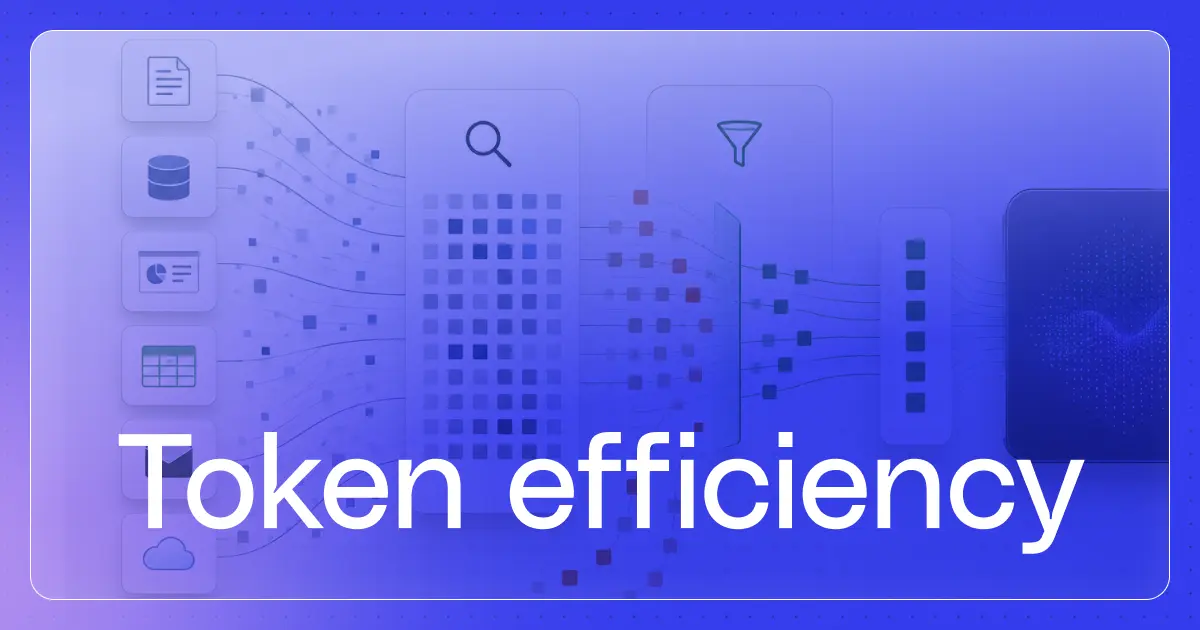
Most enterprise AI teams optimize for the wrong thing. They’re focused on prompt hygiene — shorter instructions, less filler, compressed wording — when the real gains in token efficiency come from what happens before the model ever sees a prompt: retrieval quality, context selection, and orchestration design.
Token efficiency in enterprise AI is the ability to get high-quality answers using the minimum necessary context and compute. In production systems, that means the biggest opportunities are usually not in the prompt itself, but in what gets retrieved, selected, and passed to the model in advance of generation.
For enterprise teams, token efficiency goes beyond budget impact. It affects latency, answer quality, trust, and how well an AI system holds up as it scales across users and workflows. A system that sends less noise to the model tends to be at once cheaper, faster, more grounded, and easier to trust. A smart token strategy focuses more on getting the best outcome per token than squeezing token counts down at any cost.
What token efficiency actually means for enterprise AI
Defining token efficiency as “using fewer tokens” misses the point. Here’s a more useful definition: token efficiency is the ability to complete a task with the least amount of context and compute required while still producing a strong result. That makes it a business metric as much as a model metric.
In enterprise environments, better token efficiency typically means:
- Lower inference cost
- Faster responses for users
- More reliable, grounded answers
- Better scaling across teams, workflows, and use cases
- Less noise for the model to reason through
More context is not automatically better context. A large context window can mask weak system design for a while, but it doesn’t fix underlying problems. If the system keeps passing irrelevant information, the model still has to process noise before it can find signal. That’s why token efficiency in enterprise AI is ultimately a quality, latency, and cost problem all rolled into one.
Where token waste really comes from
Prompts do waste tokens. But in enterprise systems, prompt length is often a smaller factor than it appears. The larger sources of waste include:
- Retrieving too many documents
- Sending long chunks when only a short passage matters
- Duplicating the same information across tools, turns, or workflow steps
- Passing full documents when only a few lines are relevant
- Asking the model to reason over noisy or weakly ranked evidence
- Repeating context across multi-step workflows instead of summarizing intermediate states
Consider this common scenario: An AI assistant needs to answer an HR policy question, explain a finance rule, or summarize an internal support issue. The system retrieves eight long documents, of which only two short passages are truly relevant. Whether efficiently worded or not, the problem is not the prompt. Token waste started upstream, when the system delivered too much evidence with too little selectivity.
Why retrieval matters more than prompt length
While a cleaner prompt can save some tokens, better retrieval can entirely change the economics and quality profile of an AI system. Imagine two adjustments to the same workflow: shortening a prompt by 15 percent, and reducing irrelevant retrieved context by 60 percent.
The first helps a little. The second typically improves cost, latency, and answer quality simultaneously — because retrieval determines what the model has to read before it can think. Wrong documents, poorly scoped chunks, or weak ranking mean the model spends tokens processing context that contributes nothing to the answer. In some cases, that extra context makes the answer worse, pulling the model toward tangents, outdated material, or conflicting evidence.
For retrieval-augmented generation and agentic systems, the stakes are higher. Token waste compounds across steps. A bloated first retrieval step carries its costs into the next step, and the next. By the time the workflow completes, the system has paid for bad context many times over.
Enterprise teams should treat token optimization as a retrieval problem first, and a prompting problem second.
What a well-designed enterprise AI system looks like
Solving for token efficiency at scale requires a context layer that knows what your company knows — one that retrieves from live knowledge across tools, respects permissions accurately, and surfaces specific passages rather than whole documents.
Glean’s Work AI platform is built around Enterprise Context — a shared system of context that helps AI retrieve better evidence, respect permissions, and act on current company knowledge. Rather than treating every document as an isolated text blob, Glean connects retrieval to the relationships, permissions, and knowledge structures that already exist across an organization’s systems. The result is a foundation where retrieval quality improves first, and chunking, prompting, and orchestration decisions all start from better evidence.
The enterprise framework for token efficiency
The strongest enterprise AI teams optimize across the full stack. We can think about that optimization as comprising four layers:
Layer 1: Retrieve less, but retrieve better
Start with retrieval quality. The system should find the smallest set of evidence that can still support a strong answer — which means improving precision, not just recall. Better ranking and reranking are crucial here, as is narrowing the search space with metadata, permissions, ownership, recency, and task context.
Getting retrieval right requires a strong context layer. Systems need to know which content is relevant to the user, which version is current, which artifacts are connected, and which information the user is actually authorized to see. Glean grounds retrieval in live company knowledge, permissions, and cross-system relationships — so fewer irrelevant tokens ever reach the prompt.
Layer 2: Pass only the evidence that matters
Once the right sources are retrieved, the next job is avoiding the temptation to pass everything. Enterprise systems should use chunking and passage selection capabilities to avoid sending full documents when a few passages are sufficient. The target is semantically meaningful chunks, passage-level selection, deduplication, and selective compression. An assistant answering a policy question or addressing a support case does not need the entire wiki page, the full Slack thread, and the whole CRM record. It needs the specific passages that support the answer.
This is one of the clearest differences between a prototype and a production system. Prototypes stuff context in just to be safe. Production systems learn to be selective.
Layer 3: Structure prompts for control, not compression
Prompt design remains important, but it’s not your primary lever. A good enterprise prompt gives the model a clear task, a clear output shape, and the minimum necessary background. It avoids repeated instructions, duplicated policy text, and broad context that belongs elsewhere in the system. The most durable prompt engineering is about control, not compression:
- State the task clearly.
- Specify the output format.
- Constrain the answer where needed.
- Avoid repeating instructions the system already knows.
- Keep the model focused on the retrieved evidence.
If the surrounding system is noisy, a perfectly concise prompt will not save it.
Layer 4: Orchestrate intelligently across steps
Token efficiency also depends on workflow design. In agentic or multi-step systems, a common source of waste is sending the same raw context repeatedly at each step. A better approach is to break work into stages, summarize intermediate outputs, route tasks to the right tools, and avoid reloading identical information unless it is genuinely needed again.
Orchestration, handled well, becomes a practical performance enhancer. A system that decides what to retrieve, what to summarize, what to cache, and what not to repeat will frequently outperform one with a larger context window but weaker coordination. More than model access, enterprise agents need trusted retrieval, permission-aware context, and workflow logic that prevents irrelevant context from reaching the model.
How to measure token efficiency without sacrificing answer quality
The wrong way to measure token efficiency is to optimize for minimum tokens alone. Cutting too aggressively — removing needed evidence, collapsing important context — produces answers that are cheaper and weaker at the same time. The better question is: what outcome are you getting per token?
A practical set of evaluation metrics includes:
- Tokens per successful task
- Latency per task
- Cost per task
- Retrieval precision
- Answer quality or groundedness
- Context utilization rate
Context utilization rate is particularly useful. If the system routinely passes large amounts of context that never influences the final answer, the system is paying for noise. Teams need to know not just how many tokens they used, but whether those tokens improved the result. Systems that surface citations, source links, and clear evidence chains make that easier to inspect and improve over time.
Common mistakes enterprise teams make
A few patterns show up repeatedly.
Treating shorter prompts as the primary lever. This leads teams to over-focus on word trimming while ignoring larger problems: bad retrieval, oversized chunks, and redundant context.
Assuming large context windows solve the problem. Bigger windows can delay hard design choices, but they don’t remove the cost, latency, or quality impact of irrelevant context. They just make the cost less visible.
Optimizing for cost alone. A less expensive answer is not better if it is harder to validate, less grounded, or less useful to the person asking.
Measuring token counts without measuring retrieval quality. Token numbers alone will not explain why answers are expensive or inconsistent if the retrieval layer is the actual source of the problem.
Compressing context too aggressively. Context compression helps only if the important detail survives. Strip away the exact evidence an answer depends on, and the system costs less but offers weaker responses.
All of these mistakes reflect the same error: treating token efficiency as a prompt-editing exercise rather than a systems design discipline.
Build for better outcomes per token
Token efficiency in enterprise AI is an architecture problem disguised as a prompting problem. Teams that focus on shortening prompts may recover some tokens at the edges. Teams that improve retrieval, context selection, and orchestration can improve cost, speed, and answer quality together. But that requires designing AI systems that send only the right context at the right time.
For a closer look at how enterprise AI teams improve answer quality and efficiency with better retrieval and grounding, explore the Glean Platform.
Frequently asked questions
What is the difference between token efficiency and context window size?
Context window size is a model capability — how much text a model can technically receive and process. Token efficiency is a system design discipline — how much of that capacity you actually need to use to get a strong answer. A larger context window gives a system more room to work with, but it does not make the system more efficient. Teams that rely on large windows to absorb bad retrieval or redundant context are paying for space they should not need. The goal is to use the smallest window necessary to produce the right answer, not to fill the largest window available.
What are the limitations of token optimization in enterprise AI?
Token optimization has a floor. Below a certain threshold, removing context starts to remove the evidence the model needs to produce accurate, grounded answers, and the system becomes at once less expensive and less reliable. Optimization also cannot compensate for a fundamentally weak retrieval layer or poorly designed orchestration. Teams that focus narrowly on token counts without measuring answer quality, retrieval precision, and context utilization often end up with systems that are leaner but worse.
Why does retrieval quality affect token cost so much?
Retrieval quality directly controls how much context reaches the model — which makes it one of the highest-leverage variables in any enterprise AI system. When retrieval is imprecise, the model receives more tokens than it needs: too many documents, poorly scoped chunks, or weakly ranked evidence that contributes nothing to the answer. In retrieval-augmented generation systems specifically, the problem compounds. A RAG pipeline that returns broad similarity matches rather than specific, permission-aware passages forces the model to process noise at every step. Treat retrieval precision as a first-order design constraint, not an afterthought, and token efficiency tends to follow.
How does enterprise search differ from standard RAG when it comes to token efficiency?
Many basic RAG implementations rely heavily on similarity-based retrieval, while enterprise search layers in additional signals like permissions, recency, ownership, and cross-system relationships. Those additional signals allow enterprise search to narrow retrieval more precisely — returning fewer, more relevant passages rather than a broad similarity match. For token efficiency, that distinction matters significantly. Glean’s enterprise search is built around those layers, which is why it tends to reduce token waste at the retrieval stage rather than compensating for it downstream with larger prompts or wider context windows.
How does Glean help reduce token waste in enterprise AI systems?
Glean reduces token waste by grounding retrieval in live company knowledge, cross-system access controls, and content relationships, so AI systems retrieve a smaller, more relevant set of evidence rather than broad document dumps. Because Glean understands who is asking, what they are authorized to see, and how content across tools relates to the query, it can return specific passages instead of full documents. That reduces the noise reaching the model, which typically improves cost, latency, and answer quality simultaneously.
