




.webp)
Most organizations still treat AI performance as an adoption problem.
When results fall short, they add more tools, licenses, agents, mandates, and dashboards. But access was never enough. The real question was whether AI could work within the workflows, company context, and operating practices that determine how work gets done. Adoption is no longer the main constraint.
The Work AI Index 2026, from Glean’s Work AI Institute, found that 87% of digital workers use AI at work, 75% say it makes them more productive, and workers report saving roughly 11 hours a week through AI automation.
Yet only 13% say their organization is performing significantly better because of it.
We call these transformative organizations: companies whose employees say AI has significantly improved organizational performance and outcomes.
We surveyed 6,000 full-time digital workers across the United States, the United Kingdom, and Australia, spoke with dozens of AI leaders, and analyzed anonymized, aggregated workplace AI interactions from Glean’s enterprise AI platform to understand what separates them.
The most surprising difference is how their employees spend their time.
Workers at organizations reporting no impact, negative impact, or uncertainty spend 49% of their AI-related time directly using AI tools. At transformative organizations, that falls to 27%.
They aren’t avoiding AI. They’re spending more of their AI-related time on the work around it by providing context, checking outputs, integrating results into real workflows, and deciding when AI shouldn’t be used.
That’s the difference between AI activity and AI impact.
They measure outcomes, not just activity
Many organizations track AI through what’s easiest to count:
- Tokens consumed
- Prompts submitted
- Tools activated
- Agents built
- Lines of code generated
- Login and adoption rates
These metrics can show whether employees are using AI. They can’t show whether the work is accurate, useful, or ready to move forward.
Transformative organizations measure AI across an average of 5 dimensions, compared with 3 at other organizations. They’re more likely to track quality, productivity, time saved, AI skills, employee engagement, and revenue growth.
That broader view matters because each metric tells employees what the organization values. They shape how employees define success and where they choose to invest their attention.
At organizations that measure productivity alone, 74% of workers report botshitting. That means shipping AI-generated work they haven’t adequately reviewed, don’t fully understand, or couldn’t confidently defend. At organizations that measure both productivity and quality, 64% do.
The same pattern appears in how workers judge the result. Where organizations measure quality alongside productivity, 83% of workers say AI has improved the quality of their work. In productivity-only environments, 68% say the same.
Activity metrics still have value. They can show which tools are being used, where adoption is growing, and which workflows may need support. But they need to sit alongside measures that answer a more important question: Is the work getting better?
They turn usage data into feedback
Who gets to see AI usage data matters almost as much as what the organization tracks.
Transformative organizations are more likely to monitor AI usage:
- 73% track it, compared with 44% of other organizations.
- 71% let employees see their own usage data, compared with 40%.

When AI data only flows upward, employees may experience it as surveillance or as a performance score. They manage the metric, hide where the tools are creating problems, and perform whichever version of adoption leadership appears to reward.
When employees can see the data themselves, it can support better questions:
- Where is AI saving time?
- Which tasks create more review than value?
- Where are people repeatedly leaving approved systems?
- Which workflows are producing stronger outcomes?
- Are quality and employee experience improving alongside adoption?
The goal isn’t to rank employees by how much AI they use. It’s to give teams a clearer view of where AI is improving the work and where it needs to change.
They make governance usable
Most organizations have an AI policy. That doesn’t mean employees know what to do when the decision gets difficult.
Governance matters when a deadline is close, the approved tool is producing a weak answer, and an unapproved system appears to work better. It matters when someone is deciding whether an agent can act, which information it can access, and how closely its work needs to be reviewed.
Transformative organizations make those decisions clearer. Compared with other organizations, they’re more likely to:
- Review their AI policy regularly: 93% versus 55%
- Explain why the policy exists: 91% versus 57%
- Make the consequences of violations clear: 85% versus 56%
- Define who can build or deploy AI agents: 89% versus 61%

Governance works when employees have clear guidance they can realistically apply to the decisions they face in daily work.
If employees don’t understand the reason behind a rule, they’re more likely to treat it as friction. If the approved system can’t complete the task, they’ll look for another option. If ownership for deploying agents is unclear, teams can end up with duplicated workflows, inconsistent controls, and no clear person responsible when something goes wrong.
The result of better governance is confidence. 93% of workers at transformative organizations say they trust their company’s AI strategy, compared with 57% elsewhere.
Workers who are confident in their organization’s strategy are also 28% less likely to be actively looking for another job.
Employees need more than a list of rules. They need to understand what the organization is trying to accomplish, where the boundaries are, and who remains accountable for what AI produces.
They start with the work
For many organizations, AI strategy begins with the technology they already own.
A vendor adds AI to an existing product. A contract expands. A new tool becomes available. Teams are then asked to find places to use it.
That sequence makes adoption easier to measure, but it doesn’t guarantee the technology addresses the organization’s most important problems or fits the work.
Organizations closing the gap start by identifying where work is stuck:
- Which handoffs slow teams down?
- Where do employees repeatedly reconstruct context?
- What work needs to be redone downstream?
- Which decisions stall because the right information arrives too late?
- Where are customers or employees repeatedly frustrated?
- Which tasks should be automated?
- Which parts still need human judgment?
Then they choose the technology that fits those problems.
Workers at transformative organizations are less likely to say existing vendors constrain their AI strategy, 33% compared with 49% elsewhere. They’re also more likely to describe AI rollouts as collaborative with vendors, 78% compared with 44%.
Starting with the work changes the definition of success. Activating the tool isn’t enough. The real measure is whether the workflow improves.
That improvement may come from removing a slow handoff, reducing repeated work, helping someone make a stronger decision, or creating capacity that the team can use elsewhere.
They give AI full context, not just access
Choosing the right workflow is only the first step. Organizations also need to ensure AI has the context required to execute that work effectively.
Giving an AI system access to company data isn’t the same as giving it the context required to use that data correctly.
Access allows AI to retrieve a document or record. Context helps it understand:
- Whether the information is current
- Which source is authoritative
- How the information relates to the task
- Which internal definitions apply
- What the employee is permitted to see or do
- What needs to happen next
That context often lives across several systems or in the experience of the employee doing the work.
An AI tool might be able to retrieve every forecast without knowing which one is final. It may find the official process without understanding the workaround the team uses in practice. It may surface the correct customer record without knowing which part of that history matters for the decision.
53% of workers say critical information they need isn’t accessible through their AI systems.
When that context is missing, employees fill the gaps themselves. They copy information into prompts, explain the task repeatedly, compare conflicting answers, and move work into unapproved tools when approved systems can’t help.
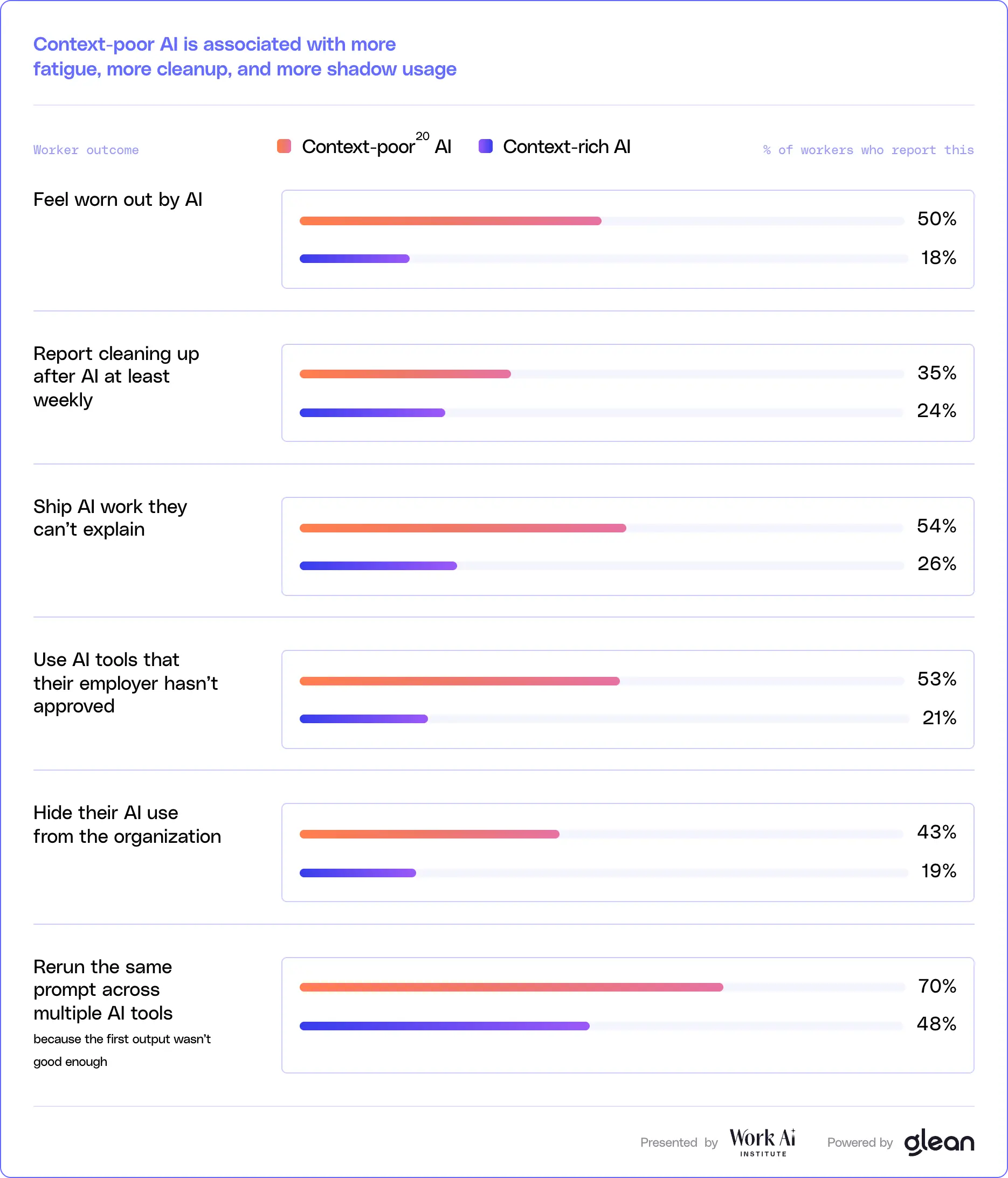
Workers in context-rich AI environments report a different experience:
- 18% feel worn out by AI, compared with 50% in context-poor environments.
- 26% ship work they can’t explain, compared with 54%.
- 21% use unapproved tools, compared with 53%.
- 48% rerun prompts across tools, compared with 70%.
Better context doesn’t remove the need for human review. It reduces the repetitive work employees have to complete before meaningful review can begin.
When AI can work with trusted, current, permission-aware company context, employees spend less time making the tool usable and more time deciding what to do with the result.
They invest in people
Giving employees access to AI doesn’t create fluency on its own.
People need time to learn where a tool helps, where it fails, and which work still requires their judgment. Organizations also need to show that those skills matter.
Workers at transformative organizations are more likely to say their company:
- Provides enough AI training and support: 90% versus 52%
- Formally rewards AI skills: 84% versus 48%
- Publicly recognizes useful AI contributions: 83% versus 48%
- Gives employees the AI skills they need: 93% versus 70%

These investments help employees build judgment through real work rather than performing fluency for an adoption dashboard.
Managers have an important role here, too.
Managers who are high AI achievers (workers who report gains in both productivity and work quality from AI) delegate 32% more coordination work to AI than other managers. Tasks like drafting routine updates, summarizing meetings, preparing follow-ups, and gathering background can create more time for coaching, feedback, prioritization, and skill development.
AI can keep some of the work moving. Managers still need to help people improve the work, and the judgment behind it.
They redesign work instead of adding more volume
The clearest difference may be what transformative organizations do with the time AI creates.
AI can make an existing task faster without changing the way the organization works. The employee finishes sooner, receives more of the same work, and continues operating inside the same process. The saved time disappears into higher volume, review, and cleanup.
90% of workers at transformative organizations say their employer treats AI as an opportunity to redesign work, compared with 54% elsewhere.
Redesigning work means deciding:
- Which steps can disappear entirely
- Which tasks no longer require a person
- Where human judgment still needs to lead
- Who remains accountable when AI contributes
- Which skills employees need next
- Where the time AI saves should go
These choices determine whether AI creates better outcomes, more output, or more work for employees to absorb.
Removing a repetitive step can create more room for analysis, customer work, coaching, or stronger decisions. Automating the part of a role where employees develop expertise and judgment can weaken the capabilities the organization still depends on.
The technology creates capacity. Work design determines whether that capacity becomes value.
The advantage sits around the model
AI tools will continue to improve, and more organizations will have access to the same underlying capabilities.
That makes adoption easier to achieve and less meaningful as a differentiator.
What’s harder to copy is everything around the model, including the company context it can use, the quality standards applied to its output, the decisions it’s allowed to make, and the people who know when to rely on it and when to step in.
Those are organizational choices.
The companies closing the AI impact gap aren’t waiting for a better model to solve it for them. They’re building the measurement, governance, context, and work design required to turn faster output into work the business can trust.
Read the full Work AI Index 2026 to see how organizations are closing the gap between AI adoption and business impact.
