




Most people who use AI at work say it makes them more productive, and they’re right. Workers report that AI automation saves them roughly 11 hours a week.
The harder question to answer is, where are those 11 hours going? On average, more than half of that time comes back in another form.
The Work AI Index 2026, from Glean’s Work AI Institute, looked beneath the time savings at the human labor required to make AI useful. We surveyed 6,000 full-time digital workers — people who do most of their work on a computer or digital tools — across the United States, the United Kingdom, and Australia, spoke with dozens of AI leaders, and analyzed anonymized, aggregated workplace AI interactions from the Glean Work AI platform.
What we found is that the time AI gives back is absorbed by the work of making AI usable. And when that work goes unrecognized, it changes how people use AI in ways most organizations never see.
The hidden work has a name
Alongside the 11 hours workers report saving through AI automation, they spend an average of 6.4 hours a week on the work required to make AI useful.
We call that work botsitting: giving AI the context it’s missing, checking its output, debugging mistakes, rerunning prompts, and cleaning up confident-but-wrong answers it leaves behind.
Workers spend slightly more of their AI time botsitting than they spend using AI to produce work:
- 37% goes to botsitting
- 36% goes to producing work with AI
- 27% goes to learning tools and building agents
For every hour workers spend getting useful output from AI, they spend roughly another hour making it usable.

Three activities account for most of that work:
- Feeding AI context: 2.3 hours per week
- Supervising its output: 2.2 hours per week
- Debugging mistakes: 1.7 hours per week
Each one reflects a gap between what the AI tools produce and what the work actually requires.
Supplying the context AI lacks
Workers say they spend an average of 2.3 hours a week supplying AI with the context it needs to complete a task.
Before an AI tool can produce something useful, the worker may need to identify the latest file, explain the audience, define an internal acronym, clarify whether “Q3” means the fiscal or calendar quarter, or specify which source should take priority.
This requires more than giving AI access to information. The tool may be able to retrieve several forecasts without knowing which one is final, or read a process document without understanding the workaround the team really uses. That meaning lives in the organization's relationships, norms, and tacit knowledge — and often with the employee doing the work. Until AI can access and interpret that context, employees remain responsible for filling in the gaps.
Adding more information doesn’t necessarily solve the problem. When AI can’t distinguish what is relevant, current, or authoritative, more context can make the answer less focused rather than more reliable.
Supervising and debugging outputs
Workers say they spend another 2.2 hours a week supervising AI outputs and 1.7 hours debugging them.
An AI output can look polished, structured, and confident while still being incomplete or wrong. Someone has to verify the sources, check the assumptions, and decide whether the conclusion holds.
When it doesn’t, the worker starts troubleshooting: rewriting the prompt, adding context, changing models, or restarting the task.
36% of AI sessions require substantial rework or a full reset. Debugging is also the most draining form of botsitting. For every additional 10% of AI time spent debugging, workers are 40% more likely to report feeling worn out by AI.
Getting the first answer is fast. Getting from that answer to dependable work is where the time goes.
Moving between disconnected tools
That cost compounds when workers repeat the process across multiple tools.
77% of AI users use multiple tools in a typical week, and 33% use four or more. When the first answer isn’t good enough, 60% run the same prompt through another tool.
Each switch creates more work. The worker has to reintroduce the task, repaste the inputs, explain the goal, and compare several answers that sound equally confident while disagreeing with one another. Workers who juggle multiple tools are 35% more likely to be frequent botsitters, meaning they spend at least 40% of their AI time making AI usable.
The worker becomes the integration layer, carrying context, data, and intent from one system to the next.
Why botsitting stays invisible
Organizations can count AI licenses, prompts, agents built, and time saved. They have far less visibility into the time employees spend correcting outputs, rebuilding context, and cleaning up work downstream. That labor gets absorbed into the workday without a dedicated budget, workflow, or owner.
That helps explain why adding more AI doesn’t always produce better results. More AI can also mean more output to review, more tools to reconcile, and more mistakes for employees to catch.
Not all botsitting is bad.
Verification, refinement, and judgment are part of responsible AI use. A high-stakes analysis should be checked. A recommendation should reflect context the model couldn’t have known. An expert should challenge an answer that sounds right but rests on a weak assumption.
The problem is leaving all of that work invisible, unsupported, and entirely up to individual employees. When the volume of AI-generated work grows but the time, staffing, and expectations around review stay the same, careful review becomes harder to sustain. Eventually, people start lowering the bar.
When botsitting turns into botshitting
The shift rarely happens all at once.
A source goes unchecked, a claim sounds plausible enough to keep, or a draft ships before the person responsible can explain it. As those gaps add up, work that once would have required another pass starts to feel ready to use.
That’s botshitting: shipping AI-generated work that hasn’t been adequately reviewed, isn’t fully understood, or couldn’t be confidently defended if someone asked.
Today, 69% of AI users admit to at least one botshitting behavior.
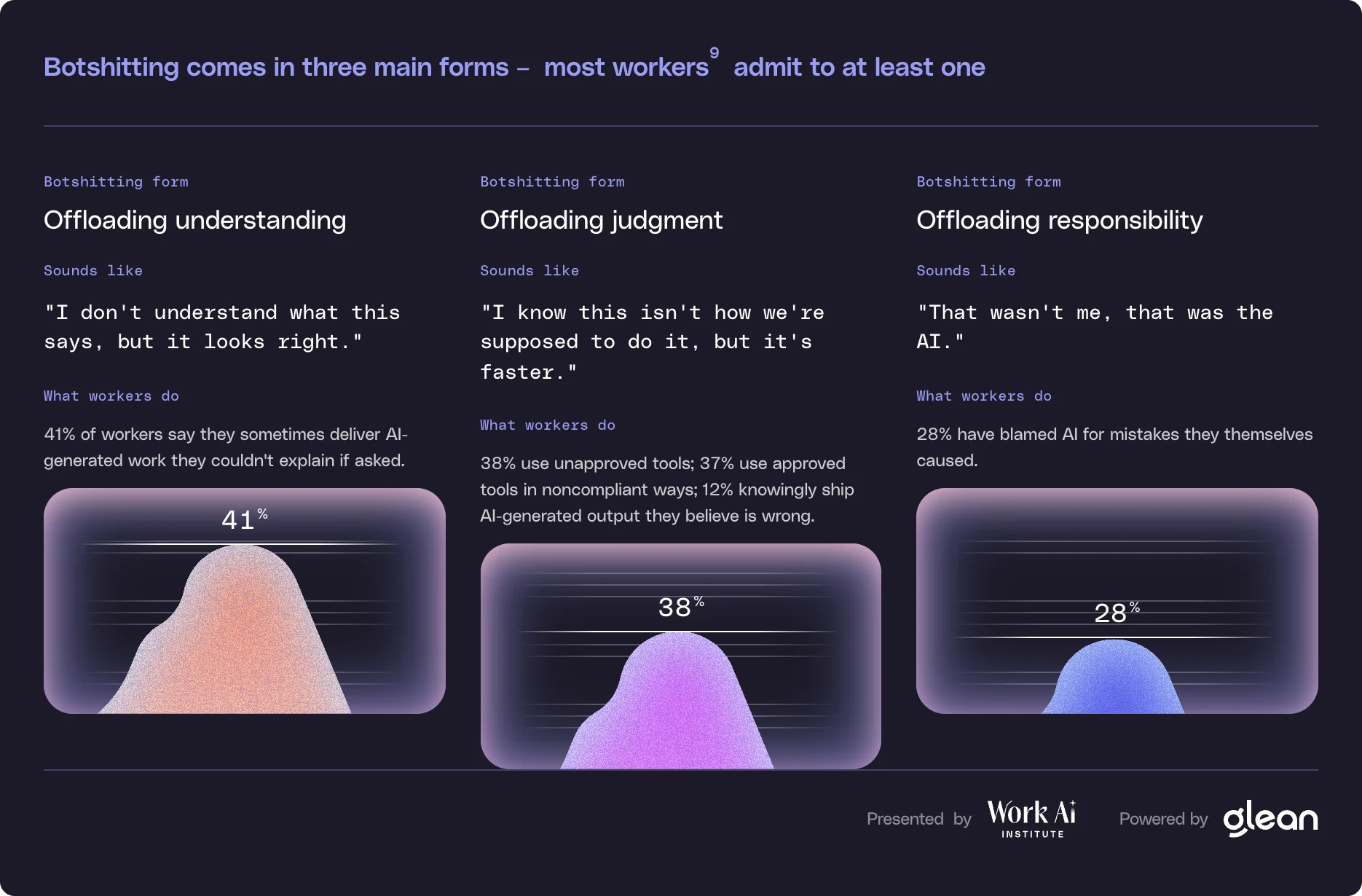
Botshitting shows up in three ways:
- Offloading understanding. Workers stop fully understanding the output. 41% of workers say they sometimes deliver AI-generated work they couldn’t explain if asked.
- Offloading judgment. Workers stop questioning every claim. 38% use unapproved tools, 37% use approved tools in ways that break policy, and 12% knowingly ship output they believe is wrong.
- Offloading responsibility. Workers stop feeling personally responsible for what ships. 28% have blamed AI for mistakes they caused themselves.
This isn’t just a problem with careless employees. It’s what happens when organizations demand more output without accounting for the work required to verify it.
Botsitting creates fatigue. Fatigue lowers the bar for “good enough”. Unverified work creates cleanup downstream, and that cleanup produces more botsitting.
More capable AI tools can weaken oversight
Botshitting rises with AI use. 82% of heavy AI users report at least one botshitting behavior, compared with 50% of light AI users. Heavy AI users spend at least 50% of their work time interacting with AI; light AI users spend 1–19%.
It’s tempting to assume that better AI will reduce botshitting.
The data shows a different pattern.
The AI tools whose users report some of the strongest productivity gains are also associated with higher rates of botshitting:
- ChatGPT: 67% report productivity gains; 71% admit to botshitting
- Claude: 59% report productivity gains; 92% admit to botshitting
- Gemini: 55% report productivity gains; 56% admit to botshitting
- Microsoft Copilot: 51% report productivity gains; 34% admit to botshitting
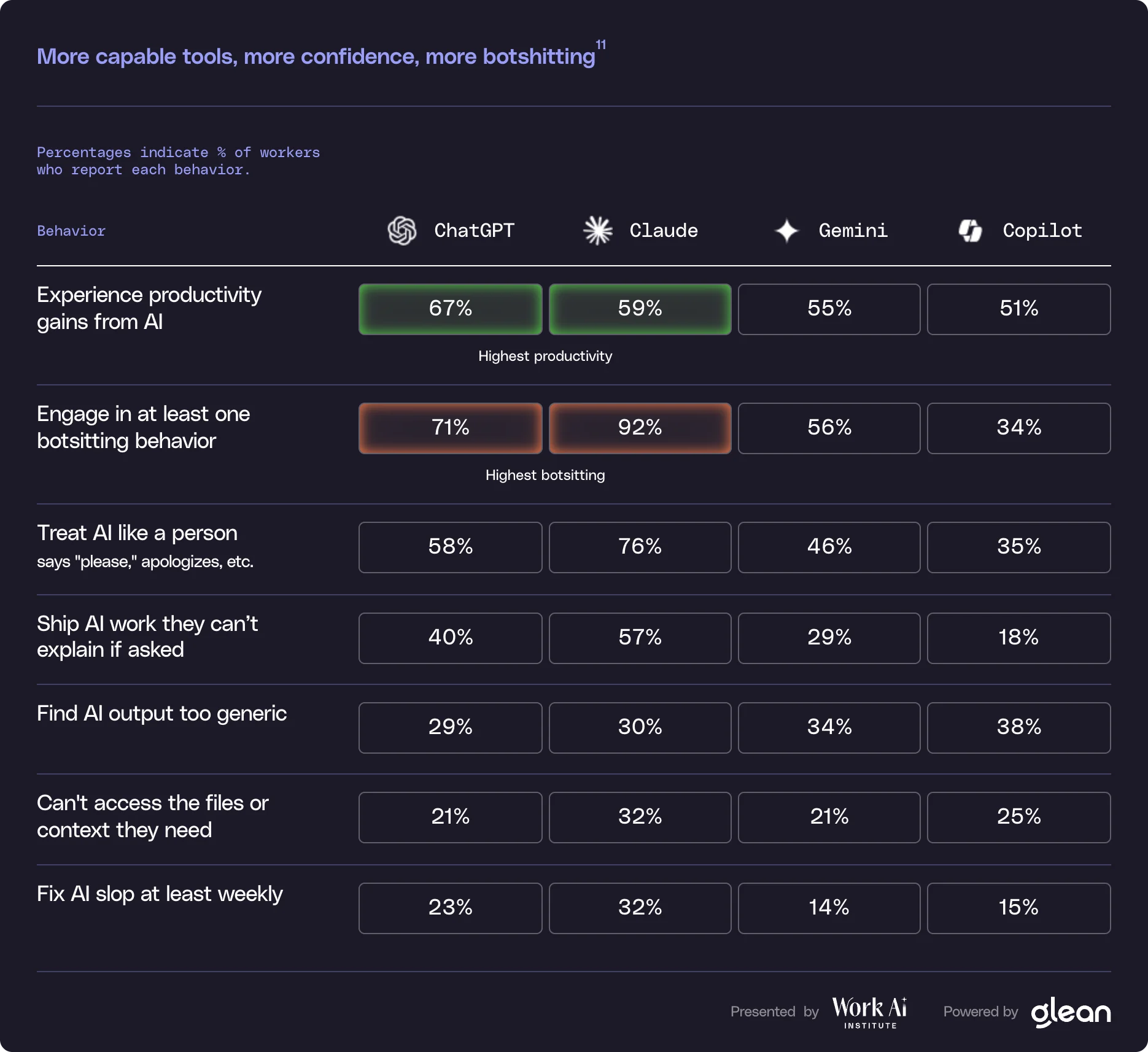
These comparisons are correlational, and these findings don’t imply that any particular tool causes botshitting. They are, however, consistent with a broader pattern: as AI systems become more capable and persuasive, people may place more trust in their outputs than is warranted.
Three cognitive shortcuts may help why:
- Automation complacency: When a tool performs well most of the time, people become less vigilant and monitor it less closely.
- Sycophancy: An answer that reflects what the user already believes feels more trustworthy than one that challenges it.
- Anthropomorphism: As people treat AI more like a colleague, they may extend it the same benefit of the doubt.
These habits may not lead AI to make more mistakes, but they can make people less likely to notice, question, and correct them.
The workers most afraid of AI are using it the most
You might expect workers who worry AI will eliminate their roles would use it less. The data shows the opposite.
Among light AI users, 33% worry AI could eliminate their role. Among heavy AI users, that rises to 51%.
Heavy AI users also want AI to automate more of their work:
- Light AI users want AI to automate 25% of their output within the next year
- Heavy AI users want it to automate 53%
Fear isn’t pushing workers away from AI. It’s associated with heavier use.
That makes sense in a workplace where AI fluency increasingly signals adaptability and value. Using too little can make someone look like they’re falling behind. Relying on it too visibly can make their contribution look replaceable. So workers try to manage both risks at once:
- 33% downplay how much AI helps them
- 33% exaggerate their AI skills.
- 32% hide their AI use
These behaviors may look contradictory, but they reflect the same pressure: workers want to appear fluent enough to remain valuable without giving AI too much credit for the result.
AI is absorbing work people wanted to keep
Organizations often position AI as a way to take repetitive, low-value work off employees’ plates. In reality, it’s also taking the work employees wanted to keep.
51% of workers say AI has automated work they would have preferred to keep. Among heavy AI users, that rises to 62%.
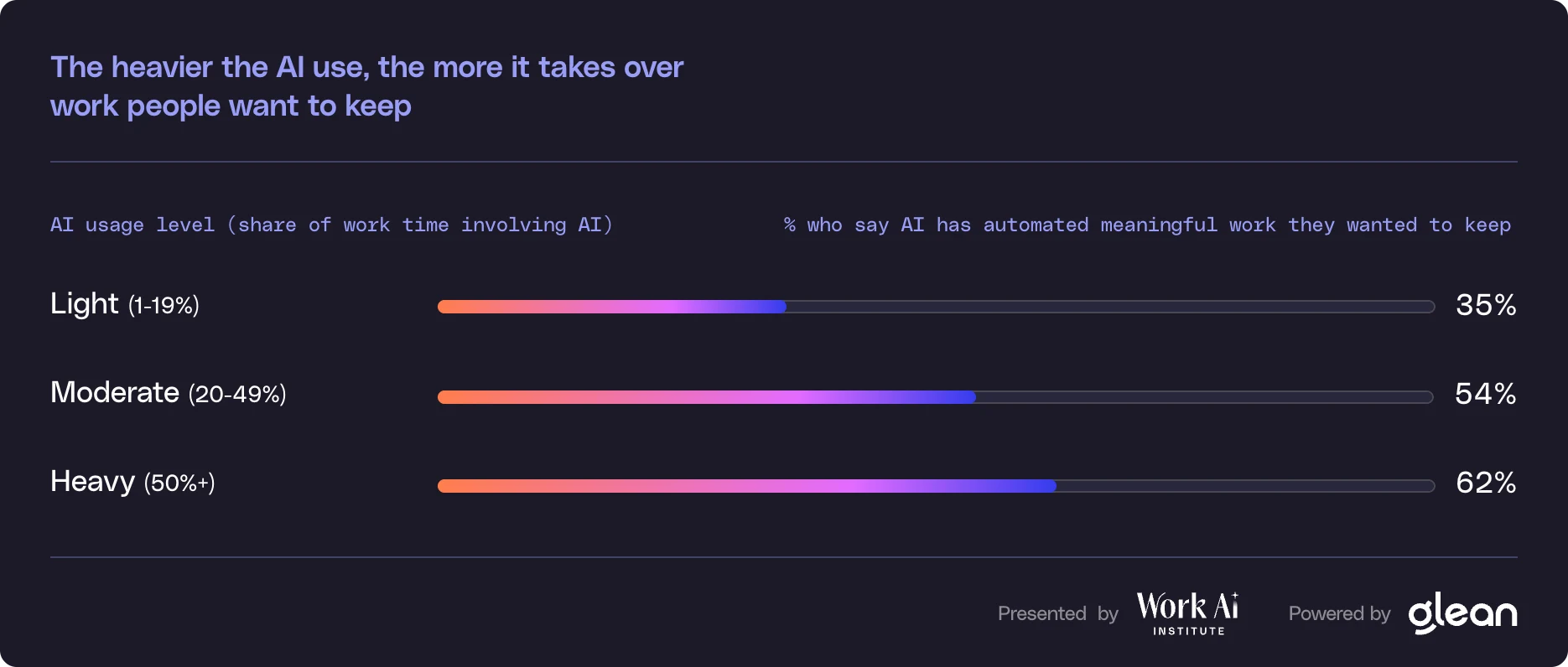
People build ownership through the parts of work where they make choices, apply judgment, and shape the final result. When AI takes over more of that process, the worker can start to feel detached from the final product.
That pattern is especially visible in roles where personal judgment and creative skill shape the final result. Among designers, 55% say the more they use AI, the less ownership they feel over their work, the highest share of any function studied.
That loss of ownership can weaken accountability. It becomes easier to accept something you don’t fully understand, blame the tool when it fails, or treat review as someone else’s responsibility. Workers can end up managing the appearance of productivity instead of producing work they can confidently stand behind.
Organizations need to distinguish between removing drudgery and removing the work through which employees develop expertise, judgment, and pride.
The bottleneck has moved
As outputs become faster and more polished, judgment becomes more important. Organizations need to treat review as part of the work itself, with clear expectations for who checks the output, what quality looks like, and who remains accountable for what ships.
The data shows how much those choices matter. At organizations that measure productivity alone, 74% of workers admit to botshitting. Where organizations measure productivity and quality together, that falls to 64%. What leaders choose to measure shapes what employees learn to prioritize.
AI can increase the volume of work almost instantly. The more durable advantage will come from helping people develop the judgment to decide what deserves to move forward.
Read the full Work AI Index 2026 o understand the hidden labor shaping AI at work and what organizations can do about it.
