





Almost all desk workers now use AI at work, and yet very few organizations can prove they’re better off for it. That gap is the most important and least understood story in AI at work today.
The Work AI Index 2026, from Glean’s Work AI Institute, explores the hidden human labor AI has added to the workday, and how that work affects the value organizations ultimately see.
We surveyed 6,000 full-time digital workers across the United States, the United Kingdom, and Australia, spoke with dozens of AI leaders, and analyzed anonymized, aggregated workplace AI interactions from the Glean Work AI platform. What we found is a workforce that has embraced AI, along with a thick, mostly invisible layer of human labor holding it all together.
AI adoption isn’t the problem
By every measure of uptake, AI has arrived in the workplace:
- 87% of digital workers now use AI at work
- 75% say it makes them more productive
- Workers report that AI automation saves them roughly 11 hours a week
In most cases, these aren’t reluctant users. Most workers (x%) now reach for AI before asking a coworker, want it to automate larger parts of their jobs (x% vs. y% today), and are x% are even comfortable with AI playing a role in firing their human colleagues.
Adoption has moved faster than most organizations’ ability to support it. Individuals are saving time and getting more done, but, for too many organizations, that value should show up in business performance.
Most companies still aren’t seeing the impact
Just 13% of workers say their organization is performing significantly better because of AI.
.webp)
That disconnect between individual productivity and organizational performance is the productivity paradox at the center of the Work AI Index. Workers say AI helps them move faster, but most don’t see those gains adding up to significantly better results for their organizations.
When we look at what’s happening behind the scenes, it’s clearer why.
Workers are spending hours making AI useful
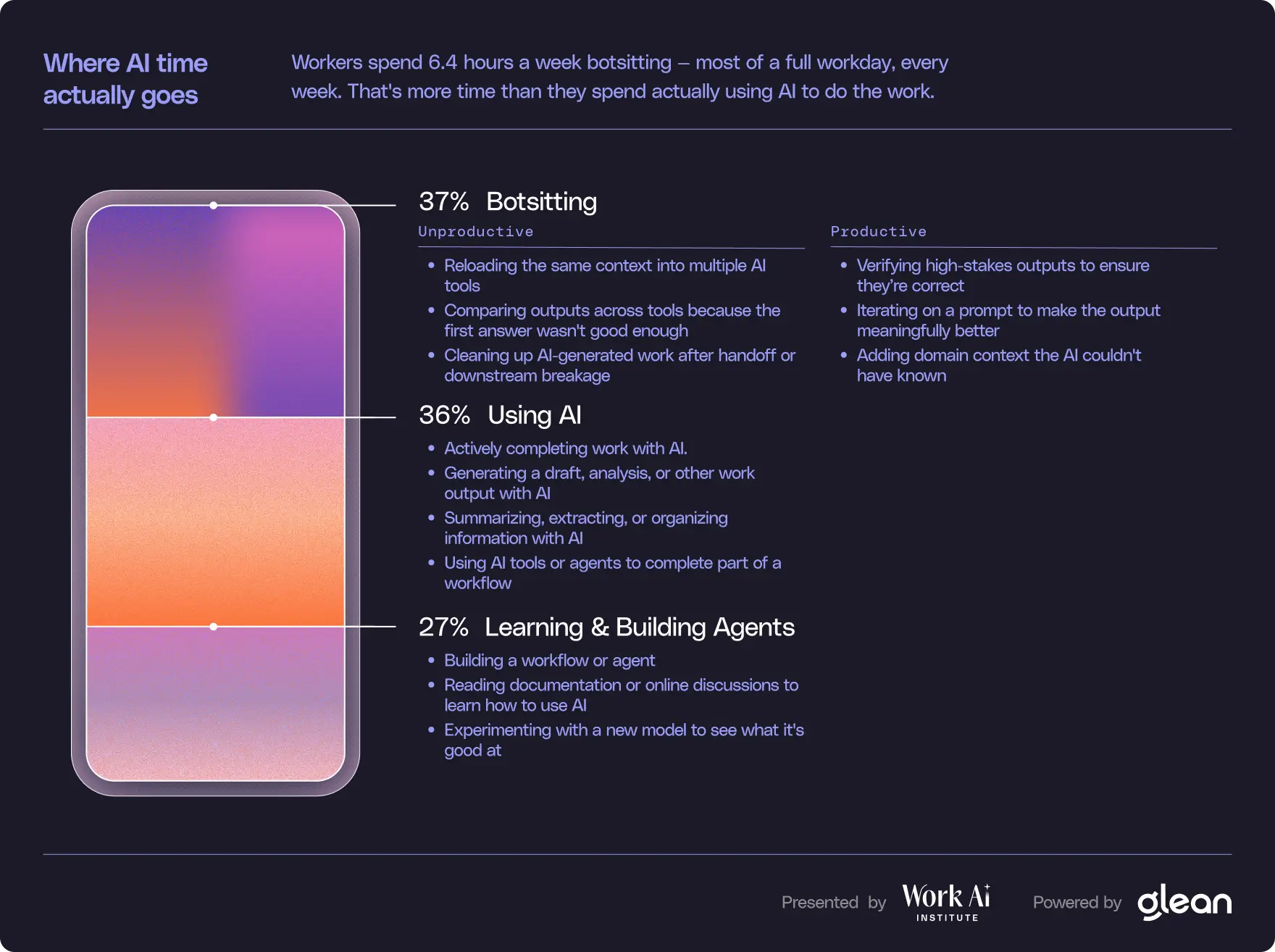
Alongside the 11 hours workers save with AI automation, they spend 6.4 hours a week on the work required to make AI useful.
We call that work botsitting: giving AI the context it’s missing, checking its output, debugging mistakes, rerunning prompts, and cleaning up confident-but-wrong answers it leaves behind.

Workers spend more time botsitting than they spend using AI to produce the work itself. For every hour spent getting useful output, they spend roughly another hour making that output usable.
Both the savings and the botsitting are real. The key difference between them is visibility.
Time saved shows up on dashboards and, often, in how people feel about their day. Botsitting, on the other hand, is rarely visible, because few organizations tack, budget, or reward it. That helps explain why adding more AI doesn’t always produce better results. Without the right support, more AI can also mean more checking, more corrections, and more work for employees to absorb.
While most botsitting is tedious and mundane (like repasting the same prompt into three different AI tools because the first and second outputs were subpar), not all botsitting is bad, however. Verification, refinement, and judgment are part of responsible AI use. The problem is leaving that work invisible, unsupported, and entirely up to individual employees.
Unmanaged botsitting turns into botshitting
When the work of checking AI goes unrecognized, people eventually start cutting corners. They stop verifying outputs, accept the first answer that looks good enough, and ship work they can't fully explain or defend.
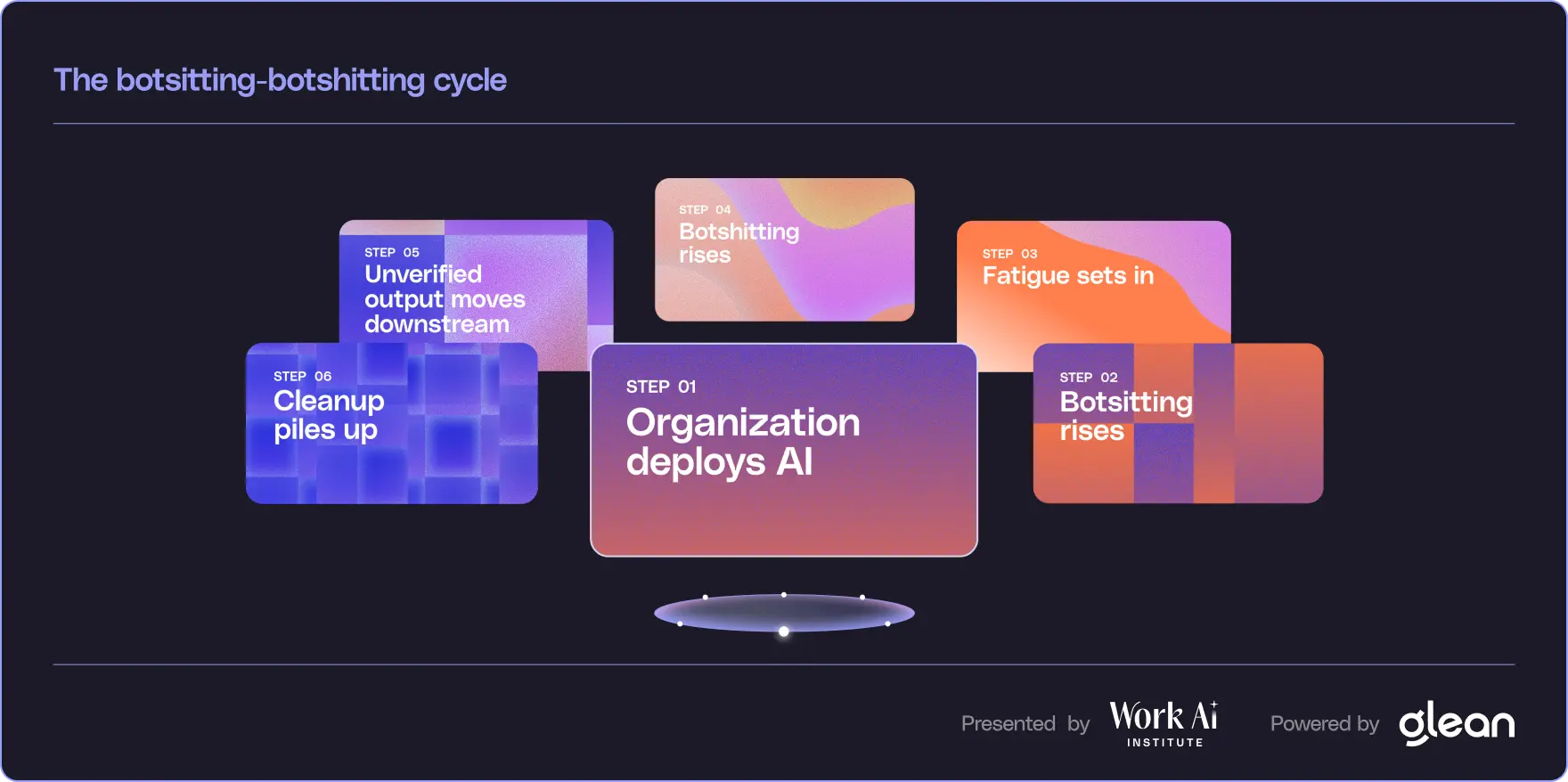
That’s when botsitting becomes botshitting: shipping AI-generated work that hasn't been reviewed, isn't fully understood, and couldn't be defended if someone asked. Today, 69% of AI users admit to at least one botshitting behavior.

Botsitting wears people down, fatigue leads to botshitting, and unverified work creates more cleanup downstream, which produces more botsitting.
What the 13% of companies getting this right do differently
The companies closing the gap aren’t necessarily the ones using the most AI. They’re the ones building the judgment, habits, and systems that make AI dependable as adoption grows — the human infrastructure of AI. They’re building it at three levels:
Individuals apply judgment.
The high AI achievers don’t accept every output at face value. They check the work, refine it, and learn from what goes wrong.
They’re also more willing to set AI aside when it doesn’t improve the task. Better AI use doesn’t always mean more AI use. It means knowing where AI helps, where it needs oversight, and where human judgment should lead.
Teams stay accountable.
High-achieving AI teams treat AI output as a starting point, not a finished product. Workers on these teams are more likely to treat AI as a “teammate.” Similar to a human teammate, they give feedback, correct weak answers, and try again when the first result falls short.
Managers who are high AI achievers also use AI to take coordination work off their plates, then reinvest that time in people. They coach, mentor, and help employees build the skills they’ll need as work changes.
AI can contribute to the work, but accountability still belongs to the team.
Organizations provide context, not just access.
Giving AI access to company data isn’t the same as giving it the context required to do good work.
More than half of workers (x%) say the critical information they need isn’t accessible through their AI tools. That leaves employees filling in the gaps themselves, copying information between systems, rewriting prompts, and correcting answers built on incomplete context.
Workers in context-rich organizations report a different experience. They’re:
- 64% less likely to feel worn out by AI.
- 52% less likely to ship work they can’t explain.
- 31% less likely to botshit.
More tools won’t fix the problem. The organizations getting more from AI start with the work, choose technology that fits the job, and give AI the company context it needs to be useful.
Solving the productivity paradox
The gap between 87% adoption and 13% organizational impact isn’t simply a technology problem that’s going to be solved with more powerful models. It’s a work-design problem.
Organizations control how they measure AI, where they apply it, what context they give it, and how they support the people responsible for its output. They can decide where AI should lead, where it should assist, and where human judgment matters most.
AI is saving people time, but some of that time is being absorbed by the work of checking, correcting, and making its output usable.
Organizations that account for that work and build the human infrastructure to support it are better positioned to turn individual productivity into results the business can actually reap. Without those changes, companies risk adding more AI without seeing much more value from it, while employees continue to absorb the work behind the scenes.
Read the full Work AI Index 2026 to understand the hidden labor shaping AI at work and what organizations can do about it.
