





The UK has built one of the strongest institutional environments for AI at work. Workers have adopted it, employers have written policies for it, and regulators have begun setting expectations around its use.
The results look stronger than they do in the other countries represented in the Work AI Index 2026:
- 90% of UK digital workers use AI at work.
- 78% say it makes them more productive, the highest share across the UK, US, and Australia.
- Workers report saving roughly 12 hours a week through AI automation.
- 18% say AI has significantly improved their organisation’s performance, compared with 12% in the US and 10% in Australia.

UK workers also have more confidence in the system around the technology. 65% have read their organisation’s AI policy in full, compared with 57% in the US. 73% say they’re confident in their organisation’s AI strategy.
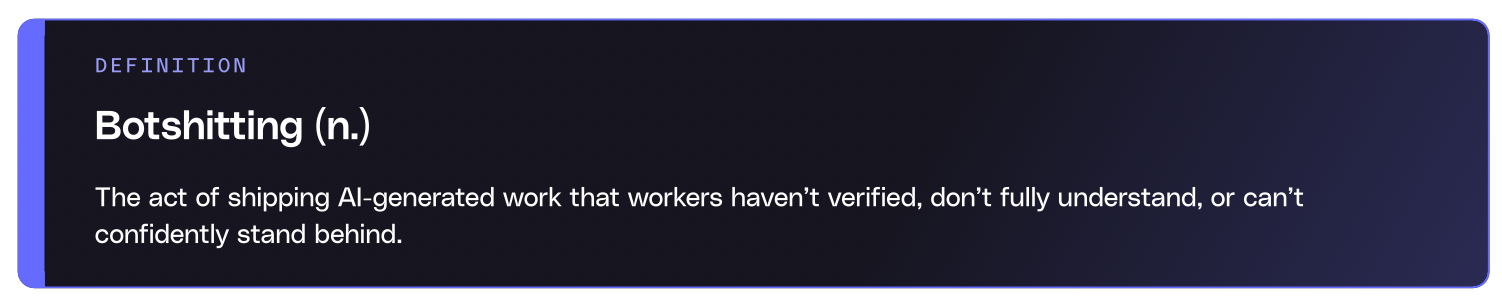
And yet 70% of UK AI users report at least one form of botshitting: shipping AI-assisted work they haven’t adequately verified, don’t fully understand, or couldn’t confidently defend.
The UK has paired strong policy confidence with high adoption. It still hasn’t solved verification.
The Work AI Index 2026: UK, from Glean’s Work AI Institute, surveyed 1,500 UK digital workers as part of a global study of 6,000 full-time workers. We also spoke with dozens of AI leaders and analysed anonymised, aggregated workplace AI interactions from Glean’s enterprise AI platform.
What we found is a country that has made AI feel permitted at work, without always making its output dependable.
The UK’s AI advantage is institutional
AI has moved further into the formal operating system of work in the UK than it has in the US.
42% of UK workers say AI is embedded in core workflows across multiple departments, compared with 32% in the US. More than half have sent an AI digital twin to attend a meeting on their behalf. AI is also playing a growing role in the decisions that shape people’s careers.
UK workers are more comfortable than their US counterparts with AI being used in high-stakes HR decisions:
- Performance evaluation: 54% in the UK versus 42% in the US
- Hiring: 40% versus 34%
- Promotion and compensation: 40% versus 35%
- Termination: 31% versus 28%
That comfort is already showing up in practice. 40% say their organisation uses AI in performance evaluations. 29% report its use in hiring, and 18% say it plays a role in termination decisions.

This is happening within a system that has put visible boundaries around AI. Employers have formalised policies. ACAS has issued guidance on AI use in employment decisions. The UK AI Safety Institute has made AI governance a regular part of national policy discussions.
The result is a workplace culture where AI feels institutionally supported. Workers aren’t being asked to decide on their own whether the technology belongs at work. The organisation has already signalled that it does.
That institutional confidence sits alongside the strongest reported productivity gains and the highest organisational impact of the three countries surveyed. But it hasn’t removed the need to check what AI produces.
But confidence in the system can also create a blind spot.
The gains are real, but the gap remains wide
UK workers report saving 12 hours a week through AI automation. Only 18% say those gains have translated into significantly better organisational performance.
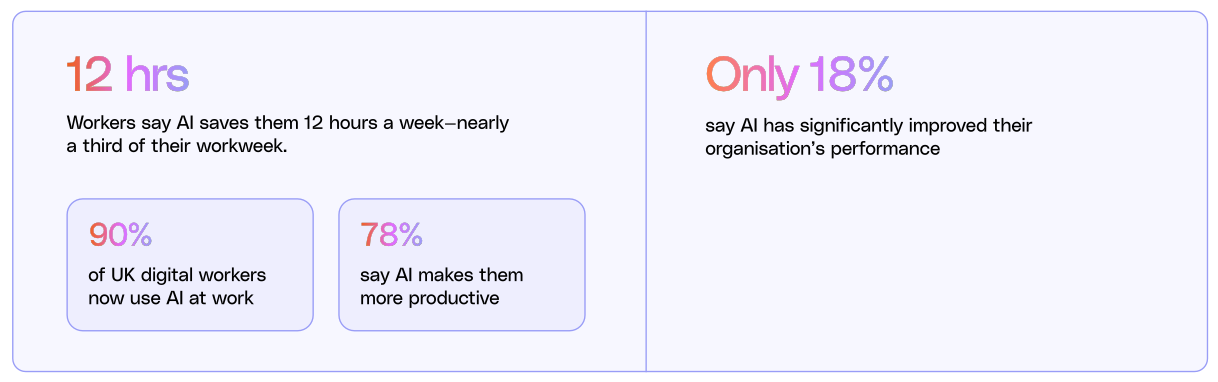
That 18% is higher than the US and Australia. It’s still far below what 90% adoption and 78% reported productivity would suggest.
Part of the gap sits in the work required to make AI useful.
UK workers spend 38% of their AI-related time botsitting: supplying missing context, reviewing outputs, debugging mistakes, rerunning prompts, and cleaning up what gets through. They spend 36% of that time using AI to produce the work itself.

For every hour spent getting useful output, workers spend roughly another hour making that output usable.
This labour hasn’t disappeared because organisations have policies. A policy can tell an employee which tool is approved, which data it can access, and which uses are prohibited. It can’t check whether a source is real, notice that an answer missed an important constraint, or decide whether a polished draft is ready to use.
That judgement still sits with the person doing the work.
Policy doesn’t check the output
Despite greater policy awareness and institutional backing, 37% of UK AI users still say they sometimes ship AI-assisted work they haven’t fully checked, nearly the same as 36% in the US.
70% of UK AI users report at least one botshitting behaviour, compared with 64% in the US.
That shows up in important ways:
- 40% sometimes deliver AI-assisted work they couldn’t explain if asked.
- 34% use tools their employer hasn’t approved.
- 35% use approved tools in ways that break company policy.
- 24% have blamed AI for a mistake that was their own.
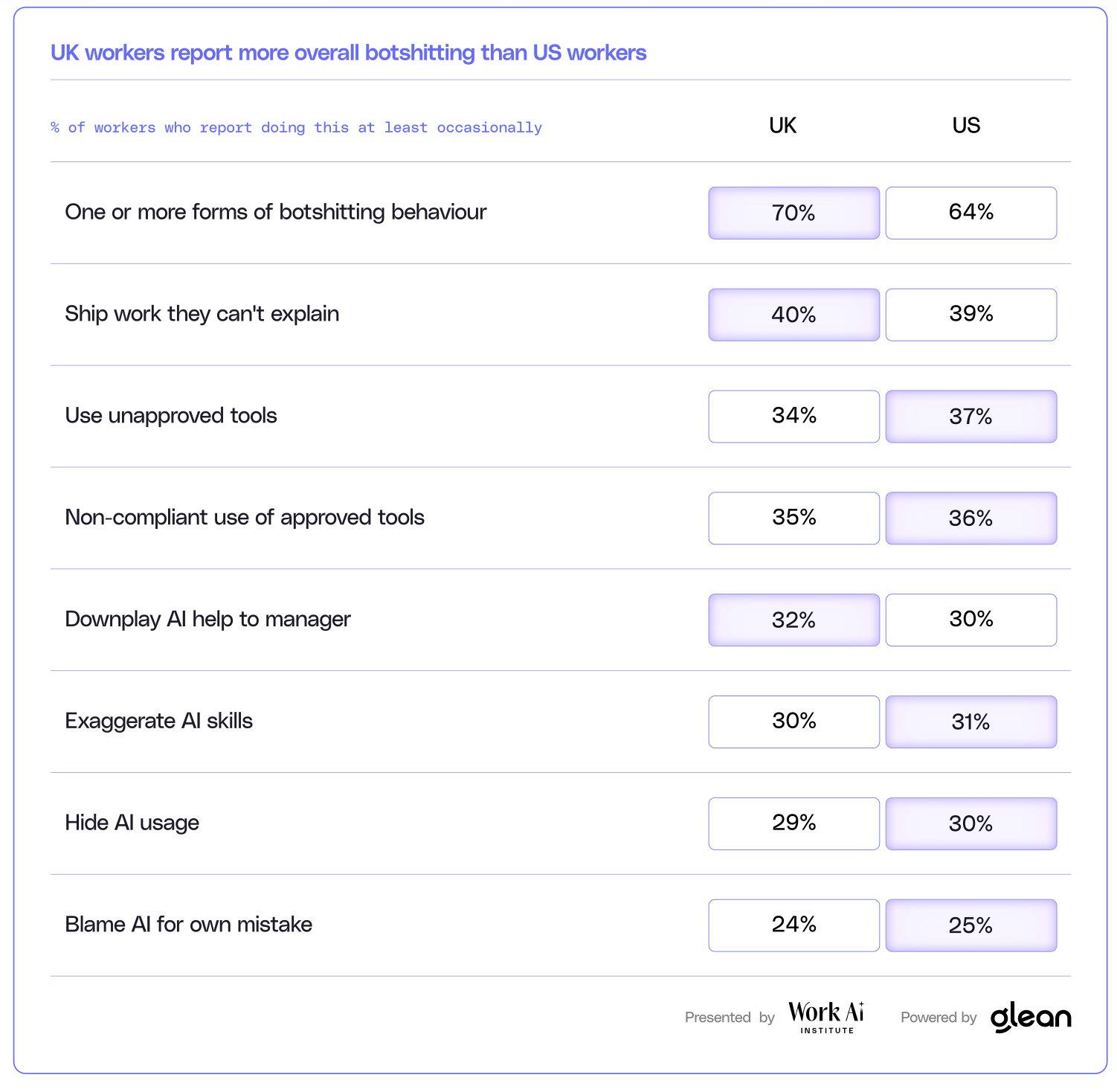
These numbers don’t suggest that UK policies have failed. They show the limit of what a policy can accomplish on its own.
Policy establishes permission and boundaries. Verification happens later, inside the work itself.
It happens when an employee decides whether to check a citation, challenge an assumption, trace a number back to its source, or send the output because the meeting begins in 10 minutes.
Institutional approval can make AI feel safer to use. It can’t make every answer safe to trust. That distinction becomes more important as AI moves into higher-stakes work.
Higher-stakes work raises the cost of weak verification
The UK legal profession offers a clear example.
In 2025, the High Court warned that solicitors and barristers could face contempt proceedings for submitting AI-generated material containing fabricated case citations. The warning followed cases where lawyers cited authorities that didn’t exist.
The Solicitors Regulation Authority and the Bar Standards Board reinforced the same principle: responsibility for verifying an authority sits with the lawyer, not the tool.
The issue wasn’t whether lawyers were allowed to use AI. It was whether someone remained accountable for checking what it produced.
The same principle extensds well beyond law. AI-assisted work now feeds into performance reviews, hiring recommendations, financial models, strategic analyses, and decisions that move across several teams.
A weak assumption in a private draft is one problem. The same assumption carried into a performance review, board pack, or customer recommendation is much harder to contain.
The need for verification isn’t hypothetical. 77% of UK workers have corrected or redone AI-assisted work in the past month. 26% do it at least weekly.

As AI becomes more embedded in important workflows, verification can’t remain an informal task that everyone assumes someone else completed.
The approved path has to work
The UK’s next challenge goes beyond writing more rules. It’s making the sanctioned way of using AI practical enough to survive contact with real work.
Workers don’t always use unapproved tools because they’re indifferent to governance. They may be responding to an approved system that is too slow, too generic, or too disconnected from the information the task requires.
Half of UK workers say important information they need isn’t accessible through their AI tools.
That leaves employees filling the gaps themselves. They paste internal information into prompts, reconstruct the task for each tool, and compare several confident answers that don’t agree. 60% rerun the same prompt across multiple AI tools because the first answer wasn’t good enough.

A clear policy can still produce workarounds when the approved tool can’t complete the work.
That creates a difficult choice for employees:
- Follow the sanctioned process and struggle to get a useful result.
- Use the tool that works and accept the policy risk.
- Move forward with an answer they don’t fully trust.
Strong governance needs a usable path through that decision. That means giving approved AI access to the right company context, keeping policies current as tools and workflows change, and making it clear when human review is required.
The safest path also needs to be a realistic path.
Verification needs to become part of the workflow
The UK has already done much of the visible work of AI adoption. The next phase is more operational.
Organisations need to translate policy into clear expectations for how AI-assisted work is reviewed, owned, and shipped.
That starts with a few practical decisions:
- Set review standards by risk. A meeting summary and a termination recommendation shouldn’t pass through the same level of scrutiny.
- Name the accountable person. AI may contribute to the output, but someone still needs to understand and stand behind it.
- Build checks into the workflow. Source review, approval steps, and escalation paths shouldn’t depend entirely on an employee remembering to add them.
- Give approved tools the context they need. Employees will keep reconstructing company knowledge by hand when AI can’t identify the current, authoritative, and relevant information.
- Use workarounds as feedback. Repeated policy exceptions often reveal that the sanctioned tool or process doesn’t fit the job.
The goal isn’t to make every AI interaction slower. It’s to make careful review normal where the consequences justify it.
The UK’s next AI advantage is operational
The UK’s policy-led approach has produced real benefits. UK workers report stronger productivity gains, greater confidence, and more organisational impact than their peers in the US and Australia.
That foundation matters. But policy confidence can’t substitute for verification discipline.
The most important test of AI governance isn’t whether the policy exists or whether employees have read it. It’s what happens when the deadline is close, the answer looks convincing, and checking it would take more time.
Does the employee know what needs another pass? Can the approved system produce an answer grounded in the right company context? Is it clear who remains accountable for the final result?
The UK has helped make AI legitimate at work. Its next advantage will come from making reliable AI-assisted work the default.
Read the full Work AI Index 2026: UK to see where AI’s time savings are going and how UK organisations can turn policy-led adoption into real impact.
