




Glean Waldo vs. traditional AI: cost, latency, and quality comparison
Agentic search models cut enterprise AI costs and latency by separating retrieval planning from response generation — letting a small, specialized model handle the search step before a larger reasoning model produces the final answer. The result is faster responses, lower token usage, and no loss in answer quality.
Separating retrieval from reasoning matters because most enterprise AI systems today route every query through a single large language model, whether the task requires deep reasoning or simple information retrieval. That one-size-fits-all approach drives up per-query costs and adds seconds of latency that compound across thousands of daily interactions.
Glean — the Work AI platform — built Waldo, an agentic search model post-trained on NVIDIA Nemotron 3 Nano specifically for enterprise search, to demonstrate this pattern in production. It plans the search — deciding which tools to call, what evidence to gather, and how to decompose a question — then hands off to a frontier model only for the final answer. In Glean's published benchmarks (2026, measured across enterprise deployments), the architecture delivers roughly 50% lower end-to-end latency, approximately 25% fewer tokens consumed, and no measurable drop in answer quality.
What is an agentic search model and why does it matter for enterprise AI?
An agentic search model is a purpose-built model that owns the retrieval step in an AI pipeline, separating the work of finding relevant information from the work of generating an answer. This agentic RAG approach matters because most enterprise architectures waste compute and time by forcing a single large model to do both jobs.
The search model breaks each query into sub-tasks — deciding which data sources to query, what search terms to use, and which results are relevant — before passing curated evidence to a larger reasoning model. Most enterprise AI architectures today skip that split entirely.
Every query, from "What's our return policy?" to "Summarize last quarter's pipeline changes across EMEA," hits the same frontier model end-to-end. Simple lookups burn the same compute as complex analysis.
The cost and latency penalties are predictable: per-call latency around three seconds at the 50th percentile (Glean published benchmarks, 2026), and token budgets inflated by retrieval reasoning the large model was never optimized for.
The composable alternative — using the right model for each step — reflects where enterprise AI architecture is heading. Waldo, for example, handles retrieval planning at roughly 250 milliseconds per call (compared to approximately three seconds for the default reasoning model), then routes only the gathered evidence to a frontier model for answer generation.
Forrester analyst Rowan Curran noted in 2026 the growing appeal of "more directed models for tasks within overall agentic workflows" (AI Business, May 2026). Specialized models working alongside general-purpose ones, each doing what it does best, deliver measurable gains in cost and speed without trading away quality.
How does a specialized search model reduce latency compared to traditional approaches?
A purpose-built search model cuts end-to-end response time by handling query decomposition, tool routing, and evidence gathering without invoking heavy reasoning compute. In production, the search step runs in roughly 250 milliseconds at the 50th percentile — compared to approximately three seconds for a frontier model (Glean internal benchmarks, 2026).
The speed difference matters most at the orchestration layer. A traditional pipeline sends the full query to a large model, which then decides what to search, parses the results, and generates a response — all in one pass. Because token count impacts latency directly, this single-pass approach compounds delays at every step. A specialized search model breaks that sequence apart.
The search model decomposes the question into sub-queries, selects the right data sources, evaluates intermediate results, and constructs a curated evidence package before the reasoning model is ever called. That handoff eliminates the slowest bottleneck: waiting for a large model to do work a smaller, tuned model handles faster.
The compounding effect is where latency reduction becomes a business metric. Consider a company with 10,000 employees, each running five to 10 queries per day through an AI assistant. Shaving even one second per interaction across that volume adds up to thousands of recovered hours per quarter.
Waldo achieves roughly 50% lower end-to-end latency by completing the entire retrieval planning step before the frontier model begins generating.
For a support engineer triaging tickets or a sales rep preparing for a call, the difference between a three-second wait and a sub-second response changes whether the tool gets used at all.
Why does token usage drop without sacrificing answer quality?
When a single large model handles both retrieval and generation, it reads far more text than necessary — scanning documents, filtering irrelevant passages, re-ranking candidates, and reasoning about which evidence to include. At enterprise scale, that token overhead translates directly into compute cost. Separating the search step from the generation step eliminates most of that waste.
A specialized search model pre-processes the retrieval workload: decomposing the original question, querying the right sources, evaluating whether the gathered evidence is sufficient, and assembling only the relevant passages into a compact context window. The reasoning model receives a tightly scoped evidence package rather than a sprawling set of raw search results.
The measured outcome is approximately 25% fewer tokens per query. The answer stays the same length; the input to the reasoning model is simply cleaner.
Answer quality holds because the search model is post-trained specifically for enterprise retrieval tasks. Waldo, built on NVIDIA Nemotron 3 Nano, learned to judge evidence relevance and sufficiency during post-training — skills a general-purpose model develops only incidentally.
Bradley Shimmin of Futurum Group observed in 2026 that companies with domain expertise can "translate that knowledge into cash using a targeted model" (AI Business, May 2026). In practice, the search model knows when it has gathered enough evidence to stop searching and when it needs to issue another query — a judgment call that a generic model typically resolves by over-fetching.
What makes this architecture different from standard retrieval-augmented generation?
Standard retrieval-augmented generation (RAG) and agentic search planning both pair retrieval with a language model, but they differ in how much intelligence sits in the retrieval step. The gap between them determines how efficiently an enterprise AI system uses compute, tokens, and time.
Standard RAG runs a single, static search with no ability to refine results
A conventional RAG pipeline follows a fixed sequence: embed the query, retrieve the top-k documents from a vector store, concatenate those results, and send the combined text to a language model for generation. The retrieval step is static — it runs once, with no ability to refine the search, try alternative queries, or evaluate whether the returned documents actually answer the question.
That rigidity creates a specific failure mode. When retrieval returns noisy or incomplete results, the language model compensates by reasoning harder over a bloated prompt.
A sales rep asking "What pricing objections did we face in EMEA last quarter?" triggers a single vector search that may surface tangentially related documents. The model then burns tokens sifting through irrelevant context to construct an answer — or worse, confabulates from fragments that looked relevant but were not.
The cost and latency penalties are a symptom of weak retrieval, not weak reasoning.
Agentic search planning adds a dynamic retrieval layer that standard RAG lacks
An agentic search model introduces a planning layer between the query and the retrieval step. Instead of a single vector lookup, the search model decomposes the question into sub-tasks — an approach that enterprises like Morgan Stanley and ServiceNow are already deploying in production, selects retrieval strategies for each, reads intermediate results, and decides dynamically whether to search again or proceed to generation. For the EMEA pricing question, an agentic planner might first identify the relevant deal records, then search for objection notes within those records, then verify that the results span the correct time period — three targeted retrievals instead of one broad sweep.
The architectural principle is model specialization through decoupling. A compact, fast planner handles the iterative search work — achieving better cache locality and lower compute per step — while a frontier reasoning model focuses exclusively on synthesizing the curated evidence into a final answer. Glean's implementation pairs Waldo as the search planner with the best available reasoning model at generation time.
That composability means you can upgrade the reasoning model independently without rebuilding the retrieval infrastructure, and each component operates within the performance envelope it was designed for.
How does this approach affect enterprise AI cost at scale?
Enterprise AI cost is driven by two variables: the number of tokens processed per query and the size of the model processing them. A specialized search model reduces both — a pattern consistent with broader market trends, where analysis of 2.4 billion enterprise API calls shows multi-model routing already cutting blended AI costs by 67% year over year — running retrieval planning on a compact foundation model and passing fewer, more targeted tokens to the reasoning model.
A 25% reduction in tokens per query, multiplied across 10,000 employees running multiple queries each day, compounds into substantial monthly savings on compute — reducing what some analysts call the hidden cost of AI.
The cost story goes beyond raw token math. When retrieval is weak, organizations compensate by over-provisioning infrastructure — larger context windows, more powerful models, additional re-ranking layers — to maintain acceptable answer quality. That infrastructure overhead carries its own cost curve, one that scales linearly (or worse) with user count.
A decoupled architecture changes the cost trajectory. The search model handles the high-volume, lower-complexity retrieval work at a fraction of the per-token cost of a frontier model. The frontier model is called only once per query, with a pre-filtered evidence package.
For budget planning, the difference is between a cost model that grows predictably and one that balloons with every new user or use case. Glean's Agentic Engine implements this split at the platform level — Waldo handles query decomposition and evidence gathering, then routes to the appropriate reasoning model — giving teams a way to scale AI usage without rewriting infrastructure.
Where does a system of context fit into this architecture?
A specialized search model is only as good as the context it can access. Speed and efficiency at the retrieval layer mean little if the model is searching over incomplete, stale, or poorly connected data. Most enterprise AI architectures lack a deep, structured representation of how people, content, and interactions relate to each other.
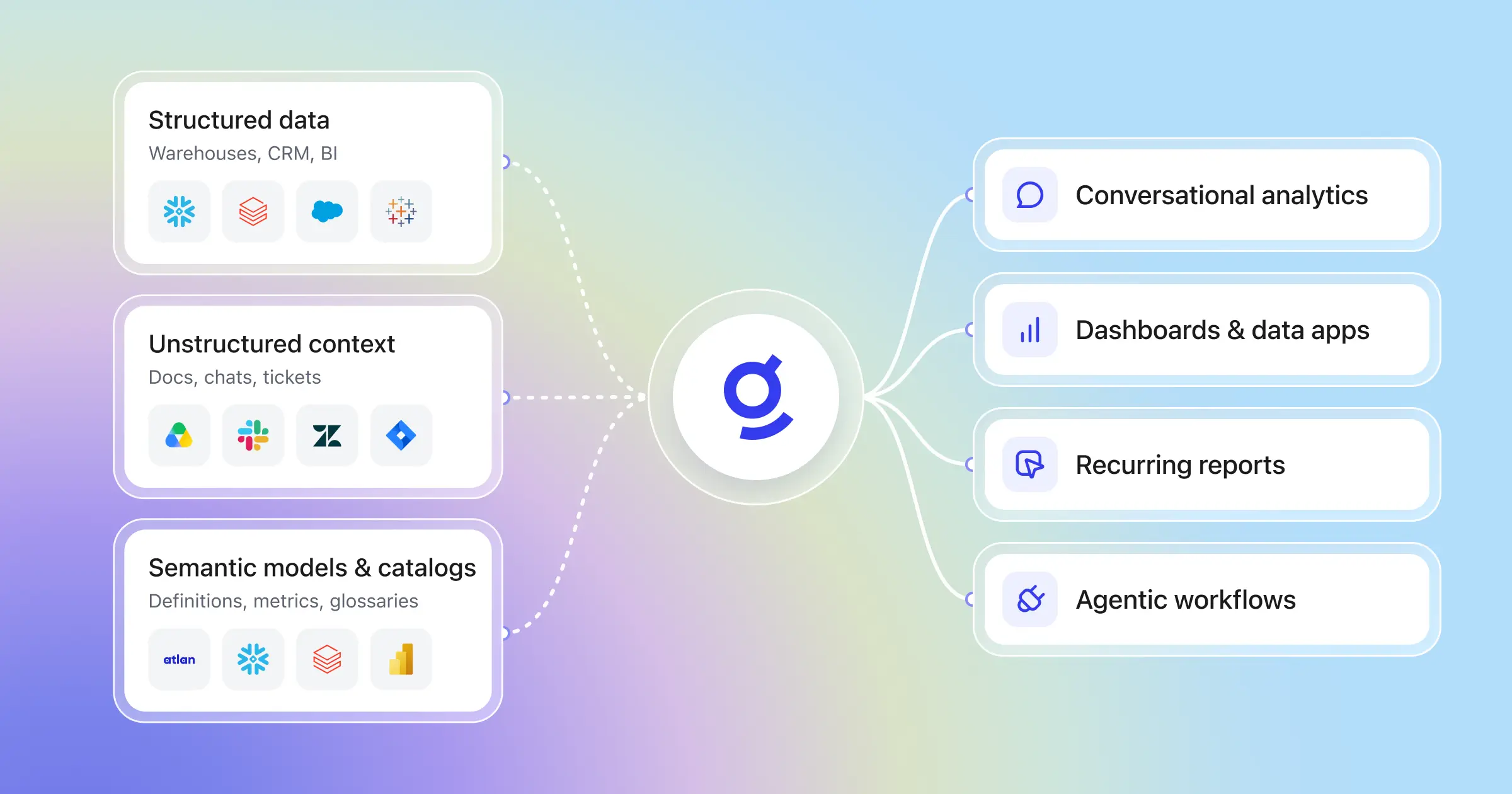
Glean's Enterprise Graph (a structured map of relationships across an organization's data and people) and Personal Graph (a user-specific layer that tailors that map to individual role, activity, and interaction history) provide that layer. The Enterprise Graph builds a comprehensive knowledge graph that connects documents to projects, projects to teams, teams to individuals, and tracks how those connections evolve. Together, they give the search model a structured view of company knowledge rather than a flat index of documents.
When a product manager asks about a feature's launch timeline, the search model does not just find documents containing those keywords. It traces the relationships — the feature spec, the linked project plan, the team Slack channel, the latest status update — and gathers evidence that reflects how the organization actually works.
Glean's internal research (2026) shows that search quality improves by 20% within the first six months as the Enterprise Graph learns from user interactions — a self-reinforcing feedback loop that static retrieval systems lack. Agentic reasoning, which uses this context layer to plan multi-step searches, delivers a 24% increase in response and action relevance compared to standard RAG alone (Glean internal research, 2026).
Permission awareness is enforced upstream of any model call — an approach that depends on building the right permissions structure, not applied as a filter after results are generated. Every document retrieved through Glean's 100+ native connectors respects the user's existing access controls — a constraint that matters for governance and for answer quality, since unpermitted results introduce noise the model must then ignore.
Combined with contractual zero-day data retention with LLM providers and built-in audit trails, the architecture treats security as a structural property rather than a bolted-on feature. A specialized planner plus a deep context layer plus a frontier reasoning model produces answers that are faster, cheaper, and more accurate. Each component handles the work it was designed for — the search model retrieves, the context layer filters by permission and relevance, and the reasoning model synthesizes.
How to evaluate whether your enterprise AI architecture is optimized for cost, latency, and quality
Evaluate three dimensions — task specialization, retrieval adaptiveness, and governance architecture — to determine whether your AI system is spending compute efficiently and delivering the fastest, highest-quality answers your data can support.
Start by auditing your current pipeline. If a single model handles both retrieval and reasoning for every query, you are almost certainly overspending on compute and underperforming on latency.
The first diagnostic step is to measure P50 and P95 latency separately for the search phase and the generation phase. If both numbers are high, the bottleneck is likely a monolithic architecture where one model does everything.
Next, calculate your token cost per query and multiply it by your active user base. A query that consumes 4,000 tokens costs meaningfully more at 10,000 daily active users than at 500. Look at whether your retrieval step is static — a single vector search with no ability to refine or iterate — or adaptive, with multi-step planning that adjusts based on intermediate results.
Static retrieval is a signal that your system compensates for weak search with expensive reasoning.
Three other factors separate an optimized architecture from one that merely functions:
- Permission enforcement at the retrieval layer. If access controls are applied after results are generated, every unpermitted document that reaches the model wastes tokens and introduces potential hallucination vectors. Glean enforces permissions upstream, before any model processes the content.
- Composability across model components. Can you swap the reasoning model without rebuilding your search infrastructure? If your retrieval and generation steps are tightly coupled, every model upgrade becomes a replatforming project. Glean's architecture lets teams update the reasoning model independently of the search planner and context layer.
- Governance as architecture, not afterthought. Active data and AI governance, including audit trails, data residency controls, and contractual zero-day data retention with LLM providers are not optional at enterprise scale. They need to be structural properties of the platform, not features you negotiate separately.
Frequently asked questions
How does an agentic search model maintain answer quality while using fewer tokens?
The search model is post-trained specifically for enterprise retrieval — it decomposes questions, evaluates evidence relevance, and determines sufficiency before passing results to a reasoning model. Fewer tokens reach the reasoning model, but the tokens that do arrive are higher quality. The result is a tighter, more relevant context window that produces answers as accurate as those generated from a larger, unfiltered input.
What are the cost implications of adding a specialized search model to an existing AI stack?
Adding a specialized search layer reduces the per-query token load on your reasoning model by approximately 25%, which compounds into significant compute savings at enterprise scale. The search model itself runs on a compact architecture, so its per-call cost is a fraction of a frontier model's. The net effect is lower total cost per query, not an additional expense.
What use cases benefit most from this approach?
Use cases with high query volume and time-sensitive responses see the largest gains. Support ticket resolution, where agents need fast access to product documentation and case history, is one clear example.
Sales preparation — pulling together account context, competitive positioning, and recent interactions before a meeting — is another. Employee onboarding and internal knowledge discovery also benefit, since new hires generate a high volume of broad, exploratory queries that an agentic search model handles more efficiently than a static pipeline.
How does this architecture handle data security and governance at enterprise scale?
Permissions are enforced at the retrieval layer, upstream of any model call, so users only see results they are authorized to access. Glean maintains contractual zero-day data retention with LLM providers, meaning no query or document content is stored by the model provider. Built-in audit trails and data residency controls are structural properties of the platform.
Is this approach limited to search, or does it extend to agentic workflows?
The architecture extends beyond search into multi-step agentic workflows. AI agents in the enterprise are already demonstrating this pattern. The same planning layer that decomposes a search query can orchestrate sequences of actions — pulling data from one system, writing to another, triggering a notification — with the same permission-aware governance. Glean Agents use this pattern to automate recurring work like report generation, status updates, and process orchestration, with human oversight built into the workflow at configurable checkpoints.
The gap between enterprise AI that works and enterprise AI that works efficiently comes down to architecture — specifically, whether your system uses the right model for each step of the query lifecycle. Specialized search models paired with deep organizational context and frontier reasoning deliver measurable gains in cost, latency, and answer quality without forcing trade-offs between them. Request a demo to explore how Glean and AI can transform your workplace.

.jpg)

.png)



.jpg)
.webp)