




How AI consolidates campaign data for actionable insights
What is AI marketing analytics?
AI consolidates campaign data by connecting structured metrics and unstructured documents across every platform into a single retrievable layer, then applying retrieval, classification, and summarization to surface patterns, explain changes, and recommend next steps. Instead of forcing you to manually stitch together reports from disconnected sources, AI unifies spend and conversion data with briefs, audience definitions, and customer feedback so the full picture is always available in one place.
The distinction matters because scattered data rarely answers the question behind the metric. Knowing that conversions dropped 12% last week is not useful on its own. You need to know which campaign, audience segment, message variant, or timing change caused the shift — and what to adjust.
That is where AI for marketing changes the equation. When AI can access not just dashboards but also launch notes, sales feedback, and support tickets, it moves from summarizing numbers to explaining what changed, why it changed, and what to do next. The result is fewer hours spent hunting through tabs and more time spent making confident decisions about budget, creative, and targeting.
How to turn scattered campaign data into actionable marketing insights
The path from fragmented campaign data to clear, usable insights follows a consistent sequence: connect your data sources, normalize naming and metrics, ground the analysis in business context, and then use AI to answer real marketing questions. You likely already have the data you need. The problem is that it sits in separate systems — ad platforms report on impressions, CRM tracks pipeline, web analytics measures sessions — and no single view ties them together. This is exactly the challenge that next-generation data analysis tools are designed to solve.
A 2024 McKinsey study on marketing effectiveness found that organizations with unified data foundations make budget and targeting decisions 40% faster than those relying on siloed reports.
You need faster, more confident decisions about where to spend, who to target, what creative to run, and when to act — not more dashboards or longer reports. AI techniques like semantic retrieval, classification, anomaly detection, and clustering handle the analytical heavy lifting — surfacing which audience segments converted at higher rates, flagging a sudden cost-per-click spike, or grouping customer feedback by theme. Organizations that invest in real-time data integration report exceptional returns, with some achieving up to 295% ROI over three years.
For example, a marketing team reviewing a product launch can use AI to pull campaign performance from its ad platform, cross-reference that with CRM deal velocity, and compare both against the original launch brief to pinpoint where messaging resonated and where it fell flat.
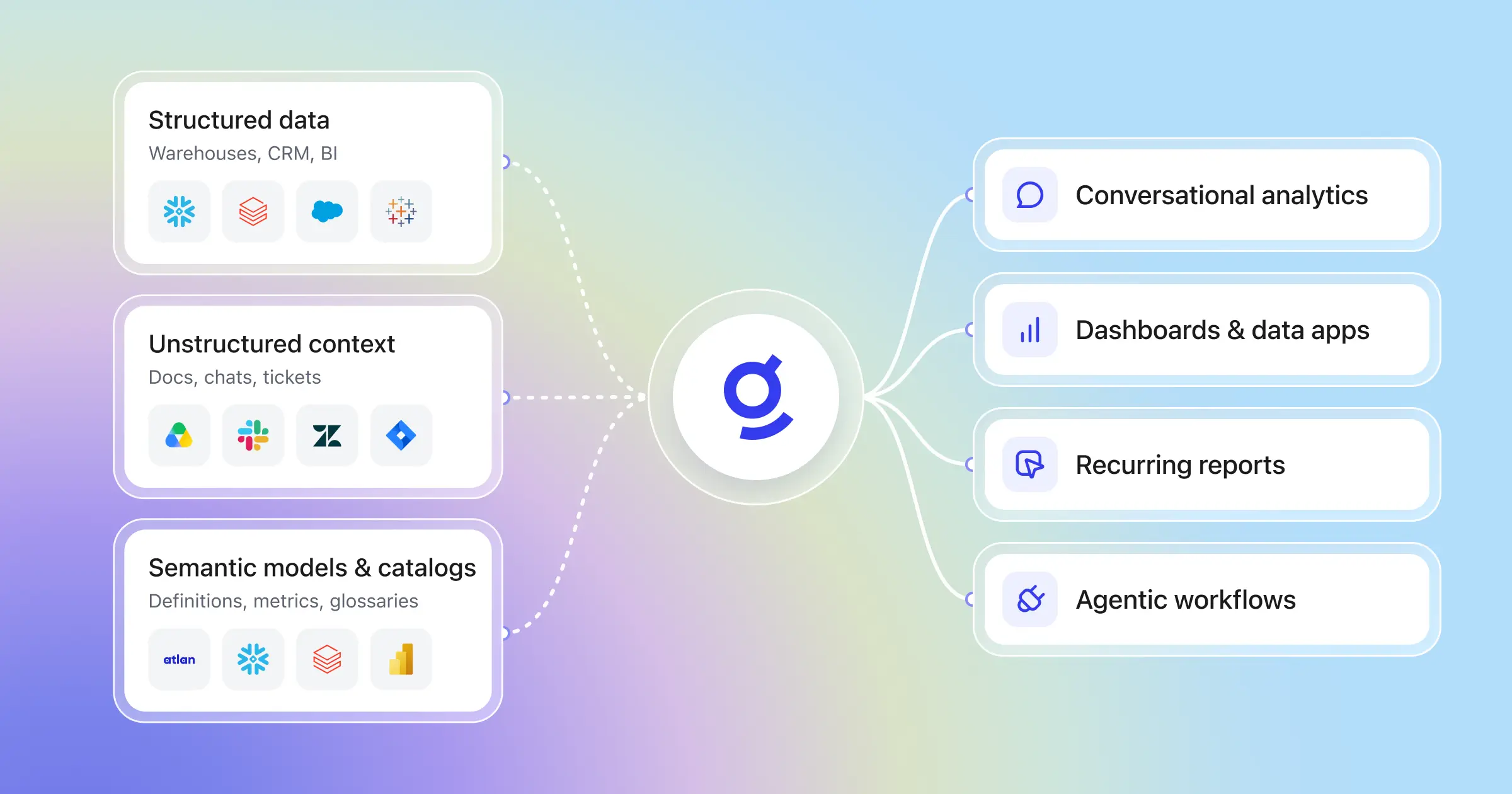
This process works best when humans stay in control of strategy while AI handles search, synthesis, and repetitive comparison. Glean approaches this by using its Enterprise Graph to unify knowledge across tools — connecting campaign data with the internal documents, audience definitions, and team notes that explain what the numbers actually mean.
The output is grounded in cited sources and respects existing permissions, so every team member sees only the data they are authorized to access. Each insight traces back to its origin, which makes it easier to trust the recommendation and act on it without second-guessing the source.
1. Connect campaign data across every system that shapes performance
Most marketing teams run campaigns across five to 15 platforms, but the data from those platforms rarely speaks the same language. Ad networks report impressions, CRM tracks pipeline stages, email tools count opens, and web analytics measures sessions. When each source stays in its own dashboard, the team sees fragments instead of a full story. A 2024 Gartner survey found that 75% of marketing leaders cite data integration as their top analytics challenge, and the root cause is usually access, not volume.
The fix starts with connecting both structured data (spend, clicks, conversion rates) and unstructured knowledge (launch briefs, audience definitions, weekly recaps, sales notes). That second category is where most integration projects stall. Ad platforms are easy to plug in. Internal documents are not, because they live in drives, wikis, messaging threads, and project management tools that traditional ETL pipelines ignore. According to Forrester research, organizations implementing AI marketing analytics see an average 23% productivity improvement and 19% better marketing ROI within the first year.
Glean Search connects to more than 100 enterprise applications and indexes both structured metrics and unstructured documents in one permission-aware layer. You can query across ad performance data and the original launch brief without switching tools or asking a colleague to forward a file. Because retrieval respects existing access controls, sensitive budget or pipeline information stays visible only to the people who should see it. The result is a connected foundation where every downstream question draws from the full picture, not a partial view.
2. Standardize metrics, naming, and campaign entities before asking AI for answers
AI can only produce reliable answers when the underlying data is consistent. If one platform labels a campaign "Q2_Brand_US" and another calls it "US Brand — Spring," the system treats them as two separate efforts. Multiply that mismatch across hundreds of campaigns and dozens of channels, and the errors compound fast. A 2023 Forrester report on marketing measurement maturity found that inconsistent taxonomy is the single largest barrier to cross-channel attribution accuracy.
Start by aligning core definitions: what counts as a qualified lead, how conversion rate is calculated, which spend categories roll up into which totals. Then normalize naming conventions so the same campaign, audience, and region are recognized everywhere they appear. Small fixes here — standardizing date formats, resolving duplicate contacts, aligning time zones — prevent large reporting errors later. AI-powered systems now handle much of this data cleaning and reconciliation work that previously consumed 60–80% of an analyst's time, running continuously in the background. Teams that invest in structured data analytics can accelerate this normalization significantly.
Build a shared semantic layer that gives AI a stable map of what each metric means and how related metrics connect. Without that layer, AI tools for marketers can summarize a single report but cannot reconcile conflicting KPI definitions across platforms. Glean's Enterprise Graph acts as this connective tissue, mapping relationships between campaigns, documents, people, and tools so that when a marketer asks a question, the answer reflects the full, consistent data set rather than whichever source happened to load first. A comprehensive knowledge graph is the foundation that makes this cross-platform reconciliation possible.
3. Add business context so AI can explain why performance changed
Numbers show what happened. Context explains why. A 12% drop in paid social conversions is just a data point until you connect it to the creative refresh that launched the same week, the landing page test that redirected half the traffic, or the budget reallocation that shifted spend toward a new audience segment. According to a 2024 McKinsey report on marketing analytics, organizations that pair performance data with qualitative business context are 2.3 times more likely to act on insights within the same planning cycle.
Bring in the documents people actually use to run campaigns: messaging hierarchies, experiment plans, budget change logs, postmortems, and feedback from sales or customer support. Customer language matters too. Reviews, support tickets, call transcripts, and win-loss summaries help AI spot shifts in sentiment and demand that performance tables alone miss.
Glean Assistant lets marketers ask follow-up questions in natural language and receive cited answers grounded in company knowledge. A demand generation lead investigating a conversion drop can ask "What changed in the retention campaign last week?" and get a response that references the specific brief update, the A/B test result, and the support ticket spike — all with source links. That grounding is what separates a generic summary from a deep research insights workflow where every explanation traces back to evidence the team can verify.
4. Ask AI the marketing questions that matter most
Once data is unified and contextualized, the value of AI shifts from aggregation to interpretation. Instead of building a new dashboard for every question, you can ask directly: Which campaigns drove pipeline this quarter? Why did cost per acquisition spike in the Midwest region? What content assets influenced closed-won deals in the mid-market segment? Natural language querying removes the bottleneck of remembering exact field names, filter logic, or which dashboard holds the answer. Teams looking for a starting point can explore ready-to-use AI prompts for marketing to accelerate this process.
Behind each question, several techniques work together. Retrieval augmented generation locates the most relevant information across connected systems. Summarization condenses results into a digestible explanation, and entity matching links campaigns, audiences, and assets across platforms so the answer reflects the full cross-channel picture.
A 2024 HBR article on marketing AI adoption noted that teams using natural language interfaces for data exploration reduced average time-to-insight from days to under 30 minutes. McKinsey's DataMatics survey reinforces this: organizations intensively using customer analytics are 23 times more likely to outperform competitors in new-customer acquisition.
The strongest outputs go beyond a short answer. They include supporting metrics, cited source material, and a recommended next question so the team can dig deeper without starting from scratch. Glean Assistant generates responses with inline citations, so when you review a campaign summary, you can click through to the original data source, the brief, or the customer feedback that informed the answer. That traceability builds the trust required to act on the insight instead of requesting another manual pull.
5. Use AI techniques that surface patterns, forecasts, and segment-level opportunities
AI becomes most valuable when the question shifts from "what happened" to "what should we do next." Pattern recognition, anomaly detection, trend clustering, predictive modeling, and recommendation generation each play a distinct role. Anomaly detection flags a sudden cost-per-click spike before it burns through budget. Clustering groups audience segments by behavior — purchase frequency, content engagement, conversion path — so you can tailor messaging to each group rather than blasting a single message to everyone. Understanding the distinction between predictive AI techniques and generative approaches helps teams choose the right tool for each analytical task.
Predictive models estimate outcomes such as conversion likelihood, churn risk, or the expected return from shifting spend between channels. The key is grounding those predictions in historical campaign data and current business context, not just statistical extrapolation. A 2023 AMA study on predictive analytics in marketing found that models incorporating both behavioral data and qualitative business inputs outperformed purely quantitative models by 34% in forecast accuracy. Research published in the Journal of the Academy of Marketing Science further illustrates this balance — Gen AI ads prompted three times higher click-through rates, but human-created ads generated 9.5 times as many leads, underscoring why human oversight remains essential.
For teams refining B2C marketing strategies, segment-level analysis connects audience behavior, offer timing, and channel response so personalization moves from guesswork to measured precision. Glean Agents can automate recurring analytical tasks — running weekly segment performance comparisons, flagging underperforming cohorts, and drafting summary reports — with governance controls that keep a human reviewer in the loop before any recommendation triggers a downstream change.
6. Turn insights into actions inside marketing workflows
An insight that stays in a dashboard is just an observation. The gap between analysis and action is where most marketing teams lose speed. Converting findings into clear next steps — adjusting budget allocation, revising subject lines, launching an A/B test, updating audience exclusions, or escalating a quality issue to the web team — requires the insight to arrive where work already happens, not in a separate reporting layer.
Push findings into the tools marketers use daily. That can mean alerts in Slack when a key metric crosses a threshold, auto-generated experiment briefs with a hypothesis, target segment, success metric, and review date, or follow-up questions routed to the right channel owner. When the path from insight to action is short, teams test faster and course-correct before a small problem becomes a quarter-long drag on performance. Platforms that support marketing task automation can streamline this handoff by connecting AI outputs directly to campaign management workflows.
Glean Agents support this handoff by orchestrating multi-step workflows with enterprise governance. Your marketing operations team can configure an agent to monitor weekly campaign results, draft a performance summary with cited data, flag anomalies, and route recommended actions to the appropriate owner — all without building a custom integration. Each step logs its reasoning, so you can audit why a specific recommendation was made and adjust the workflow as priorities shift.
7. Govern the system so insights stay reliable over time
Governance is what separates a pilot that impresses in a demo from a system teams actually trust quarter after quarter. Review data freshness, source coverage, metric definitions, and output quality on a regular cadence — monthly at minimum, weekly for high-volume campaigns. Without that rhythm, even well-built analytics systems drift. Connectors break silently, taxonomy updates lag behind new campaigns, and summaries start sounding confident while citing stale data.
Keep humans responsible for high-stakes decisions: budget reallocations above a set threshold, customer-facing messaging changes, and strategic pivots. AI accelerates the analysis, but the marketer owns the judgment call. Track which recommendations led to improved outcomes and which missed. That feedback loop sharpens future prompts, improves data mapping, and surfaces gaps in context coverage. A 2024 Forrester study on enterprise AI governance found that organizations with formal feedback loops improved model output quality by 28% over six months compared to teams that deployed AI without structured review. Implementing active data and AI governance ensures that sensitive data stays protected while teams scale their use of AI agents.
Glean's permission-aware architecture supports ongoing governance by design. Every answer cites its sources, every retrieval respects the access controls already set in connected systems, and administrators can monitor which queries surface which data.
When governance is strong, you move faster because you spend less time second-guessing whether the number is current or the source is trustworthy. That trust compounds over time, turning AI from an experiment into the default way your team makes decisions.
Frequently asked questions
What specific AI techniques can be used to analyze marketing data?
The most practical mix includes semantic retrieval, natural language querying, summarization, classification, clustering, anomaly detection, and predictive modeling. Each technique handles a different job: retrieval finds the right information, summarization explains it, clustering groups similar behaviors, and predictive models estimate what is likely to happen next.
How can AI help identify trends from scattered data?
AI compares patterns across channels, time periods, audience segments, and supporting documents at a speed manual analysis cannot match. It detects sudden changes, recurring themes, underperforming segments, and cross-channel relationships that are hard to see in separate dashboards.
What are the benefits of using AI for actionable marketing insights?
Faster analysis, clearer customer insights, stronger campaign performance decisions, and less time spent manually assembling reports from disconnected sources. Teams also shift from reactive reporting to proactive optimization by surfacing what changed, why it changed, and which action is most likely to improve results.
How do teams implement AI without disrupting the current stack?
Start with one high-value use case, such as weekly campaign reviews or diagnosing conversion drops. Connect the relevant systems, clean the data, define shared KPIs, and expand from there. The strongest rollouts build on existing workflows and keep permissions, governance, and source validation in place from day one.
What challenges should marketers expect?
The most common issues are inconsistent data definitions, weak taxonomy, missing business context, stale sources, and overreliance on uncited summaries. These are manageable when AI is grounded in trusted company data, tied to source evidence, and paired with clear governance and regular human review.
Request a demo to explore how Glean and AI can transform your workplace.

.jpg)

.png)



.jpg)
.webp)