




How B2B marketing teams can use shared context for effective launch planning
B2B marketing teams use shared context — a connected view of company knowledge, account signals, and team decisions — to plan launches faster and tailor messaging to specific accounts without starting from scratch each time.
Most B2B launches don't fail because teams lack effort. They break down when product marketing, demand generation, sales, and customer success operate from different versions of the same story. Launch briefs live in one tool, account notes in another, and customer feedback in a third.
Shared context solves this by giving every team access to the same trusted information: what changed, who it matters to, what proof exists, and where each account stands. The sections below walk through how to build and use that shared view across the full launch cycle — from connecting inputs to measuring results.
Define shared context for B2B launch planning
Shared context is the connected, searchable layer of company knowledge that B2B marketing teams use to plan launches and personalize account outreach. It combines launch briefs, product roadmaps, positioning documents, campaign history, sales notes, customer feedback, and account activity into one working view — so teams stop piecing together information from five different tools.
Fragmented launch context creates real problems because B2B buying decisions involve multiple stakeholders, long sales cycles, and cross-functional handoffs. When marketing, product, sales, and customer teams pull from different sources, messaging drifts, accounts get inconsistent outreach, and launch timelines slip. According to a 2023 Gartner survey of knowledge workers across industries, employees spend an average of 2.5 hours per day searching for information across tools — time that compounds fast during a product launch. In fact, a separate Gartner survey found that 45% of product launches are delayed by at least one month, frequently due to poor understanding of market requirements and internal misalignment.
For launch planning specifically, shared context helps teams answer practical questions quickly: what's launching, who it's for, what evidence supports the value claim, and what objections to expect. For account messaging, scattered signals — CRM notes, support tickets, prior campaign engagement — become usable insight. Instead of writing generic copy, marketers can tailor outreach to a buyer's role, priorities, and known pain points.
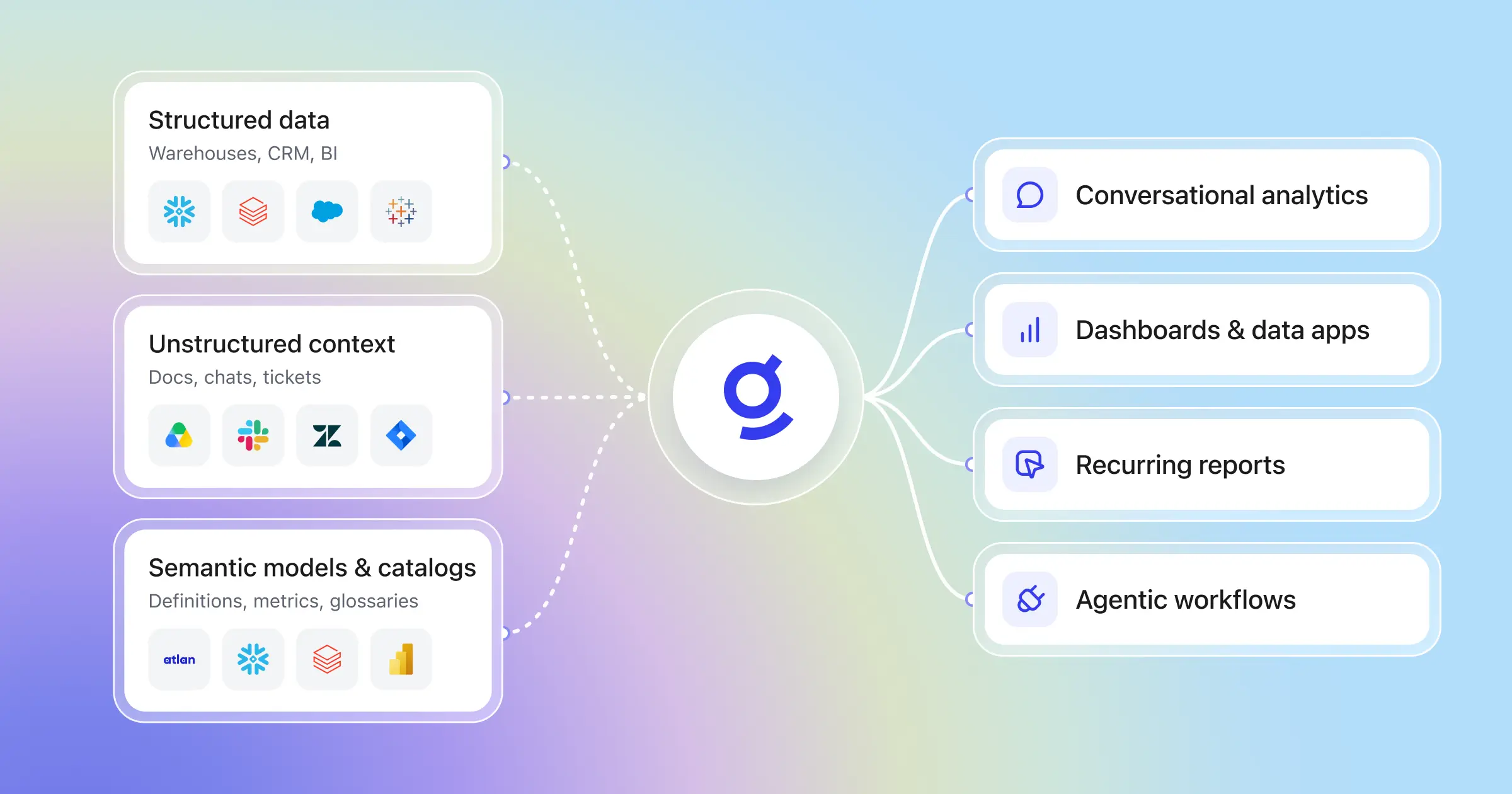
The foundation has to be trustworthy. Information should be current, searchable, grounded in source material, and easy to share without exposing sensitive data. Modern enterprise AI search makes it possible to connect disparate knowledge sources and return grounded answers — so marketers spend less time hunting and more time acting.
Glean Search connects enterprise knowledge across 100+ tools and returns cited, permission-aware results — so marketers can search, compare, and get grounded answers from a single interface without rebuilding context manually.
Use shared context to strengthen launch planning and account messaging
B2B marketing teams use shared context by connecting launch inputs, aligning on a single narrative, mapping accounts and stakeholders, tailoring messages from real evidence, coordinating execution, and learning from results. The goal is faster, better decisions across cross-functional teams that need the same facts without repeated handoffs.
Shared context supports real workflows across product marketing, demand generation, content, field marketing, sales, and customer teams. It improves launch readiness and keeps account messaging consistent from first touch to follow-up. Teams spend less time hunting through documents, chats, dashboards, and notes, and more time turning insight into campaigns and conversations. Research shows that companies with strong sales and marketing alignment experience 20% average annual revenue growth and are 67% better at closing deals — underscoring why shared context matters.
Used well, shared context reduces duplicate briefs, speeds up approvals, clarifies ownership, and produces more relevant messaging across target accounts. Companies using Glean for cross-functional knowledge sharing report that new employees reach productivity 30% faster — a signal that connected context accelerates work well beyond launch planning. The six steps below break down how to put shared context into practice using Glean's Enterprise Graph, which maps relationships across people, content, and activity to surface the right information at the right time.
1. Connect launch inputs into one trusted source
Start with the inputs that shape every launch: product changes, release timing, positioning, ideal customer profiles, market research, campaign plans, customer interviews, support tickets, open opportunities, and win-loss notes. These inputs already exist — the problem is that they live in separate systems with no connective tissue.
Do not rely on manual copy-paste into a slide deck or spreadsheet. Static summaries go stale within days and strip away the source material teams need when details shift close to launch. Instead, connect the systems where the work already lives so marketers can search across them, compare information, and get grounded answers without rebuilding launch context every week.
Keep source links and citations attached to the information. When a stakeholder asks where a proof point came from, or when a roadmap date changes, traceability saves hours of back-and-forth. Assign clear owners for critical inputs — release scope, proof points, pricing, target segments, and launch dates — so each source has a steward and an update rhythm.
Glean Search connects knowledge across tools like Confluence, Google Drive, Salesforce, and Slack, and returns cited, permission-aware results. Marketers can query "Q3 launch positioning" and get grounded answers drawn from the latest product documents, meeting notes, and campaign briefs — without opening five tabs.
2. Build a single launch narrative every team can use
Once inputs are connected, turn them into a single launch narrative every team can use. A useful launch brief answers five questions: what is launching, who it's for, why it matters now, how it changes the customer experience, and what teams should say when buyers ask follow-up questions.
Keep the narrative specific enough for execution. Include the decisions behind the message — tradeoffs, non-goals, known gaps, and unresolved questions — not just the final talking points. Notes on why the team chose one positioning angle over another prevent confusion later when different functions interpret the same asset in different ways.
Use grounded summaries from meetings, product documents, customer calls, and account feedback to replace long recap threads. Create one approved set of core talking points, then define how each function adapts them. Marketing needs campaign copy, sales needs objection-handling language, and customer teams need rollout guidance. Building a strong go-to-market team that partners deeply across functions is key to making this work.
Alignment no longer depends on who attended the last meeting. It depends on whether teams can access the same trusted narrative on demand. Glean Assistant lets any team member ask a question — "What's the approved messaging for the enterprise tier?" — and get a cited answer pulled from the latest launch brief, positioning doc, or internal FAQ, grounded in company knowledge.
3. Map shared context to target accounts and buying groups
Launch planning gets more actionable when teams connect the launch narrative to the accounts most likely to care. Start by layering account fit, open opportunities, stakeholder roles, recent engagement, support history, and customer journey stage on top of the launch message.
Go beyond broad segment views. B2B buying decisions involve multiple stakeholders inside the same account — champions, evaluators, budget owners, and end users — each with different priorities.
A technical evaluator may care about integration effort and rollout timeline, while a business leader may care about speed to value and team productivity. Shared context keeps those differences visible so marketers don't default to one-size-fits-all outreach. Research from Forrester shows that contact-level ABM can increase conversion to booked meetings by up to 74% — precisely because it addresses individual stakeholder priorities rather than treating the account as a monolith.
Build account-level context from sources teams already use: account plans, CRM notes, call summaries, prior campaign engagement, product feedback, support trends, and expansion signals. Then map that context to buyer needs. This is where account-based marketing strategies become practical — teams can prioritize accounts with relevant pain, active buying motion, or strong internal champions and tailor outreach to each.
With Glean Search, marketers can query across CRM records, call transcripts, and deal notes to build a full account picture without switching between Salesforce, Gong, and Slack. The Enterprise Graph surfaces relationships between people, content, and activity — so teams can see both what an account has done and which contacts inside the account are most engaged.
4. Build tailored account messaging from real evidence
Use the shared context you've gathered to create a message matrix for each priority segment or account tier. A practical message matrix includes:
- Persona — the specific buyer role (e.g., VP of Marketing, IT Director)
- Problem — the pain point most relevant to that persona
- Desired outcome — what success looks like from their perspective
- Supporting proof — customer stories, usage data, or analyst validation
- Likely objection — the concern they'll raise and how to address it
- Recommended call to action — the next step that fits their stage in the journey
Keep one stable core message across the launch, then adapt the angle by industry, role, account maturity, and funnel stage.
Pull proof from trusted internal sources — customer stories, product usage patterns, implementation notes, support resolutions, competitive feedback, and sales call takeaways. Specific proof makes account messaging more credible than generic value statements. For example, instead of saying "our platform improves productivity," reference the specific workflow improvement a similar customer experienced during onboarding. Knowing how to prepare for sales calls with this kind of evidence gives reps a measurable edge in buyer conversations.
Tailored messaging should sound informed, not invasive. Use context to clarify relevance — "We noticed your team recently expanded into EMEA, and our latest release supports multi-region compliance" — rather than overloading the buyer with every fact your team knows about the account.
Build modular assets from the message matrix so teams can reuse approved language across emails, landing pages, ad variations, sales follow-ups, and field campaigns without rewriting from scratch. Glean Assistant can help marketers draft segment-specific messaging by pulling from the latest positioning documents, customer proof points, and account context — then generating content grounded in company knowledge rather than generic templates.
5. Orchestrate launch execution where teams already work
Once the message is ready, make the context easy to access in the flow of work. Marketers, sellers, and customer-facing teams should find launch answers inside the tools they already use — Slack, email, CRM, project management — without opening five tabs and reading three meeting recaps.
Surface practical answers, not just documents. Teams need quick access to launch dates, approved claims, persona angles, account notes, asset status, and next steps. A question like "What's the objection-handling language for the mid-market tier?" should return a direct, cited answer — not a link to a 40-page enablement deck.
Use automation for repetitive launch work that depends on shared context: drafting campaign briefs, summarizing readiness meetings, generating launch FAQs, compiling enablement notes, and routing updates when source documents change. Marketing teams can automate marketing tasks like these using purpose-built apps and actions, freeing time for higher-value strategic work. Keep access permission-aware from the start. Some launch details — customer references, pipeline notes, pricing discussions — should only be visible to the right teams.
Coordinate around triggers and milestones. When a release note changes, a proof point gets approved, or an asset is updated, the right teams should know what changed and what action is required. Glean Agents can automate these workflows — monitoring for document changes, notifying stakeholders, and surfacing relevant context — with enterprise-grade governance and permissions built in.
6. Measure launch performance and feed the results back into shared context
Set launch metrics that reflect both execution quality and business impact. Useful measures include asset adoption, message consistency, engagement by segment, sales usage of launch content, influenced pipeline, meeting quality, objections surfaced, and time spent finding answers.
Review performance by account tier, persona, channel, and buyer stage. Total campaign numbers can hide important variation — one message may resonate with technical buyers while another moves executive stakeholders. Pair quantitative data with qualitative signals: notes from sales calls, customer questions, support escalations, and post-launch reviews often explain why a message landed, where it stalled, and what information was missing. The data reinforces the pattern: teams with aligned audience targeting see an 87% boost in conversions from target buying groups to pipeline — proof that shared context pays off at every stage.
Feed those learnings back into the same shared context layer the team used to plan the launch. Update the message matrix, account notes, FAQs, enablement content, and next-launch assumptions so the work compounds. Teams stop starting from zero and begin each launch with a better record of what worked, what changed, and what buyers actually cared about.
Glean's Enterprise Graph continuously learns from how teams interact with knowledge — surfacing the most relevant, authoritative content first — so each launch cycle benefits from the accumulated context of every previous one.
Frequently asked questions
What are effective ways to share context among B2B marketing teams?
Connect the systems where launch, campaign, and account knowledge already lives instead of creating another static repository. Make the information searchable, grounded in source material, and easy to access inside daily workflows. Keep permissions intact so teams collaborate broadly without exposing sensitive details.
How can shared data improve account messaging in B2B marketing?
Shared data helps marketers connect launch value to account reality — stakeholder priorities, open opportunities, prior engagement, and known friction points. It replaces broad personalization with messaging that is relevant, supportable, and consistent across channels. It also gives sales and marketing a common view of the account, which improves follow-up quality and reduces mixed messages.
What steps should be taken to plan a successful product launch in B2B?
Connect launch inputs into one trusted source, build a single narrative every team can use, and map it to target accounts. From there, tailor messaging from real evidence, orchestrate execution where teams work, and feed results back into shared context for the next launch.
How does shared context influence customer engagement strategies?
Shared context lets teams see the full picture of each account — past interactions, current priorities, recent engagement, and open issues — so outreach is relevant rather than generic. It also keeps messaging consistent across marketing, sales, and customer success, which reduces confusion and builds trust with buyers navigating long B2B sales cycles. Explore AI prompts for marketing to see how teams can use shared context to generate better campaign ideas and buyer insights.
What tools support shared context in B2B marketing teams?
Look for connected enterprise search across company knowledge sources, assistants that return grounded answers with citations, workflow automation that can summarize, route, and update launch work, and permission-aware systems that respect existing access controls. The key is connecting knowledge where it already lives rather than duplicating it into another tool.
With shared context, B2B launches follow a repeatable system — one where every team works from the same trusted knowledge, and every account gets messaging grounded in real evidence. The difference between a good launch and a great one is often how quickly teams can find, share, and act on the right information.
Request a demo to explore how Glean and AI can transform your workplace.

.jpg)

.png)



.jpg)
.webp)