

How repo-aware coding assistants compare to enterprise AI platforms
Repo-aware coding assistants and enterprise AI platforms solve different problems: coding assistants help individual developers write, review, and refactor code faster inside the editor, while enterprise AI platforms connect code to the broader context of documentation, tickets, decisions, and people across the entire software delivery lifecycle. The right choice depends on whether your bottleneck is writing code or finding the knowledge that shapes it.
That distinction matters more now than ever. According to the 2024 Stack Overflow Developer Survey, 62% of developers actively use AI coding tools, and AI generates roughly 41% of enterprise code in 2026, according to an Exceeds AI analysis of engineering teams. Yet engineering leaders report a persistent gap between what these tools produce and what production systems actually need. A developer can generate a service endpoint in seconds, but if the assistant doesn't know about a recent architecture decision documented in a design doc or a policy change discussed in Slack, the output may compile cleanly and still be wrong.
This article breaks down how repo-aware coding assistants and enterprise AI platforms differ across context scope, users served, governance, and automation. If you're evaluating AI tools for your software engineering team, the comparison that follows will help you match each category to the work it actually fits.
Understand which layer of engineering work each category serves
Repo-aware coding assistants and enterprise AI platforms occupy different layers of the engineering workflow. According to the DORA 2025 State of AI-Assisted Software Development report, 90% of software development professionals had adopted AI tools at work by 2025, with developers spending a median two hours per day on AI-assisted work. Yet coding assistants are optimized for individual developer flow inside the editor, terminal, or pull request, while enterprise AI platforms are built for cross-system reasoning and action across repositories, tickets, documents, chat, CI systems, runbooks, and people. Choosing between them starts with the job to be done.
When a developer needs to refactor a function, generate unit tests for a module, or understand an unfamiliar file in a monorepo, a repo-aware assistant is the right tool. Research from MIT, Princeton, and the University of Pennsylvania found that developers using an AI coding assistant completed 26% more tasks on average, with junior developers seeing gains of 27–39%. These tools index the local codebase, parse syntax trees, and use surrounding files as context to produce relevant completions, explanations, and edits. The workflow stays inside the editor, and the feedback loop is fast. For tasks where the answer lives in code, repo-aware tools are the right fit.
The picture changes when the answer doesn't live in code. Consider an engineer debugging a production incident at 2 a.m. The root cause might involve a config change approved in a ticket three weeks ago, a capacity decision documented in a design review, and a rollback runbook buried in a wiki. A repo-aware assistant sees the code but not the ticket, the design doc, or the runbook. An enterprise AI platform connects to all of those systems and returns a grounded answer with citations from each source, scoped to what that engineer has permission to see.
Five dimensions help you evaluate which category fits a given workflow:
- Job to be done. Code-centric tasks like completion, refactoring, and test generation favor repo-aware tools. Cross-system tasks like incident triage, onboarding, and architecture research favor enterprise platforms.
- Context the tool can access. Coding assistants draw from repository files, git history, and sometimes local documentation. Enterprise platforms draw from 100+ connected tools, building a unified understanding of people, content, and activity across the organization.
- Users served. Coding assistants primarily serve individual developers. Enterprise platforms serve developers, engineering managers, SREs, product managers, and anyone who touches the software lifecycle.
- Controls required. As AI moves beyond experiments, governance features like SSO, audit logs, and permission-aware retrieval (where answers are scoped to only the content each user already has access to) become deciding factors. Enterprise platforms are built around these controls from the start.
- Workflows each can automate. Coding assistants automate code generation, PR summaries, and commit messages. Enterprise platforms automate multi-step workflows that span tools, such as triaging a support escalation by pulling context from the ticket, the relevant service's recent deploys, and the on-call rotation.
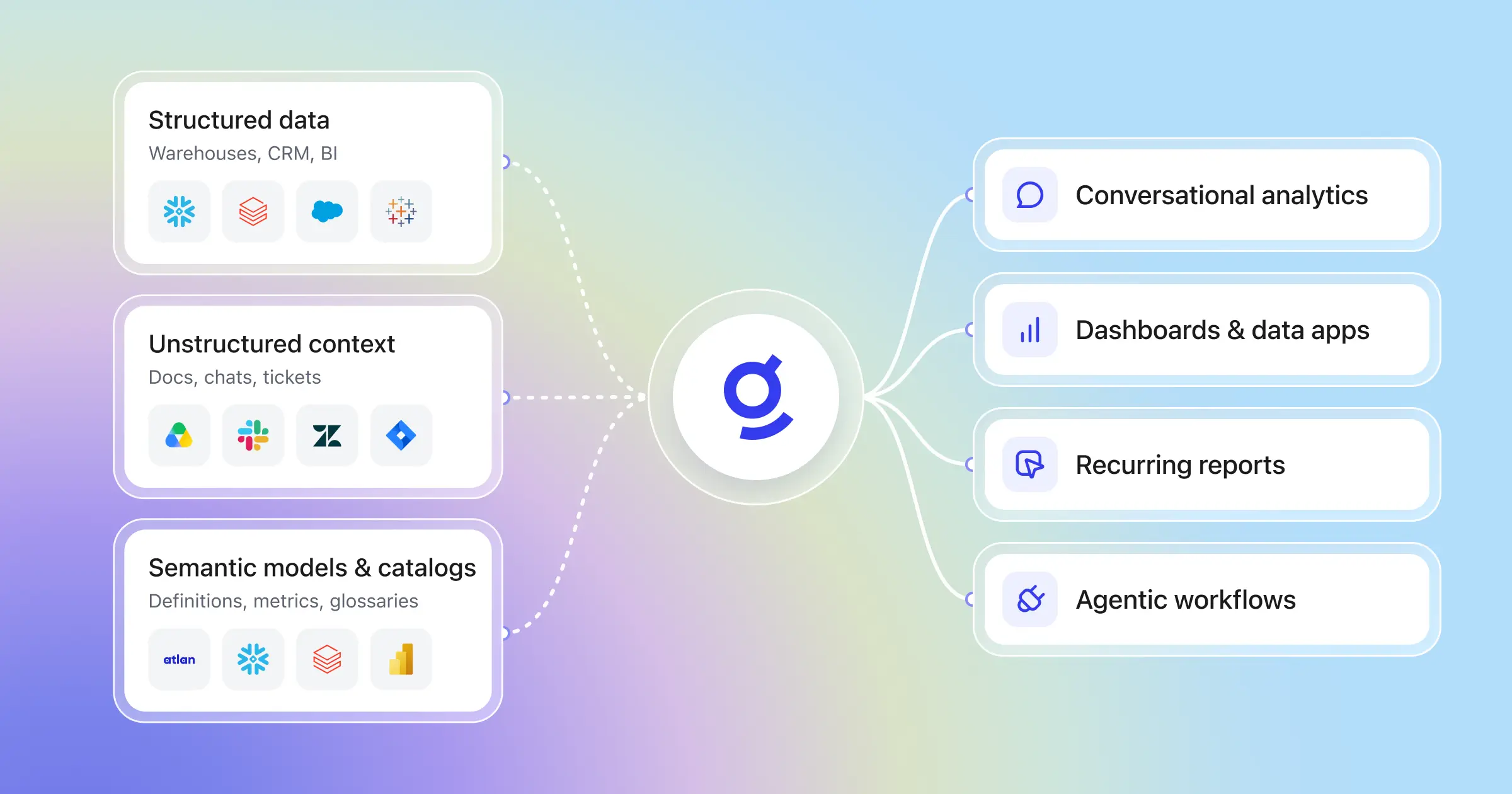
Glean's Enterprise Graph is one example of how enterprise platforms build this cross-system context. Rather than treating each connected tool as an isolated data source, the Enterprise Graph maps relationships among repositories, documents, conversations, and people, so an engineer asking about a recent architectural decision gets context from the pull request, the design doc, and the team discussion together.
Neither category replaces the other. Repo-aware assistants and enterprise AI platforms address different parts of the broader AI stack that engineering teams are building. Start with the problems your engineers lose the most time on today, and match each category to that layer of work.
Compare the core job each category is built to do
Repo-aware coding assistants are built around one job: helping a developer write, edit, explain, and test code using the repository as context. They parse syntax trees, index nearby files, and use patterns in the current project to generate completions, refactors, and explanations. The center of gravity is always the codebase itself.
Enterprise AI platforms are built around a different job: helping teams find trusted answers and take action across company knowledge and workflows. Their center of gravity is the broader engineering operating environment, including documentation, tickets, design decisions, incident histories, and the people connected to each system.
The practical difference shows up fast. When a developer needs a unit test for a utility function, a repo-aware assistant is the right tool. When a developer needs to understand why a service was built a certain way, who approved the current architecture, and what rollout policy applies, the answer usually lives across a design doc, a Slack thread, a ticket, and a pull request. No amount of repository indexing surfaces that context.
That distinction — code generation versus company-grounded reasoning — is the first real fork in AI for software development. Many buying mistakes happen when teams expect a coding assistant to act as a full engineering knowledge layer, or expect an enterprise platform to replace in-editor code completion. Each category earns its value in a different part of the workflow, and teams that try to double developer productivity with only one category often hit diminishing returns.
Glean's Agentic Engine is purpose-built for that second job. It reasons across connected systems to answer multi-step engineering questions, pulling from repositories, wikis, tickets, and chat in a single response rather than asking the developer to search each tool separately. That cross-system reasoning is what separates generative AI for software engineers from code completion alone.
Repo-aware tools reduce the friction of writing code. Enterprise platforms reduce the friction of understanding the system around it. Neither replaces the other, and confusing them leads to mismatched expectations.
Compare the context each tool can actually understand
Repo-aware coding assistants draw context from a well-defined perimeter: the files in the current repository, git history, open tabs, and sometimes local documentation. Within that perimeter, they perform well. They can trace function calls, identify patterns across modules, and generate suggestions grounded in the project's own conventions.
The perimeter becomes a constraint when the right answer depends on information outside the repository. Product requirements live in a project management tool. Architecture decisions live in design documents. Incident postmortems live in a wiki. Approval chains live in tickets. Customer escalation context lives in a support system. A repo-aware assistant sees none of that, even when the code change it suggests should account for all of it.
Enterprise AI platforms extend the context perimeter to the full set of tools an engineering organization uses. Using knowledge graphs for enterprise AI, they connect to code hosts, issue trackers, wikis, document stores, chat systems, incident platforms, and more, then retrieve information based on the user's existing permissions. The result is a grounded answer with citations from across sources, not a guess based on code patterns alone.
That grounding matters for verification. When an engineer receives an answer about a deployment freeze or a dependency risk, they need to trace the claim back to its source. Enterprise platforms return linked references so the engineer can confirm the answer before acting on it. Repo-aware tools, by design, cite code, not company knowledge.
Scale amplifies the gap. In a 50-person startup, most context fits in a handful of repositories and a shared Slack workspace. In a 5,000-person organization with hundreds of services, the truth about any system is spread across dozens of tools and teams. Glean's Enterprise Graph maps relationships among repositories, documents, conversations, and people to surface that distributed context in one place, scoped to the permissions each user already has.
Context scope is not a feature comparison. It is a category distinction. Coding assistants are deep on code. Enterprise platforms are broad across knowledge. The right tool depends on where the answer actually lives.
Compare the day-to-day developer workflows each tool improves
Repo-aware coding assistants fit best in workflows that start and end inside the editor. The strongest use cases — from boilerplate generation and test drafting to bounded refactors, code explanations, and AI prompting for software engineers — share a common trait: the relevant context already exists in the repository, and the developer needs faster execution, not broader understanding.
Enterprise AI platforms fit best in workflows that span tools and teams. The strongest use cases include answering architecture questions, summarizing design history, finding the right service owner, locating runbooks during incidents, speeding up onboarding for new engineers, surfacing related past incidents, preparing release notes from scattered sources, and pulling together context before a change is made.
The divergence becomes clear in specific engineering moments:
- A developer says "write a test for this function" or "explain this class." A repo-aware assistant handles that well.
- A developer says "what services depend on this one," "who approved the current retry policy," or "what broke the last time we changed this config." That question crosses tool boundaries and requires enterprise-wide retrieval.
When teams rely only on coding assistants, the code gets written quickly, but the surrounding work — finding the right context, confirming the right approach, and aligning with the right people — stays slow.
Glean Assistant addresses that surrounding work directly. An engineer can ask a question in natural language and get a cited answer drawn from connected repositories, documents, tickets, and conversations, without leaving the flow of work. The answer includes source links, so the engineer can verify before acting. That workflow, question to verified answer to action, is the one enterprise platforms are built to shorten.
Coding assistants speed up the writing itself, while enterprise platforms reduce the time spent on everything surrounding the code change — finding context, verifying decisions, and coordinating across teams.
Compare which tool is better for team collaboration in software development
Enterprise AI platforms are generally better for team collaboration because collaboration in software engineering depends on shared knowledge, not just shared code. A repo-aware coding assistant improves the experience of the person in the editor. It does not automatically close the knowledge gaps between teams, services, or time zones.
Collaboration in engineering looks like this: onboarding a new hire who needs to understand 15 services in two weeks. DX's Q4 2025 report found that daily AI use cut onboarding time nearly in half, reducing time to a new developer's 10th merged PR from 91 days to 49 days. But the broader challenge remains: tracing a past decision that shaped a system's current behavior, finding the right reviewer for a change that touches three teams' boundaries, coordinating an incident across SREs, application developers, and the on-call product manager, or answering the same onboarding question for the fourth time this quarter without interrupting a senior engineer.
These situations share a pattern. The bottleneck is not writing code. The bottleneck is finding, sharing, and reusing knowledge that already exists somewhere in the organization but is buried across tools, threads, and documents. Effective knowledge management in software development is what closes that gap.
Enterprise AI platforms make that knowledge searchable and answerable from a single interface. Rather than pinging a colleague, searching three wikis, and scrolling through old Slack threads, an engineer can ask a question and get a grounded answer with sources — the core promise of enterprise knowledge management. The knowledge stays accessible whether the original author is on vacation, has left the company, or is asleep in another time zone.
Glean's Enterprise Graph strengthens this pattern by mapping relationships between people, content, and activity across connected systems. When an engineer asks who owns a particular service, the answer draws from repository contributors, recent document authors, ticket assignees, and organizational data, not just a stale wiki page. That relationship-aware retrieval is what makes the answer trustworthy and current.
A useful contrast for teams evaluating tools: if the problem is "my developers spend too much time writing routine code," start with a coding assistant. If the problem is "my developers spend too much time hunting for answers across repos, tickets, docs, and chat," the category that fits is closer to enterprise AI software than to a standalone editor tool.
Compare features, limits, and failure modes side by side
A structured comparison helps clarify what each category includes and where each one falls short.
| Dimension | Repo-aware coding assistants | Enterprise AI platforms |
|---|---|---|
| Primary function | Code generation, completion, refactoring, and testing inside the editor | Cross-system search, answers, and workflow automation across engineering tools |
| Context sources | Repository files, git history, open editor tabs, local docs | 100+ connected tools: repos, wikis, tickets, chat, incident systems, documents, people data |
| User scope | Individual developers | Developers, engineering managers, SREs, product managers, and cross-functional teams |
| Output style | Code suggestions, inline edits, PR summaries, commit messages | Cited answers with source links, automated multi-step workflows, knowledge summaries |
| Permission model | Typically scoped to repository access | Permission-aware retrieval across all connected systems |
| Governance controls | Varies; often adopted bottom-up before governance is applied | Built-in SSO, audit logs, admin controls, and centralized policy management |
| Strongest use case | Writing, explaining, and testing code where context lives in the repo | Finding answers, coordinating work, and automating tasks where context spans tools and teams |
Repo-aware assistants are limited when the right answer depends on business context, historical decisions, documentation outside the repository, or knowledge spread across teams. They may generate plausible code that compiles cleanly but misses a policy constraint, a known service dependency, or an incident pattern that should shape the change.
Enterprise platforms are limited when the task is purely code execution. They are not built to be the fastest tool for inline completion, local rewrites, or editor-native pair programming. They find the right answer and the right next steps, but the code-writing step itself often belongs to a different tool.
Glean Agents bridge part of this gap by executing multi-step workflows across connected systems. An agent can triage a support escalation by pulling context from the ticket, checking the relevant service's recent deploys, and identifying the on-call engineer, all within governed permissions. That workflow automation goes beyond what either a standalone coding assistant or a simple search interface can do.
Understanding where each category breaks down is more useful than comparing feature lists alone. The failure mode reveals the boundary.
Compare governance, security, and scale for enterprise teams
Governance becomes the deciding factor once AI moves from individual experiments into production engineering operations. The 2025 Stack Overflow Developer Survey found that 69% of AI agent users report increased productivity, yet the question for enterprise teams has shifted from "which tool writes better code" to "how will AI access sensitive code, internal documents, incident data, customer information, and operational workflows across the organization."
Repo-aware coding assistants are often adopted bottom-up. A developer installs an extension, connects a repository, and starts generating code. That pattern works for code assistance, but it does not address the governance requirements that enterprise teams face once AI touches knowledge beyond a single repository.
Enterprise AI platforms approach governance differently. They are built to respect existing permissions across every connected system, so a user only sees answers sourced from content they already have access to. An engineer with access to one repository and one incident channel receives answers scoped to those sources, even when the platform is connected to hundreds of repositories and systems across the organization.
The importance of permission-aware AI retrieval is especially clear in software engineering, where access boundaries are granular. The same engineer might have read access to a frontend repository but not the infrastructure repo, visibility into one team's incident thread but not another's, and access to a design document shared within their org but not a confidential roadmap shared only with leadership.
Scale adds another layer. A system that works for one team and a handful of repositories must also work for hundreds of teams, thousands of repositories, and dozens of connected knowledge sources while remaining manageable for IT, security, and engineering leadership. Achieving AI governance at scale — with centralized admin controls, audit logs, and consistent policy enforcement across departments — is a requirement, not a feature.
Glean's permission-aware architecture enforces these boundaries by default. Every answer, every search result, and every agent action respects the access controls already configured in the source systems. There is no separate permission layer to maintain. That design reduces the operational burden on security teams and gives engineering leaders confidence that expanding AI access does not mean expanding data exposure.
If the primary challenge is safe, governed access to engineering knowledge and actions at company scale, the enterprise platform category is built for that problem.
Choose the right tool based on the software engineering problem you need to solve
The decision starts with the problem, not the tool. Match each category to the layer of engineering work it actually handles.
Choose a repo-aware coding assistant when the primary goal is helping individual developers code faster inside their daily environment. Strong fits include writing boilerplate, generating tests, refactoring bounded code, explaining unfamiliar files, drafting PR summaries, and producing first-pass implementations. A randomized controlled trial across 4,800 Accenture developers measured a 75% reduction in PR cycle time when using a coding assistant — evidence that for tasks where the context lives in the repository, the value comes from faster execution within the editor.
Choose an enterprise AI platform when the primary goal is helping teams find answers, reduce interruptions, reuse existing knowledge, and automate work across tools. Strong fits include onboarding new engineers, investigating incidents across systems, answering architecture questions, looking up service ownership, coordinating releases, and executing multi-step workflows tied to trusted company context.
Many engineering organizations benefit from a combined model. Use coding assistants for code-centric execution. Use an enterprise AI platform as the shared layer for knowledge, context, and governed actions across the software delivery lifecycle. Developers still get fast in-editor help. The broader organization gets a reliable system for cross-tool retrieval and workflow automation.
Glean fits the enterprise layer in that model. Its Enterprise Graph connects repositories, documents, tickets, conversations, and people into a unified context layer with permission-aware retrieval, so engineering teams get grounded answers and workflow automation without building a separate knowledge infrastructure.
The layered approach works because code generation and company-wide knowledge retrieval are different problems with different data requirements, different user scopes, and different governance needs. Forcing one tool to cover both leads to gaps in either speed or breadth.
A clear selection rule: if the question starts with "write," "refactor," "test," or "explain this code," start with a repo-aware assistant. If the question starts with "find," "understand," "verify," "coordinate," or "automate work across systems," start with an enterprise platform.
How repo-aware coding assistants compare to enterprise AI platforms: frequently asked questions
What specific features differentiate repo-aware coding assistants from enterprise AI platforms?
Repo-aware coding assistants focus on code-centric capabilities: inline suggestions, repository-aware chat, refactoring, debugging help, and test generation. Enterprise AI platforms focus on cross-system retrieval, permission-aware answers with cited sources, and workflow automation across engineering tools and knowledge sources. The core distinction is scope: one is built to help write code in repository context, and the other is built to help teams find answers and act across company context.
Which type of tool is better for team collaboration in software development?
Enterprise AI platforms typically provide more collaboration value because engineering collaboration depends on shared knowledge across documents, tickets, chat, repositories, and people, not just shared code. Repo-aware coding tools help individuals move faster, but they do not create a shared answer layer across the engineering organization. Teams with high interrupt loads, complex ownership structures, or long onboarding cycles usually feel the difference fastest.
What are the limitations of repo-aware coding assistants compared to enterprise AI platforms?
The biggest limitation is context scope. Repo-aware assistants are strongest when the answer lives in the repository and weakest when the answer depends on company knowledge outside the codebase, such as design intent, policy constraints, historical decisions, service ownership, or operational context. That does not make them less useful for code-centric work. It means they solve a narrower part of the engineering job.
Do software engineering teams need both categories?
Often, yes. Engineering work spans code execution and company context. A coding assistant speeds up implementation, while an enterprise platform supplies the trusted knowledge and workflow support needed before and after the code change. Teams get the strongest result when they match each tool to the layer of work it is actually built to handle, rather than expecting one category to cover both.
The strongest engineering teams don't choose between faster code generation and better knowledge access — they invest in both. Repo-aware coding assistants handle the code-centric work, and an enterprise AI platform handles everything around it: finding the right context, verifying decisions, and automating cross-tool workflows. Request a demo to explore how Glean and AI can transform your workplace.

.jpg)

.png)



.jpg)
.webp)