


Key features to compare: AI coding assistants vs. enterprise context platforms
Evaluating AI coding assistants against enterprise context platforms starts with understanding they solve different problems: one speeds up writing code, the other speeds up finding the knowledge that shapes what you build. The features that matter most depend on which bottleneck your team actually faces.
AI coding assistants work inside your IDE to generate, complete, and refactor code using large language models (LLMs). Enterprise context platforms connect to your organization's documents, tickets, conversations, and repositories to surface relevant knowledge across every team. Both categories are growing fast, and many organizations now use tools from each.
This article breaks down the key features to compare across both categories — context depth, integration capabilities, security, performance measurement, scalability, and cost — so you can build an evaluation framework grounded in your team's real needs, not vendor marketing.
What are AI coding assistants and enterprise context platforms?
AI coding assistants generate, complete, and refactor code inside your IDE using large language models. Enterprise context platforms connect to all of an organization's knowledge — documents, tickets, conversations, repos, and wikis — and make that context available to people and agents across every function. They solve adjacent problems: one accelerates writing code, the other accelerates understanding the context around it.
Coding assistants handle a narrow task well. They predict the next line, suggest a function body, or refactor a block based on the open file and nearby code. Their context window typically spans tens of thousands to hundreds of thousands of tokens drawn from the current repository.
That scope works for syntax-level tasks but falls short when a developer needs to understand why a service was designed a certain way, who owns an API, or what business requirements drove a past architectural decision. The question of whether AI can truly double developer productivity depends on how much of the work is code generation versus context gathering.
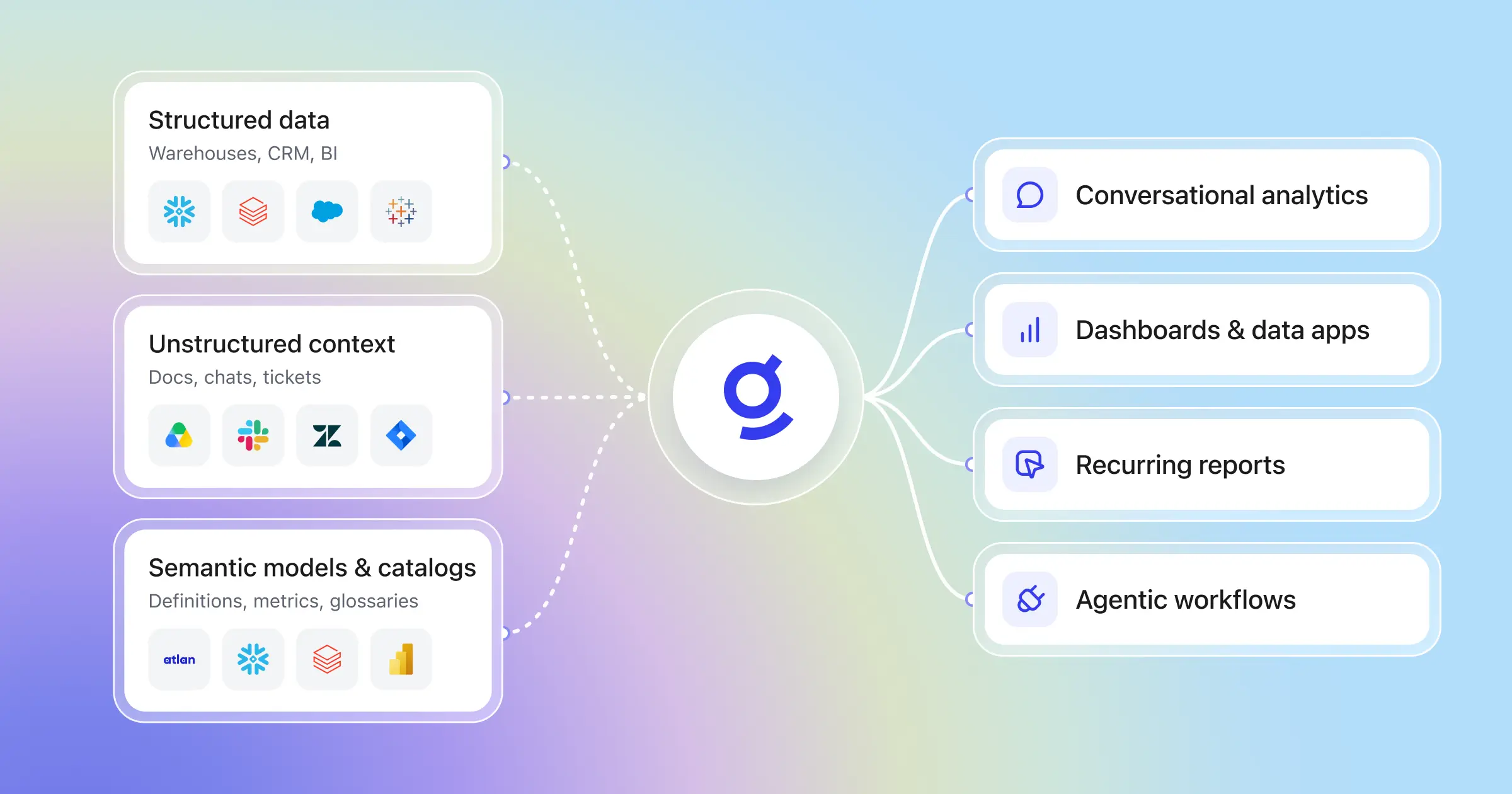
Enterprise context platforms take a wider approach. They build a persistent knowledge graph that maps relationships between people, content, and interactions across every connected system — not just code.
Consider a concrete example: a coding assistant can suggest how to implement a payment retry function, but it can't tell you that the product team specified a three-attempt limit in the requirements doc, that the previous implementation caused a billing incident documented in a postmortem, or that the payments team discussed the retry logic in a Slack thread last quarter. Glean's Enterprise Graph surfaces exactly that kind of cross-system context, connecting information from 100-plus apps so engineers spend less time searching and more time building.
The distinction matters because code generation is only one piece of software delivery. According to Gartner, employees spend an average of 2.5 hours per day searching for information across tools — and for developers, that search often involves design docs, team ownership, and past decisions rather than code. Research from the University of California, Irvine found that it takes an average of 23 minutes and 15 seconds to fully regain focus after a significant interruption, which means every tool switch compounds the productivity loss. High-performing engineering organizations recognize this and invest in both categories: coding assistants to accelerate writing, and context platforms to accelerate understanding.
How does context depth differ between coding assistants and enterprise platforms?
Coding assistants understand your code. Enterprise context platforms understand your organization. The gap between those two determines how much time your team spends switching tabs, searching wikis, and chasing down tribal knowledge before writing a single line.
AI coding assistants pull context from the files open in your editor and, in some cases, a broader repository index. That scope works well for autocomplete, refactoring, and generating boilerplate. But it hits a wall when a developer needs to answer questions like "Why did we deprecate this endpoint?" or "Which downstream services depend on this data format?" Those answers live in design documents, architecture decision records, and past incident reviews — none of which exist inside the codebase.
Enterprise context platforms close that gap by indexing knowledge across every connected system and preserving the relationships between artifacts. Glean's Personal Graph, for example, learns which projects, teams, and tools each person works with so it can surface the most relevant context for that individual — not just the most popular result. The result is that a backend engineer searching for "rate limiting" sees the service owner's design doc and the related Jira epic, while a product manager sees the feature spec and customer feedback thread.
The practical test is straightforward: ask your team where they actually spend time stuck. If the bottleneck is syntax and boilerplate, a coding assistant addresses it. If the bottleneck is finding and verifying information scattered across a dozen tools, context depth at the organizational level is what you need. A strong knowledge management strategy can help teams quantify and close that gap.
What integration capabilities should teams evaluate?
Teams should evaluate both the breadth and depth of a tool's integrations — how many systems it connects to, and how much useful information it extracts from each one. A long connector list means little if the connectors only pull surface-level metadata.
Coding assistants integrate with IDEs, version control systems, and sometimes CI/CD pipelines. Some now support the Model Context Protocol (MCP) to reach external data sources, but the integration surface stays centered on the developer's editor. That limited scope is fine for code-centric tasks, but it means engineers still need to leave their workflow to find information stored in project management tools, documentation wikis, or communication platforms.
Enterprise context platforms take a different approach by connecting to the full range of tools an organization uses — from GitHub and Jira to Salesforce, ServiceNow, and internal wikis. The critical detail is whether each connector respects source-system permissions natively. Evaluating connector quality means asking whether connectors index deep content or just surface metadata, and whether they enforce permissions at the data layer. Glean Agents can both retrieve and act on information across these connected systems, so a developer can trigger a workflow that pulls the latest deployment runbook and the on-call schedule without switching applications.
When running your evaluation, test connectors against your actual tool stack in a staging environment. Verify that permission enforcement works as expected, that search results reflect real access controls, and that updates from source systems appear in the platform within a reasonable timeframe — ideally minutes, not days.
What security features matter most when comparing these tools?
Permission-aware retrieval, data retention policies, and deployment flexibility are the three security dimensions that separate enterprise-ready tools from everything else. Getting any of these wrong can expose sensitive data at scale.
AI coding assistants introduce a specific risk: source code — often a company's most valuable intellectual property — leaves the local environment and travels to an external inference endpoint. The security questions to ask are direct: Does the vendor retain code after inference? Is any customer data used to train or fine-tune models?
Some vendors now offer zero-retention agreements with their upstream LLM providers, but teams should verify these contractually, not take a marketing page at face value. A 2025 BigID report found that 69% of organizations cite AI-powered data leaks as their top security concern, yet nearly half have no AI-specific security controls in place. Can telemetry collection be fully disabled? Ask — and get the answer in writing.
Enterprise context platforms face a broader challenge because they index content from across the entire organization. The key differentiator is whether access controls are enforced before data reaches the model — not after. If a document in Google Drive is restricted to three people, only those three should see it in search results or in any AI-generated answer. Glean Search enforces source-system permissions at query time — meaning results are filtered against each user's actual access rights before any AI model sees the data. Access controls stay current as permissions change in the original application, without requiring a manual sync or admin intervention.
For organizations in regulated industries — financial services, healthcare, government — deployment flexibility is non-negotiable. Cloud-only tools may not meet data residency or air-gapped requirements. Evaluate whether the vendor offers VPC, on-premises, or hybrid deployment models before you get deep into a proof of concept.
Use this checklist to evaluate prompt and data handling
- Is inference data retained after processing? If so, for how long and in which geography?
- Is any customer data used for model training or fine-tuning?
- Can all telemetry and usage data collection be fully disabled?
- Are results filtered by the user's actual permissions before reaching the LLM?
- What happens to indexed data if the contract is terminated or not renewed?
How should teams measure performance and effectiveness?
Measure coding assistants on downstream quality, not upstream speed. Measure context platforms on time saved finding information, not just search volume. The wrong metric for either category will lead you to the wrong vendor.
For coding assistants, suggestion acceptance rate is the most commonly tracked metric — and the most misleading. A high acceptance rate tells you developers are clicking "accept," but it says nothing about whether the accepted code survives review, introduces security vulnerabilities, or increases incident frequency. A more useful set of metrics includes PR cycle time, defect escape rate, and the ratio of security findings in AI-assisted changes versus human-written changes. A 2024 randomized controlled trial published by METR found that experienced open-source developers using AI coding tools took 19% longer to complete tasks than those working without assistance — a result that underscores the need to measure outcomes, not just activity.
For enterprise context platforms, the metrics tie more directly to operational cost savings. Track time-to-answer (how quickly someone finds what they need), ticket deflection rate (how many IT or support questions get resolved without a human agent), and onboarding velocity (how fast new hires reach productive output). Glean Assistant, for instance, provides answers grounded in your organization's own data, which lets you measure whether employees are getting accurate responses rather than filing redundant support requests.
Regardless of which category you're evaluating, establish a baseline before the pilot begins. Compare pre-rollout metrics to post-rollout metrics over a fixed period — four to eight weeks is typical — and hold the tool to the same quality standards you'd apply to any production system.
What does scalability look like for each category?
Coding assistants scale linearly with headcount. Enterprise context platforms scale with both headcount and the volume of organizational knowledge they index. Understanding which dimension matters more to your organization shapes the buying decision.
Coding assistant costs are straightforward: per-seat pricing, typically between $10 and $200 per developer per month depending on the tier. The less obvious scalability concern is governance. When hundreds of engineers each have access to an AI coding tool, administrators need centralized controls — model selection policies, usage dashboards, and the ability to enforce consistent code review standards across all AI-assisted output. Without these controls, adoption at scale creates fragmentation rather than efficiency.
Enterprise context platforms face a different scalability challenge. A deployment serving 500 people across five applications looks nothing like one serving 50,000 people across 150 applications. ISG's 2025 State of Enterprise AI Adoption report found that only 31% of prioritized AI use cases have reached full production — double the rate from 2024 — illustrating how difficult it remains to scale AI tools beyond initial pilots.
Retrieval speed, answer accuracy, and index freshness all need to hold up as the knowledge base grows. Glean's Agentic Engine is built to handle this kind of scale, powering enterprise search and agent workflows across large organizations without degrading response quality as data volume increases.
There's also an adoption dimension. Coding assistants serve one role: developers. Context platforms serve every function — engineering, support, sales, HR, legal, finance. That broader surface area means faster organization-wide ROI, but it also requires a rollout strategy that accounts for different teams, different use cases, and different levels of technical comfort.
How should teams run a cost-benefit analysis across both categories?
Total cost of ownership extends well beyond the license fee. For coding assistants, factor in downstream costs like increased code review time and security remediation. For context platforms, measure the value of hours reclaimed across every team that uses the tool.
Coding assistant pricing looks simple on paper — a per-seat monthly charge — but the real costs show up later. A 2025 GitClear analysis found that AI-assisted code tends to generate more review churn and a higher rate of reverted changes, adding downstream cost that the license fee doesn't reflect.
A tool that saves 20 minutes of writing time but adds 45 minutes of review and fix time is a net negative. Your cost model should capture review hours, rework hours, and incident response hours alongside the license fee. Maximizing coding time and efficiency requires looking at the full development lifecycle, not just the speed of code generation.
Enterprise context platforms carry their own cost profile: licensing, connector setup, administrative overhead, and the organizational change management required to drive adoption. But the ROI formula is broader. Instead of measuring "more code produced," you're measuring "fewer hours spent searching," "faster incident resolution," and "fewer redundant support tickets." These outcomes translate to capacity freed for higher-value work across every department, not just engineering. Glean's enterprise AI platform is designed to deliver this kind of cross-functional value, connecting knowledge workers to the information they need regardless of where it lives.
When presenting the analysis to leadership, build a model that works in plain terms: time saved per person per week, multiplied by fully loaded hourly cost, multiplied by the number of affected employees, minus total platform cost and implementation effort. Treat risk reduction — fewer incidents, fewer compliance exceptions — as a benefit only when you can tie it to a measurable outcome your finance team will accept.
How to build an evaluation framework that covers both categories
Start by mapping your team's actual pain points, then match each pain point to the tool category — and the specific features within that category — that addresses it. A framework built on real bottlenecks produces better outcomes than one built on feature comparisons alone.
The first step is an honest audit. If your engineers spend a significant portion of their week searching for context outside the IDE — reading design docs, tracking down API owners, reviewing past decisions — a coding assistant alone will not solve that problem. If the bottleneck is raw code production speed on well-understood tasks, an enterprise AI assistant alone will not solve that either. Most organizations face both bottlenecks, which means the evaluation framework needs to cover both categories with distinct success criteria for each.
Define measurable outcomes before you engage vendors. For coding assistants: PR cycle time, defect escape rate, review iteration count, and security finding volume. For context platforms: time-to-answer, onboarding velocity, ticket deflection, and cross-team knowledge reuse. McKinsey's 2025 workplace AI survey found that 46% of C-suite leaders identify talent skill gaps as the biggest barrier to AI adoption — a reminder that your framework should account for team readiness, not just tool capabilities.
Assign an owner to each metric, establish a baseline, and run a controlled pilot for four to eight weeks with a representative set of teams. Glean's Enterprise Graph gives you a concrete way to test the context-platform side of the framework — it connects knowledge across 100-plus apps and maps relationships between people, content, and activity, so your pilot can measure how quickly teams find cross-system answers compared to their current workflow.
Use this checklist to structure your evaluation across both tool categories
- Define two to three measurable outcomes tied to business goals before vendor conversations begin
- Verify permission enforcement and data handling policies with your security team, not just the vendor's documentation
- Test integration depth with your actual tool stack, not a demo environment
- Measure downstream impact (review time, incident rate, rework) alongside upstream speed gains
- Assess governance capabilities: admin dashboards, usage reporting, policy configuration, and audit trails
- Confirm deployment flexibility matches your compliance requirements — cloud, VPC, on-premises, or air-gapped
- Evaluate whether the platform supports growth from its initial use case into agentic automation over time
Frequently asked questions
What specific features should teams prioritize when comparing AI coding assistants?
Focus on features that reduce downstream cost rather than maximize raw output. Context window size, language coverage, IDE compatibility, and code review integration all matter — but the most important question is whether the tool's generated code passes your existing CI/CD checks, security scans, and review standards without requiring extra cycles.
How do enterprise context platforms enhance the functionality of AI coding assistants?
They supply the organizational knowledge that coding assistants can't access — design documents, architecture decision records, incident postmortems, and team ownership maps. When developers can find this context without leaving their workflow, the code they write is more accurate and better aligned with how the system actually works.
What integration requirements should teams evaluate for enterprise AI tools?
For coding assistants: native support for your primary IDE, compatibility with your branching model, and the ability to route generated code through your existing linting, testing, and security pipeline. For context platforms: native connectors to your communication, documentation, and project management tools with permission-aware indexing that reflects real access controls.
What security considerations are most important when adopting AI coding or context tools?
Data retention policies, model training exclusions, and permission enforcement are the top three. Verify contractually — not just through marketing materials — that your data is not retained after inference, not used for training, and not visible to users who lack access in the source system. For regulated industries, confirm deployment options that meet your data residency requirements. A comprehensive approach to AI security should address all three dimensions from day one.
How can teams measure whether AI coding assistants and context platforms are actually working?
Establish a baseline before rollout, then track outcomes over a fixed pilot period of four to eight weeks. For coding assistants, measure PR cycle time, defect escape rate, and security finding volume — not just acceptance rate. For context platforms, measure time-to-answer, ticket deflection, and onboarding velocity against that same baseline.
Choosing between an AI coding assistant and an enterprise context platform is not an either-or decision — most teams see stronger outcomes when they invest in both, matched to the specific bottlenecks slowing their work. The key is building your evaluation around real outcomes, not feature lists or vendor demos. Request a demo to explore how Glean and AI can transform your workplace.

.jpg)

.png)



.jpg)
.webp)