




What does 'full context' mean for AI in marketing workflows?
Full context in AI marketing means the AI has access to every relevant piece of information — customer records, campaign history, brand guidelines, audience segments, and channel performance — before it generates a recommendation or takes action. Without that depth, AI outputs stay generic. Enterprise AI is now the fastest-scaling software category in history, surging from $1.7 billion to $37 billion since 2023 — yet most deployments still lack the context layer needed to deliver on that investment.
Most marketing teams already use AI in some form: drafting copy, scoring leads, personalizing emails. But when each tool only sees the data inside its own silo, the results miss the mark. An email tool might draft a follow-up to a lead who already churned. A content generator might produce messaging that contradicts the brand voice document sitting in a shared drive nobody connected.
When AI can pull from CRM records, past campaign results, brand rules, and real-time analytics at once — while respecting who has permission to see what — every output reflects the actual state of the business. The sections below break down what full context actually requires, where partial context falls short, and what changes when the full picture is in place.
What does "full context" mean for AI in marketing workflows?
Full context is the complete set of structured and unstructured information an AI system assembles before it acts within a marketing workflow. That set includes customer data, campaign history, brand guidelines, audience segments, competitive positioning, channel performance metrics, and the institutional knowledge spread across your team's documents, decks, and chat threads. A system operating with full context doesn't just respond to a prompt — it understands who is asking, what the business objective is, what has already been tried, and what constraints apply, from budget limits to compliance rules. The stakes are high: an MIT study found that 95% of generative AI pilots fail to generate a return on investment, with poor data context — not model quality — identified as a leading contributor.
The distinction matters because most AI marketing tools today operate with partial context at best. A standalone copy tool might draft ad headlines, but without access to last quarter's A/B test results, the audience segments that converted, or the brand voice documentation your team maintains, the output is a starting point that still needs heavy editing. A 2024 Forrester report on enterprise AI readiness found that poor data context — not model quality — is the leading cause of failed AI initiatives in marketing organizations. The context layer, everything between a raw user request and the AI model itself, is where production-grade systems succeed or stall.
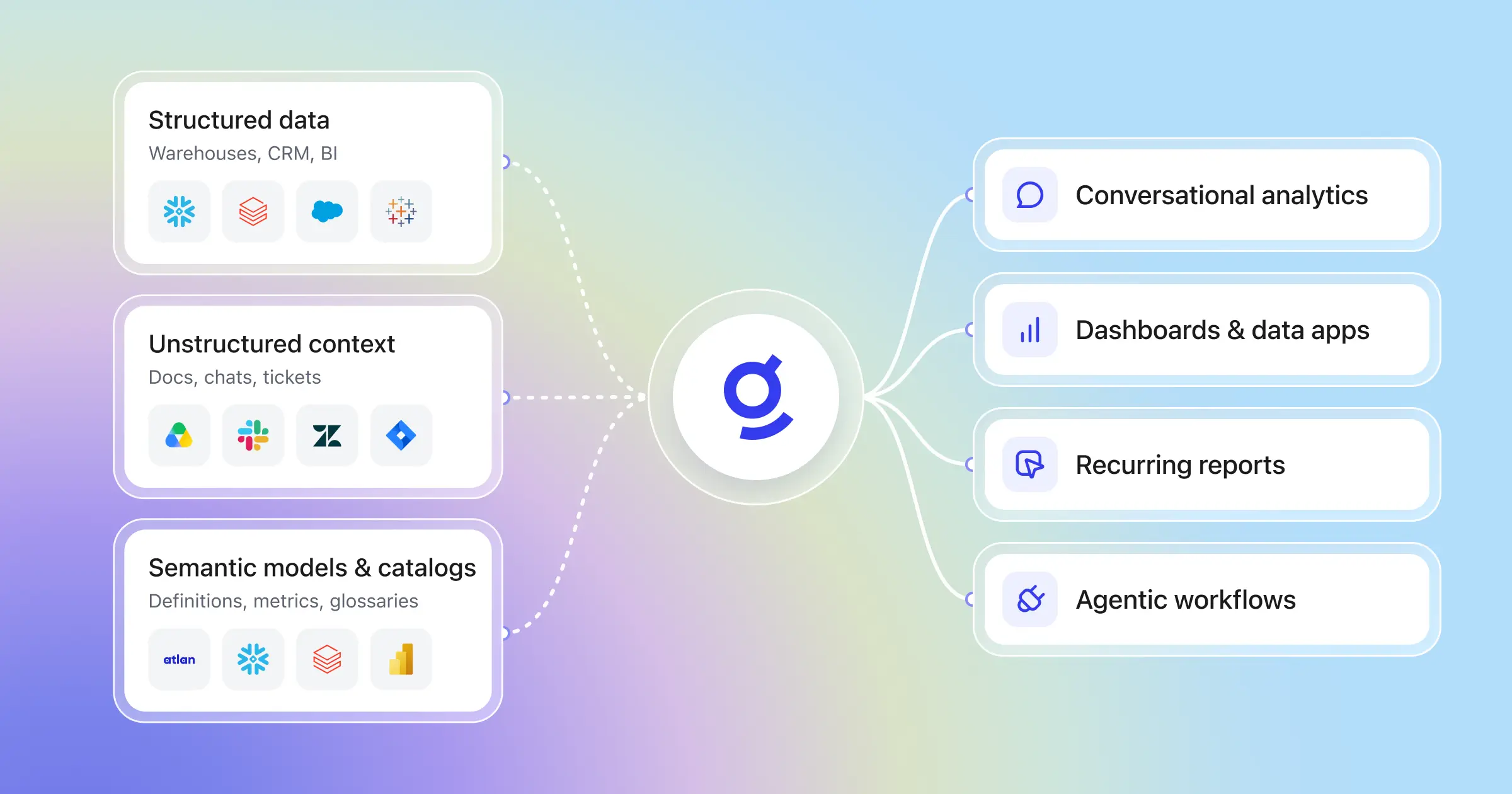
Building a full context layer means connecting across the tools marketers already use — CRM, analytics platforms, content management systems, project trackers, email platforms — and synthesizing that information in real time. Four components separate a production-ready context layer from a basic one: memory (what the system retains across sessions), retrieval (how it finds the right information), state management (tracking where a workflow stands), and permissions (respecting who can see what data). Glean's Enterprise Graph, for example, maps these relationships across 100+ connected apps so that when a marketer asks for campaign recommendations, the answer reflects actual performance data, existing assets, and team decisions — not a guess based on a single prompt. Context organization matters more than context volume. Teams getting the strongest results from AI give it better-organized context, not just more of it.
Why marketing AI fails without full context
Most marketing AI tools see only what lives inside their own platform. A content generator pulls from its prompt and maybe a style guide. A lead scoring model reads CRM fields. A campaign optimizer looks at one channel's performance data. Each tool produces outputs that sound reasonable in isolation — and fall apart when they meet reality. According to McKinsey's 2025 State of AI survey, 88% of organizations now use AI in at least one business function, yet nearly two-thirds have not begun scaling it across the enterprise — a gap that context fragmentation largely explains.
The failures are specific and predictable. A campaign planning tool recommends reallocating budget to a channel your product marketing team deprioritized last quarter — because the tool never saw that decision. A lead scoring model flags an account as cold while your support team is actively resolving a critical ticket for that same customer. The pattern repeats across content, attribution, and outreach tools: each performs exactly as designed, but only against the fragment of information it can see.
McKinsey's 2024 survey on AI in marketing found that cross-functional data fragmentation — not algorithm quality — is the primary barrier to scaling AI across marketing organizations. When sales, product marketing, demand gen, and customer success each run separate AI tools against separate data sets, those tools generate conflicting recommendations about the same customers, the same campaigns, and the same pipeline.
The compounding effect matters most. One team's AI says a deal is at risk; another says the same account is primed for upsell. A third tool calls for pausing outreach entirely — based on engagement scores that don't account for an open support case. Without a shared context layer, there is no tiebreaker.
Glean's Enterprise Graph addresses this by mapping relationships across 100+ connected applications into a single, continuously updated knowledge layer. When every AI surface draws from the same graph of people, content, projects, and interactions, the "which tool is right?" question disappears. The context is shared, so the outputs are consistent.
What makes up the context layer in a marketing AI system
A context layer sits between the raw request and the AI model, assembling the right information before the model generates a response. Context engineering — the discipline of designing what information reaches the model and how — is emerging as a distinct practice beyond prompt engineering, closely related to agentic reasoning in enterprise AI. Four components define a production-grade context layer for marketing.
Enterprise knowledge graph
An enterprise knowledge graph maps the relationships between people, content, campaigns, accounts, and interactions across your go-to-market stack. Unlike a data warehouse that stores records in tables, a knowledge graph captures connections: which rep owns which account, which campaign targets which segment, and how content assets map to product launches.
The graph must update continuously. A static export from last quarter's CRM data is a snapshot, not context. Real-time updates mean the AI knows about the deal that closed yesterday, the campaign that paused this morning, and the product announcement scheduled for next week.
Glean's Enterprise Graph connects to over 100 applications and rebuilds these relationship maps as data changes across systems. The Personal Graph adds a per-user layer, weighting results by what each person has worked on and been tagged in — so two marketers asking the same question get answers tuned to their specific work.
Retrieval and relevance filtering
Full context does not mean dumping every available data point into the model's input. The practice of retrieval-augmented generation addresses this directly: context windows are smaller than vendors suggest in practice, and intelligent chunking, selective retrieval, and strategic summarization determine whether the model sees signal or noise.
Effective retrieval means the AI fetches the three most relevant campaign briefs instead of every brief ever written. Glean Search uses hybrid search combining semantic understanding with keyword matching, then applies RAG to ground responses in the specific documents that matter for the query. Real-world RAG use cases span industries from healthcare to financial services, demonstrating the breadth of this approach.
Memory and state management
Without memory, every AI interaction starts from zero. You explain the campaign goals, share the target audience, outline the constraints — and next session, you do it again.
AI memory and state management allow continuity across sessions. The system remembers that you decided to deprioritize paid social last sprint, that the messaging framework changed in April, and that three rounds of feedback narrowed the headline options to two finalists.
Glean Assistant maintains conversation context and can reference prior interactions, so planning sessions build on previous decisions rather than restarting each time.
Permissions and governance
A context layer without permission boundaries is a liability. Marketing teams routinely work with sensitive pricing, pre-announcement product details, customer financials, and competitive intelligence. The AI must respect the same access controls that govern human access.
Production-grade AI governance means the system checks permissions at query time, not just at ingest. If a contractor asks about an upcoming product launch that only full-time employees can see, the AI should return nothing — not a summary with the sensitive details stripped out.
Glean enforces document-level permissions inherited from source applications. When someone asks Glean Assistant a question, the response only draws from content that person is authorized to access. No permission mapping workaround is needed because permissions sync directly from each connected app.
How full context improves AI performance across marketing workflows
Context engineering pays off when AI outputs require less correction and fewer handoffs. A 2026 Harvard Business Review Analytic Services survey found that while 59% of organizations have moved beyond AI experimentation, only 30% report AI impacting new revenue streams — a gap that better workflow integration and context access can close. Marketing teams spend less time verifying whether the AI got it right and more time acting on recommendations across four common workflows.
Campaign planning and optimization
AI with access to historical performance data, current pipeline, seasonal patterns, and competitive positioning can recommend budget allocation and channel mix based on actual business conditions — not just last quarter's averages. Teams can use AI prompts for marketing that draw on this full context to generate actionable campaign briefs and optimization recommendations.
Full context surfaces the specifics: not just that email performed well last quarter, but that it performed well for mid-market accounts in the expansion stage and underperformed for enterprise prospects who had open support tickets. That level of detail reveals why a campaign underperformed — audience fatigue, creative misalignment, timing — rather than just flagging that it did.
Glean Agents can automate recurring campaign analysis workflows by pulling performance data from connected analytics platforms, CRM pipeline stages, and historical campaign records, then assembling a briefing document with cited sources.
Content creation and brand consistency
A content tool with access to your brand voice guidelines, product positioning, latest messaging framework, and recent customer research produces drafts that need minor edits rather than full rewrites. Without that context, teams report spending more time correcting AI-generated content than they would have spent writing from scratch — a 2024 Forrester survey found that brand inconsistency is the top concern enterprise marketers cite when evaluating AI-generated content.
Glean Assistant grounds its responses in your company's actual documents — style guides, messaging decks, product specs — and cites the sources it drew from. When a marketer asks for a product description, the response pulls from the approved positioning doc, not the model's general training data.
Lead management and customer engagement
Connecting CRM records, engagement history, support interactions, and marketing touchpoints gives the AI a full picture of each account. A lead that looks cold in the CRM might have attended three webinars, downloaded a technical whitepaper, and filed a feature request — signals scattered across different systems.
Full-context lead scoring surfaces buying signals that single-platform models miss. Glean Search lets revenue teams query across all connected systems to find relevant interactions with a specific account, pulling results from email threads, Slack conversations, meeting notes, and support tickets in one search.
Reporting and attribution
Marketing attribution typically requires pulling data from multiple analytics platforms, ad channels, CRM, and engagement tools — then stitching it together manually. A 2023 Gartner survey found that marketing analysts spend roughly 30% of their time collecting and reconciling data before any actual analysis begins.
Full context collapses that collection step. Instead of opening five dashboards and cross-referencing IDs, you ask a question and get an answer grounded in data from every connected source.
Glean Assistant can synthesize information across connected analytics and CRM platforms, returning answers with citations to the specific reports, dashboards, and records it referenced — so you can verify the source without retracing the query yourself.
How marketers can build full context into their AI workflows
Building a context layer is an infrastructure decision, not a tool purchase. Industry analysis shows that transitioning from siloed data strategies to unified enterprise data architectures is the defining challenge of 2025. Start by mapping where your valuable marketing context actually lives — CRM, analytics platforms, content repositories, project management tools, communication channels like Slack and email. Identify which systems are connected and which operate as isolated data stores.
Define permission boundaries before building integrations. Decide which roles should see which data categories, and confirm that your AI platform enforces those boundaries at query time. Retrofitting permissions after deployment is significantly harder than designing them upfront.
Prioritize enterprise connectors based on context value, not ease of integration. The systems that hold the highest-signal data for your workflows should connect first. AI-native workflows depend on access to the data sources where decisions, approvals, and customer interactions actually happen — not just the systems with the cleanest APIs.
Design retrieval strategies that prioritize relevance over volume. More data in the model's context window is not better if most of it is outdated or tangential. Set up retrieval rules that favor recency, document authority, and query specificity.
Build observability into the system from the start. Log what context the AI assembled for each output so you can audit why a recommendation was made, identify retrieval gaps, and improve context quality over time. When an AI-generated campaign brief misses a key detail, the log should show whether the relevant document was retrieved and ranked — or never surfaced at all.
Once the context layer is reliable, consider AI agents in the enterprise for automating recurring workflows. Glean Agents can handle tasks like weekly performance summaries, competitive monitoring, and content audit reports — running on the same permission-aware, continuously updated context layer that powers search and assistant interactions.
Frequently asked questions
What does "full context" mean in the context of AI?
Full context refers to the complete, permission-aware set of information — spanning multiple systems, data types, and time periods — that an AI system assembles before generating a response or taking an action. It means outputs are grounded in actual business reality rather than isolated data fragments.
How does full context improve AI performance in marketing?
Full context reduces hallucination and improves personalization. Recommendations reflect actual business conditions — past performance, current objectives, audience behavior, competitive dynamics, and brand constraints — rather than a single metric from a single tool.
What are the components of a full context layer in AI?
A production-grade context layer includes an enterprise knowledge graph, retrieval and relevance filtering, memory and state management across sessions, permission enforcement, and native connectors to the tools where your data actually lives. Glean's Enterprise Graph and 100+ native integrations are built to cover exactly this stack.
What challenges arise when implementing full context in AI systems?
The primary challenges are connecting siloed data sources, enforcing permission boundaries across systems, filtering context for relevance without losing critical information, maintaining freshness as data changes, and building observability to diagnose context failures when outputs miss the mark.
How can marketers use full context in their workflows?
Start by auditing your existing tool stack for connectivity gaps. Define governance policies for sensitive data. Deploy AI systems with broad native integrations — like Glean, which connects to the apps your team already uses — and gradually expand from search and content assistance to autonomous agent workflows as the context layer matures.
When your systems, permissions, and knowledge are connected, every output reflects actual business conditions rather than isolated data fragments. Request a demo to explore how Glean and AI can transform your workplace.

.jpg)

.png)



.jpg)
.webp)