

Evaluating AI solutions best assistants for Slack and Google Workspace
Enterprise teams today rely on dozens of interconnected applications — from Slack and Google Workspace to Salesforce and ServiceNow — yet the knowledge employees need to do their jobs remains scattered across all of them. The gap between where information lives and where people actually work has become one of the biggest drags on productivity in fast-growing organizations.
AI assistants built for the enterprise aim to close that gap. Unlike consumer tools trained on general internet data, these platforms connect directly to your company's internal documents, conversations, customer records, and knowledge bases to deliver answers grounded in organizational context.
Choosing the right AI assistant requires more than a feature comparison. It demands a clear understanding of what enterprise-grade AI actually means, how it differs from the chatbots and copilots already embedded in individual apps, and what capabilities matter most for teams across engineering, sales, support, IT, and HR.
What is an enterprise AI assistant?
An enterprise AI assistant is software that uses artificial intelligence to help employees find information, automate tasks, and take action across the tools they already use every day. It sits at the intersection of search, knowledge management, and workflow automation — pulling from internal documents, messaging threads, CRM records, project boards, and knowledge bases to deliver answers that reflect your organization's actual data, not generic internet results.
This distinction matters. Consumer AI tools like standalone chatbots generate responses from broad training data, which makes them useful for general brainstorming or writing tasks but unreliable when someone needs to know the status of a specific deal, the latest version of an internal policy, or which engineer resolved a similar production incident last quarter. Enterprise AI assistants solve this by ingesting and indexing company-specific content, then retrieving it in real time with full awareness of who is asking and what they are permitted to see.
The best enterprise AI platforms, such as Glean, are distinguished by five core properties that separate them from consumer-grade alternatives:
- Company-grounded answers: Every response draws from your organization's own data — documents, conversations, tickets, and records — rather than relying on a general-purpose language model's training corpus alone.
- Permission-aware access: The assistant inherits access controls directly from each connected source application. An employee in marketing sees only what marketing has access to; a finance analyst sees finance data. No exceptions, no manual configuration required.
- Action capabilities: Mature assistants go beyond answering questions. They can draft content, update records, trigger workflows, and coordinate multi-step tasks — functioning more like a capable teammate than a search bar.
- Enterprise security and compliance: Non-negotiable requirements include SOC 2 Type 2 certification, data encryption, zero-day data retention with model providers, and contractual guarantees that no customer data trains third-party models.
- Centralized admin controls: IT teams need full visibility into deployment, usage analytics, and governance policies. The assistant should offer audit trails, user provisioning, and the ability to manage integrations from a single administrative interface.
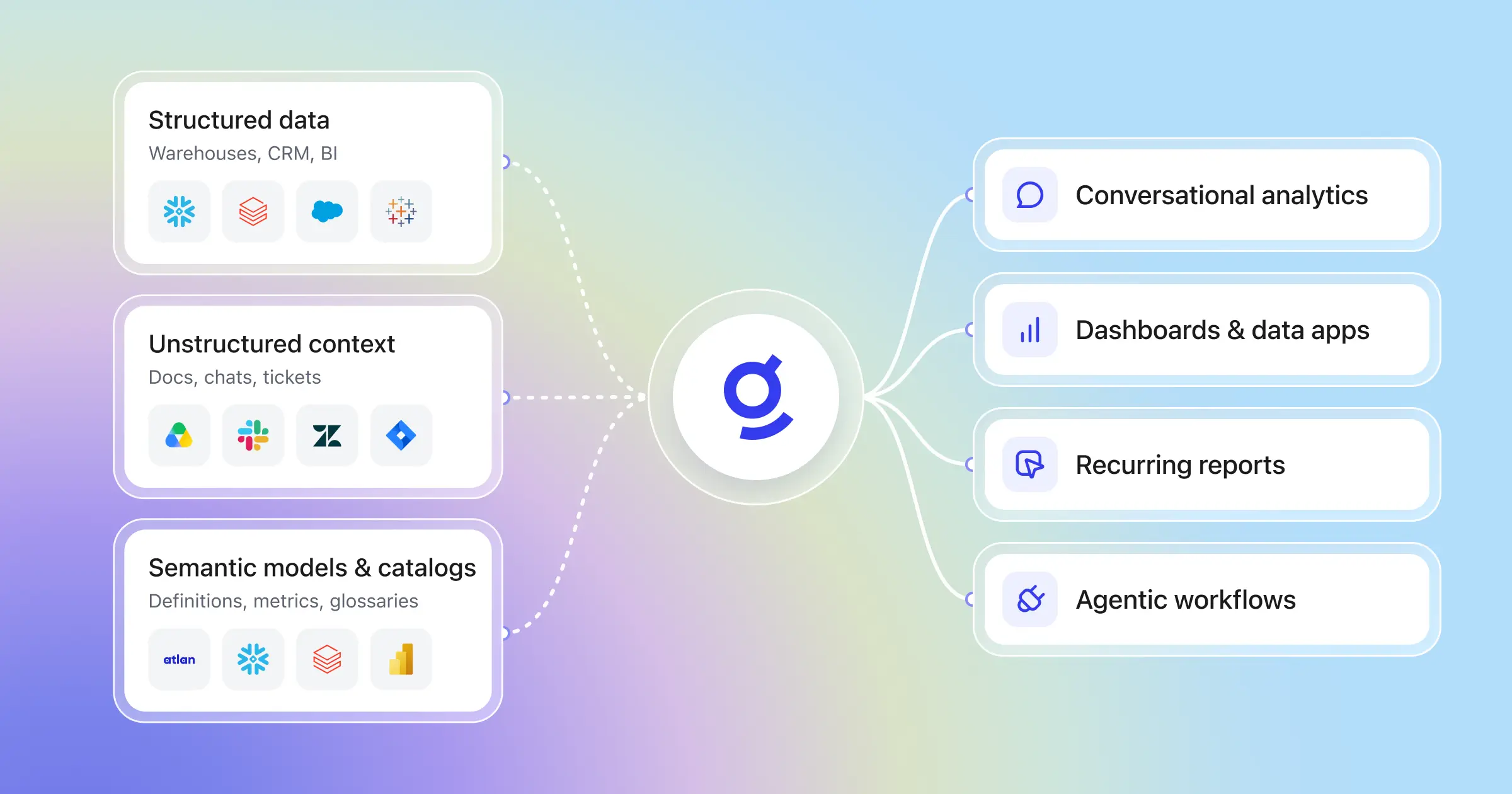
What elevates the most capable platforms beyond a simple retrieve-and-respond pattern is architectural depth. The strongest systems combine enterprise search, retrieval-augmented generation (RAG), and agentic reasoning into a unified architecture. Search handles fast, direct lookups. RAG grounds large language model responses in verified internal knowledge. Agentic reasoning breaks complex, multi-step requests into plans — searching, reflecting, executing, and responding — so the assistant can resolve a support ticket, prepare a meeting brief, or surface competitive intelligence without requiring the employee to orchestrate each step manually. This layered approach transforms an AI assistant from a convenience into a productivity multiplier across every team and function.
Why integration with your existing tools matters
Integration depth decides whether an AI assistant becomes part of daily execution or stays a separate destination that employees visit only when they remember. In most enterprises, work spans team chat, email, file storage, calendars, ticket queues, customer systems, code repositories, and internal browser tools; partial access means partial answers.
That distinction shapes adoption as much as answer quality. When the assistant sits inside the same surfaces employees already open all day, it can respond in context, pull the right source at the right moment, and hand work to the next system without a manual relay.
Integration turns a workspace into an operating layer
A native presence inside the collaboration layer changes how people use the assistant. Instead of opening a standalone chat window, an employee can ask for a thread recap, request the latest policy, pull an incident update, or route a request to the right team from the same conversation where the issue first appeared.
That in-flow model supports several high-value behaviors:
- Inline retrieval: The assistant can bring in meeting notes, service records, product specs, or account context directly inside a conversation instead of forcing a search across separate tabs.
- Automatic triggers: It can react to events such as a new escalation, a handoff request, or a launch discussion and start the right workflow without a manual prompt chain.
- Intelligent routing: It can identify the right expert, team, or downstream system based on the request, the subject matter, and prior activity.
- Coordinated follow-through: It can pass context from the collaboration layer into a ticketing system, case console, or internal workflow so the next step starts with full background intact.
Productivity suites provide the missing context
A communication stream rarely holds the full story. The real record often sits across the mailbox, the shared drive, the calendar, the meeting transcript, and the latest approved document. Deep integration with a productivity suite gives the assistant access to those signals, which means it can interpret not just the topic at hand, but also the timeline, ownership, and current state of work.
This matters in practical ways. A request about a customer review may depend on the latest slide deck, a follow-up email from legal, and the scheduled renewal call on the calendar. A question about an internal project may require the current spec, the meeting recap, and the task owner from a project tracker. Without that surrounding context, the assistant can only return isolated fragments.
Cross-system reach prevents a new layer of silos
Customer-facing teams face the same problem from another angle. Account history, contract terms, opportunity status, support cases, and internal playbooks often live in separate systems. An assistant with access to all of them can present one coherent picture, which removes the need to reconcile five sources before a rep replies to a customer or a manager reviews pipeline risk.
The strongest platforms extend that same experience across team chat, video meetings, service consoles, developer environments, and browser workflows. That breadth matters because work rarely stays inside one product for long. A narrow assistant may perform well inside one application, but it still leaves employees with separate interfaces, separate prompt habits, and separate stores of context — the exact fragmentation enterprise AI should reduce.
Key features to look for in an enterprise AI assistant
A polished chat box tells you very little about enterprise fit. The real test sits deeper in the stack — in how the platform connects to live systems, interprets messy company data, routes complex requests, and stays reliable under real governance requirements.
Broad connector coverage
Connector count matters, but connector quality matters more. A serious platform should pull from the systems that shape day-to-day work — chat, email, documents, calendar, CRM, ticketing, project management, source control, and internal knowledge bases — and it should do so through native integrations rather than brittle workarounds.
Ask harder questions than “How many apps do you support?” Ask how often the platform crawls each source, whether it indexes both structured and unstructured content, and whether it can normalize short-form enterprise data such as chat messages, comments, and meeting notes. Enterprise knowledge does not arrive in neat, long-form documents; much of it lives in fragments. A platform with broad, well-maintained connectors can assemble those fragments into a usable answer.
Permission-aware search and retrieval
Permission handling should hold up under constant change. Employees change teams, groups shift, channels close, folders move, and account access updates daily. The assistant should reflect those changes without a lag and without extra policy work from IT.
Look for a platform that applies access rules at retrieval time, not after response generation. That distinction matters. It means the model only receives material the user already has the right to access, which reduces leakage risk and keeps responses aligned with the source systems of record. Source links and citations matter here too; they let users verify the answer and move straight into the underlying file, case, or thread.
Knowledge graph and contextual understanding
Enterprise data needs more than semantic similarity. Strong platforms build a contextual layer that tracks how people, projects, documents, systems, and decisions relate to one another. That layer helps the assistant rank information with more precision, especially when the same term means different things across departments.
This is where company-specific language becomes important. Teams use acronyms, code names, internal product aliases, and shorthand that generic models do not understand well. The best systems adapt to that dialect over time and use signals such as role, team, close collaborators, and recent activity to improve relevance. The result feels less like generic search and more like informed guidance from someone who understands how the organization actually works.
Agentic reasoning and workflow automation
The next tier of capability starts when the assistant can coordinate work, not just answer a question. Complex requests often require a sequence: interpret intent, break the task into steps, choose the right tools, gather evidence, draft output, and complete a follow-up action in the right system.
A useful evaluation framework is simple:
- Planning quality: Can the system rewrite an ambiguous request into a clear task plan with the right sources and steps?
- Tool choice: Can it choose between search, data analysis, employee lookup, email, calendars, and business apps without user micromanagement?
- Execution depth: Can it do more than draft text — for example, create a ticket, prepare a meeting brief, suggest next steps on a support case, or review a pull request?
- Self-check behavior: Can it inspect its own output, catch weak evidence, and improve the response before it reaches the user?
The strongest platforms use a tool-based architecture because it gives enough flexibility for broad task coverage without the fragility of a fully open-ended computer operator. That matters in enterprise settings, where repeatability and control carry as much weight as raw model capability.
Enterprise-grade security and governance
Security review should cover the full operating model, not just a compliance badge. Baseline requirements still matter — SOC 2 Type 2, encryption, identity controls, and centralized administration — but buyers should also inspect how the vendor handles model providers, logs actions, and supports oversight after deployment.
A stronger checklist looks like this:
- Provider controls: Clear terms that prevent model training on customer data and support strict retention limits.
- Admin visibility: A central console for deployment settings, connector status, policy controls, and usage patterns.
- Operational logs: Detailed records of what the assistant searched, what tools it called, and what actions it took.
- Evaluation and monitoring: Built-in quality measurement for retrieval and response accuracy, not just uptime metrics.
- Change management support: The ability to test rollouts, inspect behavior by department, and keep governance policies consistent as usage expands.
Governance should not slow the product to a crawl, but it should make the system legible. IT, security, and business teams need to know not only that the assistant works, but how it works, where it pulls from, and what happens after a user asks it to act.
How AI assistants improve productivity across teams
Productivity gains do not appear as a single headline number. They show up in smaller operational wins that compound fast: less prep before meetings, fewer stalled handoffs, faster resolution paths, and better decisions made with current information instead of partial memory.
Sales and customer-facing teams
Revenue teams spend a surprising amount of time reconstructing account history. An enterprise assistant can assemble that history on demand — contract milestones from the CRM, renewal risk from recent support activity, stakeholder changes from email, and product usage context from internal notes — so an account executive or customer success manager starts with a current picture instead of a blank page.
That changes the pace of customer work. Before a renewal call, the assistant can produce a concise timeline of open issues, expansion signals, past commitments, and internal recommendations. For service teams, the same system can surface patterns across similar cases, expose the most effective resolution path, and help staff reply with language that matches company policy and product reality rather than a generic template.
Engineering and product teams
For technical teams, the main value comes from compression. Engineers no longer need to chase context across issue trackers, repos, architecture docs, incident channels, and internal wikis just to answer a narrow question. The assistant can connect those threads into a usable view: which component changed, which teams weighed in, what dependencies matter, and where the most relevant technical evidence sits.
Product teams benefit from that same compression across a different kind of signal. Instead of pulling customer pain points from support queues, sales notes, research docs, and roadmap discussions one source at a time, they can ask for a grouped view by theme, segment, or feature area. That makes it easier to spot repeat requests, identify launch risks early, and turn a week of scattered debate into a short decision memo that the broader team can use.
IT, HR, and support teams
Internal operations teams deal with high-volume requests that follow known patterns but arrive in inconsistent language. A capable assistant can interpret those requests, collect the missing details, classify the issue correctly, and present the employee with the right next step — whether that means a policy answer, an access workflow, a hardware replacement process, or a benefits explanation tied to the employee’s location and role.
Support organizations see a similar effect on case quality. Instead of asking agents to piece together product documentation, known defects, prior escalations, and customer-specific history under time pressure, the assistant can prepare a case-ready package before the first reply goes out. That shortens the path to a precise answer and gives specialists more room for the exceptions that require judgment, negotiation, or technical depth.
What separates the best AI platforms from the rest
The difference does not sit in the chat window. It shows up in what happens behind the prompt after the system enters production: how often it refreshes enterprise data, how it ranks mixed content types, and how it decides whether a request needs a fast lookup, a grounded synthesis, or a tool-driven workflow.
That distinction matters because enterprise data rarely arrives in clean form. Teams rely on chat threads without titles, CRM fields with shorthand, stale document copies, duplicate records, and ticket histories spread across multiple systems; the best platforms turn that mess into a usable index instead of forcing a language model to guess its way through incomplete context.
Architecture, not interface, defines capability
Top platforms treat retrieval as an engineering problem, not a prompt problem. They ingest content, identity, and activity data into a shared system that supports authority ranking, freshness checks, and source normalization across the full application stack. That approach produces better answers than products that depend on live API calls from each source at query time, which often return partial data and little context about what matters most.
A few technical signals separate mature systems from lightweight ones:
- Continuous indexing over federated lookup: Strong platforms maintain an up-to-date index of enterprise content rather than querying each application separately at the moment of the request. This allows cross-system ranking, faster response times, and far better coverage of short-form records such as messages, comments, and ticket updates.
- Query planning before answer generation: Vague prompts rarely map cleanly to enterprise data. Better systems rewrite broad requests into precise retrieval instructions, identify likely source systems, and expand internal shorthand before any answer draft begins.
- Enterprise-specific ranking: Search quality depends on more than semantic similarity. The best platforms score results with signals such as document authority, source reliability, recency, and organizational relevance, which helps the system surface the HR policy owner instead of an old message that happens to use similar words.
Adaptation improves accuracy over time
The strongest platforms improve through operational feedback, not one-time setup. Search interactions, accepted answers, follow-up edits, failed lookups, and escalation patterns all reveal where retrieval falls short and which sources employees actually trust for different types of work.
Mature vendors also evaluate quality with far more discipline than most buyers expect. Some use language models to grade retrieval quality and answer faithfulness across large test sets, which helps detect regressions after connector updates, ranking changes, or model swaps. That matters in production because a system that looks strong in a demo can drift quickly once source systems change, permissions shift, and new content enters the index every hour.
Flexibility and proof build trust
The best platforms avoid hard dependence on a single model. Different workloads demand different strengths: low latency for chat, long context for policy synthesis, stronger reasoning for case resolution, and lower cost for high-volume automation. A model-agnostic architecture gives enterprises room to match the model to the task without rewriting retrieval, orchestration, or safety controls each time the model market shifts.
Trust also depends on proof that extends beyond fluent output. Leading platforms expose answer provenance, freshness markers, and system-level quality signals so teams can judge whether a response came from the right source, used current information, and met internal standards for reliability. In practice, that operational clarity marks the line between an assistant that stays in pilot and one that becomes part of daily work.
How to evaluate and choose the right AI assistant for your organization
Selection works best as an operating review, not a beauty contest. The right platform should match the shape of your environment, fit the pace of your teams, and hold up under the messy conditions of day-to-day work.
Audit your stack before you compare vendors
Start with a source map, not a feature list. Document which systems hold official records, which ones capture conversation and decision history, and which surfaces employees use to ask for help or move work forward; those categories rarely sit in one place.
That map should answer five practical questions before any vendor review starts:
- Where does authoritative data live? Identify the system of record for customer data, policies, tickets, code, project plans, and internal documentation.
- Where do employees ask for help? Note the actual work surfaces — Slack, Teams, ServiceNow, Zendesk, GitHub, and browser workflows often matter more than a standalone assistant screen.
- Which sources change fastest? Freshness matters. A platform that reads yesterday’s version of a case, doc, or account note will fail in live use.
- Which connections support action, not just lookup? Some connectors only read data; others can post updates, draft responses, open tickets, or route work.
- Who owns each source? Every critical system needs an internal owner for access, cleanup, and rollout support.
Once that inventory is complete, rank use cases by business impact. Focus first on work that creates long wait times, repeated handoffs, or expensive manual review — not the easiest demo prompts.
Run a proof of concept on real data
A useful proof of concept should look like a controlled field test. Connect the platform to production sources, load a fixed set of tasks from recent work, and score results against a shared rubric that product, IT, security, and business teams all accept before the test begins.
Keep the test grounded in real operating conditions. Use current accounts, active tickets, recent pull requests, live policy questions, and open internal requests; then run those scenarios inside the places employees already use. That means chat surfaces, support consoles, developer workflows, and browser context — not only a vendor-hosted workspace.
A strong evaluation rubric should measure four things:
- Answer fidelity: Does the response rely on the right source, the latest record, and the correct internal context?
- Time to useful output: How fast does the platform return something an employee can actually use, edit, or send?
- Workflow fit: Does the assistant work inside the tools teams already open all day, or does it force a context switch for every request?
- Operational overhead: How much admin effort does setup, connector maintenance, prompt tuning, and user support require?
This stage should also include prebuilt agents and orchestration options. A mature platform should show immediate value through concrete tasks such as meeting recap, support documentation, IT help desk assistance, delegation tracking, or sales outreach — not just generic chat.
Evaluate cost, governance, and room to grow
Price alone rarely predicts success. Total cost of ownership includes rollout time, connector setup, identity integration, internal support hours, training effort, and the work required to keep sources reliable after launch.
That makes pricing structure worth close review. Straightforward per-user models are easier to budget, compare, and expand; opaque enterprise quotes often mask setup fees, service costs, or limits that only appear after procurement moves forward.
Growth path matters just as much. Many organizations start with a narrow retrieval layer, then expand into routing, drafting, task completion, and coordinated multi-step work as trust grows across teams. The right platform should support that progression without a second deployment, a major rebuild, or a new governance model for each stage.
Adoption depends on early alignment across three groups: IT, security, and the employees who will rely on the system every day. Each group should leave the evaluation with clear evidence on rollout speed, administrative control, and day-one usefulness inside real workflows.
The right AI assistant should disappear into the way your teams already work — connecting knowledge, compressing busywork, and turning scattered context into clear next steps across every tool in your stack. That standard is exactly what we build toward every day: a unified AI platform that earns trust through depth, security, and real operational proof.
Request a demo to explore how we can help transform your workplace with AI that actually fits the way you work.

.jpg)

.png)


.jpg)
.webp)