


How AI automation influences team productivity metrics
AI automation has moved well beyond simple task scheduling and rule-based triggers. Today's intelligent systems can analyze data, route workflows, draft content, and surface insights — all without manual intervention from team members. For enterprise organizations, this shift represents a fundamental change in how productivity is created, measured, and scaled.
Yet most teams still rely on productivity metrics designed for a pre-AI world: tasks completed per hour, tickets closed per day, lines of code written per sprint. These measures capture activity, not impact — and they fail to account for the ways AI reshapes what work people actually do.
The organizations that pull ahead will be the ones that understand both sides of this equation. They need clarity on what AI automation actually means in a team context, which metrics reflect its true influence, and how to implement it in ways that compound value across functions rather than create isolated pockets of efficiency.
What is AI automation in the context of team productivity?
AI automation refers to the use of intelligent systems that execute tasks, route workflows, and surface relevant insights without manual intervention. In the workplace, this spans a wide range of activities — from automating repetitive administrative work like data entry and status updates to deploying AI agents capable of analyzing datasets, drafting communications, and triggering actions across connected enterprise systems. The scope is broad, but the underlying principle is consistent: remove low-value effort from human plates so teams can redirect their energy toward strategic, judgment-intensive work.
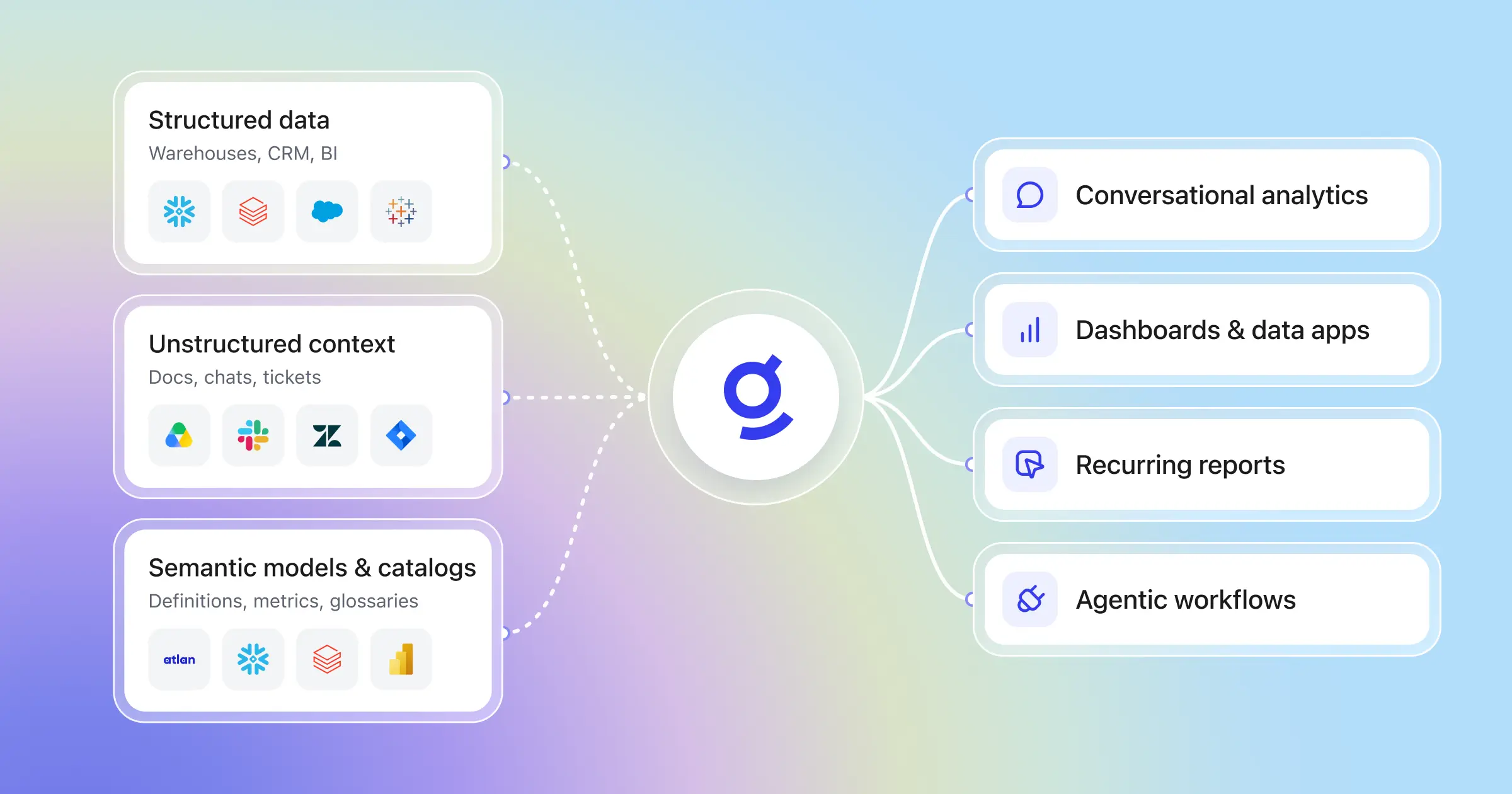
What distinguishes AI automation from basic task automation is contextual awareness. Traditional automation follows static rules — "if X happens, do Y." AI automation, by contrast, accounts for organizational context: permissions, roles, team structures, and real-time information flows. An AI-powered system can determine not just what to do, but who should see the result, when it matters most, and how it fits into a broader workflow. Platforms like Glean take this further by connecting to 100+ enterprise applications and enforcing native permissions, so every AI-generated output respects existing access controls. This depth of integration is what separates tools that automate a single step from systems that reduce friction across entire workflows.
The connection between AI automation and team productivity is direct, but often misunderstood. The most significant gains rarely come from speeding up individual tasks in isolation. Instead, they emerge when AI removes the friction between tasks — the context switching, the information hunting, the manual handoffs that silently consume hours each week. A 2023 study published by the National Bureau of Economic Research found that customer support agents with access to generative AI saw a 14% increase in issues resolved per hour, with the largest gains among less experienced workers. Research from MIT and Stanford has shown similar patterns in professional writing tasks, where AI reduced completion time by roughly 40% while also improving output quality. These findings point to a consistent theme: AI automation benefits compound when systems are embedded in the flow of work rather than bolted on as standalone utilities. The real productivity unlock is not a faster individual — it is a team that spends less time managing processes and more time delivering outcomes.
Why traditional productivity metrics fall short in AI-enabled teams
Legacy scorecards assume a simple equation: more human effort should produce more visible output. That logic worked well enough for routine work with clear units, but it weakens once AI takes over parts of the process and people step in later, at a higher point of complexity.
The distortion sits in the unit of measurement itself. A “ticket,” a “task,” or a “deliverable” no longer carries a consistent amount of labor once AI handles intake, sorting, drafting, lookup, or first-pass analysis. Two teams can post the same output count and produce very different business results; one may spend its time on edge cases, approvals, and risk-heavy decisions that older dashboards treat as ordinary work.
Volume metrics flatten changes in work design
This is why raw throughput often points leaders in the wrong direction. In a support environment, AI may absorb straightforward requests, classify issues, and attach the right context before an agent opens the case. The human queue then shifts toward exceptions and multi-step problems. A lower ticket count per person can reflect a stronger operation, not a weaker one — especially when first-contact resolution improves, escalations fall, and average resolution quality rises.
The same pattern shows up outside support. In software teams, the strongest gains do not come from code volume alone; they show up in faster diagnosis, shorter review loops, better documentation, and fewer delays between problem discovery and fix delivery. In product and project roles, AI often improves roadmap analysis, requirement clarity, stakeholder prep, dependency mapping, and risk detection. Simple output counts miss most of that change because they track artifacts, not the quality of the decisions behind them.
Time recovered from AI changes what teams optimize for
Once AI shortens routine steps, teams rarely spend every saved minute on more of the same output. They use that capacity to tighten quality control, check assumptions, resolve blockers earlier, and coordinate with adjacent teams before issues spread downstream. Those choices improve performance, but they do not always raise the most visible counters on a dashboard.
A better measurement model accounts for that shift:
- Case mix matters as much as case volume: When AI filters basic work out of the queue, the remaining workload grows more complex. Metrics should reflect severity, resolution depth, and escalation avoidance — not just how many items each person touches.
- Lifecycle speed matters more than isolated task speed: In engineering and operations, the relevant question is not how fast one step moves; it is how quickly work moves from issue identification to verified completion with minimal rework.
- Decision quality deserves its own signal: In planning-heavy functions, AI can improve prioritization, forecast accuracy, and stakeholder alignment. Those gains appear in fewer reversals, less duplication, and cleaner execution later in the cycle.
- Variance across the team often tells a bigger story than average output: Research on AI in customer support found the largest lift among less experienced workers. That kind of performance spread reduction can strengthen service consistency even when average throughput changes only modestly.
The practical shift is clear: teams need metrics that capture outcome quality, decision speed, rework reduction, and workload complexity. Without that adjustment, AI can improve real performance while the old scorecard reports noise.
Key metrics to measure the impact of AI automation on team productivity
A strong measurement model should show whether AI changes team capacity in a durable way. That means a mix of process metrics, business-quality signals, and usage patterns that reveal whether teams have turned AI from a trial tool into part of daily execution.
Operational efficiency metrics
Operational metrics answer a basic question: does work move with less delay once AI enters the process. The most useful measures focus on elapsed time and labor mix, not just output counts.
- Time-to-resolution: Track the full span from issue creation to verified completion. In support, IT, and service teams, this metric shows whether AI helps staff reach a correct answer sooner through faster case intake, stronger retrieval, and better issue framing.
- Workflow cycle time: Measure the time between major checkpoints in a process, such as request submission to approval or bug report to production fix. This makes it easier to see whether AI shortens queue time between steps rather than only speeding up one isolated task.
- Manual task reduction rate: Quantify how much work has shifted away from people for routine tasks such as record updates, request tagging, internal note creation, and source collection. This metric matters because reclaimed labor often moves into planning, analysis, and customer work that traditional dashboards rarely capture.
These numbers become more useful with team- or workflow-level cuts. A company-wide average can hide a major gain in support operations and almost no change in finance or HR.
Quality and outcome metrics
Efficiency without outcome control can create a false sense of progress. AI has real value only when faster work also produces stronger decisions, fewer defects, and better service experiences.
- Decision accuracy: Measure whether AI-assisted judgments lead to the right result more often. Depending on the function, that may show up in lower exception rates, fewer incorrect approvals, stronger forecast quality, or higher customer satisfaction.
- First-contact resolution rate: In customer and employee service environments, this metric shows how often a request reaches closure in the first exchange. It is especially useful when AI helps staff pull together prior case history, relevant policy, and likely next steps before they respond.
- Rework rate: Track the share of outputs that need a second pass after review. This is one of the clearest ways to detect shallow AI use, since a team can appear faster on first delivery while hidden cleanup rises in the background.
The best teams read these numbers together. A shorter resolution window paired with lower rework and higher satisfaction points to genuine improvement; a shorter window with more corrections points to a quality problem, not a productivity win.
Adoption and engagement metrics
Adoption metrics show whether value exists beyond a pilot group. They also show where trust, habit, and workflow fit remain weak.
- Active usage rates: Measure daily and weekly use by role, function, and team. In mature rollouts, weekly adoption often reaches 60% to 70% of eligible users, while daily usage in high-frequency roles tends to land around 40% to 50%.
- AI suggestion acceptance rate: Track how often employees keep or act on AI output. In many software and knowledge workflows, healthy acceptance often falls in a middle range — high enough to show relevance, low enough to show review and judgment still matter.
- Self-reported time savings: Use short pulse surveys to capture how much time employees believe they recover each week. In practice, many teams report gains of two to three hours per person, with larger gains among heavy users and roles with dense administrative load.
- Recurring-workflow usage: Measure whether AI appears inside repeated tasks such as account planning, ticket review, sprint preparation, approval handling, or status reporting. Access alone does not indicate value; repeat use inside core work does.
Segmentation matters here as much as the top-line number. Research has shown that less experienced workers often see the largest gains first, which means adoption data by tenure, role, and manager can reveal where AI has lifted the floor and where more enablement is still necessary.
How AI automation improves productivity across different team functions
AI changes team performance in different ways because the bottlenecks differ by function. The most useful view looks at where time leaks out of each workflow, what AI can remove, and which outcomes improve once that friction disappears.
Engineering and product teams
Engineering teams gain the most when AI cuts the coordination load around software delivery. It can turn noisy incident reports into structured issues, group related defects from multiple channels, surface likely owners based on past commits, and draft test cases from bug descriptions. That reduces the time between signal detection and first action, which improves sprint stability and keeps senior engineers out of repetitive triage work.
The same pattern shows up in release work. AI can compare requirements against shipped behavior, flag missing documentation before launch, and identify code areas that may need extra review based on change history. Controlled studies in software development have shown faster task completion with AI assistance, but the practical gain for enterprise teams often shows up in fewer stalled reviews, cleaner handoffs between engineering and QA, and less time lost to rework after release.
Product teams benefit on a different axis: synthesis. AI can convert interview transcripts, support notes, CRM feedback, and usage trends into concise themes that product leaders can sort by frequency, revenue impact, or strategic fit. It can also draft requirement outlines, convert stakeholder notes into action items, and map launch risks across teams. That shortens the path from raw input to a decision-ready plan.
Sales and customer-facing teams
Sales teams lose a surprising amount of time to account research, internal coordination, and record maintenance. AI can pull recent buyer activity, summarize open objections, draft follow-up notes after calls, and update opportunity records from meeting transcripts. That gives account executives a cleaner pipeline without the usual admin tax, which means more time for discovery, negotiation, and deal strategy.
AI also sharpens timing. It can detect changes in prospect behavior, identify dormant deals that show new signals, and suggest outreach based on product interest, role, or stage risk. In customer-facing work, speed matters, but relevance matters more; a rep who enters a call with current contract details, prior support history, and likely expansion paths has a better chance of moving the conversation forward without delay.
For post-sale and service teams, AI helps maintain consistency at scale. It can draft renewal briefs, surface unresolved product issues before a customer meeting, and highlight accounts with rising support volume or falling engagement. That gives teams a clearer view of where intervention matters most, especially in large books of business where manual monitoring fails.
IT and support teams
IT and support teams benefit when AI reduces queue complexity before a human touches the case. It can assign severity, identify probable categories from free-text requests, detect duplicate incidents, and match a ticket to approved fixes or escalation paths. That makes case distribution more precise and helps managers keep specialists focused on the issues that require their expertise.
A large field study in service environments found that AI assistance raised output most for less experienced agents. In practice, that means new hires can handle a broader share of cases earlier in their ramp period because the system helps with diagnosis, policy lookup, and response drafting. Teams see the payoff in shorter training curves, more even workload distribution, and fewer delays during peak volume.
Support operations also gain a stronger control layer. AI can watch queue depth, repeat incident patterns, and resolution backlog in near real time, then flag unusual spikes before service levels slip. That matters most in enterprise environments where one unresolved systems issue can trigger a cascade across departments.
HR and operations teams
HR teams carry a high volume of repetitive process work that rarely appears in strategic headcount plans but consumes hours each week. AI can screen applicants against role criteria, extract missing qualifications from resumes, schedule interview steps, and answer routine policy questions with approved language. That reduces turnaround time for recruiting and employee support without stripping out human judgment where it matters most.
Onboarding becomes more reliable as well. AI can assemble task lists by role and location, trigger access requests, remind stakeholders about pending approvals, and tailor early communications to the employee’s department. Instead of a manual checklist that depends on follow-up across multiple teams, the process moves through a more consistent sequence with fewer missed steps.
Operations teams see similar gains in internal service workflows. AI can review incoming requests, identify exceptions that need finance or legal review, and route work based on urgency, spend threshold, business unit, or policy type. In coordination-heavy environments, that reduces the lag between request intake and decision, which improves internal service quality without adding headcount.
Common challenges when integrating AI automation into team workflows
Once teams start to track AI’s operational impact, rollout problems usually surface before technical limits do. Most setbacks come from process design, role clarity, and governance gaps — not from a lack of model capability.
The pattern looks familiar across functions. Early pilot users often experiment in narrow ways, managers interpret that activity as adoption, and leaders expect measurable gains before work patterns have actually changed. In practice, teams need enough time for prompts, approvals, handoffs, and review habits to settle into a repeatable flow before the numbers mean much.
Where rollouts break down
- Adoption gaps across roles: AI does not spread evenly through an organization. Support agents may use it every hour because it shortens lookup time and drafts responses, while HR or finance teams may touch it only for occasional summaries. Research on customer support shows the largest gains often appear among less experienced workers, which means poor onboarding can leave the biggest improvement opportunities untouched. Clear role playbooks, manager expectations, and function-specific examples matter more than broad access.
- Measuring too early: The first weeks of a rollout rarely show durable impact. Early data reflects trial behavior, prompt practice, and inconsistent usage patterns rather than stable changes in execution. A more reliable readout usually appears after three to six months, once teams can compare similar work across similar periods. Before-and-after analysis works best when leaders control for seasonality, staffing shifts, and workload mix.
- Data quality and connectivity: AI automation weakens fast when the underlying information is outdated, duplicated, or spread across tools with inconsistent structure. A support system that pulls from stale help articles, unresolved ticket histories, and fragmented internal notes will generate weak recommendations no matter how strong the model looks in a demo. Metadata quality matters here as much as raw access: titles, owners, timestamps, tags, and source reliability all shape whether the output feels useful.
- Over-indexing on speed: Faster task completion can hide operational drift. A service team may lower average handle time while escalation rates rise, or an engineering team may shorten review cycles while defect rates creep upward after release. The strongest programs pair speed indicators with outcome checks tied to the actual function — rework, customer satisfaction, first-contact resolution, rollback rates, or approval accuracy.
- Privacy and security concerns: Enterprise teams need clear answers on retention, audit trails, model training boundaries, and data handling rules before they commit meaningful work to AI. Legal, compliance, and security teams often slow rollouts for good reason: once sensitive records enter the wrong workflow, recovery becomes expensive. Productive deployment depends on firm governance rules that employees can understand and managers can enforce.
These barriers rarely appear in isolation. Weak source data complicates evaluation, uneven training distorts usage patterns, and unresolved governance questions keep high-value workflows off limits. The result is not a failed model; it is a rollout that never reaches the parts of the business where the largest productivity gains should show up.
How to implement AI automation to maximize team productivity
Effective rollout depends on sequencing. Teams get better results when they treat AI as an operating change with clear scope, clear ownership, and clear proof points.
That requires discipline at the start. A loose launch with broad access and vague expectations usually produces scattered usage, weak evidence, and fast skepticism.
Start with high-friction workflows
The best first deployment sits inside a process that already has stable rules, repeat volume, and visible delay. Look for work that follows a known pattern, depends on digital records, and carries a low cost of review. Support intake, renewal prep, interview coordination, incident summaries, and routine status reporting often fit that profile.
Keep the first release narrow enough to test end to end. A smaller slice — one queue, one team, one workflow, one business unit — gives leaders a cleaner view of what changed and why. Useful selection criteria include:
- Clear source material: the workflow depends on documents, tickets, messages, or records that already exist in structured form.
- Frequent repetition: the team handles enough volume to surface patterns within weeks, not quarters.
- Reviewable output: a manager or subject-matter expert can verify accuracy without heavy overhead.
- Operational relevance: the process affects service levels, team capacity, or a visible internal bottleneck.
This approach aligns with what the strongest field studies show. AI produces the most reliable lift in language-heavy, moderately structured work where people can check the result quickly and apply it inside an existing process.
Establish the baseline before rollout
A baseline needs more than a dashboard snapshot from the week before launch. Capture a full operating picture first — at least several weeks of performance data, plus a clear record of how people complete the work today. That history makes it easier to separate tool impact from seasonality, staffing changes, or shifting demand.
A stronger measurement plan uses matched comparisons instead of broad averages. Compare the same team before and after deployment; compare heavy users with light users; compare similar cohorts across roles. Teams in engineering have used this method well: the cleanest evidence often comes from same-person analysis over time rather than cross-team comparisons. Build the baseline around:- Process completion history: volume, completion windows, backlog age, and exception rates.- Review burden: how much manager or peer time the workflow requires.- Escalation patterns: where routine work turns into specialist work.- Ramp differences: how new hires, experienced staff, and managers handle the same process.- Readiness signals: training completion, workflow documentation quality, and data availability.
Avoid early judgment. Research on workplace AI adoption shows that meaningful patterns often emerge after a three- to six-month adjustment period, once teams learn when to rely on the system and when to override it.
Prioritize connected systems over standalone tools
Implementation quality depends on system design as much as model quality. An assistant that sits outside the tools where work happens may produce useful drafts, but it will struggle to support decisions, trigger actions, or reduce back-and-forth across teams. The higher-value setup pulls from the systems of record and writes back into the workflow where the next step happens.
Connection strategy matters here. Start with the systems that shape daily execution, then define how information moves across them. In practice, that means more than API access. It means fresh data, consistent identity mapping, and a clear hierarchy of trusted sources. Focus on:- System-of-record priority: define which source wins when records conflict.- Freshness requirements: set update expectations for documents, tickets, CRM data, and calendars.- Action endpoints: make sure the system can do more than draft; it should route, update, create, or notify where appropriate.- Auditability: preserve a record of what the system used, what it produced, and what changed after human review.
Research on enterprise productivity tools points in the same direction. Systems that fit across the stack create more durable gains than tools that live in a side tab and depend on copy-paste workarounds.
Segment adoption and teach through role-specific use cases
General training creates shallow usage. Teams adopt AI faster when the rollout includes task-level examples that match how each role already works, plus a short list of approved prompts or actions that solve a real problem on day one.
This is where enablement needs precision. Project managers need help with risk updates, milestone summaries, and dependency reviews. Product leaders need help with PRD drafts, release notes, and backlog synthesis. Engineers often see more value in stack-trace interpretation, test case generation, and pull request context than in raw code output. Recruiters may need candidate brief creation and interview recap support. The pattern is practical, not theoretical: give each role a small set of high-frequency actions and a clear standard for what good output looks like.
Support that rollout with segmented adoption review:- Team-level usage cohorts: compare daily, weekly, and occasional users inside the same function.- Use-case mix: track which approved workflows people return to, not just how often they log in.- Manager feedback loops: ask frontline leads which outputs save review time and which still create cleanup work.- Prompt quality support: refine instructions that lead to weak results instead of blaming low adoption on resistance alone.
The strongest rollouts do not leave employees to invent the use case from scratch. They package the first set of wins in a way that feels native to the role.
Iterate from outcome data and build trust through transparency
After launch, the work shifts from deployment to control. Teams need a regular review cadence that looks at exceptions, overrides, false positives, missed context, and tasks that still bounce back to humans. This is where many programs stall: leaders see early activity, assume value, and move on before they understand where the system helps and where it creates extra cleanup.
A tighter operating model solves that problem. Review workflow outcomes every month; keep a log of failure modes; retire weak use cases quickly; expand only after the first group shows stable results. Trust grows faster when employees can see the boundaries in plain terms:- What data the system uses- How long that data is retained- Whether provider models train on company input- Which actions require review or approval- What the system should never do on its own
Clear limits matter as much as strong output. Teams trust automation more when the organization publishes failure rules, escalation paths, and retention standards up front rather than after a mistake.
The teams that gain the most from AI automation are the ones that treat it as an operating change, not a technology experiment. They measure what matters, sequence their rollout with discipline, and build trust through transparency rather than hype. If you're ready to see what that looks like in practice, request a demo to explore how we can help transform the way your teams work.

.jpg)

.png)



.jpg)
.webp)