

How enterprise AI bridges gaps between business and tech teams
Most enterprises don't set out to build walls between their business and technical teams. The walls form gradually — one department adopts a CRM, another builds custom internal tools, a third relies on spreadsheets and email threads — and before long, the people who need to collaborate most are operating from entirely different information ecosystems.
Enterprise AI has the potential to tear those walls down, but only when it functions as a shared intelligence layer rather than another isolated tool. The difference between AI that unites teams and AI that deepens existing divides comes down to architecture: whether the system understands organizational context, respects permissions, and connects knowledge across every application employees already use.
That shift — from fragmented tools to a unified platform that serves both business users and engineers with equal depth — represents the core promise of enterprise AI collaboration. The sections ahead explore what that looks like in practice, why silos persist, and how to design an AI strategy that removes barriers instead of reinforcing them.
What does it mean to bridge the gap between business and tech teams with AI?
Enterprise AI collaboration starts when a single platform connects the people, data, and workflows that business users and technical teams depend on daily. The critical distinction: neither group should have to adopt the other's tools or learn the other's language to access shared knowledge. A sales director checking on a product launch timeline and a software engineer reviewing the same project's technical dependencies should both get accurate, relevant answers — drawn from the same underlying sources but tailored to their context.
Organizational silos form when departments adopt separate technology stacks, each optimized for local needs but disconnected from the broader enterprise. Sales lives in one system, engineering in another, support in a third. Over time, these isolated environments don't just separate data — they separate understanding. Metrics drift apart, terminology diverges, and the simple act of answering a cross-functional question becomes an exercise in translation. AI that understands organizational context — who works on what, where knowledge lives, and how permissions are structured — can serve as a connective layer that both sides of the business trust and use naturally.
The goal isn't to make every employee technical or to flatten complex workflows into oversimplified dashboards. It's to give every team access to the same accurate, up-to-date information so decisions rest on a single source of truth. Three principles define what this looks like in practice:
- Context-aware intelligence: AI must go beyond keyword matching to understand relationships between people, content, and activity across the organization. A knowledge graph that maps these connections allows the system to surface the right depth of information for each user — an executive summary for a business stakeholder, a technical specification for an engineer — without requiring separate queries to separate systems.
- Enterprise-wide deployment over point solutions: When AI operates in isolated pockets — a chatbot for customer service here, a code assistant for engineering there — each tool generates intelligence that never reaches the people who need it most. This creates what researchers and practitioners now call the "AI silo" problem, where departmental AI tools optimize for local outcomes rather than enterprise-wide alignment. A platform approach, like what we offer at Glean, prevents this by indexing and reasoning across every connected application simultaneously.
- Permission-native architecture: Expanding access to knowledge across teams cannot come at the cost of security. Real-time permission enforcement ensures that every answer respects the access controls already defined in source systems. Business users see what they're authorized to see; engineers access what their roles permit. This design principle makes enterprise AI collaboration safe to scale without requiring a separate governance project for every new department that adopts the platform.
When these principles hold, AI stops functioning as a departmental tool and starts functioning as organizational infrastructure — the kind that makes cross-functional collaboration feel less like coordination overhead and more like the default way work gets done.
Why do silos persist between business and technical teams?
The divide between business and technical teams tends to follow ownership lines inside the company. Budgets, procurement decisions, compliance reviews, and team charters all sit within departments; the work itself cuts across them.
Local optimization creates enterprise fragmentation
Most silos begin with practical decisions made under time pressure. A department buys software to fix an immediate workflow, a regional office adopts its own process to meet local requirements, or an acquired business keeps its existing stack because replacement costs too much and carries too much risk.
Those decisions accumulate. Customer records split across CRM, ERP, support systems, and shared drives; product data sits in separate analytics tools and internal docs; identity data lives elsewhere again. Each system reflects the needs of its owner, not the needs of the enterprise. Data exports fill some gaps, but exports strip context, age quickly, and create more copies to reconcile later.
The language gap widens over time
Silos persist because teams often operate with different definitions for the same metric. Revenue can mean booked, billed, or recognized; resolution can mean first reply, ticket closure, or root-cause fix; launch date can mean public release, internal handoff, or feature flag availability.
That mismatch creates friction long before anyone touches AI. Cross-functional work slows because every dashboard requires interpretation, every request carries hidden assumptions, and every handoff depends on someone who knows how one team's terminology maps to another team's schema. What looks like poor alignment often starts with inconsistent definitions, weak metadata, and no shared semantic standard.
Knowledge stays trapped where work happens
Important knowledge rarely sits in one place. A support agent sees the customer symptom, a sales rep sees account history and renewal risk, and an engineer sees logs, incidents, and system constraints. Each person holds a valid part of the answer, but the organization lacks a reliable way to assemble those parts into one clear view.
Legacy architecture makes that harder. Decisions hide inside ticket threads, change logs, chat messages, dashboards, PDFs, and internal wikis. Research on enterprise information access shows that employees spend about 20% of the work week just trying to locate internal knowledge across disconnected systems. That time loss affects more than efficiency; it limits judgment, slows escalation, and turns basic collaboration into a sequence of manual lookups.
AI can deepen the problem when each department deploys its own toolset with no common knowledge foundation behind it:
- Narrow retrieval scope: a model that searches one application's content cannot account for adjacent systems that hold the missing context.
- Schema-level inconsistency: each tool inherits the field definitions, taxonomies, and business rules of the system around it, so the same question can produce different answers across departments.
- Isolated feedback loops: one assistant improves through support interactions, another through engineering prompts, another through sales activity; the intelligence becomes more specialized but less coherent across the enterprise.
That dynamic explains why silos last so long. The enterprise does not suffer from a lack of information; it suffers from information that remains split across systems, definitions, and workflows that never evolved to work as one.
How does AI help break down organizational silos?
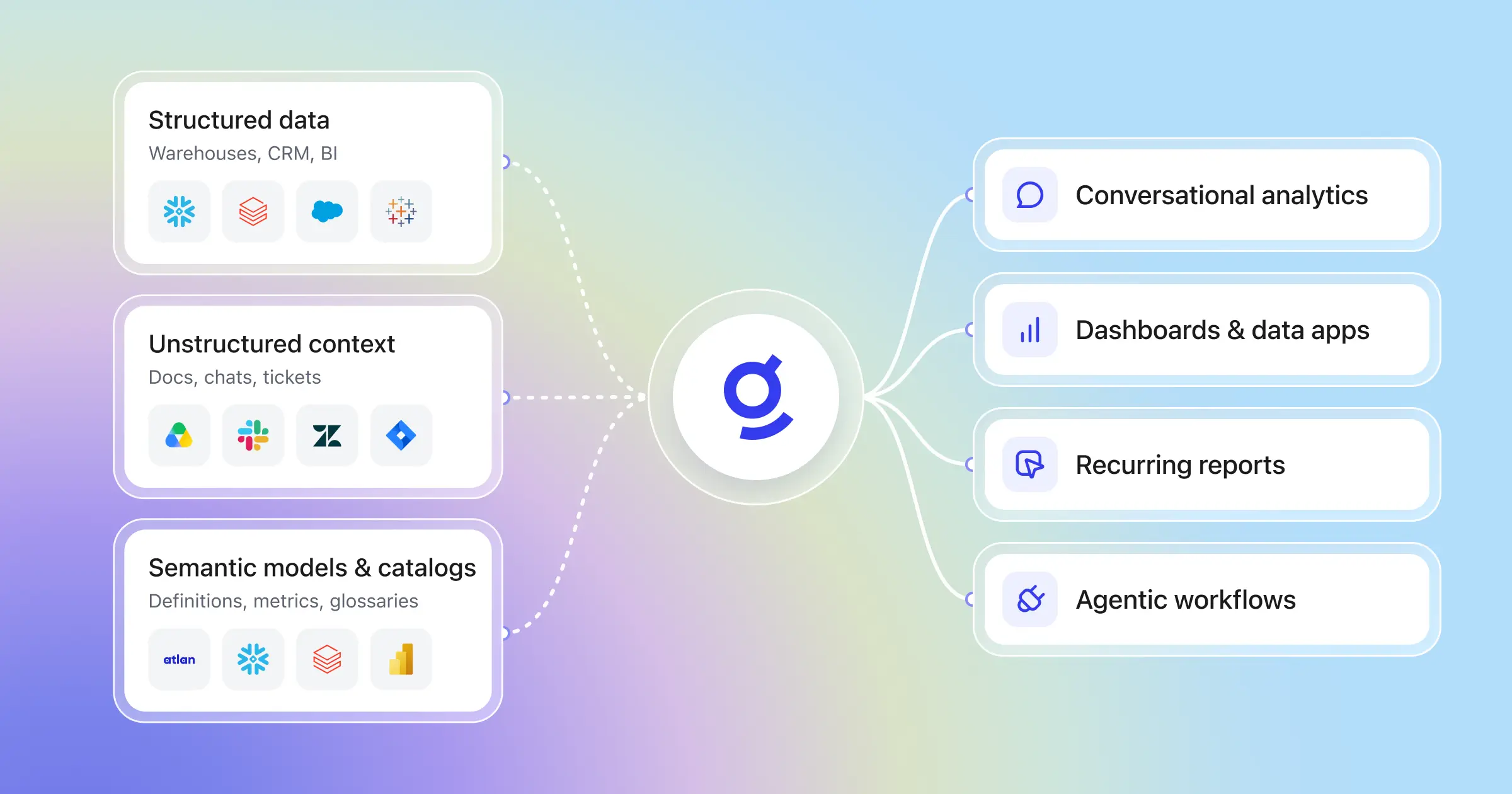
AI helps break down silos when it connects systems that were never built to work as one. Instead of forcing employees to jump from a CRM to a ticketing system to an internal wiki just to answer one cross-functional question, enterprise AI can pull the relevant records into a single response that reflects the full business context. That matters most in day-to-day work, where the blocker is often not a lack of data but a lack of access to the right combination of data at the right moment.
A shared index makes knowledge usable across teams
The practical mechanism is a unified index that spans structured records, unstructured documents, chat history, project updates, and internal directories. With that foundation in place, AI can interpret a request such as “Why did this account escalate last quarter?” and connect support tickets, renewal notes, product defects, and internal postmortems without the user knowing where each artifact lives. A revenue leader sees the commercial risk; an engineer sees the defect trail; a support manager sees the case history that shaped the outcome.
That changes how teams work together because it removes the hunt for source systems before work can even start. Sales does not need to wait for engineering to locate a root cause document, and engineering does not need to chase support for account history that already exists elsewhere. The handoff becomes shorter, the answer becomes fuller, and the work moves with far less friction.
- One entry point for enterprise knowledge: Employees ask for a business outcome or an operational fact; the system handles retrieval across apps and repositories behind the scenes.
- Natural-language access for every role: A finance lead, HR partner, and platform engineer can all use the same interface without SQL, product-specific syntax, or deep familiarity with internal tool sprawl.
- Better decisions from connected context: Answers reflect the state of the business across departments, not the narrow view inside one application.
Relationship context turns search into coordination
Search alone does not fix fragmentation unless the system can recognize how information relates across the company. A knowledge graph provides that layer of structure: it can connect a person to a team, a document to a project, a support case to a product area, or a policy change to the employees it affects. That relational view allows AI to surface not just content, but the path between content, ownership, and action.
This becomes especially useful in mixed business and technical workflows. A customer success manager who asks about a delayed rollout may need the current release note, the owner of the launch decision, and the open issues tied to the account. An engineer who looks into the same situation may need deployment history, incident notes, and the internal expert closest to the service. AI can assemble those connections fast because it understands how people, content, and activity fit together rather than treating every file as an isolated object.
Permissions and agents extend collaboration into action
Access across departments only works when security holds at every step. Enterprise AI can preserve existing source permissions in real time, which means a support lead can reference approved product material without exposure to restricted HR files, and a sales rep can review contract status without access to confidential incident data. That approach expands useful visibility without weakening governance.
Once the retrieval layer and permission model are in place, AI agents can support work that spans multiple functions instead of staying trapped inside one workflow. An agent can review supply data from ERP, account history from CRM, and product notes from engineering systems before it drafts a customer response. Another can take a bug report from support, pull the most relevant logs and documentation, identify prior incidents with similar symptoms, and route the issue with enough context for engineering to act immediately. The result is not just faster access to information; it is a shared operating picture that lets teams respond with more precision across the business.
What challenges arise when integrating AI across departments?
Once AI moves beyond a single team, the friction shifts from experimentation to coordination. Departments bring different approval paths, risk thresholds, and definitions of success, so the same system that looks useful in one workflow can stall in another. A support leader may want faster case resolution, while IT focuses on access controls and engineering focuses on reliability under load. Without a shared operating model, deployment slows long before model quality becomes the deciding factor.
The data layer adds a second source of complexity. Enterprise records rarely sit in one clean environment; they stretch across SaaS apps, legacy platforms, file systems, email, chat, and internal tools with uneven structure and uneven freshness. In that environment, AI must work with duplicate entities, stale snapshots, missing metadata, and conflicting ownership fields. The challenge is not simple access to data; the challenge is access to usable, current, well-scoped context across systems that were never designed to work as one.
Connector quality and data design decide the outcome
Department-level AI projects often fail at the connector layer. A system may technically connect to dozens of applications and still miss the information people rely on every day. Comments, attachments, ticket history, custom fields, approval states, identity mappings, and activity trails often carry the context that explains why a record matters. When connectors skip those details, AI returns answers that sound polished but miss the operational truth.
A few patterns tend to cause the most trouble:
- Incomplete source coverage: Many enterprise tools expose only part of their data through standard interfaces. AI may retrieve the record itself but miss workflow status, relationship history, or the human discussion around it, which leaves critical business context behind.
- Identity mismatch across systems: The same employee, customer, or project can appear under different names, IDs, or ownership models from one platform to the next. AI cannot reason cleanly across departments when the underlying entities fail to line up.
- Recency gaps: Scheduled syncs create lag. In fast-moving environments such as support, incident response, supply chain, or sales operations, even a short delay can produce the wrong answer at the wrong moment.
Governance gaps turn scale into risk
Cross-functional AI needs more than a security review. It needs explicit decisions about accountability, verification, escalation, and auditability before the system touches real workflows. Teams need clarity on what AI can recommend, what it can automate, what requires human review, and which logs prove what happened after the fact. When those rules stay vague, departments improvise, and inconsistency spreads fast.
That problem grows sharper as use cases widen. HR may require tight controls around employee records; finance may require traceable outputs for sensitive decisions; customer-facing teams may need strict review standards for external communication. One generic policy will not cover all of that. What works at enterprise scale is a governance model that adapts to department-level risk while still preserving one consistent framework for permissions, oversight, and accountability.
Point solutions create a second layer of silos
Department-specific AI often looks efficient at first because each team can move fast inside its own workflow. The problem appears later, when insights stop at the boundary of the tool that produced them. Sales may have one assistant for account research, support another for ticket triage, and engineering a separate system for incident analysis. Each tool improves a narrow task, yet no shared layer carries that intelligence across the business.
This fragmentation creates operational drag that resembles the old silo problem in a new form. Teams duplicate work, leaders compare outputs from systems that do not share context, and IT inherits a patchwork of vendors, policies, and monitoring requirements. Instead of one enterprise capability, the organization ends up with a stack of disconnected AI surfaces.
The strongest deployments avoid that pattern through close design work between engineers and domain experts. Not after rollout; at the start. Support teams can show where ticket handoffs break, finance can define where approval logic matters, and operations can surface the exceptions that never show up in process diagrams. That level of joint design keeps AI aligned with the messy, high-stakes reality of enterprise work rather than the simplified version that appears on an org chart.
What strategies ensure AI supports both business users and technical teams?
Support for both groups depends on product choices that hold up under real work conditions. The best systems match the pace of business teams, expose enough detail for technical teams, and keep both sides inside the same operational frame.
That requires more than a strong model. It requires role-aware design, a unified retrieval layer across enterprise systems, and governance that sits inside production from the first rollout.
Design for every user, not just power users
AI should feel usable on first contact for a sales manager, an HR partner, a support lead, or a finance analyst. Prompts should accept plain business language; answers should return in the format the role needs — a short explanation, a policy summary, a customer account view, or a list of next steps.
Technical teams need a different level of access from the same system. Engineers, IT admins, and data teams often need source records, field values, event history, document versions, and workflow controls that let them inspect, validate, or act on the result. A strong platform supports both modes without forcing business users into technical detail or hiding the evidence technical teams need.
- Role-aware output: A regional sales lead may need contract status and renewal risk in plain terms; a systems engineer may need incident history, linked changes, and service dependencies. The interface should adapt to the task, not force every user into one response style.
- Progressive depth: The first answer should stay concise; deeper layers should sit one step away. That structure keeps the experience simple for non-technical teams and still gives experts a path to source material, metadata, and workflow context.
- Direct workflow handoff: Answers should connect to the systems where work happens — ticketing tools, CRM records, knowledge bases, HR systems, or admin consoles. That shortens the gap between insight and execution.
Unify knowledge across the enterprise
Cross-functional AI breaks down fast when retrieval stops at one application boundary. Questions about a delayed launch, a customer escalation, or a policy exception often span chat threads, support tickets, product documents, CRM notes, internal wikis, and identity systems. AI needs deep connectors that pull content, activity data, and access signals from all of those sources, then normalize them into one retrieval plane.
This matters just as much for meaning as for access. Teams often use the same term in different ways, or different terms for the same concept. Revenue operations, product, finance, and engineering need a shared semantic contract for terms such as booked revenue, active customer, release freeze, severity level, or service owner. Without that discipline, AI will surface conflicting answers that look valid in isolation and still force teams back into manual reconciliation.
A durable strategy usually includes three layers:
- Connected systems: Enterprise search should span documents, messages, tickets, code repositories, customer records, and internal process tools rather than rely on a narrow set of sources.
- Normalized context: The platform should preserve titles, timestamps, ownership, relationships, and source authority so the answer reflects how the business actually works.
- Shared definitions: High-value terms need an owner, a stable definition, and consistent use across departments so AI can return one answer instead of several partial ones.
Embed governance from the start
Governance works best as part of the deployment model, not as a late approval gate. Every connector, retrieval step, and action path should inherit source permissions, preserve a review trail, and follow department-specific policies for sensitive content such as customer contracts, personnel records, legal material, and financial data.
Operational ownership matters here. Someone has to approve connector scope, decide which actions require human review, define retention rules for retrieved context, and monitor answer quality across departments. Organizations that scale AI well treat these tasks as production work alongside version control, observability, and change management.
- Access should follow identity systems: The AI layer should respect the same role and group rules that already govern each source application. That keeps access decisions consistent across departments.
- High-impact outputs need evidence: Answers tied to policy, compliance, customer commitments, or technical incidents should show source support and leave a clear audit record.
- Policies need workflow coverage: Search, chat, summarization, and automation should follow the same rules for data handling, retention, and approval. Gaps between workflows create risk fast.
- Accountability should stay explicit: Teams need named owners for connector approval, data classes, model behavior review, and action boundaries so responsibility does not disappear across functions.
What role does governance play in cross-functional AI collaboration?
As AI moves across departments, governance becomes the shared contract that keeps work consistent from one team to the next. It sets the rules for source-of-truth data, approval thresholds, retention limits, audit requirements, and escalation paths when an answer conflicts with policy, regulation, or business logic.
Without that contract, each function sets its own standard. Finance may require formal review for a forecast adjustment, support may accept a draft reply without verification, and engineering may rely on a separate evaluation process for technical recommendations; the same platform then behaves like three different systems inside one company.
Governance creates one operating contract for many teams
That contract matters most when AI touches workflows with different risk levels. A low-risk task such as internal knowledge lookup should not follow the same controls as a pricing recommendation, an HR policy response, or a customer-facing action. Good governance defines these boundaries in advance so teams do not renegotiate rules every time AI enters a new workflow.
A durable model usually includes three layers:
- Policy tiers by workflow risk: Internal lookup, document drafting, and action-oriented automation each need a different control model. This keeps lightweight tasks fast while reserving stricter review for workflows that affect revenue, compliance, or customer commitments.
- Lineage and audit records: Teams need a clear record of which source version, connector state, and model configuration shaped an output. That record matters when a legal team reviews a policy answer, when IT investigates a faulty action, or when operations needs to trace a decision back to a stale record.
- Exception ownership: Some requests will fall outside normal rules — conflicting source data, unclear ownership, edge-case approvals. Governance should assign those cases to a named owner or queue so ambiguity does not turn into delay.
This structure removes friction in a practical way. Business teams move faster because routine work follows predefined rules; technical teams avoid ad hoc policy debates because the platform already knows which standard applies to which class of task.
Governance determines how AI scales after the pilot
Pilot programs often succeed under close supervision because a small group can compensate for weak process design. Enterprise rollout changes the equation: new connectors enter the system, source schemas shift, departments apply different regulatory standards, and model behavior changes as prompts, providers, or workflows evolve. Governance has to account for that movement with release controls, evaluation benchmarks, rollback plans, and clear rules for data handling across every external model or service in the stack.
The strongest enterprise programs treat governance as part of operational maturity, not legal review. They track answer quality by workflow, inspect failure patterns across teams, maintain provider agreements with strict data-use terms, and revisit policies as systems and org structures change. That discipline gives sales, support, HR, IT, and engineering a common framework for AI use — one that stays stable even as the underlying tools, data sources, and business needs shift.
How to build an AI strategy that removes silos instead of creating new ones
A workable AI strategy starts with a map, not a model. Before any platform rollout, teams need a clear view of where information changes hands, where work leaves the system of record, and where people rely on side channels such as spreadsheets, forwarded emails, private notes, or copied chat threads to complete routine tasks.
That review should measure operational drag in concrete terms. Track how often support cases return for missing details, how long sales waits for product or legal input, how many HR requests require manual policy checks, and how often incident updates move through chat instead of the ticketing system. Those numbers show where AI can remove friction and where process debt still sits underneath the surface.
Start with the landscape you already have
Enterprise AI works best when it connects to the systems employees already trust. CRM records, ticket histories, file repositories, calendars, chat threads, identity data, and internal tools all carry part of the operating picture; a useful platform reaches into those sources through deep integrations rather than forcing teams into a new application estate before value is clear.
A practical audit should examine the stack through an operational lens:
- System overlap: Find places where two or more tools track the same business object — customer status, roadmap dates, employee records, case severity — with no clear owner.
- Exception paths: Identify the moments when work exits the core workflow and moves into email, shared drives, or manual trackers because the primary system cannot carry the full process.
- Handoff failure points: Note where one team submits work that another team must reinterpret, enrich, or reformat before action can start.
- Adoption strain: Flag tools that require employees to search, translate, or rekey information across departments just to complete a standard task.
Choose context, not just connectivity
A long connector list does not guarantee useful AI. The more important question asks whether the platform preserves the structure around the data: document hierarchy, case status, version history, thread order, source ownership, timestamps, approval state, and relationship to nearby records. Without that structure, the system may retrieve content but still miss the business meaning behind it.
This point matters most in cross-functional work. A renewal issue can appear as a billing exception in finance, a product complaint in support, a usage concern in customer success, and a revenue risk in sales. The AI platform has to retain that process context so each team sees the same issue through the correct operational frame. Context turns a set of linked records into something teams can act on with confidence.
Align on definitions before scale
Before broad deployment, establish a small but strict shared language for the metrics and entities that shape joint work. Teams do not need a perfect enterprise taxonomy on day one, but they do need agreement on the terms that drive planning, escalation, forecasting, and execution.
That foundation should include a few non-negotiable fields for every critical definition:
- Business term: The exact metric or entity, such as critical incident, active customer, qualified lead, release date, policy exception, or renewal risk.
- Owner: The function accountable for the definition and for future changes.
- System of record: The application or database that serves as the authoritative source.
- Refresh cadence: How often the value updates and who validates the update logic.
- Usage rule: Where the definition applies — dashboards, AI answers, workflow triggers, or executive reporting.
This discipline prevents a common failure mode in enterprise AI programs: a technically sound deployment that spreads competing definitions faster than teams can correct them.
Prove value through cross-functional use cases
The first rollout should target a workflow with visible delay, multiple stakeholders, and a measurable business outcome. Good candidates usually sit between departments rather than inside one function, because that is where handoffs, missing context, and duplicate effort create the highest cost.
Early use cases should favor short feedback loops and clear before-and-after metrics. Examples include sales access to contract history and open support issues during renewal planning, HR and IT coordination during employee onboarding, or finance visibility into customer escalations that affect collections or account health. Each one ties AI to a real business process instead of a generic productivity claim.
A disciplined rollout sequence keeps scope under control:
- Select one workflow with a known coordination cost: Choose a process where delays come from fragmented information, not from lack of staffing.
- Set a hard baseline before deployment: Measure turnaround time, rework rate, handoff count, or request volume before the system goes live.
- Expand by adjacency, not by enthusiasm: Add the next team only when the first workflow shows stable gains and clear operating rules.
Redesign the workflow, not just the interface
A chat box on top of an old process rarely changes much. Better results come from redesigning the sequence of work itself: preassembled case packets, automated routing based on business rules, cited summaries for review, and next-step actions inside the systems where teams already execute.
Consider a renewal review that usually pulls sales, finance, support, and product into a long thread. In a stronger design, the AI system surfaces open billing disputes, contract terms, product usage signals, unresolved support cases, and roadmap dependencies at the start of the review. The account team no longer waits for each department to contribute context one by one; the workflow begins with a complete operating picture, which shortens decision time and reduces avoidable back-and-forth.
Enterprise AI earns its place when it changes how teams work together, not just how individuals search for answers. The organizations that move fastest treat AI as shared infrastructure — one layer of context, one permission model, one operating picture that every function can trust.
If you're ready to see what that looks like in practice, request a demo to explore how we can help transform your workplace.

.jpg)

.png)



.jpg)
.webp)