




How to Integrate Campaign Data and Customer Sentiment in B2C Marketing
Integrating campaign data with customer sentiment gives B2C marketers a single workflow for understanding what's working, why customers respond, and which creative assets to deploy next. Without that connection, teams bounce between analytics dashboards, social listening tools, and asset libraries — stitching together a picture that's already outdated by the time it's complete.
The core challenge is structural. Campaign data (click rates, conversion metrics, spend) is neatly organized. Customer sentiment — reviews, survey responses, social comments — is messy and unstructured. A 2026 Demand Gen Report survey found that as recently as 2024, marketing data was scattered across disconnected systems — with 57% of organizations still relying on manual spreadsheets. Approved creative assets live in yet another system with their own naming conventions and version histories.
This article walks through how to connect those three inputs into one practical workflow, so your team spends less time hunting for information and more time acting on it.
What is a unified B2C marketing workflow?
A unified B2C marketing workflow is a shared system that connects campaign performance metrics, customer sentiment signals, and approved creative assets under common identifiers — campaign IDs, audience segments, and asset metadata.
The goal is a working environment where a campaign manager can trace an underperforming ad set to the sentiment data tied to that audience and find the approved creative variant that tested better — all without switching tools.
The reason most teams don't operate this way comes down to how these data types are stored. Campaign metrics sit in structured databases with clean rows and columns. Sentiment data — a customer review saying "I loved the packaging but the checkout was painful" — doesn't fit neatly into a spreadsheet.
Creative assets have their own lifecycle: draft, review, approved, expired. Each data type has a different shape, a different owner, and usually a different tool. Poor taxonomy breaks everything downstream; if your campaign naming conventions don't match your asset tags or your sentiment categories, no amount of tooling — not even a comprehensive knowledge graph — will stitch the picture together.
The most effective B2C teams solve this by building a shared taxonomy first, then connecting tools around it. A customer data platform (CDP) can unify structured campaign metrics and audience profiles. A work AI platform like Glean Assistant lets teams ask questions across those connected systems and surface the specific creative brief, performance report, or customer feedback thread they need. The result is a workflow where finding answers and deciding what to do next happens in one motion.
How to integrate campaign data and customer sentiment in B2C marketing
Campaign metrics, customer sentiment analysis, and creative asset workflow are one system — and treating them as connected inputs is what makes analysis fast and actionable. Performance data tells you what happened, such as click-through rates dropping or a retargeting campaign stalling. Sentiment data explains why customers responded the way they did, and creative assets provide the missing context of what people actually saw.
When these inputs share the same campaign IDs, audience segments, and asset metadata, you can trace a drop in conversion directly to negative sentiment about a specific ad variant and find the approved alternative without opening a second tool.
The practical difference shows up in speed. A retail brand running back-to-school campaigns across email, paid social, and SMS might notice that one audience segment converts at half the rate of another.
In a disconnected setup, someone pulls a report, someone else digs through survey verbatims, and a third person searches the asset library — that takes days. Research shows employees lose an average of 15 hours per week chasing data across siloed tools, and 48% of businesses say those silos prevent a consistent customer experience.
In a connected workflow, you query one system and get the performance breakdown, the relevant customer comments, and the creative that ran. Glean Search lets teams run exactly that kind of cross-system query, pulling results from campaign platforms, feedback repositories, and content libraries in a single search with permission-aware access.
Building this way makes marketing automation and optimization repeatable. You're not relying on one analyst's memory of where data lives or which Slack thread had the customer quote. You're working from a shared, searchable record that connects structured metrics with unstructured feedback and the creative your audience actually experienced. Teams that automate marketing tasks across these connected systems compound that advantage with every campaign cycle.
1. Define a shared campaign model before you connect anything
Before you wire up a single integration, agree on the objects your workflow will track: campaign ID, channel, audience segment, market, flight dates, owner, asset ID, creative theme, and primary success metric. Not every metric belongs in every model — spend, impressions, CTR, conversion rate, revenue, retention, and ROAS are common starting points.
A subscription box company optimizing for retention and lifetime value will weight post-purchase feedback and churn signals differently than a fast-fashion brand focused on first-purchase conversion and ROAS.
Next, scope your sentiment sources. Reviews, survey verbatims, support tickets, chat transcripts, social comments, and post-purchase feedback all qualify, but mixing them without labels creates noise. Tag each source type and tie it to the campaign or audience segment it relates to.
Add creative metadata from the start — asset ID, format, version, creative theme — so you can trace which visual or message a customer responded to. A home goods brand that tags every ad image with its creative theme ("cozy minimalism" vs. "bold color") can later correlate sentiment about "cluttered layouts" directly to a specific asset family.
Taxonomy failures are the most common reason data-driven marketing programs stall. If your paid media team labels campaigns by region and your lifecycle team labels by channel, you'll never compare performance across both. Align naming conventions across marketing, analytics, brand, lifecycle, and customer teams before anything connects. Glean Agents can help enforce consistency here — you can configure an agent to flag campaigns that don't match your naming taxonomy, catching mismatches before they reach your reporting layer.
2. Connect campaign, feedback, and asset systems into one searchable layer
A searchable layer needs to index three categories of sources:
- Campaign data: ad platforms, web analytics, CRM, email service provider, ecommerce system
- Sentiment sources: support ticket platforms, survey tools, review aggregators, social listening feeds
- Creative repositories: digital asset management system, design tool exports, project management boards where briefs and approvals live
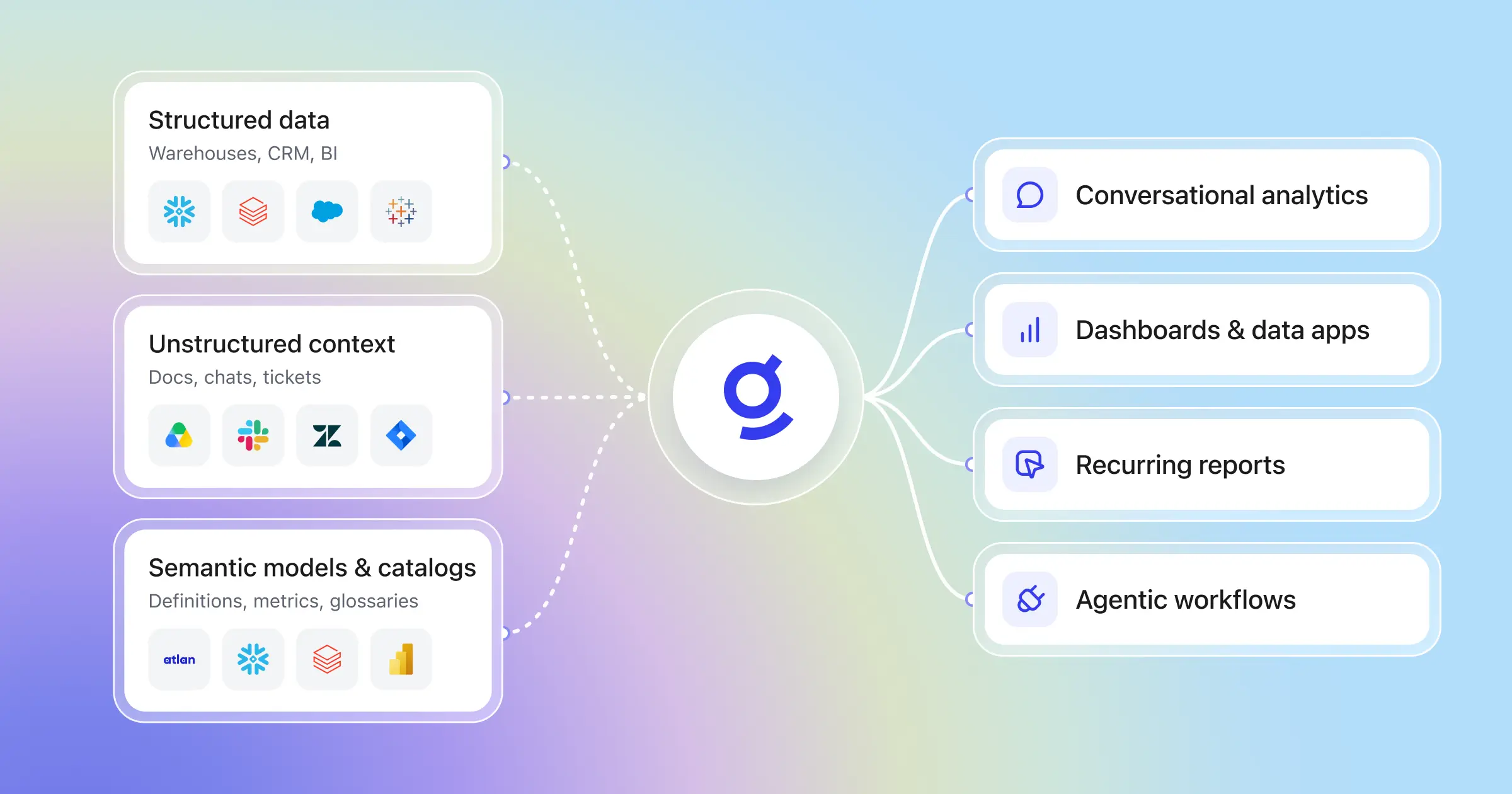
The goal is cross-channel marketing visibility — a foundation of strong enterprise knowledge management — where both structured tables (spend by segment, conversion by channel) and unstructured materials (creative briefs, customer verbatims, campaign recaps) are available in one place.
Use connectors or APIs to bring these sources together without duplicating data or breaking existing permissions. A beauty brand with 15 active integrations doesn't need to migrate everything into one database. It needs a layer that indexes current and historical materials so a campaign manager searching for "Q1 loyalty program results" finds the performance summary, the customer feedback report, and the approved email designs — not just a dashboard with topline numbers. Preserving access controls matters here; your finance team's spend data and your CX team's verbatim feedback may have different sensitivity levels — PwC research found that 83% of consumers rank data protection as a top trust factor.
This is where many teams get stuck. They have enough data, but they don't have fast enough access to the right context at the right moment. A searchable, permission-aware layer solves this by surfacing the right context at the right moment. Glean Assistant serves this role by connecting to 100+ enterprise tools and letting marketers ask natural-language questions across all of them — "show me customer complaints about our holiday campaign creative" — and get cited, contextual answers grounded in your company's actual data, not generic summaries.
3. Turn raw customer sentiment into signals marketers can use
Positive, neutral, and negative labels aren't actionable. Break sentiment into themes that map to decisions you can make: price perception, product quality, delivery experience, trust, clarity of offer, creative relevance, and friction in the purchase flow.
A pet food brand analyzing post-purchase surveys might discover that "too expensive" sentiment clusters around a specific subscription tier and ad set, while "great quality" sentiment tracks to a different audience segment entirely. Themes like these tell you where to adjust pricing messaging and which customer complaints deserve a campaign-level response. Teams using targeted AI prompts for marketing can surface these patterns faster across large volumes of feedback.
Score each theme by campaign, channel, audience, region, time period, and creative variant. Capture representative phrases with citations to the original source — the actual review, survey response, or social comment. Marketers need proof they can bring to a creative brief or a stakeholder meeting, not untraceable summaries.
Automation handles volume: set rules to flag sentiment spikes, surface recurring complaints above a threshold, and highlight messages that correlate with high-performing creative. With nearly half of B2C marketers now prioritizing AI-driven personalization, automated sentiment scoring is becoming table stakes.
A fitness apparel company running a spring launch across four markets can use automated scoring to catch that "sizing runs small" complaints spiked in one region within 48 hours, triggering a creative update before the next ad rotation.
Keep a human review step for nuance. Sarcasm, mixed reactions ("love the product, hate the packaging"), and context-specific language (slang that reads as negative but isn't) all need a person in the loop. The output is a sentiment view your team trusts — filtered by campaign context, tied to themes that connect directly to creative and media decisions. Glean's Enterprise Graph can surface these themed sentiment patterns across connected feedback sources, letting you query something like "show me delivery complaints linked to our summer campaign in the Southeast" and get cited results from the actual feedback records, not a generic sentiment score.
4. Link every creative asset to campaign performance and sentiment response
Assign every creative asset a persistent identifier that connects it to its campaign, audience segment, placement, offer, and approved version. That identifier should follow the asset from brief through production, approval, deployment, and post-campaign review. Include the full asset set: creative briefs, copy blocks, image variants, video cuts, landing pages, and legal or compliance notes. A meal kit company running 12 weekly ad variations across paid social needs each variant tagged with its target segment, promotional offer, and approval status — otherwise, finding what ran where becomes a manual archaeology project.
Connect asset metadata to both performance data and customer response. You want fast answers to questions like "which headline variants drove the highest add-to-cart rate among new customers?" and "did any of those high-performing variants also generate negative sentiment about misleading claims?"
An asset might drive clicks but create negative sentiment that shows up weeks later in higher return rates or cancellation spikes. A direct-to-consumer electronics brand discovered that its "lowest price ever" ad variant outperformed all others on CTR but generated a wave of "bait and switch" complaints when customers encountered shipping fees at checkout. Linking the asset to both performance and sentiment data surfaced that pattern before the variant scaled to additional channels. This is especially critical as research shows creative quality now outweighs budget size as the primary driver of marketing ROI.
Store approved assets with full context: target audience, campaign objective, winning message, and supporting proof points. Glean's Canvas lets teams assemble and share these asset packages — creative brief, performance summary, and relevant customer feedback — in one document that stays connected to the source systems, so the next campaign team inherits context instead of starting from scratch.
5. Build one workflow for analysis, decisions, and follow-up actions
Your team shouldn't need separate tools to search past campaign results, summarize customer feedback, and route next steps. A connected B2C marketing workflow should let these capabilities live in one place. One workflow should let anyone ask a plain-language question — "which creative themes drove conversion with positive sentiment last quarter?" or "which campaigns got the most pricing complaints?" — and get an answer grounded in connected campaign, sentiment, and asset data. When data is insufficient, the system should say so rather than generate a confident-sounding guess.
Route follow-up actions automatically. If negative sentiment about delivery times crosses a threshold for a running campaign, the workflow should flag it, notify the campaign owner, pull the underperforming asset, and draft a revised creative brief — without someone manually checking dashboards every morning.
A telecom provider running a device upgrade promotion used automated routing to catch that "hidden fees" sentiment spiked within the first three days, triggering a creative swap and a revised landing page before the campaign's heaviest spend window.
Give brand, performance, and content teams role-based views into the same underlying data. The brand team needs sentiment themes and creative compliance. The performance team needs conversion metrics and spend efficiency. The content team needs winning messages and approved assets for the next brief. Glean's Personal Graph tailors what each person sees based on their role, past queries, and the systems they work in — so a brand manager searching for "Q2 campaign sentiment" gets results weighted toward the creative and feedback context they care about, not raw media-spend tables.
6. Review outcomes, learn faster, and improve the next launch
After every campaign, run a structured post-launch review that combines performance metrics, sentiment trends, and creative results in one view. Focus on patterns: which message themes scaled across channels, which audiences amplified negative sentiment, and which assets are worth reusing, revising, or retiring.
A national grocery chain reviewing its holiday campaign found that recipe-based ad creative outperformed discount-focused variants on both conversion and sentiment — but only in email. Paid social told the opposite story. That channel-level distinction only surfaced because performance and sentiment data were reviewed together, not in separate reports.
Track workflow health alongside campaign outcomes. Measure time to insight (how quickly your team identifies a sentiment shift), time to creative update (how fast you can swap an underperforming asset), asset reuse rate, and decision cycle time.
If it takes four days to get from "customers are complaining about this ad" to "revised creative is live," the workflow has a bottleneck worth finding.
Save lessons where the next team can find them. A strong workflow compounds: revised messages that improve both conversion and sentiment get tagged with that outcome so future campaigns can discover what worked and why.
Watch for gaps that erode this cycle — missing metadata on assets, inconsistent campaign IDs, unclear ownership of sentiment review, or delays in ingesting feedback from new channels. Glean's Agentic Engine can automate parts of this review loop, running post-campaign analysis across your connected systems and flagging gaps in metadata or tagging that would weaken the next cycle's data quality.
The teams that move fastest aren't working with more data — they're working from connected data, where campaign metrics, customer feedback, and creative context are part of the same decision flow. Once your workflow links these inputs, every campaign cycle gets sharper. Request a demo to explore how Glean and AI can transform your workplace.
How to integrate campaign data and customer sentiment in B2C marketing: Frequently asked questions
What tools can B2C marketers use to combine these data sources?
Most teams use a combination of a customer data platform for structured metrics, a feedback or social listening tool for sentiment, and a digital asset management system for creative. The missing piece is usually a connective layer that lets you query across all three — a work AI platform like Glean indexes these sources and lets marketers ask natural-language questions across campaign data, customer feedback, and creative assets without switching tools.
How does integrating these elements improve campaign effectiveness?
Connected data shortens the gap between identifying a problem and fixing it. Instead of waiting for a weekly report to discover that a creative variant is driving complaints, your team can catch the pattern in real time and swap the asset before it scales. That speed reduces wasted spend and protects customer trust — the same principle behind AI-powered customer service improvements, where faster context leads to better outcomes.
What are the best practices for managing creative assets in this workflow?
Tag every asset with a persistent ID tied to its campaign, audience, creative theme, and approval status from the moment the brief is written. Store approved assets with context — the objective, target audience, winning message, and performance results — so future teams can reuse what worked without recreating it.
What challenges do marketers face when trying to integrate these workflows?
The biggest challenge is taxonomy inconsistency — teams label campaigns, audiences, and assets differently, which breaks any cross-system analysis. Other common blockers include permission mismatches between systems, delays in ingesting unstructured feedback, and the gap between generating an insight and turning it into a follow-up action.

.jpg)

.png)



.jpg)
.webp)