







How to present AI knowledge platform benefits to leadership
Every organization accumulates knowledge at scale — across documents, chats, tickets, wikis, and the minds of individual employees. The challenge is no longer a shortage of information. It is the inability to surface the right knowledge, in context, at the moment someone needs it.
That gap between what a company knows and what its employees can actually access has a measurable cost. Teams lose hours each week to fragmented search, duplicated effort, and decisions delayed by missing context. For leadership, this is not an abstract AI conversation — it is a productivity and execution problem with a practical solution.
This guide breaks down how to present the benefits of an AI knowledge platform to company leadership in clear, business-ready terms. Each section maps directly to what decision-makers care about most: the problem, the fix, the ROI, the risks, and the path forward.
What is an AI knowledge platform?
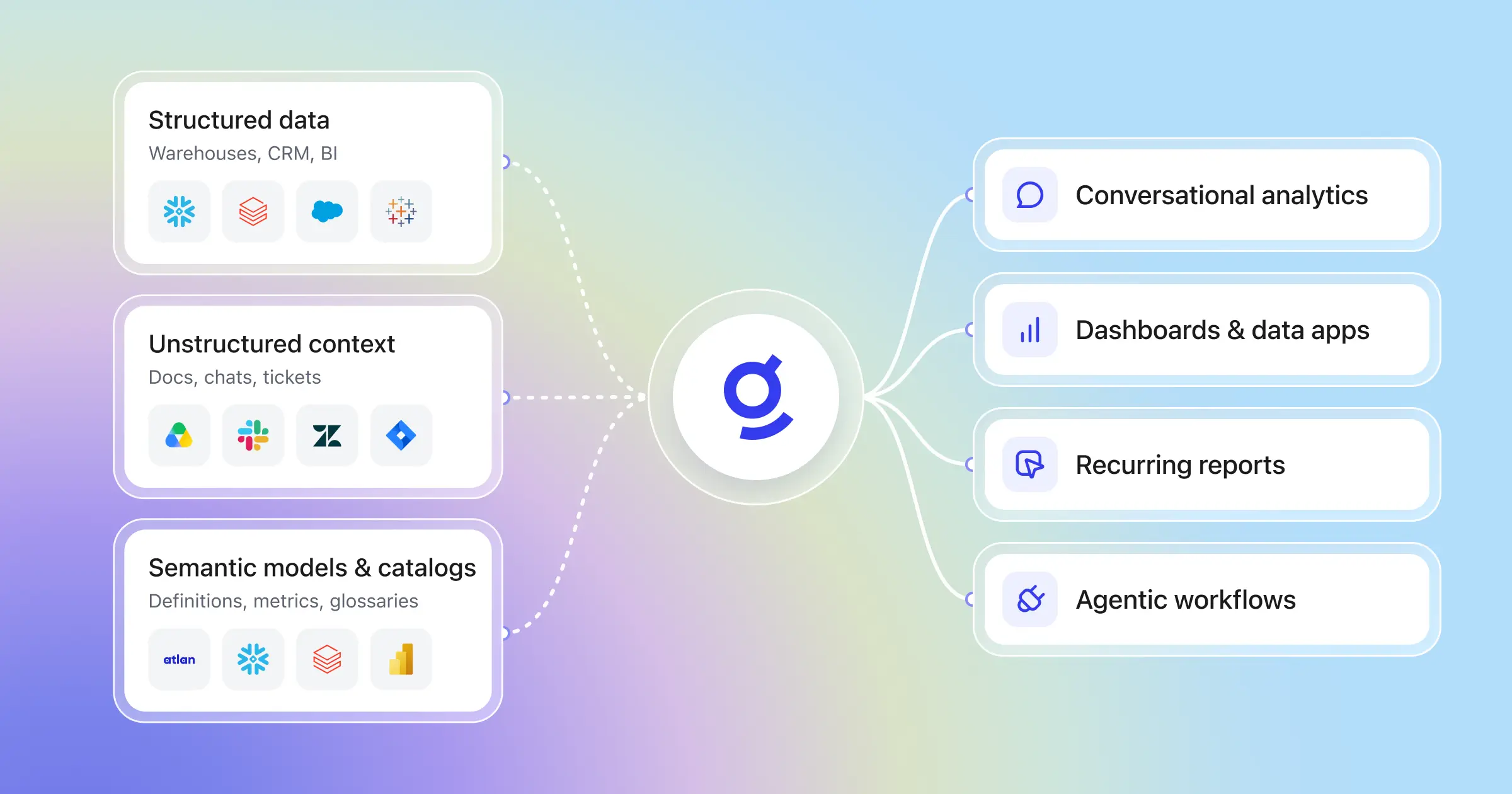
An AI knowledge platform is a unified system that connects enterprise knowledge across applications, understands natural-language questions, enforces existing access permissions, and delivers grounded answers and actions in context. Unlike a static knowledge base or a standalone chatbot, it sits on top of the tools teams already use — from collaboration and support systems to CRMs, code repositories, and HR portals — and turns scattered information into a reliable, searchable layer of organizational intelligence.
The architecture behind these platforms typically combines several core capabilities that work together to make enterprise knowledge useful at the point of need:
- Enterprise search and retrieval: The platform continuously indexes content across dozens or hundreds of connected applications. Rather than relying on basic keyword matching, it uses hybrid search methods — including semantic understanding, lexical search tuned for enterprise data, and a knowledge graph that maps relationships between people, content, and activity — to return relevant, authoritative results.
- Permission-aware access: Every query respects the original source permissions. An employee only sees information they are authorized to access, which makes the platform viable for sensitive environments in financial services, healthcare, government, and other regulated industries.
- Context-rich AI responses: When an employee asks a question, the platform retrieves relevant enterprise content and feeds it to a large language model through a retrieval-augmented generation (RAG) pipeline. The result is a grounded answer drawn from trusted internal sources — not a generic response from a model trained only on public data.
- Workflow-level action: The most advanced platforms go beyond answers. They support governed AI agents that can draft responses, summarize documents, surface next steps, or trigger actions inside business systems — all within the tools employees already use daily.
Why leadership should care
For senior leaders, the value of an AI knowledge platform is straightforward. It reduces the time employees spend searching for information, improves the consistency of answers across teams, and accelerates decision-making by putting trusted context within reach. It also helps the organization extract more value from existing software investments, content libraries, and subject matter expertise that would otherwise remain siloed or underused.
The distinction matters: this is not another content repository or a general-purpose AI assistant. It is a foundation for better work — one that unifies fragmented information, eliminates repetitive knowledge retrieval, and helps every team move with more confidence. Platforms built for this purpose, such as Glean, treat enterprise search, connectors, permissions, and contextual understanding as the base layer on which all useful AI capabilities depend.
That framing is critical when presenting AI to leadership. Position the platform as business infrastructure that improves how people find, trust, and act on knowledge that already exists across the enterprise — not as a technology experiment that requires new workflows or unfamiliar tools.
How to present the benefits of an AI knowledge platform to company leadership
Set the terms of the conversation before the discussion drifts into features. Tell leadership they will get four things from the meeting: a clear view of the operating friction in front of them, a practical way to remove it, a short list of metrics that will show whether the effort works, and a contained rollout plan with defined oversight.
That opening does two jobs at once. It keeps the conversation grounded in business performance, and it makes the proposal easier to compare against other investments. Senior leaders do not need a tour of interface details to decide whether a knowledge initiative deserves support; they need a case with visible inputs, visible outputs, and visible controls.
Frame the discussion as an operating decision
Build the story around a before-and-after view of work. Before adoption, employees piece together answers from ticketing systems, file repositories, chat threads, CRM records, wikis, and old email chains. After adoption, they get one governed access layer that surfaces current company knowledge and supports repeatable work without extra handoffs.
A simple structure works well here:
- Show the source of drag: Point to high-friction moments leadership already knows well — support teams hunt for approved responses, account teams search for the latest collateral, engineers retrace past decisions, and internal service teams answer the same policy questions every week.
- Name the remedy in business terms: Describe the platform as a way to unify access across existing systems, preserve source-level controls, and deliver responses tied to approved company information.
- Define the measurable change: Focus on reduced search time, fewer duplicate requests, faster resolution on internal and external questions, and shorter ramp time for new employees.
- Present a controlled first phase: Recommend a narrow pilot with a known workflow, a small group of users, and a review window that makes expansion or course correction easy.
That sequence keeps the conversation in operating terms instead of product terms. Leaders can see the current cost of the bottleneck, the mechanism that addresses it, and the discipline behind the rollout.
Use executive language, not product language
Choose language that aligns with how leadership evaluates risk and return. Terms such as cycle time, answer consistency, institutional knowledge reuse, auditability, and employee ramp resonate because they connect directly to cost, service quality, and execution speed. Technical language has its place, but it should support the case rather than carry it.
A useful method is to translate capabilities into outcomes as you speak. System integrations become less switching between tools; cited responses become easier verification; inherited access controls become stronger data governance; workflow assistance becomes lower queue volume and fewer interruptions. The more direct the translation, the easier the discussion becomes for finance, operations, and business-unit leaders.
Keep the supporting detail available for follow-up, not for the center of the meeting. The main presentation should stand on its own as a business case for AI, even with no product demo on screen.
Return to one idea throughout the presentation
The strongest throughline is execution. The platform matters because it shortens the path from a question to a reliable next step. That benefit appears in different forms across the business, but the operating pattern stays the same: less time lost to retrieval, less inconsistency in answers, and less dependency on a small set of experts.
Make that pattern concrete by function. In customer support, it can reduce escalations and improve response quality. In engineering, it can surface prior decisions, runbooks, and documentation without long delays. In sales, it can tighten access to current messaging and account context. In HR and IT, it can reduce repetitive requests and strengthen self-service.
Keep that point visible throughout the presentation. The value of AI in enterprise settings does not come from novelty or broad claims about transformation; it comes from better work flow, better access to company knowledge, and a measurable lift in day-to-day execution.
1. Start with the business problem, not the technology
Leadership attention rises when the discussion opens on business friction that already costs time and money. In many enterprises, one routine task now requires a chain of lookups across collaboration tools, internal portals, support systems, file stores, and side conversations with subject-matter experts. The issue is not technical curiosity. The issue is lost throughput across teams that should move faster with the knowledge they already own.
Present the problem in operating terms. High-value employees spend part of each day on basic verification: which answer is approved, which document reflects the latest policy, which prior decision still applies, which team owns the next step. That effort drains capacity from revenue work, service delivery, and core operations. It also creates uneven execution, because two employees can face the same question and reach two different answers based on what they happen to find first.
Make the status quo visible
A strong presentation makes this friction easy to picture. A team lead prepares a response to an employee question and must check a policy page, a recent internal thread, and a ticket note before feeling comfortable with the answer. A seller heads into a customer call and needs current pricing guidance, product positioning, and account history, but each piece sits in a different system. A developer starts work on a change request and must chase incident context, architecture notes, and prior approvals before code review can even begin.
This is where the status quo becomes expensive. Employees often locate something useful, yet still spend extra time on validation, cross-checks, and follow-up messages because certainty is low. That hidden tax rarely shows up as a line item, but it surfaces in longer cycle times, avoidable interruptions, repeat escalations, and slower decisions.
Use examples leadership will recognize
Use workflow examples that match the audience in the room:
- Engineering: Design rationale, incident history, and internal standards often live in separate places. Senior engineers become routing points for context instead of spending time on architecture and delivery.
- Customer support: Frontline teams pause on edge cases because macros, policy updates, and product guidance do not always align. Supervisors then step in to confirm answers that should already be easy to verify.
- Sales: Reps assemble proposals from multiple sources and ask for last-minute confirmation on pricing, messaging, or contract details. That extra loop slows deals and increases the chance of inconsistent outbound communication.
- HR and IT: Service teams field a steady stream of routine requests on access, onboarding, policies, equipment, and benefits. Repetition absorbs capacity that should go toward exceptions, planning, and employee support that requires judgment.
These examples work because they show leadership a familiar pattern: expensive teams spend too much effort on retrieval and confirmation before they can act. The conversation then stays anchored in workflow improvement, not product novelty.
Frame the issue as a business lever
Keep the risk framing calm and specific. This is not a story about looming disruption or unchecked automation. It is a case for reducing avoidable delay, tightening operational consistency, and giving employees faster access to approved context inside normal work.
That framing also sets up the rest of the presentation. Any AI layer that comes later depends on reliable retrieval, clean permissions, and current source knowledge beneath it. When those foundations are weak, answer quality drops and trust erodes. When those foundations are strong, teams move with less friction and leaders gain a credible path to measurable improvement while human oversight stays in place where judgment matters most.
2. Match AI knowledge management benefits to leadership priorities
At this stage, move from explanation to executive relevance. Put each benefit next to a business objective that already appears in an annual plan, operating review, or board update.
That shift changes the discussion. Instead of abstract talk about AI capability, leadership can judge the platform on familiar terms: throughput, service quality, process discipline, faster ramp for new teams, and better use of knowledge assets the company already funds.
Tie the value to each leadership role
Each executive sponsor has a different lens. Keep the core story steady, then tune the proof points to the outcomes each role owns.
- CEO and business unit leaders: Stress speed to market, cleaner coordination across functions, and the ability to spread company know-how as the organization grows. This matters most in fast-moving environments where product, sales, support, and operations depend on the same facts but often pull them from different places.
- COO: Focus on process friction, repeat internal demand, and uneven execution. A strong platform cuts avoidable back-and-forth, reduces policy variance across teams, and helps each function handle routine requests with less manual effort.
- CIO and IT leaders: Lead with system fit and control. The strongest knowledge management solutions work across current applications, avoid yet another destination for employees to check, and maintain the access model already set in each source system.
- CFO: Tie value to labor efficiency and prior investment return. Show how fewer wasted hours, less rework, faster onboarding, and better reuse of licensed content and enterprise software can expand productive capacity without a parallel rise in spend.
- People leaders: Emphasize employee confidence and mobility. When staff can locate policy, process, and team knowledge without delay, new hires settle in faster and internal moves place less pressure on managers and peers to fill every gap by hand.
Keep the benefit categories tight
A short framework helps leadership absorb the case fast and compare it against other priorities. Four buckets usually hold the full story without drift:
- Productivity: Employees spend less effort on low-value knowledge work such as answer hunts, repeat requests, and manual validation.
- Decision support: Teams reach sound judgments faster because the latest policy, prior resolution, account context, or project history sits closer to the point of need.
- Cross-team execution: Shared access to approved knowledge reduces confusion between departments and improves continuity from one team to the next.
- Process reliability: The business sees fewer avoidable variations in how people respond, advise, and complete common tasks.
This is also the point to distinguish enterprise-grade platforms from generic AI products. In the broader market of AI knowledge management tools, leadership should favor systems built for company context — connected data, policy-aware access, workflow support, and governed automation — because those traits decide whether the platform helps real work move or just produces fluent text.
3. Explain the AI platform advantages in enterprise terms
Connected systems, not another destination
Traditional search works best when content sits in one well-maintained repository and the user knows roughly where to look. Enterprise work does not look like that. Important context sits across service desks, chat threads, CRM records, internal docs, meeting notes, code systems, and line-of-business tools; a useful platform brings those sources into the same operating view without asking employees to reconstruct the answer themselves.
That difference is practical, not cosmetic. Older knowledge bases often depend on manual curation, while standalone assistants depend on whatever context a user happens to paste into the prompt. An enterprise platform carries source metadata, freshness signals, authorship, and system context with the content itself, so the answer reflects how the business actually runs rather than how one document was written.
Permission-aware access builds trust
In a large organization, access rules are part of daily operations. Finance content, legal guidance, customer records, security incidents, and draft product plans do not belong in a common pool. A credible platform respects that reality by inheriting the policies already attached to each system — user identity, group membership, role changes, and content-level restrictions — instead of creating a parallel access model that teams must manage by hand.
That matters in leadership conversations because it turns security from a promise into an operating principle. Executives want to know that the platform can sit across sensitive systems without widening exposure, blurring ownership, or weakening governance. The strongest answer is simple: the system should behave like the underlying enterprise, not bypass it.
Retrieval quality determines AI quality
Static repositories reward exact recall. Employees must guess the right title, phrase, or folder path; the system then returns a list of possible matches, often without enough context to know which one is safe, current, or authoritative. Enterprise AI requires a different standard. It must interpret short tickets, acronyms, internal project names, and half-formed questions, then rank results based on relevance to the user, the task, and the organization.
That is where real platform depth shows up. Strong systems account for terse chat messages and formal policy pages differently; they weigh recency, role relevance, document authority, and organizational relationships before any model writes a response. Search quality is not a front-end feature. It is the control point that determines whether AI helps an employee move faster or sends them in the wrong direction with more confidence.
From knowledge access to workflow support
A traditional search tool stops at retrieval. A standalone assistant often stops at language generation. An enterprise platform should carry the work one step further. After it identifies the right context, it can help prepare a support reply from approved material, assemble the background for an account handoff, summarize a long trail of operational updates, or guide an employee through the next step in a repeatable process.
This is where governed agents start to matter. With the right controls, the platform can support specific actions inside service management, collaboration, engineering, and browser-based workflows without turning every use case into a broad automation project. The enterprise advantage is not access to a powerful model in isolation; it is the ability to apply company knowledge, policy, and process to real work with enough consistency that people can rely on the result.
4. Quantify the ROI with a simple, credible business case
At this stage, interest shifts to scrutiny. Leadership will want a financial case they can test, plus a measurement plan they can trust after launch.
Start with a before-and-after scorecard drawn from current operations. Use metrics that already exist inside service desks, onboarding programs, support queues, and team workflows: volume of repeat requests, number of escalations to subject-matter experts, case reopen rates, time from question to approved answer, and the point at which a new hire can handle standard work without backup. That baseline gives the business case weight because it ties value to live operating data, not vendor assumptions.
Start with a narrow set of value levers
Keep the model compact. A short list of measurable outcomes will hold up far better in an executive review than a long forecast with too many moving parts.
- Lower interrupt volume: Track how many routine requests move out of email threads, chat pings, and manual escalations because employees can resolve them through the platform. This works well for HR, IT, internal operations, and support environments with high-frequency questions.
- Stronger first-pass quality: Measure fewer reopened cases, fewer revisions to customer replies, fewer internal corrections, and better adherence to approved guidance. This shows value beyond speed; it shows that teams get it right earlier in the process.
- Shorter cycle time for knowledge-heavy tasks: Focus on work that depends on scattered context — proposal drafting, incident review, policy lookup, case response, account preparation, or internal service resolution. Compare elapsed time before and after rollout.
- Faster time to proficiency: For new hires, look at how quickly they can complete common tasks without shadow support. This metric often matters more than general onboarding satisfaction because it ties directly to output.
Use conservative math once the value levers are set. A modest drop in reopened tickets, a small reduction in expert interrupts, or a shorter completion time for recurring workflows can add up quickly across hundreds or thousands of employees. Conservative assumptions tend to survive finance review because they leave room for upside instead of depending on ideal behavior.
Add reliability and knowledge utilization to the model
A credible ROI case should include operational quality, not just capacity. Better knowledge access can reduce policy drift between teams, cut the number of answers that require manual correction, and improve trust in day-to-day outputs where teams need current guidance, not partial recall.
It also helps to show how the platform activates knowledge assets that already exist but rarely contribute at the moment of need. Closed tickets, archived project notes, meeting summaries, approval histories, and expert-authored documents often sit unused because retrieval is weak. Once those assets become usable in daily work, the organization gets more return from past effort that would otherwise remain dormant.
Present a range, not a single number
A single ROI figure can look brittle. A better approach is to present a small range tied to rollout maturity:
- Pilot case: One workflow, one team, limited data sources, tight measurement.
- Operational case: Two or three workflows with repeat demand and visible handoff reduction.
- Scaled case: Broader adoption after governance, content quality, and usage patterns are stable.
That structure gives leadership a realistic path from proof to expansion. The point of the model is not a claim of perfect automation; it is evidence that knowledge-heavy work can move with fewer delays, fewer handoffs, and fewer avoidable errors when employees have dependable access to the right material.
5. Address security, governance, and adoption concerns before leadership raises them
Once the economics make sense, the conversation usually shifts to operating risk. Leadership will want to know who sets the rules, which data enters scope, how outputs stay within policy, and what controls prevent a small pilot from turning into unmanaged sprawl.
Security and data control
Treat security as an operating model, not a feature list. The strongest presentations show that the platform fits inside existing control structures — data classification, identity management, vendor review, audit policy, and incident response — rather than asking the business to invent a new one for AI.
That means spelling out a few specifics up front:
- Data scope stays deliberate: not every repository needs to enter the first phase. Start with approved systems, define excluded content classes, and document why each source belongs in scope.
- Provider terms stay explicit: leadership should know how enterprise data moves through the stack, what retention rules apply, where logs live, and what contractual limits govern downstream model use.
- Oversight stays named: security, legal, IT, and the business owner each need a defined role in approval, review, and exception handling.
This level of detail changes the tone of the discussion. Instead of a broad debate about AI risk, the meeting becomes a review of familiar enterprise controls applied to a new knowledge layer.
Answer quality and governed action
Quality concerns deserve the same level of precision. Executives do not need a lesson on model architecture; they need confidence that the system will favor approved information, surface uncertainty when confidence drops, and route sensitive work to the right human owner.
A disciplined quality framework usually includes three parts:
- Content stewardship: designate authoritative sources, identify stale or conflicting material, and assign owners who can correct gaps before they spread across teams.
- Use-case tiering: classify tasks by risk level. Low-risk support can move faster; policy interpretation, customer commitments, legal language, and financial approvals need tighter review paths.
- Operational review: monitor output patterns, track failure modes, and maintain a process for prompt changes, source tuning, and workflow rollback when performance slips.
The same logic applies to agents and automated steps. Once the platform can draft, update, classify, or trigger work inside another system, governance must cover execution boundaries, approval thresholds, and post-action traceability. That is how leadership sees the difference between controlled automation and silent process drift.
Adoption and workflow fit
Adoption rarely fails because employees reject useful tools. More often, it fails because no team owns the rollout, no one curates the content that matters most, and success criteria stay too vague to guide expansion.
Present rollout as structured change management with clear ownership and short learning loops. A focused deployment works best when one business team, one workflow family, and one small set of priority sources carry the initial phase. That approach makes it easier to train managers, refine content, and measure actual behavior rather than rely on survey-level enthusiasm.
A practical adoption plan should define:
- A workflow owner: the leader accountable for usage, content health, and business outcomes
- A review cadence: regular checkpoints for quality issues, source gaps, and policy exceptions
- A narrow success definition: a small set of operational signals that show whether the system improves work in practice
- An expansion gate: clear conditions for when the organization adds new teams, new sources, or new automated actions
That framing tends to resonate with leadership because it reflects how enterprise systems earn trust: through controlled scope, visible ownership, and evidence from real operations rather than broad promises.
6. Recommend a phased rollout with a clear executive ask
Leadership should leave this discussion with an approval path, not a general sense of interest. The strongest proposal is a staged pilot: fixed scope, named owners, defined checkpoints, and a small set of business outcomes that matter to the team in question.
Choose the first phase with discipline. The best opening use cases share three traits: high question volume, clear source material, and a workflow where delay has an obvious cost. Good examples include employee policy lookup for HR, case guidance for support, prior-incident discovery for engineering, or account prep for sales before a renewal or expansion call.
Define the first phase with precision
Set the pilot in terms leadership can evaluate without guesswork:
- Source boundary: Name the exact systems in scope for day one. That may include a service desk, policy repository, CRM, product documentation, contract library, or code knowledge base. A limited source set makes result quality easier to inspect.
- User cohort: Pick one team, region, or function. A contained group gives you a clean before-and-after comparison and avoids noise from unrelated workflows.
- Job to be done: State the first workflow in one line. “Resolve common HR policy questions” or “surface prior fixes for production incidents” gives the pilot a clear purpose.
- Decision gates: Set 30-, 60-, and 90-day checkpoints with explicit pass criteria. Leadership should know what qualifies as proof, what triggers adjustment, and what would stop expansion.
Placement matters as much as scope. The pilot should appear at the point where work decisions happen — inside the case view, beside the knowledge panel, within the engineer’s browser flow, or next to the seller’s account context — so the platform supports the task itself rather than asking users to break flow and search elsewhere.
Make the pilot measurable
Use a scorecard that reflects service quality and operational lift, not just raw usage. A compact set of metrics will hold up better in an executive review than a long dashboard full of weak signals.
- Answer acceptance rate: Track how often users accept the surfaced answer or response draft without major rework.
- First-response accuracy: Measure whether the initial answer aligns with approved source material and reduces follow-up correction.
- Manual escalation rate: For support, HR, or IT workflows, count how often a case still needs expert intervention after the platform responds.
- Median cycle-time change: Compare how long the target workflow takes before and after rollout.
- Expert interrupt volume: Count the reduction in ad hoc pings to subject matter experts for routine questions.
- Repeat-user ratio: Look at whether the same users return week after week; that pattern often signals practical value better than one-time trial activity.
- Source-confidence feedback: Ask users whether the cited material felt current, relevant, and authoritative.
Each checkpoint should force a decision. At 30 days, review access, source quality, and usage patterns. At 60 days, review accuracy and workflow effect. At 90 days, decide whether the evidence supports broader deployment, a narrower second phase, or a redesign of the use case.
Ask for ownership, not just budget
A pilot needs a governance model before it needs a larger budget line. The operating group should include one executive sponsor, one business lead for the workflow, one technical owner for integrations and permissions, and one security or compliance approver where the use case touches sensitive data. That structure prevents drift when teams need decisions on source access, content quality, or policy controls.
Expansion should follow a clear maturity path. Prove retrieval quality first; then prove answer quality; then introduce tightly controlled actions for a narrow task where the business rules are well understood. That sequence matches how enterprise AI tends to mature in practice, especially when the long-term roadmap includes agents, orchestration, or action inside systems such as Teams, ServiceNow, Zendesk, GitHub, or browser-based workspaces.
The executive ask should fit on one line: authorize a limited pilot for a defined workflow, assign accountable owners, approve the initial source systems, and review results against agreed service, quality, and productivity measures at 30, 60, and 90 days.
How to present the benefits of an AI knowledge platform to company leadership: Frequently Asked Questions
As the presentation moves toward evaluation, executives tend to test the case from several angles at once — value, proof, control, and fit. The questions below help answer those concerns in terms leadership teams actually use when they assess a new operating capability.
What are the key benefits of an AI knowledge platform for enterprises?
The strongest benefits often appear where knowledge work breaks down today: handoffs, rework, policy drift, and overreliance on a small group of experts. An AI knowledge platform helps convert scattered know-how into an operational asset the business can use more consistently across regions, teams, and systems.
For enterprise leaders, the upside usually falls into four areas:
- Institutional memory at scale: Important decisions, process exceptions, and working knowledge remain available even as teams change, organizations reorganize, or subject-matter experts move on.
- Operational standardization: Employees have a more dependable way to work from approved materials, which helps reduce local workarounds and uneven process execution.
- Better return on existing investments: Content libraries, service documentation, training materials, and system data become more useful when employees can actually apply them in day-to-day work.
- Action support inside real workflows: Advanced platforms do not stop at retrieval. They can assist with tasks such as response preparation, issue triage, document synthesis, and next-step guidance.
That matters because the business benefit is cumulative. Small improvements in knowledge use can compound across service teams, product groups, operations, and internal support functions.
How can I effectively communicate the ROI of an AI knowledge platform?
The clearest ROI story starts with one expensive workflow, not a broad statement about enterprise transformation. Pick a high-friction process leadership already understands — internal support, sales response prep, engineering issue resolution, onboarding, or policy lookup — then show how knowledge delays affect cost, quality, and cycle time today.
A practical ROI model usually works best when it includes three elements:
- Workflow economics: Estimate the current effort behind the task — time spent locating information, number of touches, escalations, and review loops.
- Conservative performance improvement: Use restrained assumptions for cycle-time reduction, fewer escalations, or lower dependence on specialist intervention.
- Business impact translation: Express the result in terms leadership uses — lower service cost, faster customer response, quicker new-hire readiness, or stronger process throughput.
This framing keeps the business case disciplined. It shows how knowledge access affects operating performance in measurable ways, without asking leadership to buy into vague claims about AI potential.
What data or proof points should support my presentation?
Use evidence that reveals where knowledge friction already taxes the business. Leadership will respond more strongly to operational signals than to generic adoption metrics.
The most useful proof points often include:
- Escalation patterns: How often routine questions still require manager or expert involvement
- Rework indicators: Cases reopened, duplicate tickets, repeated clarifications, or revisions caused by incomplete information
- Training drag: Extra shadowing time, manager check-ins, or time until a new hire can handle standard scenarios independently
- Content reliability markers: Outdated documents, conflicting instructions, or materials that exist but rarely influence real work
- Decision latency signals: Delays tied to missing approvals, prior context, or the need to confirm which source is current
It also helps to bring short examples from different teams. A support leader may care about exception handling, while an engineering leader may care about prior incident context and architecture decisions. Proof becomes stronger when it shows how knowledge issues shape output, not just search behavior.
What concerns might leadership have about adopting an AI knowledge platform?
Executive concern usually centers on controllability. Leaders want to know whether the system can fit enterprise standards for access, oversight, change management, and measurable accountability.
A credible answer should address the adoption path as much as the technology itself:
- Control over enterprise data: Show how the platform works within established identity, access, and retention policies rather than around them.
- Traceable outputs: Make clear that answers and workflow support can be inspected, reviewed, and tied back to source material or approved business logic.
- Operational ownership: Define who manages content quality, use-case rollout, and policy decisions once the platform is live.
- Deployment discipline: Explain that the first release should stay narrow enough to observe behavior, tune quality, and validate outcomes before wider expansion.
- User fit: Show that the system supports existing work patterns instead of asking employees to learn an entirely new way to get work done.
This kind of response lowers resistance because it treats adoption as a managed enterprise program, not a software launch.
How does an AI knowledge platform improve collaboration and efficiency?
One of the biggest operational costs in large organizations comes from knowledge routing. Employees spend time figuring out who knows the answer, who owns the process, and which source can settle the issue. That creates hidden load on managers, experts, and support teams that rarely shows up cleanly in dashboards.
An AI knowledge platform reduces that routing burden. Instead of pushing every ambiguous question toward a person, it helps teams resolve more issues with clearer context, better reuse of prior work, and stronger alignment across functions.
That change can show up in several ways:
- Less expert bottlenecking: Specialists spend less time on routine interpretation and more time on genuinely complex work.
- Better asynchronous execution: Distributed teams can progress without waiting for someone in another office or time zone to answer a basic question.
- Stronger cross-functional continuity: Work moves with better context from one team to the next, which cuts avoidable clarification cycles.
- More usable internal documentation: Knowledge stops acting like static reference material and starts supporting execution more directly.
The efficiency gain is not only about speed. It is also about reducing the coordination tax that slows large organizations down.
What is the strongest final message to leave with leadership?
The best closing message frames the platform as a way to improve how the company uses what it already knows. That makes the decision feel grounded in operating discipline rather than tied to enthusiasm for a new class of tools.
A strong final line usually has three parts: name the business constraint, define the response, and state the evaluation model. In practice, that sounds like this: the company loses time and consistency because knowledge remains hard to apply at scale; an AI knowledge platform addresses that gap by making enterprise information usable in everyday work; success should be judged through a controlled rollout with explicit operating metrics and clear ownership.
The difference between a stalled AI conversation and a funded pilot usually comes down to preparation — showing leadership a clear problem, a measured fix, and a path they can govern with confidence. The frameworks above give you the structure to do exactly that, whether you're presenting to a CFO focused on labor efficiency or a CIO evaluating platform fit.
When you're ready to see how this works in practice, request a demo to explore how we can help AI transform your workplace.

.jpg)

.png)



.jpg)
.webp)

