




The future of work 8 industries benefiting from AI automation
AI automation has moved from boardroom buzzword to operational backbone. Across every major sector, enterprises now deploy intelligent systems that go far beyond simple task repetition — they analyze context, surface buried insights, and execute multi-step workflows that once demanded hours of human effort.
The shift is not theoretical. With the global AI market projected to exceed $3.4 trillion by 2033 and adoption rates climbing across industries from healthcare to logistics, the question for most organizations is no longer whether to adopt AI-driven automation but where to start. The industries that stand to gain the most share a common profile: high transaction volumes, complex compliance requirements, and knowledge-intensive workflows spread across fragmented systems.
This article breaks down eight industries where AI automation delivers the clearest, most measurable impact — and offers a practical framework for evaluating where the technology fits within your own operations.
What is AI-driven automation?
AI-driven automation combines machine learning, natural language processing, and intelligent workflow orchestration to handle tasks that traditionally required human judgment. This is a meaningful distinction from earlier generations of rule-based automation, which could only follow predetermined scripts. An AI-driven system reads context, learns from data, adapts to new inputs, and improves its own performance over time — turning static, brittle processes into dynamic operations that self-optimize as conditions change.
At its core, the technology augments human work rather than replacing it. Employees are freed from the heavy lifting of data analysis, pattern recognition, and routine execution so they can focus on higher-value thinking: strategy, creativity, relationship-building, and complex problem-solving. The most effective AI automation tools in enterprise settings improve knowledge access, workflow execution, and decision support — not as isolated chat interfaces, but as deeply integrated layers within the systems teams already use every day.
Where the real value lives
The practical power of AI automation shows up when it connects fragmented information and makes it actionable in real time. Consider a few dimensions:
Context-aware decision-making: Unlike basic automation that triggers the same action every time, AI-driven systems weigh variables — user permissions, historical patterns, organizational context — before determining the best next step. A support ticket routed by AI, for example, factors in the customer's history, the agent's expertise, and the knowledge base simultaneously.
Continuous learning: Traditional automation degrades as business conditions shift. AI-driven systems improve. A demand forecasting model trained on six months of sales data performs better at month twelve than month one, because it has absorbed seasonal patterns, promotional effects, and supply fluctuations that no static rule could capture.
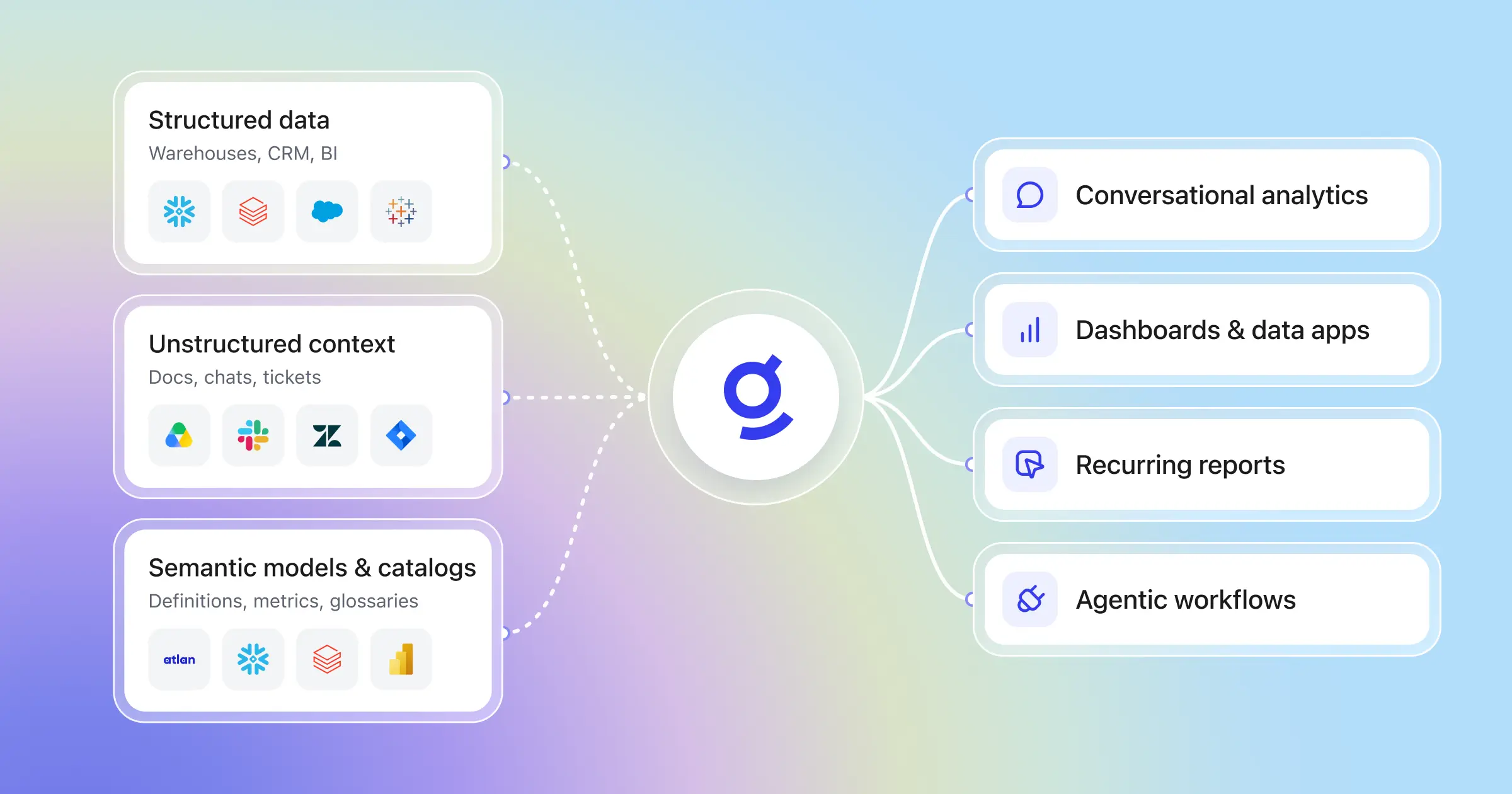
Cross-system orchestration: Most enterprises operate across dozens — sometimes hundreds — of SaaS applications, databases, and internal tools. AI automation bridges these silos, pulling relevant data from multiple sources to assemble a complete picture before acting. This is where organizations exploring AI use cases across departments discover the technology's deepest leverage: not in any single application, but in the connective tissue between them.
The distinction matters for enterprise teams evaluating AI technology adoption. A tool that automates one narrow task delivers incremental efficiency. A platform that understands organizational knowledge, respects data permissions, and orchestrates workflows across departments delivers compounding returns — the kind that reshape how an entire company operates.
Why AI automation matters for businesses right now
The business case for AI has hardened fast. Forecasts that place the global AI market above $3.4 trillion by 2033 reflect a broader enterprise reality: AI has moved into budget lines tied to operating performance, service quality, and margin protection. For leadership teams, this is less a technology bet than a response to real constraints across hiring, cost control, and execution speed.
Those constraints show up in daily work. Teams manage higher case volumes, stricter compliance demands, and records scattered across HR platforms, finance systems, support tools, document repositories, and internal wikis. In that environment, AI helps companies raise output without matching that increase in labor. It shortens cycle times, reduces avoidable manual effort, and improves consistency in processes where small errors carry outsized risk.
What organizations gain first
Faster operational decisions: AI can assemble relevant business context in seconds, which cuts the lag between request, review, and response. That matters in approval chains, service operations, and internal support queues where delay compounds quickly.
Stronger control in regulated work: Banking, healthcare, insurance, and legal operations rely on precision. AI helps standardize document handling, detect anomalies, and support policy adherence across high-volume workflows.
More usable enterprise insight: Valuable signals often sit in separate systems and never reach the person who needs them. AI improves discovery and synthesis so employees can act on current information instead of stale summaries or incomplete records.
A clear pattern has emerged in software selection as well. Organizations no longer place the highest value on standalone AI features; they favor tools that fit directly into search, support, finance, and HR workflows and respect how teams already operate. That same trend appears in pieces such as 9 Best AI Assistants to Increase Workplace Productivity and 9 best generative AI tools for enterprises in 2025, where the strongest options center on secure integration, workflow assistance, and practical business outcomes rather than novelty alone.
Healthcare and life sciences
Healthcare and life sciences present one of the most practical tests for AI automation because the work carries both human and operational stakes. A small gain in diagnostic speed, patient throughput, or documentation quality can affect outcomes, staffing pressure, and cost at the same time.
Earlier detection and stronger clinical insight
Clinical teams now use AI to review mammograms, CT scans, MRIs, pathology slides, lab panels, and longitudinal patient records with a level of consistency that manual review alone cannot match at scale. That capability matters most in conditions where subtle patterns hide in plain sight — early-stage cancer, cardiac risk, stroke indicators, or signs of deterioration that span multiple encounters rather than one visit.
The strongest clinical use cases pair detection with prioritization. An imaging queue can move suspected high-risk cases to the top; a care team can receive risk scores that combine history, vitals, medications, utilization patterns, and recent notes. That shift gives physicians and nurses a clearer basis for early intervention, especially for patients with elevated readmission risk, chronic disease complications, or likely adverse events after discharge.
Less administrative drag across the care journey
Much of healthcare still depends on repetitive administrative work that consumes clinical and operational capacity. AI helps health systems compress that burden across intake, scheduling, prior authorization, claims handling, discharge paperwork, and care coordination — all areas where delays often stem from backlog, missing information, or manual review queues.
A few workflow categories show especially strong returns:
Patient access and intake: AI can structure intake forms, capture symptom details, route requests to the right department, and prepare the next step before staff touch the case. This reduces front-desk bottlenecks and shortens the time between first contact and scheduled care.
Clinical documentation: Visit notes, discharge summaries, referral letters, and chart updates can be drafted from source material and organized into the format each team requires. That gives clinicians more time for patients and less time for after-hours chart completion.
Claims and authorization tasks: AI can extract fields from forms, check for missing elements, compare documentation against payer requirements, and surface exceptions that need human review. Revenue cycle teams benefit from fewer avoidable errors and faster case movement.
Care coordination and compliance: Follow-up plans, referral steps, handoff notes, and audit records become easier to track when AI can identify gaps, prompt the next required clinical or administrative task, and support traceable review under healthcare controls.
Practical healthcare deployments already center on intake, documentation, care coordination, and compliant automation rather than broad autonomous decision-making. That pattern reflects how the sector adopts new technology: step by step, with clear oversight, role-based review, and measurable value in day-to-day operations.
Faster research cycles in life sciences
Life sciences teams face a different form of complexity: long research timelines, high failure rates, and massive volumes of technical data. AI helps compress early discovery work by simulating molecular interactions, ranking likely candidates, and narrowing the field before wet-lab teams commit time and budget to expensive validation paths.
The same pattern extends into development and regulatory work. Research groups use AI to review literature, identify trial cohorts, detect missing data in submissions, and organize large bodies of safety or clinical evidence for review. That does not replace scientific judgment; it gives researchers, clinical operations teams, and regulatory staff a faster route to the next informed decision.
Financial services and banking
Financial institutions run on precision. A single break in a payment file, loan packet, or control check can delay funding, trigger losses, or create audit exposure, which makes finance one of the strongest fits for AI automation. Banks, insurers, and capital markets teams now use AI to inspect transaction streams, customer records, and operational documents at machine speed; the result is faster detection of suspicious activity, cleaner processing, and tighter control across high-volume work.
Where AI creates the most value
Transaction surveillance: AI scores card activity, wire transfers, ACH flows, login behavior, merchant anomalies, and beneficiary changes in one pass. This helps fraud teams catch account takeover, mule activity, and unusual payment patterns before they move deeper into the system.
Credit and origination: Loan operations benefit from models that read applications, tax forms, payroll records, bank statements, and supporting documents, then compare the contents against lending policy. This shortens approval cycles, improves consistency, and can reduce processing costs by up to 30% in document-heavy workflows.
Controlled finance operations: Reconciliation, audit preparation, sanctions review, customer due diligence, and regulatory reporting all depend on complete records and repeatable checks. AI agents now handle much of the matching, extraction, evidence gathering, and exception triage that once consumed analyst hours.
Customer-facing work has also shifted. AI can tailor spending alerts, savings prompts, portfolio signals, and product recommendations to each account holder’s patterns and financial position, which gives institutions a way to deliver more relevant guidance across retail banking, wealth, and insurance channels with far greater consistency than manual service models allow.
The less visible gains often matter just as much. Back-office teams use AI to match ledger entries, extract terms from contracts, classify disputes, assemble close packages, and prepare support for internal reviews. That pattern aligns with the strongest finance research: workflow-specific AI agents deliver the most value in tightly governed processes such as reconciliation and audit readiness, where accuracy, traceability, and operational control matter as much as speed.
Here is the revised section with the repeated content removed and the language refreshed to stay consistent with the rest of the article:
Manufacturing and industrial operations
Factory environments produce a constant stream of signals from machines, lines, warehouses, and supplier networks. AI automation turns that raw operational exhaust into usable direction for maintenance teams, plant managers, and production planners — especially in facilities where asset health, throughput, and inventory status change by the minute.
The strongest use case sits in predictive maintenance. Models trained on vibration, temperature, pressure, run time, and failure history can spot abnormal equipment behavior before a breakdown forces a shutdown; in many plants, that shift cuts unplanned downtime by up to 50% and lowers maintenance costs through better timing of service and parts replacement. Instead of servicing every asset on a fixed interval, teams can focus on the machines that show actual signs of wear.
Quality control with computer vision
AI has also changed how manufacturers inspect output on the line. Vision systems paired with high-speed cameras can review seams, dimensions, labels, solder points, surface finish, and assembly accuracy across every unit that passes through production — not just a small sample.
A few high-value uses stand out:
Inline defect spotting: Vision models catch scratches, cracks, misalignment, missing parts, and packaging errors as products move through production; operators can remove faulty units before they create downstream waste.
Lower scrap and rework: Early identification limits the spread of defects across later stages of assembly, which protects material yield and reduces the cost of correction.
More stable production standards: Automated inspection applies the same acceptance criteria across shifts and sites; output quality stays tighter even when labor conditions vary.
Production planning and resource efficiency
AI also improves how plants balance supply, output, and resource use. Forecasting models help manufacturers plan around demand swings, while inventory systems track component availability in real time and highlight constraints before they stall the schedule. In parallel, workflow analysis can reveal where throughput slows — whether the issue sits in a supplier delay, a packing station, or a single overburdened machine cell.
Energy performance has become another practical area for automation. AI can examine electricity load, idle time, peak-use windows, and equipment utilization to show where power spend rises without production value; that gives manufacturers a clearer path to both cost control and sustainability targets. These results depend on live access to ERP records, MES data, sensor platforms, and maintenance logs, because production models perform best when they read current plant conditions rather than last month’s reports.
Retail and e-commerce
Retail absorbs change at consumer speed. Demand moves with weather, promotions, social trends, and channel mix, so even small improvements in product discovery, pricing, and inventory accuracy can have an outsized effect on margin.
Personalization, pricing, and assortment
Recommendation engines now shape much more than a “you may also like” carousel. They weigh browsing paths, cart activity, purchase history, loyalty data, and current stock levels to decide which products, bundles, or substitutes to surface at the exact point of decision. That level of relevance helps retailers lift conversion and average order value while also reducing abandonment when a shopper cannot find the right item fast.
Pricing systems have evolved in parallel. Retail teams use AI to adjust prices based on sell-through rates, competitor moves, promotion performance, and margin targets across categories and regions. The same models improve assortment planning and inventory placement by forecasting seasonal demand, local preferences, and product velocity with greater precision — which means fewer emergency markdowns, fewer missed sales, and better use of working capital.
Customer service and omnichannel execution
Customer-facing automation has become more useful in retail because the questions are highly repetitive and highly time-sensitive. Virtual assistants can resolve order tracking, return eligibility, delivery updates, exchange requests, and product availability around the clock across web, mobile, and messaging channels. During peak periods, that consistency matters as much as speed because service quality often drops when volume spikes.
The more durable gains show up behind the scenes. Retailers use AI to improve omnichannel fulfillment, decide whether an order should ship from a warehouse or store, predict which items face elevated return risk, and align staffing with expected foot traffic and support demand. That broader operational role reflects where retail AI delivers the most value today: not in isolated shopper interactions, but in the daily coordination of merchandising, fulfillment, service, and store operations.
Technology and professional services
Information services, consulting, legal, accounting, software, and IT remain among the fastest adopters of enterprise AI. Their work depends on how quickly teams can turn dense material — contracts, codebases, policy sets, client records, market data, and research notes — into decisions, deliverables, and advice.
That profile makes AI especially effective in roles where delay comes from synthesis rather than transaction volume. A consulting team can compress weeks of desk research into a client-ready brief; a software team can trace patterns across release notes, tickets, and incident reports; a legal or finance team can review large document sets in hours instead of days.
Where AI removes friction
Review-heavy work: AI can read statements of work, audit files, contract packages, and policy documents at scale; pull key clauses; flag nonstandard terms; and sort issues by material risk. In legal, advisory, and compliance functions, that can reduce research and review time by 30–40%, which lets senior professionals spend more time on negotiation, interpretation, and client counsel.
Technical delivery: Engineering and IT teams use AI to connect code comments, runbooks, support histories, architecture notes, and change logs to the task at hand. That shortens root-cause analysis, speeds troubleshooting, and improves handoffs between product, platform, and support teams.
Commercial and people operations: Sales teams prepare for renewals, expansions, and account reviews with faster access to pricing guidance, implementation history, and prior objections. HR teams use the same approach for policy responses, case summaries, and internal communications that need consistency across regions and business units.
In professional services, small efficiency gains create outsized impact because time is the product. When analysts spend fewer hours on source collection and first-pass review, firms can improve turnaround, utilization, and quality at the same time.
The strongest enterprise tools support work, not just output
The most useful AI systems in these sectors do not stop at draft generation. They pull from approved internal material, help teams locate the right source at the right moment, assist with the next task in the workflow, and keep access controls intact across client and company data.
That distinction matters for marketing and analytics teams as much as it does for consultants and engineers. AI can sharpen customer segmentation, improve campaign planning, predict audience behavior, and surface clearer signals on channel performance and return on spend. In practice, the highest-value platforms combine trusted retrieval, draft support, and workflow help inside the same governed environment — which gives teams faster execution without guesswork about where the information came from.
Logistics and supply chain
Supply chain performance depends on synchronization across transport, warehousing, procurement, trade compliance, and supplier execution. AI automation improves that coordination by turning live operational signals into usable decisions before delays cascade across the network.
Faster route decisions and stronger inventory control
AI route optimization engines compare traffic flow, weather conditions, tolls, fuel prices, carrier rates, service-level commitments, and delivery windows in real time. That makes route selection more precise, cuts unnecessary miles, and helps teams reduce transit times by as much as 25% in high-volume delivery environments.
On the inventory side, predictive demand models give planners a sharper read on where stock should sit and when it should move. Instead of reacting after shelves run thin or warehouses fill up, teams can position inventory across regions based on expected demand, lead-time risk, and order volatility — which reduces waste and protects fill rates.
Less paperwork, fewer handoff errors
A major share of logistics cost hides in trade documents, supplier updates, and operational back-and-forth. AI helps by handling the paperwork that slows freight movement and creates avoidable compliance risk.
Trade documentation: AI can classify shipment data, populate customs entries, check commercial invoices against purchase orders, and flag missing details before goods reach the border.
Supplier coordination: Systems can track milestone changes, detect late confirmations, and route the right update to the right team without long email chains.
Disruption response: When storms, port congestion, tariff shifts, or demand spikes hit the network, AI can trace which orders, lanes, and facilities face exposure first and help teams choose alternate carriers, routes, or inventory sources.
The largest gains show up when these capabilities connect across transportation platforms, warehouse data, procurement records, and supplier inputs. That creates a control layer that helps planners, operators, and customer teams act from the same live picture — from network planning through last-mile execution.
Education and nonprofit
Schools and nonprofit organizations tend to work under the same constraint: limited staff, complex service demands, and a constant need to show measurable outcomes. In that environment, AI earns its place through targeted support for instruction, administration, fundraising, and program delivery.
Personalized support at scale
Adaptive learning platforms track how each student performs across lessons, assignments, and assessments, then adjust content in real time. When paired with teacher oversight, that model can improve engagement and knowledge retention by 15–20% because students receive material at the right pace rather than the average pace.
Predictive analytics also gives educators a more precise way to support student success. Attendance shifts, assignment patterns, participation signals, and performance trends can reveal which students need intervention early, which helps advisors and instructors respond before those gaps widen into missed milestones or withdrawal.
Administrative work with less friction
Many institutions see the first practical gains in high-volume operational tasks that depend on accuracy and follow-through:
Admissions and enrollment: AI can review application materials, classify documents, flag incomplete submissions, and move each file to the right stage without manual sorting at every checkpoint.
Scheduling and coordination: Class schedules, advising calendars, room assignments, and event logistics become easier to manage when systems account for constraints and resolve conflicts faster.
Grading and academic records: Staff can use AI to assist with rubric-based scoring, draft feedback, and update student records, which reduces turnaround time across large course loads.
Staff knowledge access: Faculty and program teams often need fast access to policies, grant terms, curriculum guidance, donor history, and internal procedures; well-designed AI systems can surface that information directly inside day-to-day workflows.
These improvements matter because they reduce backlog in the operational core of the institution. Instead of spending hours on queue management and manual review, teams can focus on advising, instruction, community programs, and resource planning.
Smarter outreach for nonprofit teams
For nonprofits, AI often proves most useful in fundraising and constituent engagement. Donor behavior models can identify likely giving patterns, highlight lapsed supporters with strong re-engagement potential, and recommend campaign timing based on prior response data rather than broad assumptions.
That same intelligence can sharpen how organizations allocate scarce outreach capacity. Development teams can tailor communications by donor segment, improve follow-up on grants and pledges, and track campaign performance with more precision; the result is a fundraising operation that relies less on manual list work and more on evidence from actual supporter activity.
How to evaluate AI automation potential for your industry
A useful evaluation starts with operating reality, not product demos. The strongest candidates usually live inside work that moves in steady volume, follows a recognizable path, and carries a clear cost when reviews run late or details slip through.
Find the right starting point
Begin with a process inventory. Map the workflows that absorb the most team hours, create the longest queues, or force employees to check the same sources again and again before they can act.
Frequent handoffs: Work that passes through several people or systems often hides avoidable delay. Vendor onboarding, prior authorization review, returns processing, and account reconciliation fit this profile because each handoff adds waiting time and another chance for inconsistency.
Standard inputs with recurring exceptions: AI delivers value where the base pattern stays familiar but edge cases still appear. Purchase orders, policy documents, service requests, incident reports, and student records often contain enough structure for automation with enough variation to justify machine assistance.
Mandatory review requirements: Processes tied to policy, regulation, or service-level commitments deserve early attention. Where teams must document decisions, preserve evidence, or meet fixed response windows, even modest automation gains show up quickly in cost, throughput, and quality metrics.
This exercise should produce a short list, not a platform-wide wish list. A narrow target with visible operational pain almost always beats a broad ambition with no clear owner.
Audit the information supply
Once a workflow looks promising, inspect the information it depends on. AI systems perform best when records are current, fields mean the same thing across tools, and document access follows a stable pattern.
Ask practical questions before any build begins. Does the same customer, patient, supplier, or student appear under multiple IDs? Do critical details live inside scanned forms, email threads, or free-text notes that no system can interpret consistently? Does one team trust a field that another team ignores? These are not small cleanup issues; they determine whether outputs can support real work.
Freshness matters just as much as format. A forecast built on last quarter’s inventory file, a support response drafted from an outdated policy, or a staffing recommendation based on stale scheduling data will look polished and still create more rework than relief.
Choose work that lifts expert capacity
The best use cases remove drag from skilled roles. They cut lookup time, assemble the first draft of a response, sort incoming cases by urgency, or prepare a packet for review so subject-matter experts can spend their time on judgment instead of preparation.
That distinction changes the design. In finance, automation may collect supporting records and flag unusual line items before an analyst reviews them. In healthcare, it may organize clinical context and required forms before a care team makes the decision. In professional services, it may surface relevant clauses, prior work, and internal guidance before a consultant or attorney shapes the final recommendation.
This is where teams often misjudge value. A tool that produces fast output is not enough; the workflow has to leave employees with better leverage on the part of the job that actually requires expertise.
Prove value with a bounded pilot
A pilot should test one process, one user group, and one set of business measures. Keep the scope tight enough to compare before and after performance without confusion over what changed.
Useful pilot metrics depend on the workflow:- Time to first action: how long it takes for a team member to begin meaningful work after a request arrives- First-pass quality: how often the initial output meets review standards without substantial correction- Rework volume: how many cases return for missing information, policy gaps, or avoidable errors- Cost per completed case: whether the process becomes cheaper as well as faster- Exception resolution rate: whether staff can close unusual or high-risk cases more effectively once routine work clears out
A strong pilot also needs a baseline and a stop rule. Without both, teams end up with anecdotes instead of evidence.
Build operating discipline early
Adoption depends on clarity. Employees need to know what the system prepares, what it recommends, what it can execute on its own, and what still requires approval from a person with domain responsibility.
Training works best when it stays close to the job. A support manager does not need a general seminar on machine learning; that manager needs to know how the queue changes, what signals drive prioritization, and how to override a weak recommendation. The same principle applies in hospitals, banks, schools, factories, and nonprofits.
Control design belongs in the first deployment wave, not a later cleanup phase. Define review thresholds, escalation paths, logging rules, and rollback conditions before volume increases. The organizations that capture durable gains from AI do not treat governance as a brake; they treat it as part of the operating system.
The industries moving fastest share a common thread: they treat AI automation as an operating discipline, not a one-time project. The gains compound when the right workflows, clean information, and clear human oversight come together inside a platform built for how teams actually work.
If you're ready to see what that looks like in practice, request a demo to explore how we can help transform your workplace.



.jpg)

.png)