







Top 8 questions to ask when assessing internal search solutions
Every enterprise reaches a point where the volume of internal knowledge — scattered across dozens of apps, drives, and platforms — outpaces any individual's ability to find what they need. The cost of that fragmentation is real: lost hours, duplicated work, and decisions made without the full picture.
An internal search solution addresses this problem directly by giving employees a single interface to locate information across the entire digital workplace. The right tool doesn't just save time; it reshapes how teams access knowledge, collaborate, and move work forward.
This guide breaks down the eight most important questions to ask when evaluating an internal search solution. Each one targets a specific capability that separates tools built for enterprise complexity from those that fall short under real-world conditions.
What is an internal search solution and why does it matter?
An internal search solution is a tool that allows employees to find information, documents, and answers across an organization's applications, files, and systems — all from a single search interface. Unlike external search engines that crawl the open web, internal search indexes content within your organization's digital boundaries: intranets, cloud storage, email, knowledge bases, ticketing systems, CRMs, and business applications. The distinction matters because enterprise data lives behind authentication layers, permission structures, and organizational context that public search engines simply cannot reach.
The practical impact extends well beyond convenience. Employees in engineering, sales, support, HR, and IT rely on quick access to context-rich information to do their jobs effectively. When a support agent needs to reference a product update buried in a Confluence page, or an engineer needs the latest architecture decision documented in a Google Doc, the speed of that retrieval directly affects outcomes. A well-functioning internal search tool reduces the time spent switching between apps, re-asking colleagues for information that already exists somewhere, and making decisions based on incomplete or outdated knowledge.
For enterprise organizations — particularly those in technology, financial services, retail, and manufacturing — the stakes compound as teams grow and content volumes increase. Three dynamics make internal search a foundational layer rather than a nice-to-have:
- Knowledge management sprawl: The average enterprise uses well over 100 SaaS applications. Without a unified search layer, each app becomes its own silo, and institutional knowledge fragments across platforms that don't communicate with each other.
- Distributed team structures: Remote and hybrid work models mean employees can no longer walk to a colleague's desk to ask a quick question. Search becomes the primary mechanism for self-service knowledge access, and its quality determines whether people find answers in seconds or spend 20 minutes hunting.
- Decision velocity: In fast-moving organizations, the ability to surface the right document, the right expert, or the right data point at the right moment has a measurable effect on how quickly teams ship products, close deals, and resolve customer issues.
It's also worth noting what internal search is not. Intranet search — the kind built into a single platform like a company portal — covers only a narrow slice of where work actually happens. True internal search spans the full ecosystem of tools an organization depends on, treating every connected source as part of a unified, searchable knowledge layer. That breadth is what transforms search from a feature into infrastructure.
Does it connect to all the places your team actually works?
Start with a source inventory, not a feature checklist. Before anything else, the product should map cleanly to the systems that hold day-to-day knowledge across sales, support, engineering, IT, and HR — from SharePoint, Google Drive, Salesforce, ServiceNow, Zendesk, and Workday to internal portals, file stores, and ticket history.
Connector count alone does not answer the question. What matters is whether the platform reaches the systems that carry real operational context across your company, without long implementation cycles or brittle custom integrations.
Connector breadth matters more than a polished demo
A serious evaluation should look for native coverage across both structured and unstructured content. In practice, that means support for documents, PDFs, spreadsheets, wiki pages, CRM records, case notes, ticket threads, and employee data — not just files with neat titles and metadata.
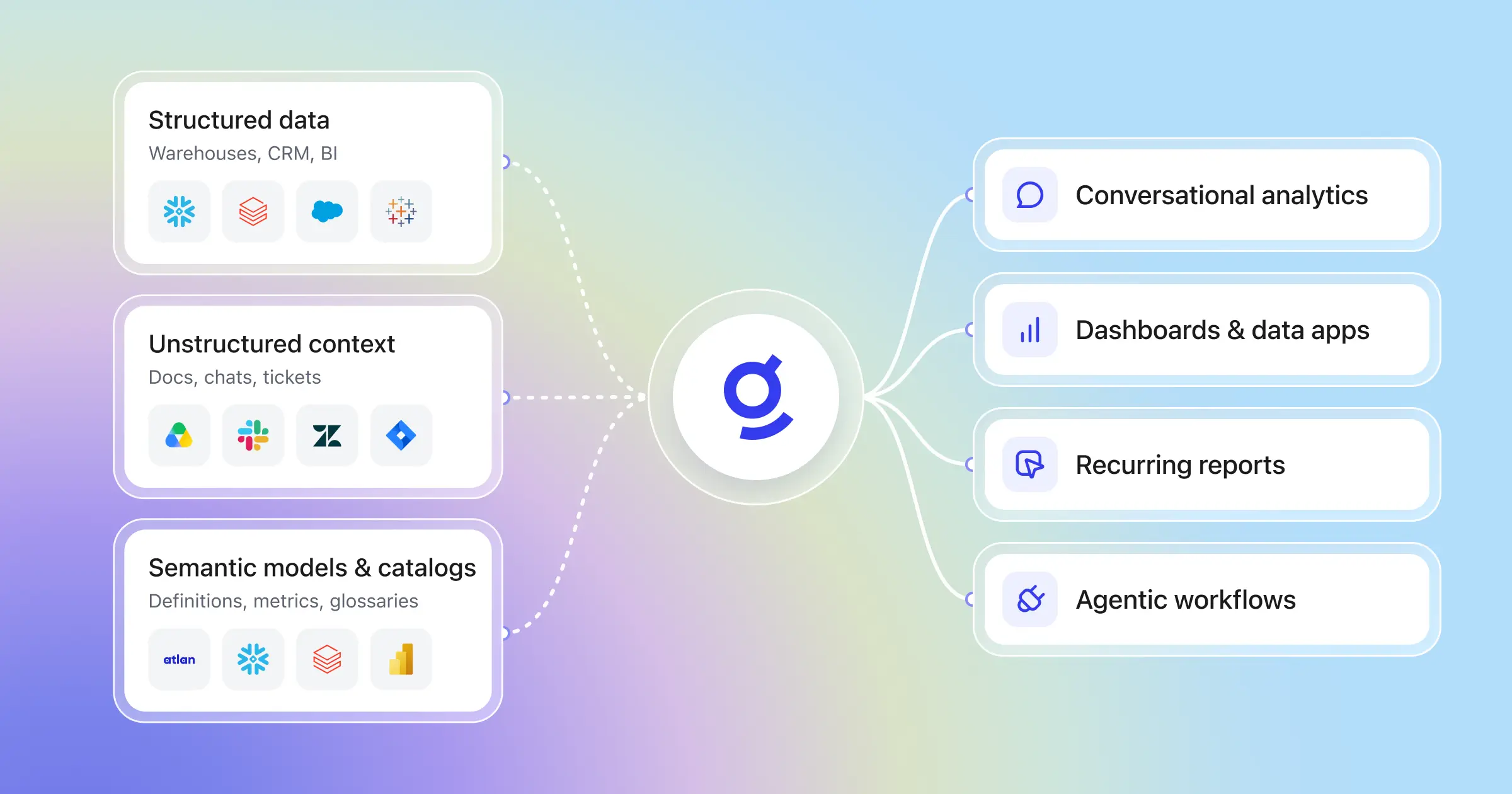
The strongest platforms, including systems like Glean, usually support more than 100 integrations because enterprise knowledge rarely sits in one content format. A useful connector strategy should account for:
- Application variety: project systems, support platforms, cloud storage, CRM tools, HR systems, and internal databases should all sit within reach of the same index.
- Data type diversity: the product should handle both clean records and messy enterprise content, such as comments, attachments, issue updates, and short-form notes.
- Native depth: a connector should capture more than top-level files; it should pull metadata, authorship, timestamps, relationships, and other fields that improve ranking and filtering.
- Operational overhead: native connectors reduce the need for internal teams to build and maintain custom pipelines every time a new system enters the stack.
A vendor may claim broad coverage while relying on shallow APIs that miss comments, permissions metadata, or historical records. That gap shows up later in production, when search results look complete on the surface but miss the exact source that holds the answer.
Freshness determines whether results stay usable
The next check is update speed. Ask how the platform detects document edits, permission changes, deletions, and newly created content; then ask how long those changes take to appear in search.
High-quality systems use continuous crawling, incremental indexing, and change-aware sync patterns so results reflect the current state of the source applications rather than yesterday’s copy. That detail matters in environments where policies change, tickets move, forecasts shift, and ownership changes hands quickly. A search result that points to an outdated version of a support procedure or an old sales deck is not slightly wrong; it is operationally expensive.
How does it handle permissions and security?
Internal search reaches the most sensitive parts of the business: compensation files, legal drafts, customer contracts, incident reports, and product plans. That reach only helps the company when access control stays exact and invisible to the employee.
A strong platform enforces source-level permissions down to the object, field, and snippet. Search results, previews, citations, and AI answers should all follow the same rule set that exists in systems such as Box, OneDrive, Confluence, GitHub, Workday, and Zendesk. One weak layer between the source and the answer is enough to erode trust.
Access control should survive real-world change
Permission drift creates most of the risk. Role changes, offboarding events, matter reassignments, and temporary project access happen every day, so the search layer has to reflect those changes on the next query — not after a nightly sync or a manual reindex.
Ask the vendor to explain four specifics:
- Result-level enforcement: A restricted file should not leak through a title, snippet, preview pane, or cited answer.
- Identity alignment: The product should work with SSO and directory systems such as Okta or Microsoft Entra ID so group membership and role updates carry through cleanly.
- Revocation latency: Access removal should propagate in seconds or minutes; “next crawl” is not a strong answer.
- Auditability: Security teams should have logs for admin actions, connector status, and access events so they can trace what happened and when.
Data handling needs clear, testable answers
Security review should also cover what the vendor does with the data after it leaves the source system. Look for TLS in transit, AES-256 at rest, tenant isolation, clear retention rules, and support for standards such as SOC 2 Type II, GDPR, and HIPAA where the business requires them. Ask where indexes live, whether regional data residency is available, and whether any employee at the vendor can inspect customer content without explicit approval and logging.
AI adds a separate line of scrutiny. Prompt content, retrieved passages, chat history, and model outputs all need firm boundaries. The vendor should state, in plain terms, whether customer data trains any shared model, how long prompts stay in logs, which subprocessors touch the data, and what controls exist for zero-retention or no-training terms. Good answers sound precise because the architecture is precise.
Can it actually understand what people mean, not just what they type?
Search quality breaks or earns trust fast. An engine that depends on exact term match will miss the language people use every day inside a company.
Intent matters more than phrasing
Enterprise queries rarely arrive in clean, standardized form. Employees use shorthand, product nicknames, half-remembered titles, department jargon, and natural language that reflects the task in front of them rather than the exact words on a page. Someone may search for “onboarding checklist for new engineers,” while the relevant material lives in an HR hub, an IT access document, and a team wiki with completely different labels.
That gap is where natural language understanding and semantic search matter. Ask whether the system can interpret meaning across variations such as:
- Synonyms: “Expense policy,” “travel reimbursement,” and “T&E rules” should not lead to three separate result sets.
- Acronyms and internal shorthand: Terms such as “SEV,” “QBR,” or a project codename should resolve to the right content without manual tuning for every query.
- Typos and incomplete input: Minor errors or partial phrases should not collapse relevance.
- Full-sentence requests: A user should be able to type “who owns customer identity docs for EMEA” and receive precise results, not a loose list of keyword hits.
Basic retrieval systems rank text that looks similar. Strong enterprise search ranks information that matches the need behind the request.
Context turns retrieval into understanding
Meaning inside a company depends on relationships. A query such as “head of security” may point to a leader, an org chart entry, a team page, a policy owner, or a recent announcement. The right result depends on role, source, and organizational context — not just the words themselves.
This is where a knowledge graph becomes important. It maps how people, teams, documents, tools, and activity connect, which gives search the context to answer requests such as “Who supports payroll in London?” or “Which team owns contractor access reviews?” with much higher precision. Products built with this kind of structure, such as Glean, can reason across those relationships instead of treating every query as plain text. Without that layer, people search, expertise lookup, and org-aware queries tend to degrade into guesswork.
Does it personalize results based on who's searching?
Once a platform can retrieve the right information securely, the next test is whether it can rank that information differently for different employees. Relevance inside an enterprise is not fixed; the best result for a support manager, an account executive, and an HR partner can come from the same set of systems but require a different order of results.
That shift should appear throughout the experience — in result ranking, autocomplete, suggested answers, and the information surfaced inside tools people already use. Strong internal search products rely on contextual signals such as department, geography, recency, project involvement, and prior engagement so employees see less noise and reach the right page, message, or record faster.
What good personalization looks like
- Adaptive ranking: The system should reorder results based on patterns from similar users and prior interactions, not force every employee through the same default ranking model. This reduces dependence on manual boosts and rule-heavy tuning.
- Workday context: Search quality improves when the engine accounts for what a person has touched recently — active opportunities, current tickets, scheduled meetings, open projects, or documents viewed in the last few days. Recency often matters more than static profile fields alone.
- Proactive discovery: The best tools do not wait for a perfectly timed search. They can surface likely-useful information in chat, browser extensions, or workspace hubs based on the task already in front of the employee.
A practical way to test this during evaluation: compare the same search across users from different functions and inspect the ranking, not just the presence of results. Personalization is real only when the output changes in a way that feels precise, explainable, and consistently useful across teams.
What metrics can you use to measure search effectiveness?
A search platform proves its value through observable outcomes, not product claims. Strong analytics show whether employees reach useful information fast, whether results deserve attention, and where the system or the content estate needs work.
At a minimum, the platform should expose search performance in a way that knowledge managers, IT leaders, and product teams can inspect without guesswork. Five benchmarks deserve constant review:
- Query success rate: The share of searches that end in a useful result. This metric gives you the clearest signal on whether employees leave search with what they came for.
- Click-through rate: The percentage of searches that lead to a click on a result, answer, or suggested source. Weak click-through often points to poor ranking, weak result summaries, or a mismatch between intent and output.
- Zero-results rate: The percentage of searches that return nothing. Each no-results query exposes a gap — absent content, poor indexing, weak synonym coverage, or language the system fails to map correctly.
- Search refinement frequency: How often people rewrite a search after the first attempt. A high refinement rate usually means the first response did not satisfy the need.
- Time-to-answer: How long it takes a user to reach useful information. This matters more than raw interface speed; instant but irrelevant output still wastes time.
Usage and adoption metrics
Search quality and search adoption rise and fall together. When people trust the results, usage spreads across the company; when relevance slips, employees fall back to side channels, local bookmarks, and direct messages.
Three signals deserve steady attention:
- Total search volume: This shows whether search plays a central role in daily work or sits outside normal habits. A sudden decline can point to ranking problems, interface friction, or weak fit with day-to-day tasks.
- Active user rate: Track the percentage of employees who use search each week or month. Break this out by function so you can spot whether customer operations, technical teams, revenue teams, people teams, and internal service groups all get value from the system.
- Frequency by team: Heavy use in one area and sparse use in another often reveals a structural issue. A knowledge-heavy support organization may rely on search every hour, while another team may ignore it because its core systems never entered the index.
Adoption data also helps separate product issues from behavior patterns. Low usage does not always reflect resistance to change; it often points to a tool that feels detached from established routines. Research on internal search experience consistently shows stronger use when search sits close to where work already happens, with fast access and minimal context switching.
Content gap and quality metrics
The most useful analytics do more than score the search layer. They reveal weaknesses in the underlying knowledge environment — thin documentation, poor metadata, duplicate assets, and outdated material that should not rank near the top.
Two metrics stand out here:
- Zero-results queries: These show what employees expect to find but cannot. Review them in clusters to spot missing policies, undocumented procedures, weak file naming, or content that exists in source systems but never became discoverable.
- Refined queries: These show where the first result set missed user intent. When people search “new hire setup,” then “laptop request,” then “access checklist,” they reveal a gap in concept mapping, ranking, or source selection.
This data has practical value beyond search tuning. Teams can use it to improve document titles, expand term coverage for business vocabulary, clean up legacy repositories, and close high-demand knowledge gaps. Search logs often become the most direct record of what the organization needs to document next.
Answer quality metrics for AI-powered search
Once search moves beyond document retrieval and starts to produce direct answers, measurement has to go deeper than clicks. You need to know whether the response was accurate, complete, grounded in source material, and useful enough to help someone finish the task.
The strongest evaluation models look at answer quality from several angles:
- Correctness: Did the response state the facts accurately?
- Completeness: Did it include the details required to answer the question in full?
- Grounding: Did the answer stay tied to retrieved source material rather than drift into unsupported claims?
- Efficiency: Did the system reduce the effort required to reach the answer?
- Response satisfaction: Did the result actually help the employee resolve the task?
These metrics matter because polished language can hide weak performance. A partial answer wastes time. An unsupported answer creates risk. A correct answer with weak source selection still damages confidence in the system. In enterprise environments, search effectiveness depends on whether people can rely on the response as a sound basis for the next decision.
How does AI enhance the search experience beyond retrieval?
Once a search platform can surface relevant material, the next layer of value comes from interpretation and execution. AI shortens the path from a question to a usable outcome — not by replacing search, but by turning search results into a response that reflects company language, recent updates, and the full context of the request.
That shift usually relies on retrieval augmented generation, or RAG. In practice, that means the system does more than fetch documents and hand them to a model. It rewrites the question when needed, pulls the most useful passages from the right systems, and assembles a response that saves the employee from opening five tabs to piece together an answer. A request such as “What is our current policy on remote work for contractors?” should pull from the handbook, regional guidance, legal exceptions, and any recent HR update — then present a clear answer in one place.
From search results to synthesized responses
This is where evaluation gets more practical. A vendor should be able to explain how the product handles query planning, context selection, and response construction across real enterprise content — not just polished demo prompts.
Three areas deserve close scrutiny:
- Query planning: The system should translate vague or messy language into something the search layer can use well. Employees rarely search with perfect terminology; they use abbreviations, partial phrases, internal shorthand, and requests with missing context.
- Context assembly: The model should receive the right snippets, not an oversized dump of loosely related text. High-performing systems select from mixed content types — policy docs, PDFs, chat threads, tickets, spreadsheets — and balance relevance with freshness.
- Verification signals: The answer should make it easy to inspect why a statement appears. Good products show document references, quoted passages, dates, and clear markers when sources conflict or the system has limited confidence.
This part of the stack separates useful AI from decorative AI. A search tool with a language model on top is not enough; the retrieval layer, prompt strategy, and answer checks determine whether the experience feels precise or unreliable.
From answers to action
The next step is agentic capability. Instead of answering one question at a time, the system can break down a task, use several tools in sequence, and return either a completed draft or a finished workflow step. For a support team, that might mean reviewing a ticket, checking product documentation, pulling prior case context, and drafting a response. For sales, it might mean preparing account context from CRM notes, call transcripts, and internal strategy docs.
This kind of orchestration depends on multi-step reasoning, tool access, and clear task boundaries. The most capable platforms usually show a few common traits:
- Task decomposition: The system splits a broad request into smaller jobs with a clear order of operations.
- Cross-tool orchestration: Search works alongside analysis, people lookup, ticket context, calendar data, and workflow systems rather than in isolation.
- Action-oriented outputs: The result can take the form of a summary, a draft, a structured brief, or an operational step such as a status update or ticket creation.
- Robust evaluation: Quality should be tested by query class and use case, with automated graders and review loops that check consistency, task success, and response quality over time.
At that point, AI improves search in a concrete way: it reduces manual synthesis, handles more complex requests, and helps employees move from “find this” to “help me finish this.”
How quickly can you deploy it, and will your team actually use it?
The first deployment question is not how impressive the product looks in a demo; it is how much work your team must absorb before employees see any value. Ask for a concrete rollout plan with named steps — identity setup, source authorization, result validation, pilot launch, and wider release — plus a clear owner for each part. A mature product should come with strong onboarding, usable admin documentation, and direct vendor support so the project does not turn into an open-ended internal build.
Usability deserves the same level of scrutiny. Employees should understand where to search, how to narrow results, and how to open the right source without a training session. Strong products make that easy with uncluttered design, readable previews, and clear recovery paths when a search returns too much, too little, or the wrong type of content.
Workflow integration
Deployment moves faster when access fits the systems employees already use to review cases, update records, and check internal documentation. During evaluation, look beyond the standalone search page and ask where the product can appear inside your existing environment through supported integrations or embedded components.
A few workflow questions reveal more than a long feature list:
- Embedded surfaces: Can teams place search inside internal portals, service consoles, or knowledge hubs through APIs or packaged components?
- Identity handoff: Does single sign-on work cleanly across those surfaces, or will users face extra login steps and session issues?
- Role-specific entry points: Can support, sales, and engineering teams start from interfaces shaped around their work instead of the same generic landing page?
Scalability and roadmap
Long-term fit shows up in operations, not just feature breadth. Ask what uptime the vendor commits to, how admin controls work across business units, and whether the platform supports multilingual environments, regional requirements, and phased expansion to new teams. Those details decide whether a successful pilot can become a stable company-wide system.
The roadmap should show more than broad AI ambition. Look for steady product depth: stronger admin tooling, better governance controls, wider deployment options, and more precise ways to adapt the experience for different departments. A credible vendor usually speaks in specific platform priorities and release areas, not vague promises.
The right internal search solution does more than return results — it becomes the connective layer between your people, your knowledge, and the work that matters most. These eight questions give you a framework to evaluate with precision, not assumption.
Request a demo to explore how we can help AI transform your workplace.

.jpg)

.png)



.jpg)
.webp)

