

When to use a chatbot vs an AI search assistant in your business
The terms "chatbot" and "AI search assistant" show up in nearly every conversation about enterprise AI adoption — yet they describe fundamentally different tools built for fundamentally different problems. One handles structured, predictable interactions; the other navigates an organization's entire knowledge ecosystem to deliver contextual, grounded answers.
For teams across engineering, sales, HR, IT, and customer support, the distinction matters more than it might seem. The wrong choice can mean employees still waste hours hunting for information, or customers hit dead ends when they need real help.
This guide breaks down what each technology actually does, where each one fits, and how to evaluate which approach — or combination — makes sense for your business.
What is a chatbot?
A chatbot is a software program that simulates conversation with users through text or voice. At its core, a chatbot follows predefined scripts, decision trees, or rule-based logic to interpret a user's input and return a matching response. Traditional chatbots rely on natural language processing (NLP) to parse what someone types or says, then map that input to a fixed set of answers. The interaction model is straightforward: a user asks, the chatbot responds within the boundaries of what it has been trained or programmed to handle.
More advanced chatbots incorporate machine learning to refine their accuracy over time, but the underlying function remains reactive. They wait for input, match it to a known pattern, and deliver a response. Joseph Weizenbaum's ELIZA, built in 1964, established this paradigm — and while the technology has evolved considerably since then, the core architecture of most chatbots still mirrors that same prompt-and-respond loop.
Common chatbot functionality
Chatbots excel in environments where the volume of inquiries is high but the complexity is low. Their sweet spot includes:
- Answering FAQs: Providing instant, consistent responses to common questions — store hours, return policies, pricing tiers — without requiring a human agent.
- Routing and triage: Directing users to the right department, resource, or human representative based on simple keyword or intent detection.
- Collecting basic information: Gathering contact details, qualifying leads, or capturing initial support ticket data through guided conversational flows.
- Automating simple tasks: Handling password resets, order status lookups, appointment scheduling, and other transactional interactions that follow a predictable path.
These capabilities make chatbots a strong fit for customer-facing scenarios: website widgets, messaging apps, help desks, and frontline support channels where speed and consistency matter most.
Where chatbots fall short
The limitations become clear the moment a conversation moves beyond a scripted path. Chatbots struggle with ambiguity — a question phrased in an unexpected way can send the interaction into a frustrating loop. They lack the ability to pull context from across different systems, reason through multi-step problems, or synthesize information from varied sources. Each conversation is typically treated as a standalone interaction; the chatbot does not recall prior exchanges or adapt its responses based on organizational context.
For enterprises with distributed knowledge spread across wikis, drives, ticketing platforms, and messaging tools, a chatbot's narrow operating window presents a real constraint. It can tell a user where a policy document lives, but it cannot read that document, extract the relevant section, and deliver a cited answer. That gap — between surface-level response and deep knowledge retrieval — is precisely where chatbot capabilities plateau and a different class of tool becomes necessary.
What is an AI search assistant?
An AI search assistant is an employee-facing system built to locate, interpret, and assemble company knowledge at the moment of need. It works across internal handbooks, shared drives, support history, project spaces, business apps, and structured records; then it returns a source-backed response instead of a list of possible links.
Under the hood, these systems rely on retrieval-augmented generation. The model does not answer from static memory alone; it plans a search, pulls approved source material in real time, and uses that evidence to compose a response with citations. Strong platforms also rank information with signals such as recency, authority, role relevance, and collaborator relationships, which keeps the output aligned with how work moves inside the business.
How it works inside the enterprise
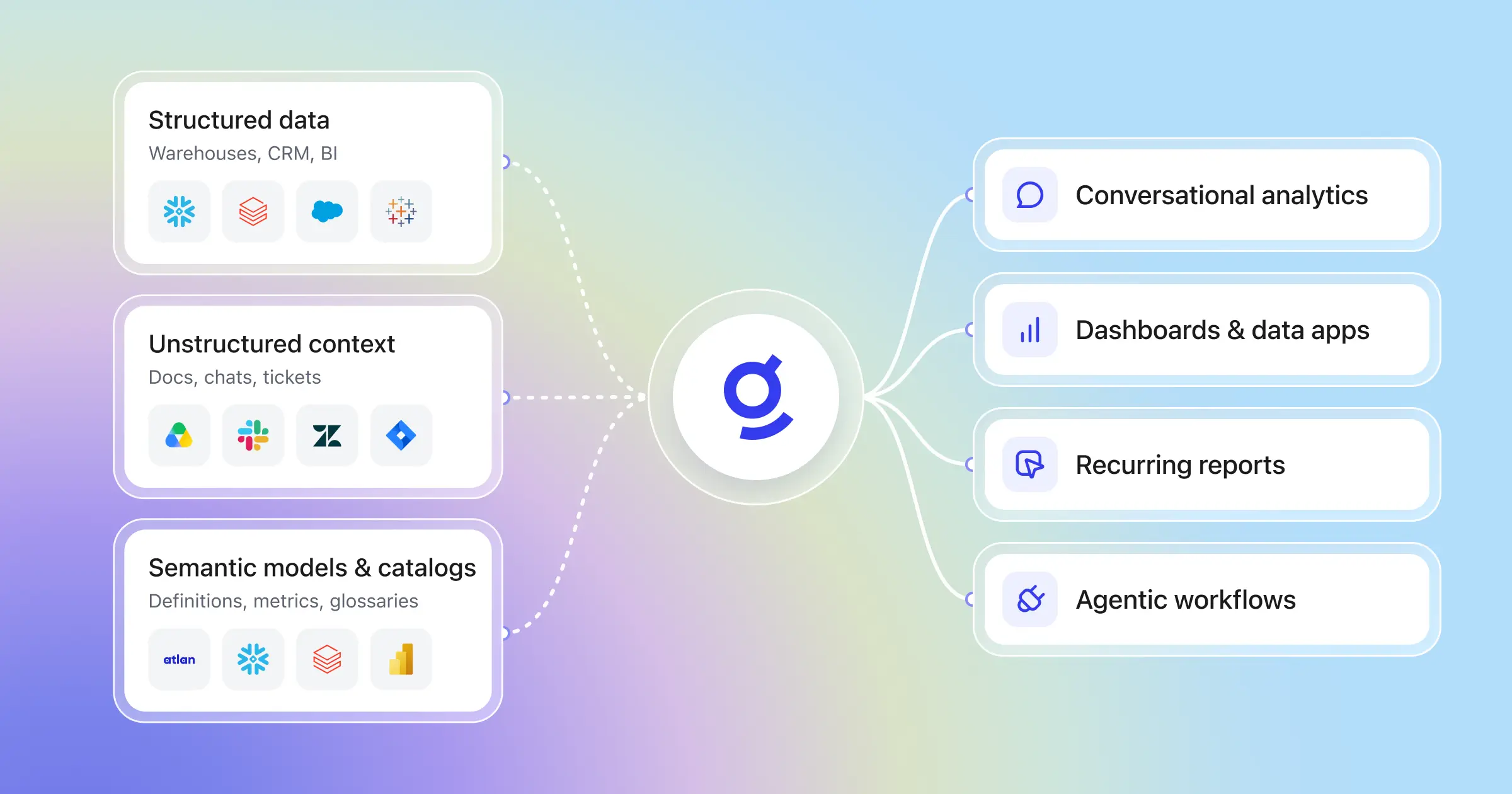
Inside the organization, an AI search assistant ties identity data, content, and activity into a knowledge graph. That graph gives the system a practical view of how work connects — which team owns a process, which document reflects the current policy, which ticket relates to a recurring issue, and which expert carries direct experience with the topic. The result is not simple document retrieval; it is organizational interpretation.
Access rules stay intact at every step. The assistant reflects the permissions of each source application, so the answer changes based on the person who asks, the systems they can access, and the role they hold. A finance lead, an engineer, and a support manager may ask similar questions and receive different materials for valid reasons.
What sets it apart
- Intent interpretation: It handles shorthand, internal terminology, and incomplete phrasing with more precision than a keyword tool. A request such as “latest discount exception path” can map to approval policy, deal desk guidance, and the right owner without exact document titles.
- Personalized ranking: It adjusts results based on team, project history, close collaborators, and recent activity. That keeps the most useful answer near the top for the person in front of it, not for an abstract average user.
- Knowledge synthesis: It reads across policy pages, message threads, case history, and system records, then turns that material into a clear response with traceable references. The user gets the answer and the path back to the original source.
- Enterprise security: It applies role-based access controls in real time, which matters in environments with sensitive customer data, legal records, payroll details, or confidential product plans.
- Continuous adaptation: It improves as it learns the company’s language, acronyms, teams, and content patterns. That makes it more useful in fast-moving organizations where terminology and priorities shift often.
For teams in engineering, sales, HR, IT, and customer support, this changes the daily experience of knowledge work. An employee can verify a process, surface the right expert, review the current source of truth, and move forward without opening each system one by one.
Key differences between chatbots and AI search assistants
The distinction becomes clearer once you look past the shared chat interface. These systems may look similar on screen, yet they rely on different architectures, operate on different data models, and solve different classes of business problems.
Scope: predefined intents vs. enterprise-wide discovery
A chatbot usually starts with a controlled set of intents: reset a password, check an order, book an appointment, route a request. That design keeps execution simple, which makes sense for customer service flows and other narrow interactions where the range of valid answers stays small and stable.
An AI search assistant starts from the opposite premise. It assumes the answer may sit across product documentation, meeting notes, case histories, CRM entries, HR policies, and team conversations at the same time. Instead of forcing every request into a menu of known intents, it searches across connected systems, resolves which sources matter, and assembles a response from the evidence it finds.
Intelligence: flow logic vs. retrieval and synthesis
A chatbot performs best when the business can define the path in advance. Teams build rules, write responses, and decide where the conversation should branch. That structure creates consistency, but it also creates a maintenance burden; every policy change, new workflow, or edge case often requires another update to the bot's logic.
An AI search assistant depends less on scripted flow design and more on retrieval quality. The system rewrites queries, ranks results, filters by access rights, and passes the most relevant source material into a language model for answer generation. That shift matters in practice: the tool does not just match a question to a canned reply; it can compare several documents, reconcile differences, and produce an answer that reflects current company records. In systems such as Glean, that process extends across more than a hundred business applications, which changes the tool from a chat surface into a knowledge layer for the company.
Context: single-session handling vs. persistent business relevance
Most chatbots process the conversation directly in front of them. They can capture a few session variables, but they rarely carry a durable understanding of how people, teams, documents, and workstreams connect across the organization. A response may be correct in isolation and still miss the most useful answer for that particular employee.
AI search assistants use richer ranking signals to avoid that problem. They account for who asked the question, which systems that person uses, what content carries authority, which collaborators sit close to the issue, and what the latest activity suggests. That is why a support manager can ask for the latest escalation process and receive recent guidance from case history and internal documentation, while an engineer who asks a similar question may receive runbooks, incident notes, and the names of teammates with direct experience.
A few operational differences shape the day-to-day experience most clearly:
- System design: Chatbots rely on conversation flows and intent libraries; AI search assistants rely on indexing, ranking, retrieval, and answer synthesis across enterprise data.
- Information coverage: Chatbots usually stay inside one channel or one business workflow; AI search assistants unify fragmented knowledge across business systems.
- Answer format: Chatbots tend to return standard responses; AI search assistants can return synthesized answers with supporting source references.
- Ongoing upkeep: Chatbots need regular script revisions as the business changes; AI search assistants improve through better retrieval, richer data connections, and stronger understanding of company language.
- Enterprise fit: Chatbots suit repetitive front-door interactions; AI search assistants suit internal knowledge work where speed, precision, and permission-aware access carry more weight.
What specific tasks can an AI search assistant handle that a chatbot cannot?
The clearest difference appears in day-to-day work. A search assistant can support requests that require investigation, judgment, and output creation inside the business, not just a short exchange in a chat window.
This matters in roles where the answer does not sit in one article or one system. Engineering, sales, support, HR, and IT teams often need a tool that can assemble context, prepare a usable response, and carry work forward without a manual hunt across half a dozen applications.
Knowledge-heavy requests
An AI search assistant can take on work such as:
- Incident reconstruction: It can assemble a timeline from alerts, ticket history, release notes, chat threads, and internal writeups so an engineer sees what changed, who responded, and what still needs attention.
- Account and deal preparation: It can prepare a sales brief from CRM activity, call notes, product questions, open support issues, and renewal risk signals before a meeting or renewal review.
- Case response drafting: It can produce a support reply from approved help content, prior case resolutions, internal guidance, and product updates so the agent starts from a grounded draft instead of a blank page.
- Policy interpretation: It can pull the right rule, exception, and supporting document for an HR or IT question that depends on office location, employment type, business unit, or internal policy history.
- Expert identification with evidence: It can point to the people closest to a topic based on past projects, document ownership, message history, or system activity — not just org chart proximity.
- Large-scale summarization: It can turn a long project thread, a set of documents, or a cluster of case notes into a short brief for a manager, executive, or new team member.
These tasks share a common trait: each one requires more than recall. The system has to examine scattered evidence, resolve inconsistencies, and return something a person can use immediately.
Operational tasks with enterprise controls
A search assistant can also move from analysis to execution. In practice, that means it can support work that touches live systems while still operating within enterprise rules around access, data scope, and approved actions.
That opens the door to tasks such as:
- Service desk orchestration: Create or update a ticket, attach the right internal reference, and pass the request to the correct team with the relevant context already included.
- Status and report generation: Build a project update, incident recap, or executive summary from source material spread across business tools, then format it for internal review.
- Request routing with context: Send a procurement, legal, IT, or HR request to the right queue with the supporting details, prior discussion, and source references intact.
- Document and message creation: Prepare follow-up emails, internal announcements, meeting briefs, or customer-ready drafts that reflect current company information rather than stale templates.
That set of capabilities places AI search assistants in a different category from chatbots. They support real knowledge work — the kind that demands synthesis, traceability, and safe interaction with business systems — rather than simple prompt-response exchanges.
When to use a chatbot in your business
A chatbot fits best when the business needs deterministic service on a narrow set of requests. The strongest use cases sit close to the edge of the business — public websites, support portals, and messaging channels where users expect an immediate answer and the acceptable answer range is already known.
Best-fit use cases
A chatbot earns its place when a team wants a repeatable exchange, not broad knowledge discovery. In that setting, the goal is simple: reduce queue volume, keep replies uniform, and move people to the next step with as little friction as possible.
- Customer self-service on common policies: Refund eligibility, billing cycles, warranty terms, appointment windows, shipping cutoffs, and account requirements work well in a chatbot flow because the business can define the answer in advance and update it on a schedule.
- Guided intake for sales or support: A chatbot can ask a fixed sequence of questions, capture the right fields, and hand off a structured record rather than a messy free-form message. That matters for teams that need clean lead data or standardized support intake.
- Step-by-step help for simple account tasks: Profile updates, email verification, subscription changes, and access recovery often follow a fixed path. A chatbot can keep users on that path without extra agent time.
- Basic transaction visibility: Customers often need a quick check on a delivery window, reservation confirmation, invoice status, or service appointment. Those moments call for speed and clarity more than interpretation.
These are strong chatbot scenarios because the business defines success upfront. The conversation does not need deep synthesis; it needs accuracy, consistency, and a clean next step.
Where chatbots create the most operational value
Chatbots also work well when teams care as much about control as they do about automation. Service leaders often need a tool that can enforce approved language, support compliance reviews, and stay stable across large request volumes without a long implementation cycle.
That makes chatbots useful in a few distinct situations:
- Seasonal or campaign-driven surges: Product launches, enrollment periods, holiday traffic, and billing deadlines can create sudden demand spikes. A chatbot can absorb the repetitive front-end traffic and protect service teams from avoidable backlog.
- Regulated or policy-sensitive communication: In industries where wording matters — financial services, healthcare-adjacent support, insurance, or legal intake — a scripted system helps teams keep responses inside approved guardrails.
- Single-channel automation: Some teams do not need a broad enterprise layer. They need a dependable assistant inside one place — a checkout page, a service portal, or a mobile app — with a tight scope and a short path to deployment.
- Structured escalation paths: A chatbot can collect the right facts before a handoff, then route the case to the right queue, specialist, or workflow. That improves agent efficiency because the next system or person starts with usable context, not a blank slate.
In these environments, the chatbot acts as a controlled operational tool. Its value comes from discipline — consistent wording, clean handoffs, and reliable behavior under pressure.
Where the fit ends
The fit weakens once the request depends on scattered internal knowledge, exception handling, or judgment across several business systems. A chatbot can support the first exchange, but it cannot serve as the main system for employees who need answers drawn from project history, internal documentation, prior decisions, and role-based access rules at the same time.
That boundary matters most inside large organizations. Support, HR, sales, IT, and engineering teams often work across disconnected tools and partial records; a chatbot can help with the front layer of demand, but not with the deeper work that follows when the answer lives across the business rather than inside a fixed script.
When to choose an AI search assistant instead
An AI search assistant makes sense when the business problem centers on knowledge accuracy, knowledge speed, and knowledge reach. In many enterprises, the issue is not customer deflection or front-door automation; it is the daily drag that comes from scattered institutional knowledge, fast-changing internal information, and too much dependence on a handful of people who know where everything lives.
This becomes more pronounced as the company grows. New teams adopt new tools, business units create local processes, acquisitions bring duplicate repositories, and critical know-how spreads across messages, docs, tickets, and meeting artifacts. At that point, a simple conversational interface is not enough; the business needs a system that can surface current, role-relevant answers from across the organization without constant manual upkeep.
Signs your business needs AI search
- Subject matter experts spend too much time as human search engines: The same engineers, HR partners, IT leads, and operations managers receive the same internal questions over and over. An AI search assistant reduces that dependency by making hard-to-locate knowledge easier to access without a personal handoff.
- Internal information changes too fast for scripted systems: Product details, policy exceptions, troubleshooting steps, pricing guidance, and process updates rarely stay fixed for long. An AI search assistant fits better when the answer must reflect current records rather than a prewritten flow.
- Employees ask layered follow-up questions: Real work rarely stops at one prompt. Teams ask for the rule, then the exception, then the owner, then the latest example. An AI search assistant handles that depth far better than a narrow bot built for one-turn exchanges.
- Traceability matters for trust: Finance, legal, security, compliance, and support teams often need to verify where an answer came from and whether it reflects approved material. A tool that can return grounded responses with source context becomes far more useful than one that simply replies with generic text.
- Growth has created knowledge drift: Different offices, regions, or departments may store similar information in different places and describe it in different ways. An AI search assistant helps normalize that complexity so employees do not need to learn every system before they can get a reliable answer.
Where AI search creates the most value
The strongest use cases tend to sit inside the business, close to day-to-day execution. New hires can ramp faster because answers do not depend on knowing the right channel or the right tenured employee. Revenue teams can prepare for renewals and account reviews with a fuller view of internal guidance and account context. IT and operations teams can move faster when diagnostic notes, runbooks, exception rules, and ownership details surface in one place. In environments like these, search quality has a direct effect on output quality.
This choice also matters in companies with strict access requirements, distributed teams, or complex reporting lines. A useful system must account for who the employee is, what systems they can see, and which sources carry the most authority for that question. It should also improve as the organization evolves — not through endless script edits, but through a deeper understanding of company language, changing content, and the relationships between teams, work, and expertise.
An AI search assistant also fits organizations that want to reduce the gap between finding information and using it. It can support onboarding, internal support, cross-functional coordination, and decision preparation with a level of precision that basic chat tools rarely match. In that kind of environment, better search is not a convenience feature; it is operating infrastructure.
How to evaluate the right fit for your organization
A sound evaluation starts with operating reality: which requests create delay, rework, or avoidable cost. The goal is not a broad AI decision; it is a precise match between the shape of the work and the system that will handle it.
Map the points of friction
Begin with the workflows that break most often. Look for queue growth, repeat escalations, duplicate questions in team channels, and the constant need to pull in a subject-matter expert for routine clarification.
A useful split looks like this:
- Transactional repetition: These requests follow a fixed path and end with a standard response or a simple handoff. Examples include invoice copies, shipping updates, account unlocks, appointment confirmation, and lead capture.
- Institutional lookup: These requests depend on company memory, past decisions, or scattered records. Examples include contract exception history, product issue context from prior cases, internal policy interpretation, or account prep across sales notes, support history, and product updates.
This distinction exposes the real source of friction. In many teams, the visible problem looks like slow response time; the deeper issue sits in weak access to internal knowledge.
Measure query complexity, not just volume
A request deserves a closer look when the answer cannot come from one approved reply. Complexity shows up in the number of records involved, the amount of interpretation required, and the level of context needed for an acceptable answer.
Use four practical checks:
-
Does the request depend on multiple record types?
A simple bot can handle a single source of truth. A more capable system becomes necessary when the answer draws from case notes, policy documents, customer history, release notes, or internal discussions at the same time. -
Does the system need to understand company language?
Large organizations rely on acronyms, project codenames, team shorthand, and region-specific terms. A tool that cannot interpret that vocabulary will miss relevance even when the source material exists. -
Does the user need an assembled answer rather than a list of links?
Some workflows call for a direct explanation, a short summary, a draft, or a side-by-side comparison. That requirement changes the technical fit. -
Does the request carry operational follow-through?
Certain interactions do not stop at information. They require a case note, a routed approval, a drafted reply, an update to a system of record, or a report for the next team in line.
Check integration depth, security, and long-term fit
The next test centers on system design. A narrow support tool can live in one channel with limited back-end access; an internal knowledge assistant needs a far broader foundation — identity data, enterprise search, content connectors, usage context, and auditability across the stack.
Security standards should reflect that difference. Any system that touches internal records must inherit source-level entitlements, respect regional and departmental boundaries, and produce answers that stay inside those constraints. For regulated environments such as financial services, manufacturing, and large technology companies, that requirement sits at the same level as accuracy.
Long-term fit comes down to change velocity. Some tools demand manual upkeep each time a process, policy, or product line shifts. Others adapt through stronger retrieval, richer enterprise context, and a more complete model of how teams, documents, and business systems relate to one another. Many enterprises separate these roles by design: one layer handles routine service interactions on public channels, while a second layer supports employees with knowledge retrieval and cross-functional execution inside the business.
The right answer for most enterprises is not one tool or the other — it is knowing exactly where each one belongs in your stack. That clarity turns AI from an experiment into operating infrastructure that compounds in value as the business grows.
We built our platform to help teams move from scattered knowledge to grounded, permission-aware answers across the entire organization. Request a demo to explore how we can help transform the way your workplace finds, uses, and acts on what it knows.

.jpg)

.png)


.jpg)
.webp)