


Which AI debugging tools connect logs and alerts most effectively?
AI debugging tools that correlate logs, alerts, and ownership data in real time are significantly reducing incident diagnosis time at engineering organizations that have adopted them. These tools replace the manual hunt through dashboards and runbooks that typically eats the first hour of every incident.
Most engineering teams still practice what amounts to telemetry archaeology: an alert fires, and an on-call engineer opens four or five tabs — logs, metrics, recent deploys, and a service map — and tries to piece together what went wrong. That process is slow and entirely dependent on tribal knowledge about which services talk to which. According to Atlassian's 2025 survey of 3,500 engineers, each tool switch costs 15 to 30 minutes of refocused work time — and on-call engineers may switch between tools dozens of times during a single incident.
AI debugging tools aim to collapse that investigation loop. They ingest the same signals an engineer would check, but they do the correlation automatically and surface a probable root cause in seconds rather than minutes or hours.
What AI debugging tools actually do during an incident
When an alert fires, an AI debugging tool pulls a narrow slice of context — recent code deploys, service dependency maps, related log lines, prior incident resolutions, and on-call ownership — and correlates those signals into a single investigation thread. Dumping 10,000 generic log lines into a context window is not investigation. The real value is tracing a causal chain: this deploy changed this service, that service calls this downstream dependency, and that dependency started throwing errors 12 minutes after the rollout. Engineers routinely report that the majority of their troubleshooting time goes to assembling context rather than actually fixing the problem.
Not all tools approach the problem the same way, and the differences matter. The market splits into three tiers. Legacy observability platforms have bolted AI onto existing dashboards — useful for summarizing logs, but limited to the data already on screen.
AIOps correlation tools group related alerts and suppress noise, which helps with triage but stops short of root-cause analysis. AI-native platforms take the third approach: they run autonomous investigations that pull environmental context — service graphs, code ownership, and historical fixes — and follow the evidence to a probable cause. A platform like Glean, with its Enterprise Graph connecting people, systems, and knowledge across the organization, represents how that broader context assembly works in practice.
The defining capability to evaluate is context assembly. A tool that surfaces the right log lines, the right alert, the right service owner, and the right prior fix in a single thread saves more time than one that simply groups alerts by cluster. For example, when a payments service starts timing out, the most effective tools will trace the failure back to a config change pushed two hours earlier by a specific team, link to the rollback runbook from the last time that config drifted, and tag the engineer who owns the service — all before anyone opens a terminal.
Why connecting logs, alerts, ownership, and prior fixes matters for incident resolution
Production incidents rarely stay contained within a single service. A memory leak in one microservice triggers cascading timeouts across downstream dependencies, and the alert that fires — a latency spike on the checkout API — appears three hops away from the actual breaking change.
Cross-signal correlation is where most incident response time disappears. Engineers don't struggle with the diagnosis itself; they struggle with assembling the right evidence from the right systems fast enough to act. Research bears this out: a 2025 peer-reviewed study found that organizations implementing AIOps experience a 62% reduction in mean time to resolution and an 82% decrease in repeat incidents.
Traditional monitoring tools surface the raw materials — thousands of log lines, dozens of firing alerts, deployment timestamps — but leave engineers to manually separate symptoms from causes. An on-call responder staring at 47 alerts from a single cascading failure still has to determine which alert represents the upstream trigger and which are downstream noise. Engineers commonly report spending 30 to 60 minutes on that triage step before the real debugging even begins.
Ownership context turns a generic alert into an actionable investigation. Knowing which team owns the failing service, who deployed the most recent change, and who resolved a similar incident last quarter compresses the path from "something is broken" to "the right person is looking at the right thing." Without ownership data embedded in the investigation workflow, engineers default to paging broad channels, waiting for someone to self-identify, and losing minutes that compound during an outage.
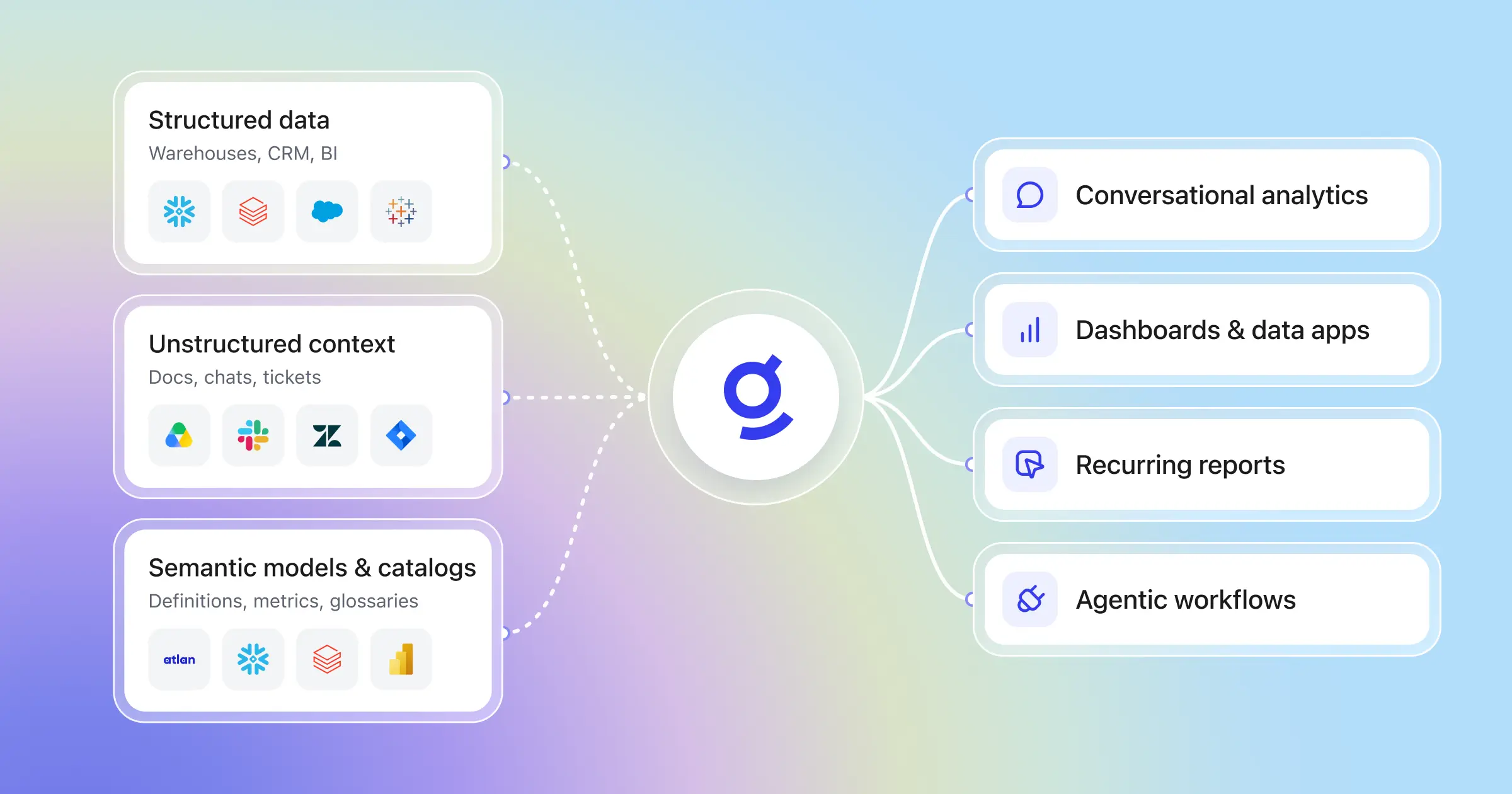
Glean's Enterprise Graph maps these relationships — people, services, code, and documentation — so that ownership context surfaces alongside the alert rather than requiring a separate lookup in a service catalog or org chart.
Prior fix data is often the least-consulted signal in incident response. When an engineer encounters a Kafka consumer lag spike, knowing that a nearly identical pattern six months ago was resolved by a specific configuration change in a specific pull request drops resolution time from hours to minutes. Organizations that fail to connect past incident records, runbooks, and resolution artifacts to current investigations force every responder to re-derive solutions that the team has already discovered. The cost isn't just slower MTTR — it's the erosion of institutional memory every time a senior engineer leaves the team. Strong enterprise knowledge management practices are the foundation for making that historical data accessible and actionable.
How the best AI debugging tools assemble context automatically
Telemetry-native vs. integration-layer approaches to AI debugging
AI debugging tools fall into two architectural camps. Telemetry-native tools ingest and store logs, metrics, and traces directly, giving the AI model immediate access to raw signals without API round-trips to external backends. Integration-layer tools take the opposite approach: they connect to existing observability platforms — Datadog, Splunk, PagerDuty, and Elasticsearch — and reason over data at query time. The trade-off is deployment speed vs. depth. Integration-layer tools deploy in hours because they work with whatever observability stack you already run, but the quality of their analysis is bounded by what those connected systems expose through their APIs.
Neither approach is universally better. Teams with mature, well-instrumented observability stacks often get more value from integration-layer tools that unify signals they already collect — and a 2026 New Relic report found that AI-enabled teams resolve issues roughly 25% faster, averaging 27 minutes per issue versus 50 minutes without AI.
Teams building their monitoring infrastructure from scratch may benefit from telemetry-native platforms that control the full data pipeline. The decision depends less on the AI capabilities and more on how much you're willing to change your existing tooling.
Context narrowing vs. context dumping in AI investigation
The difference between useful AI-assisted debugging and a glorified log search comes down to retrieval precision. Effective tools retrieve the specific 5-minute log window around the anomaly, the deployment diff from the last change to the affected service, and the relevant slice of the service dependency graph — not a bulk export of everything that happened in the last hour. Context dumping overwhelms both the AI model and the engineer reviewing its output.
Precise retrieval requires the AI to understand service topology, deployment timelines, and permission boundaries. A tool that surfaces a Kubernetes pod restart needs to also pull the deployment that preceded it, the config change that triggered the deployment, and the team that owns the affected service — the kind of debugging assistance for engineers that goes beyond simple log retrieval.
Glean Agents handle this kind of multi-step evidence assembly by traversing the Enterprise Graph — the same knowledge layer that maps relationships between people, services, code repositories, and documentation across 100-plus enterprise applications. The agent doesn't just find the log line; it finds the log line, the deploy, the author, and the runbook that matches the failure pattern, then assembles them into a single investigation thread the responder can act on.
Key capabilities to evaluate in AI debugging and incident response tools
How deep does the root cause analysis go?
Surface-level root cause identification — "this service is throwing errors" — is table stakes. The meaningful evaluation question is whether the tool can trace a causal chain across multiple services to identify the specific deploy, config change, or code commit that initiated the failure. Semantic root cause analysis, where the AI reasons through evidence rather than matching keywords against alert rules, produces more accurate diagnoses for novel failures that don't match existing runbook patterns. Glean Agents follow this approach by traversing the Enterprise Graph to trace causal connections across services, code changes, and infrastructure state rather than relying on static alert rules. Look for platforms that explain their reasoning chain rather than presenting a single verdict — capabilities that align with next-generation prompting for engineering.
Automatic ownership identification and escalation routing
The fastest root cause analysis is wasted if the engineer who receives it doesn't own the affected service. AI debugging tools should auto-identify the team and individual who owns the impacted service and last modified the relevant code path, pulling from service catalogs, on-call schedules, and organizational graphs. Glean Search surfaces ownership data by indexing across tools like PagerDuty, Opsgenie, and internal service registries, connecting the "what broke" to the "who can fix it" without requiring the responder to context-switch into a separate system.
Prior incident matching and historical context
Historical incident data tends to be both high-value and underutilized in most engineering organizations. The best tools index past incidents alongside their symptoms, root causes, and resolution artifacts — pull requests, config changes, and runbook steps — and match them against the current investigation. The result transforms tribal knowledge locked in former engineers' heads or buried in old Slack threads into searchable, citable institutional memory that every responder can access. Glean Search indexes past incidents, runbooks, and resolution artifacts across tools like Jira, Confluence, and Slack, then surfaces relevant matches when a new alert's symptoms align with a prior investigation.
Remediation guidance and automated action
Diagnosis without a next step still leaves the engineer stuck. Evaluate whether the tool suggests specific fixes, links to relevant runbooks, or can execute pre-approved remediation actions like rolling back a deployment or scaling a resource. The gap between "here is the root cause" and "here is the fix" is where significant MTTR hides — IBM research shows organizations using intelligent IT automation report a 31% reduction in IT costs and 36% fewer downtime-related losses. Tools that bridge it — by surfacing the exact runbook section or prior fix that applies — deliver measurably faster resolution than tools that stop at diagnosis. Glean Assistant can pull the specific resolution steps from a prior incident's post-mortem and present them alongside the current investigation, grounded in the company's own documentation rather than generic suggestions.
Permission-aware evidence retrieval
AI debugging tools that aggregate data across observability platforms, code repositories, and incident management systems must respect existing access controls. The evidence surfaced to a responder should reflect what that individual is authorized to view — not every log line and config file in the environment. A robust permissions structure for enterprise AI is non-negotiable for SOC 2 and ISO 27001 compliance and is a frequent gap in tools originally built for smaller teams where everyone has admin access. Glean's architecture enforces document-level permissions inherited from source systems, so an on-call engineer sees only the evidence their role permits, even when the AI agent is traversing dozens of connected data sources to assemble the investigation.
What to look for when building an AI-powered debugging stack
Start by mapping your current incident workflow end to end. Track where on-call engineers actually spend their time — not just "investigating," but the specific minutes lost switching between Datadog, Slack threads, Git blame, and the service catalog. Most teams find that the majority of incident duration goes to manual context assembly, not actual diagnosis.
Connector coverage is one of the most important differentiators. A tool that indexes your log management platform but can't reach your CI/CD pipeline, version control, or communication channels will surface partial context — and partial context during an outage is often worse than none, because it creates false confidence. Look for platforms that connect to your AI tooling stack across logging, alerting, deployment, and knowledge management simultaneously.
Evaluate whether the platform learns from your environment over time. A tool that produces the same generic analysis on day 100 as day 1 is not capturing operational knowledge — it's running the same prompt against the same data.
The tools worth investing in build a continuously updated model of your infrastructure, team ownership, and resolution patterns. Glean Agents, for example, traverse the Enterprise Graph to connect incident data with deployment history, team ownership records, and prior resolution steps, and that graph grows richer with each interaction across every connected system.
Consider how the tool fits into the broader AI stack your engineering org is adopting. Isolated point solutions — one for log analysis, another for alert correlation, a third for runbook retrieval — create the same fragmentation AI was supposed to solve. A generative AI stack that unifies search, assistive investigation, and autonomous workflows under one platform reduces the integration burden on your infrastructure team and avoids yet another data silo.
Finally, require transparency in AI reasoning. When a tool says "the root cause is a misconfigured connection pool," you should see the full evidence chain: which alert triggered the investigation, which logs correlated, which deployment introduced the change, and which prior incident showed the same pattern. Without that chain, you're trusting a black box during a production outage — exactly the situation where trust needs to be earned, not assumed. Any AI debugging tools evaluation should include a transparency audit as a non-negotiable criterion.
Limitations of current AI debugging tools
AI debugging tools can hallucinate root causes with high confidence, and in incident response that failure mode is uniquely dangerous. A wrong suggestion during a routine code review wastes minutes. A wrong root cause during a production outage sends three engineers down a false path while customer impact compounds. The stakes of hallucination scale with the severity of the incident — precisely when the pressure to trust the tool is highest.
Tools that lack full environmental context produce shallow investigations. If the platform can only see your logs but not your deployment history, service dependencies, or prior incidents, its analysis amounts to a sophisticated alert summary. It can tell you what happened in one data source but not why it happened across your system. The gap between "your error rate spiked" and "the error rate spiked because a config change in service B propagated through the message queue to service D" is the gap between alerting and actual debugging.
Most current tools are strongest at pattern recognition and initial triage — finding known failure signatures and correlating timestamps across data sources. They still require human verification for race conditions, intermittent failures, and environment-specific bugs where the symptoms don't match any historical pattern. Treating AI investigation as a first-pass filter rather than a final answer produces better outcomes than treating it as an oracle.
Privacy and security deserve specific scrutiny. Production logs routinely contain customer data, API keys, internal IP addresses, and authentication tokens. Evaluate whether the tool processes data on-premises or in your VPC, how it handles data during inference, and whether it retains zero-day data after analysis. Glean Search enforces document-level permissions during retrieval, which means an engineer querying incident data only sees logs and runbooks they're authorized to access — a constraint that matters when debugging touches multiple teams' systems.
Over-reliance on AI investigation carries a subtler long-term risk: eroding the debugging intuition that senior engineers build over years. The goal is to accelerate investigation and remove the tedious context assembly that burns out on-call teams — a dynamic explored in depth in discussions of AI developer productivity — not to replace the system understanding that lets a staff engineer look at a symptom pattern and say "check the connection pool config." Teams that use AI debugging effectively treat it as a force multiplier for experienced engineers, not a substitute for building deep system knowledge.
How to reduce incident resolution time with AI-connected debugging workflows
Connect alerting, logging, version control, and incident management into a single AI-aware platform so investigation starts the moment an alert fires — not 10 minutes later when the on-call engineer finishes opening tabs. When PagerDuty triggers, the system should already have assembled the relevant logs, recent deployments, service ownership, and prior incidents into a single view. That automatic context assembly is where most time savings originate.
Prior incident data is often the least-utilized asset in an organization's debugging workflow. Symptoms, confirmed root causes, resolution steps, linked pull requests, and post-mortem findings from past incidents contain exactly the institutional knowledge that accelerates future investigations. Index that data and make it searchable. Glean Search can surface prior incidents matching the current alert's signature across PagerDuty, Opsgenie, Jira, Confluence, and Slack — returning the resolution steps that worked last time, not just a list of similar titles.
Build feedback loops into every AI-assisted investigation. When the tool suggests a root cause and the engineer confirms it was correct, that confirmation strengthens future suggestions. When the tool is wrong and the engineer flags the error, that signal prevents the same mistake from recurring. Institutional learning — supported by capabilities like engineering apps and actions — is what separates tools that improve over time from static automation that plateaus after deployment. Without feedback loops, you're paying for a tool that never gets smarter about your specific infrastructure.
Assign clear ownership in your service catalog and keep it current. AI-powered incident response is only as good as the ownership data it can access. If your service catalog says Team A owns the payments service but Team B actually maintains it now, the AI will route context and escalations to the wrong people.
Glean's Enterprise Graph maps team ownership, on-call rotations, and service dependencies across connected systems — but the accuracy of that map depends on teams maintaining their metadata.
Measure results with specific metrics: mean time to detect (MTTD), mean time to diagnose, mean time to resolve (MTTR), and repeat incident rate. Connecting signals across the debugging stack through AI tends to reduce both diagnosis time and repeat incidents, because the system surfaces prior resolutions before engineers spend time reinvestigating known issues. According to Splunk's State of Observability report, 73% of observability leaders report MTTR improvements after converging observability and AI-driven operations. Track these numbers monthly, and compare them against the baseline you measured before adopting AI tooling.
Frequently asked questions
What features should I look for in an AI debugging tool?
Prioritize broad connector coverage across your logging, alerting, version control, and incident management systems. The tool should correlate signals across data sources automatically, surface prior incidents with matching symptoms, and provide transparent evidence chains for every suggested root cause. Permission-aware retrieval — like the document-level permissions Glean Search inherits from source systems — matters in multi-team environments where production data crosses security boundaries.
How do AI tools connect logs and alerts for faster debugging?
AI debugging tools ingest telemetry from multiple sources — log management platforms, alerting systems, APM tools, and deployment pipelines — and use temporal and semantic correlation to link related signals automatically, replacing the manual timestamp cross-referencing that slows down every investigation.
How can AI improve incident response times?
AI reduces incident response time primarily by eliminating manual context assembly. When an alert fires, an AI-connected platform automatically gathers relevant logs, recent deployments, service ownership, and prior incidents into a single view, letting engineers move directly to root cause analysis instead of spending the first hour gathering evidence.
What are the limitations of current AI debugging tools?
Current tools are strongest at pattern recognition and triage but still require human verification for race conditions, intermittent failures, and novel failure modes. Hallucination risk is real — a confidently wrong root cause during an outage can compound customer impact rather than resolve it.
Do AI debugging tools replace the need for experienced SRE engineers?
No. AI debugging tools handle the time-consuming context assembly and pattern matching that burns out on-call teams, but they don't replace the system intuition experienced SRE engineers bring to novel failures. The highest-performing teams use AI tooling to free senior engineers for the complex problems where deep system understanding matters most.
Faster incident resolution comes from AI debugging tools that connect logs, alerts, ownership, and prior fixes into a single investigation before anyone opens a terminal. Building that connected workflow starts with choosing a platform that assembles context automatically and learns from your environment over time. Request a demo to explore how Glean and AI can transform your workplace.

.jpg)

.png)



.jpg)
.webp)