

What's the ROI of deploying AI agents built with an enterprise agent builder vs hiring additional support staff?
Enterprises deploying AI agents through a governed agent builder typically reach meaningful ROI within roughly six to 10 months, while new support hires take months to ramp before they return value. Salesforce's 2026 State of Agentic AI puts the average payback near eight months, with an industry range of about 6.5 to 10.1 months.
ROI in this comparison is straightforward: the measurable financial return of deploying enterprise AI agents against the fully-loaded cost of recruiting, onboarding, and retaining human staff. Both sides carry real costs, but they scale very differently as ticket volume grows.
This is not an either/or choice. The strongest support organizations pair AI agents for high-volume, repetitive resolution with people for complex judgment work, and the actual return depends on deployment scope, the quality of the knowledge the agent can reach, and whether that agent is permission-aware and grounded in trusted data.
How to calculate the true cost of hiring additional support staff
The true cost of a support hire runs well above base pay: figure roughly $56,000 to $63,000 per year once you load in benefits, recruiting, onboarding, tooling, and training. That is about 1.25 to 1.4 times the median base salary, which the U.S. Bureau of Labor Statistics put near $44,770 for customer service reps in 2025.
Base salary is only the starting point. A complete per-hire calculation includes:
- Benefits and payroll taxes, the largest add-on to base pay.
- Recruiting costs, including agency fees, job postings, and interview time.
- Onboarding and ramp, which consumes senior staff and manager hours.
- Tooling licenses for the help desk, knowledge base, and communication apps each new rep needs.
- Ongoing training as products, policies, and processes change.
Ramp is a hidden line item. New reps need two to four weeks of initial training, per BLS, then additional months to reach full independent productivity. During that stretch, they pull time from your most experienced people, who coach, review, and escalate instead of closing their own tickets.
Attrition then repeats the cycle. Contact center turnover hit 31.2% in 2024 according to Metrigy, and industry surveys from groups like QATC generally place it in the 30% to 45% range. SHRM estimates that replacing an employee costs 50% to 200% of their annual salary, so a team of 20 reps losing a third of its people each year absorbs a steep, recurring rehiring bill. Each departure also carries costs that never show up on a spreadsheet: institutional knowledge walks out the door, answer quality varies from one agent to the next, and management overhead climbs in near-lockstep with headcount and ticket volume.
AI agent deployment behaves differently. Costs concentrate in platform licensing, integration, governance, and compute, and they are largely fixed or scale sub-linearly. Doubling resolved ticket volume does not require doubling those costs the way it would require doubling a human team, which is why the two cost curves separate as demand grows.
What tasks AI agents handle more effectively than human staff
AI agents outperform human staff on high-volume, repetitive requests that follow a predictable resolution path: password resets, account inquiries, policy lookups, order and ticket status checks, FAQ deflection, and document retrieval. On this work, agents win on speed, accuracy, and cost per resolution because the task rewards instant recall and consistent execution, not human judgment.
These requests cluster for a reason. They pull from structured data that already lives in known systems, they repeat constantly, and they resolve the same way every time. That predictability is exactly what an agent is good at, and it is why the volume concentrates so tightly. In financial services, the Druid 2026 AI Adoption Benchmark found that 90% of AI agent interactions fall into just three workflow categories: account inquiry and servicing, knowledge delivery, and transactional assistance.
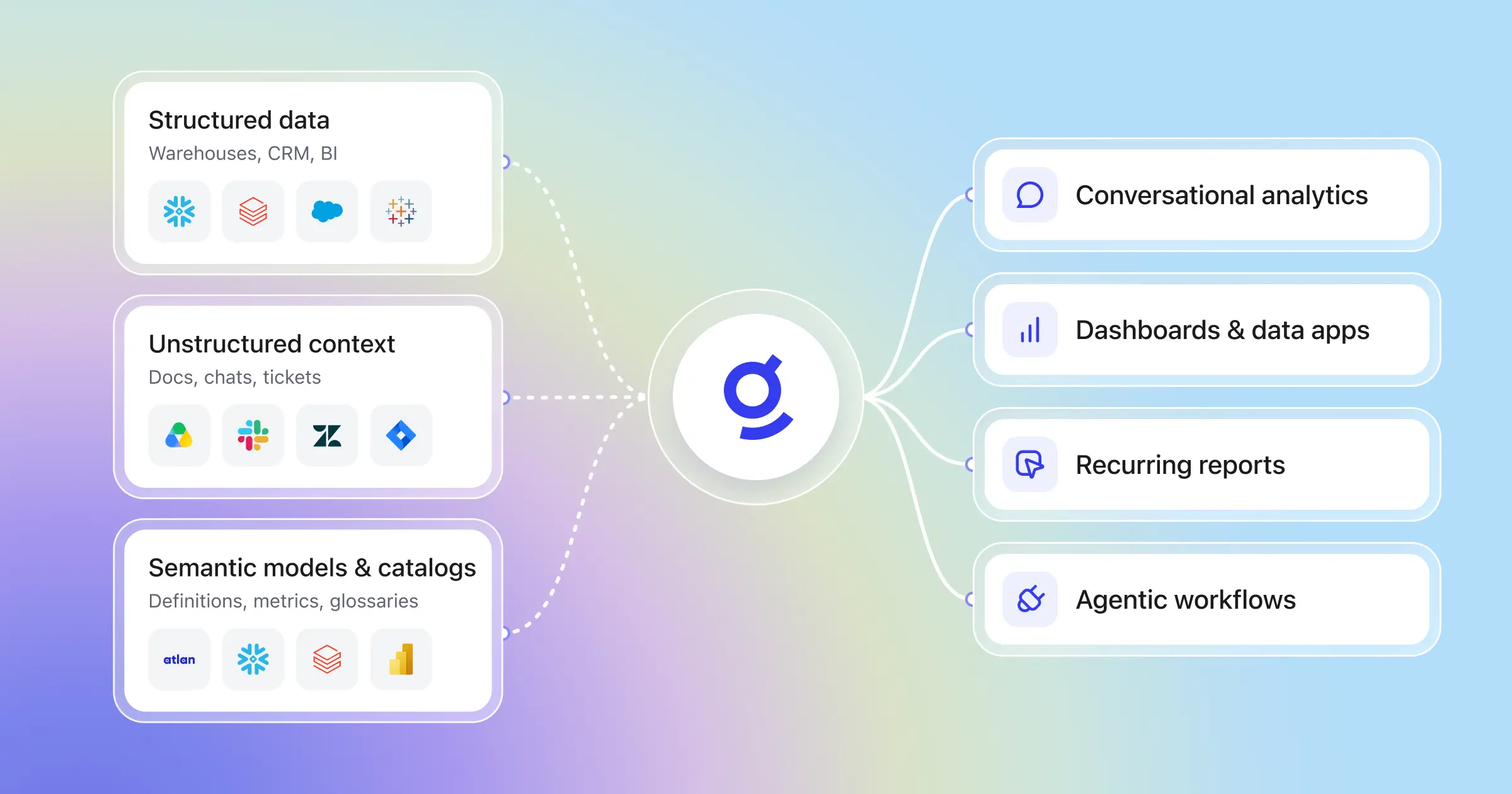
What makes an agent effective on these tasks is not the model alone. It is how the agent connects to enterprise knowledge and acts within its limits. An agent built through a governed agent development lifecycle reads across your systems, respects the permissions each employee already has, and resolves a request without a person switching between five tools to stitch the answer together.
Humans stay essential everywhere the resolution path is not fixed. Emotional nuance, ambiguous edge cases with no clear precedent, multi-party negotiations, and calls that require creative or regulatory judgment still belong with people. The goal is reallocation, not replacement: move routine volume to agents so your team spends its hours on the work that actually needs a human.
How AI agents scale without scaling headcount
Hiring scales linearly. Every jump in volume needs another person, another salary, and another manager's attention. AI agents scale sub-linearly: once an agent is deployed and connected to your systems, each additional resolution costs close to nothing. That gap is the whole argument for scaling capacity with agents instead of headcount.
The mechanism matters. An enterprise agent builder lets a team stand up a new agent for a new workflow without rebuilding data connections, permissions, and governance from scratch each time. Agents also work across time zones around the clock, with no shift differentials, overtime, or weekend staffing to fund. When demand spikes for a product launch or an open-enrollment window, agents absorb the surge without the guesswork of over- or understaffing for a peak that ends in three weeks.
Scale only holds if the knowledge layer holds. Agents running on fragmented, siloed data plateau fast, because they cannot find or trust the information a request depends on. A unified, permission-aware knowledge layer is what keeps accuracy steady as volume climbs, which is why Glean grounds its agents in that layer rather than bolting automation onto disconnected sources. Appetite for this is already broad: Cloudera reported in April 2025 that 96% of IT leaders plan to expand their use of AI agents over the next 12 months.
What determines how fast you see ROI from AI agent deployment
Three factors predict how fast an agent pays back: clean, accessible data at the moment the agent acts, a tightly bounded initial scope, and human escalation paths defined before launch. Get those right and the timeline compresses. Skip them and the agent stalls on bad retrieval and unclear handoffs.
The data on this is consistent. In the Salesforce State of Agentic AI (2026), 36% of deployers named clean, accessible data as a top success driver, and another 36% pointed to tightly bounded scope. Organizations that unified their data before deploying reached ROI in 7.3 months, compared with 8.8 months for those that did not. Yet only 31% fully unified their data before launch, which is where much of the lost time hides.
Scope choice sets the pace too. Starting with a high-volume, well-understood workflow such as tier-1 IT support or HR policy questions pays back faster than a broad, fuzzy rollout, because the resolution path is clear and the volume is there on day one. An enterprise knowledge graph does the heavy lifting on accuracy and speed here, connecting people, documents, and systems so the agent retrieves the right answer instead of a plausible-looking one.
Expect payback to track with scope. Druid's 2026 framework puts a single high-volume workflow at three to six months, a multi-workflow rollout within a single department at six to 12 months, and an enterprise-wide deployment with orchestration and governance at 12 to 18 months. One caution: do not read results at 30 to 90 days. Measuring that early is a common, avoidable reason teams conclude an agent failed before it had a fair window.
Hidden costs and risks of each approach
Hidden costs of hiring more support staff
The costs that rarely make the hiring spreadsheet are the ones tied to how a team behaves as it grows. Each new hire adds a node where knowledge can fragment, since answers now live in more heads and fewer shared systems. Management overhead climbs with headcount, because more people means more coaching, scheduling, and quality review for a lead who was already full.
Tool sprawl is the quiet one. Every added agent needs licenses, access provisioning, and offboarding, and each account widens your security surface. When someone leaves, their institutional knowledge, the workarounds and account history they carried, walks out with them and has to be rebuilt.
Hidden costs of AI agent deployment
Agents carry their own risk dynamics, starting with ongoing compute. Token costs scale with volume and architecture, not just usage. Oracle noted in 2026 that a simple large language model task at scale, such as 50,000 document-routing decisions a day, can cost 10 to 50 times more in tokens than a rule-based system doing the same job. Architecture choices decide which end of that range you land on.
Agent sprawl is the AI version of tool sprawl. Disconnected single-task agents that never share orchestration or governance recreate the exact fragmentation you were trying to fix, and that kind of sprawl never compounds into real leverage. Governance gaps compound the risk: without observability, audit logging, and permission enforcement, you inherit real compliance exposure in regulated industries. In the Salesforce State of Agentic AI (2026), organizations with below-average governance were about twice as likely to find an agent operating out of parameters only after a consequential error, at 32% versus 18%.
Change management is the last hidden cost. Employees adopt an agent when they can see how it reasons and where its information comes from. Skip that transparency and trust erodes, which quietly caps the return no matter how well the agent performs.
How to build the business case for AI agents over additional headcount
Frame the case for the three people who sign off, in their own terms. For the CFO, compare cost per resolution for an agent against a human, then show payback period and a three-year total cost of ownership that includes attrition and retraining, not just base pay. For the COO, model capacity: what does serving twice the volume look like with agents versus hiring proportionally to meet it? For the CIO, address integration risk, governance posture, auditability, and permission enforcement that sits upstream of the model rather than being patched on afterward.
Then account for the soft ROI that compounds over time. Faster onboarding, consistent answer quality across every shift, less context-switching for senior staff, and the chance to redeploy experienced agents to higher-value work all add up, even when they resist a single clean number. These gains are the reason a rollout keeps paying back after the obvious deflection savings level off.
Pair every claim with a measurable baseline so ROI is a measurement, not a projection. Capture current cost per ticket, average handle time, first-contact resolution rate, and escalation rate before launch, then track the same figures after. External proof gives the direction of travel: Gartner predicted in March 2025 that by 2029, agentic AI will autonomously resolve 80% of common customer service issues and cut operational costs by 30%. A McKinsey banking case study from 2023 documented a 40% to 50% drop in service interactions and a cost-to-serve reduction of more than 20%. Use those as reference points, and let your own baselines carry the argument.
Frequently asked questions
What are the cost savings associated with deploying AI agents?
Savings come from a near-zero marginal cost per resolution once an agent is deployed and connected. Gartner predicted in March 2025 that by 2029, agentic AI will cut customer service operational costs by 30%. A 2023 McKinsey banking case study documented a cost-to-serve reduction of more than 20%.
How does the productivity of AI agents compare to human support staff?
On high-volume, repetitive requests, agents resolve faster and more consistently than staff, working around the clock without shift limits. Humans stay more productive on ambiguous edge cases, negotiations, and judgment calls. The strongest results come from pairing the two, with agents handling routine volume and people handling exceptions.
What is the typical ROI timeline for AI agent deployment?
The Salesforce State of Agentic AI (2026) reported an average near eight months, within an industry range of 6.5 to 10.1 months. Timelines track with scope: Druid's 2026 framework puts a single workflow at three to six months, a multi-workflow single-department rollout at six to 12 months, and enterprise-wide at 12 to 18 months.
What specific tasks can AI agents handle more effectively than human staff?
Agents excel at high-volume, structured tasks with a fixed resolution path: password resets, account inquiries, policy lookups, status checks, FAQ deflection, and document retrieval. In financial services, Druid's 2026 benchmark found 90% of agent interactions concentrate in account servicing, knowledge delivery, and transactional assistance.
What are the hidden costs of hiring additional support staff?
Beyond salary, growing a team adds knowledge fragmentation, management overhead that rises with headcount, and tool sprawl that widens your security surface through more licenses and access. When experienced people leave, the institutional knowledge they carry, including account history and workarounds, walks out and has to be rebuilt.
The math comes down to how volume behaves: human teams cost more with every added ticket, while agents grounded in your company's knowledge absorb that volume at a fraction of the marginal cost. Start with one high-volume workflow, measure it against a clean baseline, and let the payback make the case for the next. Request a demo to see how we put your enterprise knowledge to work with agents that plan, adapt, and act safely at scale.