



How can I use AI to search across structured and unstructured data?
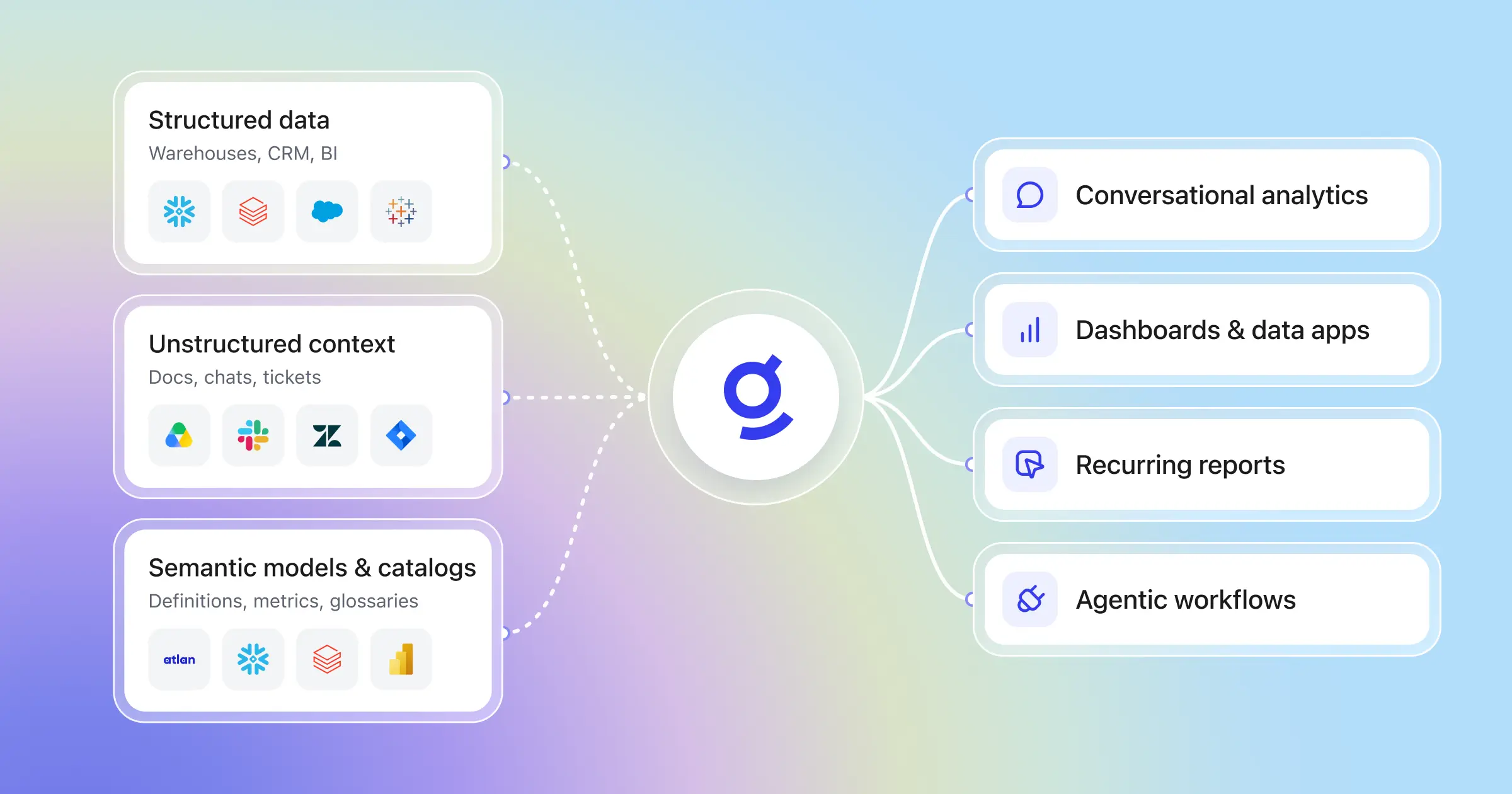
AI search across structured and unstructured data lets you ask one question and get grounded answers from records, documents, messages, and other business content. In one flow, it combines exact matching, semantic retrieval, and your existing permissions, so every answer stays verifiable.
Structured data lives in rows and fields: CRM opportunities, HR records, finance ledgers, and support tickets. Unstructured data is everything else, including documents, emails, chat threads, and multimedia. In 2022, IDC found that 90% of the data organizations generate is unstructured (IDC white paper, sponsored by Box, August 2023).
The real challenge is context, not storage. A customer record in your CRM means little until you connect it to the email thread, the contract, and the Slack discussion that explain it. It adds up: in a 2025 survey of 4,000 employees at large enterprises, Coveo found workers reported spending three hours a day searching for information, with 47% pointing to information scattered across too many applications as their biggest obstacle.
How to use AI to search across structured and unstructured data
To use AI to search across structured and unstructured data, start with a unified, permission-aware search layer. It connects your business systems and content repositories instead of copying work into another isolated tool. Good AI search tools read intent, entities, and context through natural language processing, then keep retrieval grounded in your source data instead of model memory.
One question should return the right record, the right passage, and the relationship between them. Semantic search finds the meaning behind your words, while exact matching keeps structured data search precise. A CRM account, a renewal contract, and the support ticket behind a churn risk come back together. AI data integration turns those scattered signals into AI for data insights you can act on.
For most teams the fastest path is choosing proven enterprise AI tools that already handle connectors, permissions, ranking, and governance, rather than building from scratch. A unified, permission-aware Work AI platform like Glean handles those layers so you can spend your time on questions, not plumbing.
That fragmentation is why context matters so much. IDC found the typical employee uses 37 software tools, and half of organizations say their unstructured data is mostly or completely siloed (same IDC/Box white paper). One principle keeps the results reliable: exact data stays exact, narrative context stays contextual, and a good answer brings both together.
1. Connect the sources that matter most
Start with the workflows people already struggle with, then connect the systems those workflows depend on. Account research, case resolution, onboarding, policy lookup, and product questions each pull from a predictable set of tools, so scoping to them keeps the project measurable and the value obvious. A support agent resolving a case needs the customer record and the related tickets, not the entire data warehouse.
Prioritize the structured and unstructured systems that belong together: customer records paired with support tickets, employee profiles paired with policy docs, project data paired with design notes. Connect them through native connectors and APIs so the index stays current, metadata stays intact, and permissions are inherited straight from the source. This connective work is where many programs stall — in a 2025 survey of more than 1,000 IT leaders, 80% named data integration as their single biggest obstacle to adopting AI. Skip the ambition of indexing every system on day one. Begin with the high-usage, decision-critical tools, prove retrieval quality, and expand from there.
Capture source-level details as you connect each system, because they drive ranking, filtering, and grounding later:
- Object type, owner, and status
- Created and modified timestamps
- Titles, IDs, and tags
- Participants and thread membership
- Parent-child relationships between records
A practical rollout starts with 5 to 10 core systems, not 50. That constraint forces you to name the workflows worth solving first, and it gives you a clean baseline to measure structured data search and unstructured data analysis against once the index is live.
2. Preserve structure, content, and permissions during indexing
Index each system in the shape that matches its data, and enforce permissions at the moment of retrieval. Structured records should stay records: preserve field names, object types, numeric values, dates, statuses, and the relationships between them, rather than flattening a row into a text blob. When you flatten a record, you lose the ability to filter by amount, status, or date, which is often the whole point of a structured query.
Unstructured content works differently. Break long documents and threads into smaller passages, and attach metadata to each one: source, author, date, title, workspace, thread, and any related record ID. Keep a shared identity layer across both so the same customer, person, or project resolves to one entity whether it appears in a document, a ticket, or a database row. That entity resolution is what lets a single question reach across formats and return one coherent answer.
Two rules protect trust during indexing:
- Enforce source permissions at retrieval time, not after the answer is generated, so people only see results and citations they already have access to.
- Track freshness signals, so a record updated this morning or a revised policy doc surfaces ahead of a stale copy when recency matters.
A useful engineering pattern here is a dual-index design: document chunks and normalized table rows are indexed separately, then fused at query time. Semantic search handles the passages, structured lookups handle the rows, and the merge step preserves both the prose and the precise values instead of forcing one representation to stand in for the other.
3. Enrich the data with shared context before you rank results
Add the context that helps AI connect systems the way your employees already connect them in their heads. People, teams, customers, projects, products, locations, and common internal terms form the vocabulary of a company, and encoding that vocabulary is what turns raw retrieval into relevant answers. A query about "the Q3 renewal" only works when the system knows which account, which contract, and which owner that phrase points to.
Data enrichment with AI does most of this work by extracting entities, titles, summaries, languages, topics, and table context from content that arrived without structure. It also normalizes naming drift, so an acronym typed in a chat message, a full title written in a doc, and a short code stored in a record all resolve to the same thing. Build the relationships between them too, so a contract draft, its approval thread, and the account record read as one business event rather than three disconnected files. Good enrichment does not invent meaning. It makes the meaning that already exists easier to retrieve.
Ranking is where enrichment pays off, and it can use organizational signals without touching access:
- Role and team membership
- Document affinity and recent collaboration
- Entity relationships surfaced during enrichment
These signals reorder results toward what a given person is likely to need, while permission checks decide what that person is allowed to see. Natural language processing and semantic search read intent from a plain-language question, and the enriched context decides which of the permitted results actually answer it. The result is a ranking layer that reflects how work happens, grounded in data management strategies you can audit and adjust.
4. Use hybrid retrieval so each query gets the right search method
Hybrid retrieval routes each query to the method that fits it, so a status lookup and a policy explanation never run through the same pipeline. A strong system reads the query first and decides what kind of answer the person wants: a lookup, a comparison, an explanation, a summary, a policy answer, or a suggested next step. That reading step, powered by natural language processing, shapes everything that follows.
Different data demands different retrieval. Match the method to the question:
- Structured records: favor exact filters, fielded retrieval, and entity resolution. Precision wins here. Account status, record owner, renewal date, and open case count need the right value, not the closest-sounding one.
- Unstructured content: use semantic search, passage ranking, and query expansion. These find meaning inside documents, tickets, and threads even when the wording in the question doesn't match the wording on the page.
The best results come from one ranking flow that weighs lexical, semantic, metadata, and relationship signals together. Vector similarity alone misses too much. Reranking then fuses record hits and passage hits into a single answer set, so you get the current record value next to the reasoning buried in a doc or a discussion. LLMs read intent and phrase the response well, but deterministic retrieval should still own exact facts, identifiers, and constrained filters. Machine learning for data ranking works best as a layer on top of reliable lookups, not a replacement for them.
There's benchmark support for blending methods. IBM's "Blended RAG" research, presented at IEEE MIPR 2024 (Sawarkar et al., arXiv:2404.07220), found that combining keyword, sparse-encoder, and dense-vector indexes outperformed any single method on information-retrieval benchmarks, with up to 50% higher question-answering F1 scores on standard datasets. Later work points the same way: a 2025 study benchmarking retrieval methods reported that hybrid search produced the lowest hallucination rate of the approaches tested. Treat that as a benchmark signal, not a guaranteed outcome in your own environment.
5. Generate answers from retrieved evidence, with citations and clear limits
Generate every answer from the records and passages you retrieved, and tie each major claim to a source the reader can open. A grounded answer never fills gaps with guesses. When both a record and a document contribute, cite both: the status comes from the record, and the reason comes from the discussion or the doc that explains it.
Format the answer so people can decide quickly. A pattern that works:
- A short summary that states the answer up front.
- Supporting bullets that show the key evidence.
- Source references and related records for anyone who wants to verify or dig deeper.
Say plainly when a question needs exact computation, approval context, or source-of-truth validation. AI should not invent totals, dates, or the meaning of a policy when the evidence is thin. The same discipline applies to AI data analysis: synthesizing several sources, comparing findings, and surfacing patterns only holds up when every step stays anchored to real company data. Trust grows when the answer shows its work, and people adopt AI search tools once they can inspect the source behind a claim.
Grounding reduces error, but it doesn't erase it. A 2025 Stanford study of legal AI tools (Magesh et al., Journal of Empirical Legal Studies) found that retrieval-augmented generation (RAG) cut hallucinations compared with general-purpose GPT-4, yet the researchers reported that hallucinations "remain substantial" in that legal setting. Employees feel this risk directly: nearly half (49%) told Coveo in 2025 they had experienced AI hallucinations at work. Read that as domain-specific evidence, and keep visible citations and honest limits in place rather than assuming any single accuracy rate.
6. Govern, evaluate, and improve the system like a real business workflow
Treat launch as the start of quality work, not the finish line. Measure result relevance, answer accuracy, citation coverage, permission correctness, freshness, and adoption from day one, then review the queries that failed. Momentum is on your side — in Microsoft's 2025 Work Trend Index, 82% of leaders called this a pivotal year to rethink strategy and operations, so a governed platform earns trust by proving quality rather than mandating usage. Common failures include missed intent, gaps in coverage, stale content ranked too high, and records that never got linked to the context that explains them.
Governance protects the whole system. Put clear guardrails around sensitive information:
- Access inheritance, so retrieval reflects each person's existing permissions.
- Redaction rules for regulated or confidential fields.
- Audit logs that record what was retrieved and by whom.
- Admin controls for connectors and indexing.
Keep search use cases separate from decision systems that require strict calculations or transactional updates. Search surfaces evidence and context. Source systems still own final writes and exact reporting. Once retrieval quality holds up, you can expand from search into action, such as drafting an update, summarizing findings for a review, or triggering a downstream workflow.
The stakes are concrete. IDC found that 51% of surveyed organizations reported a data-regulation non-compliance event in the prior 12 months (IDC white paper sponsored by Box, 2023). Audit controls and permission enforcement are operating requirements, not extras you add later.
Frequently asked questions: using AI to search structured and unstructured data
What are the best AI tools for searching structured and unstructured data?
The best tools connect many enterprise systems, respect existing permissions, combine exact and semantic retrieval, and return cited answers you can verify. Judge them on connector coverage, permission-aware retrieval, hybrid ranking, and metadata handling before you weigh raw model quality. Governance and audit controls should be table stakes, not upgrades.
How can AI improve the searchability of unstructured data?
AI extracts entities, summaries, topics, table context, titles, language, and relationships from PDFs, chat threads, and support tickets, turning loose text into searchable structure. It also interprets natural-language questions, so people search by intent instead of guessing exact keywords. That combination surfaces the right passage even when the wording differs from the source.
What techniques are used to integrate structured and unstructured data with AI?
Core techniques include shared metadata, entity resolution, relationship mapping, hybrid retrieval, reranking, and grounded answer generation. Records and documents connect through common identifiers like people, projects, customers, or workflow context, not one universal schema. Semantic search handles the text side while exact filters handle the records, and reranking fuses the two.
What challenges exist when using AI for data search?
The recurring challenges are fragmented permissions, stale indexes, duplicate content, unknown naming conventions, weak metadata, and overreliance on models for facts they should look up. Mixing analytical and retrieval questions causes trouble too. Search surfaces evidence, while deterministic systems own exact calculations, so keep the two jobs clearly separated.
How does AI interpret queries for unstructured data?
AI reads the query for intent, entities, synonyms, and recency cues, then adds organizational context before retrieving the passages that match. Natural language processing maps a plain question to the meaning behind it. The strongest systems use role, prior activity, and access rights to rank results without breaking any permission boundary.
Once you govern, evaluate, and refine your AI search system, the payoff shows up in daily work: faster decisions and fewer tabs to hunt through. We built our platform to unify structured and unstructured enterprise data behind permission-aware, cited answers, so your teams spend less time searching and more time acting. If you want to see how that works on your own data, you can request a demo and explore what a connected search system can do for you.

.jpg)

.png)



.jpg)
.webp)