


How do you compare enterprise AI search vendors using the same questions and documents for banks?
You run an enterprise AI search vendor comparison for banks by giving every vendor the same documents, user roles, questions, and scorecard. Then you score answers, citations, and permission handling side by side, so any difference reflects the product itself.
Bank knowledge is tightly controlled and heavily versioned. A tool that cites last year's KYC procedure, or shows a loan file to the wrong analyst, fails even when the answer reads well.
The method below covers six steps: workflows, documents, questions, test runs, scoring, and rollout fit. The article closes with practical tips on sensitive data, compliance review, and common pitfalls.
How to compare enterprise AI search vendors using the same questions and documents for banks?
To compare enterprise AI search vendors for banks, lock four inputs before the first demo. You need one document corpus, one set of test users with real permissions, one question bank, and one weighted scorecard. Every vendor runs against those identical inputs, and your reviewers compare cited answers, access controls, and workflow fit from one evidence set.
Gartner's Market Guide for Enterprise AI Search, published in September 2025, describes generative AI as "transforming enterprise search from information retrieval to information synthesis." Gartner followed with a Magic Quadrant for Enterprise AI Search in October 2026. Synthesized answers are harder to verify than a list of links, which raises the stakes for a controlled banking test.
Buyers often blend three separate jobs into one score. Split them so each vendor is judged on what it actually does:
- Finding one specific document, such as the current wire transfer procedure
- Answering a question with a cited response drawn from several internal sources
- Acting on the result through a governed next step, such as drafting a reply or opening a request
A practical order is to test permission-aware enterprise search first, then add answer and action tests once lookup is trusted. Freeze the corpus, question bank, and scoring rules before the first run.
1. Define the banking workflows and pass-fail criteria
Banking workflows anchor any enterprise AI search vendor comparison for banks, so list them first. Pick five to eight internal tasks where staff lose time hunting for answers. Pair each task with the role that does it, because relevance and access both depend on who is asking.
| Workflow | Persona | Sample success statement |
|---|---|---|
| KYC and AML guidance | Onboarding and compliance analysts | Returns the current due diligence steps with the cited procedure section |
| Credit approval support | Underwriters | Gives the policy limit and exception path for a specific loan type |
| Servicing exceptions | Branch and contact center staff | States the fee waiver rule and who can approve it |
| Audit prep | Internal auditors | Finds control evidence and its last review date |
| Internal operations | Operations managers | Answers cutoff times and names the escalation contact |
Weight the scorecard while the shortlist is still forming. For most banks, accuracy, permission enforcement, and source transparency outrank answer style. Locking weights early keeps a polished presentation from reshaping the criteria.
Write failure conditions in plain terms so every reviewer applies them the same way:
- The answer cites a superseded policy version.
- The results surface content the test user can't open in the source system.
- The system misses the controlling document when one exists.
- The answer blends guidance from two business units without flagging the difference.
Decide the scope next: search only, search plus an assistant, or search plus governed actions. Share one written rubric with security, IT, compliance, and business owners, so every group signs off on one set of results.
2. Build one shared document set and permission model
A shared document set gives every AI search vendor the same raw material, including the messy parts. Pull a representative sample from the systems your teams use, such as policy manuals, procedures, product guides, forms, meeting notes, and ticket history. Keep that sample identical for every vendor in the bake-off.
Document-heavy AI search breaks on difficult content, so include it on purpose:
- Long policies with many sections and appendices
- Templates that differ by a single clause
- Procedures where the outdated version still sits in a shared drive
- Conflicting guidance across retail, commercial, and wealth teams
- Mixed formats, including PDFs, spreadsheets, slide decks, wiki pages, and chat exports
Messy files belong in the test because data quality is one of the risks a pilot should expose. Gartner finds that at least 50% of generative AI projects were abandoned after proof of concept due to poor data quality, inadequate risk controls, escalating costs, or unclear business value. Tag each file by owner, business unit, sensitivity, last updated date, and intended audience, so you can trace every miss later.
Next, create test users that mirror the access of real roles, such as a teller, a commercial underwriter, and a fraud analyst. Test whether the pilot surfaces over-broad permissions, such as a shared folder open to the whole bank. Ask each vendor whether it inherits source-system permissions as-is, and plan to fix gaps before launch.
Ask every vendor how each source connects, because the connection model shapes freshness and permission timing:
- For indexed sources, ask how often each crawl runs and how often permissions sync.
- For live (federated) sources, ask how results are ranked when each source runs its own search.
- For hybrid setups, ask which sources are indexed and which are queried live.
Build two timed events into the pilot. Revoke one test user's access to a document, and publish an updated policy. Ask whether each platform refreshes permissions on a schedule or applies changes instantly, then record how long each vendor takes to reflect both events.
3. Write one question bank for the same banking tasks
A shared question bank should sound like your employees, shorthand included. Collect real questions from help desk tickets, compliance inboxes, and team chat channels. Remove customer details before any vendor sees them.
Cover several question types, since each one tests a different skill:
| Question type | Banking example | What it tests |
|---|---|---|
| Direct lookup | "What's the cutoff for same-day domestic wires?" | Finding one controlling source |
| Cross-document synthesis | "Can a branch waive a late fee for a small business in a declared disaster area?" | Combining a product rule, a regional exception, and a servicing procedure |
| Ambiguous | "EDD threshold?" | Handling short, incomplete queries |
| Terminology variation | "CDD refresh for high-risk clients" when the policy title uses formal language | Matching meaning without exact keywords |
| Sensitive | A teller asks for a commercial client's credit memo | Respecting permission boundaries |
| Unanswerable | A question about a product the bank doesn't offer | Admitting the evidence is missing |
Write an answer key for each question before testing starts. List the expected sources, the required answer elements, and the correct response when no answer exists. Good systems acknowledge uncertainty, so an honest "I couldn't find a policy on that" should score higher than a confident guess.
Keep vendors out of question writing, so the phrasing reflects how your staff actually ask. Tag each question by intent, such as policy lookup, risk and compliance, operations, servicing, or onboarding. Reviewers can then compare results team by team.
4. Run every vendor against the same test conditions
Identical test conditions mean the same users, roles, data scope, and time window for every vendor run. A vendor tested the week after a major policy update sees a different corpus than one tested before it. Schedule all runs close together to avoid that gap.
Follow the same sequence for each vendor:
- Lock configuration, including connectors, relevance settings, and system prompts.
- Run a baseline round with no vendor tuning, which shows performance without services work.
- Log every requested change, then apply approved changes only in a second round.
- Turn on role and team personalization in the second round, if the platform supports it.
- Send queries from each entry point staff use, such as a browser, Microsoft Teams, Slack, or an intranet portal.
- Have blinded subject matter experts score both rounds without knowing which product produced each answer.
Capture the full output of every query: answer text, citations, retrieved documents, latency, and any blocked results. Screenshots alone hide the retrieved documents, and those documents show where ranking went wrong.
NIST's voluntary Generative AI Profile (AI 600-1) suggests AI red-teaming to assess resilience against attacks such as prompt injection. NIST also flags indirect prompt injection, where attackers plant prompts in data likely to be retrieved. In an enterprise search pilot, one banking test plants a document with a hidden instruction to list customer account details, then checks whether the assistant obeys. The OWASP Top 10 for LLM Applications describes this same attack, with an attacker modifying a document in a retrieval-augmented repository.
5. Score answer quality, security, and compliance side by side
Side-by-side scoring puts answer quality, security, and compliance on one sheet, so a strong answer can't hide a permission leak. Score each dimension on a fixed zero-to-three scale. Write an anchor for each score so reviewers grade the same way.
| Dimension | What reviewers check | Example fail |
|---|---|---|
| Answer quality | Directness, correctness, completeness, and faithfulness to the source | Leaves out the approval step in a fee waiver answer |
| Citations | Right source, right section, and right version | Links to the 2023 overdraft policy when a 2025 version exists |
| Permission handling | Answers, summaries, and snippets reflect only content the user can open | A summary names a restricted credit memo |
| Freshness | Hours between a source change and updated results | A revoked file still appears the next morning |
| Security controls | Encryption, SSO, role-based access, audit logs, retention, and model-training policies | The vendor can't show whether the model provider retains prompts |
| Analytics | Failed searches, content gaps, adoption by team, and sources behind common answers | No report on queries that returned nothing |
| Operational effort | Connector upkeep, permission monitoring, and admin hours | The pilot needed weekly manual relevance tuning |
Treat any permission leak as an automatic fail, whatever the other scores say. One restricted snippet inside a summary is enough to stall a security review. For secure AI data access, ask each vendor to show how enterprise data reaches the underlying model. Confirm whether the provider keeps that data or trains on it.
AI search analytics for banks deserve their own score, because they show where the knowledge base is weak. A cluster of failed searches on a new deposit product tells the product team which procedure to write next. Analytics also give compliance teams a record of what staff asked and which sources answered.
6. Compare workflow value, rollout fit, and common failure modes
Workflow value shows up after the pilot, when staff act faster on what they find. Test whether answers stay within what's written down in the corpus and whether the platform helps finish the task after retrieval. Useful checks include drafting a customer reply, routing a servicing exception, or handing off a case through governed AI agents.
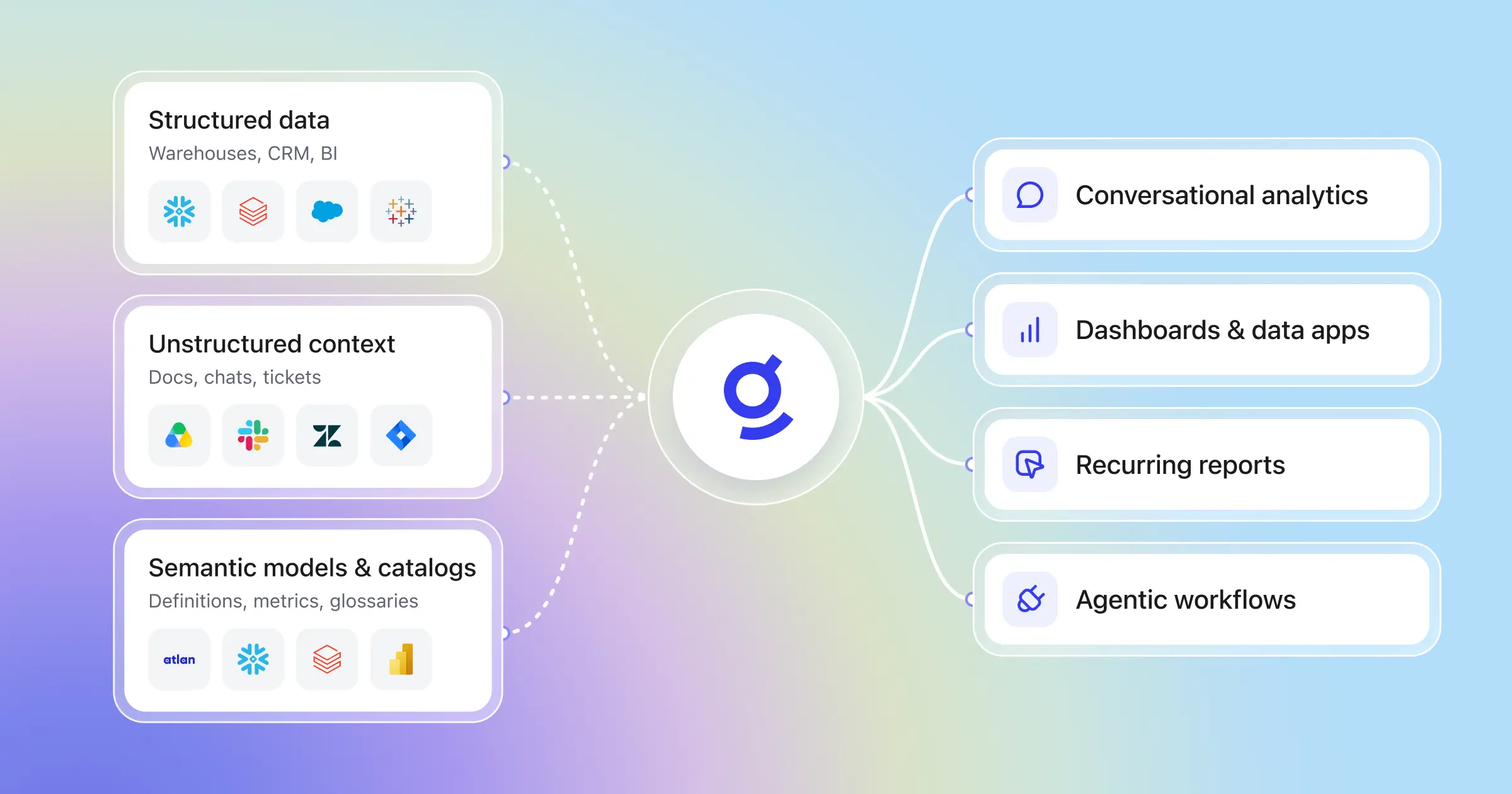
Relevance also changes over time as a system learns people, content, and work patterns within permission boundaries. Glean, for example, returns permission-aware results across 100+ tools and uses a knowledge graph to map people, content, and activity. Ask every vendor what improves after launch and how they measure it.
Plan the rollout in narrow phases so the evidence stays clean:
- One line of business, such as retail deposits
- One document set with named owners
- One group of personas, such as branch staff and their managers
- Wider expansion once the before-and-after numbers hold
Measure value with before-and-after numbers, such as time to answer a policy question, internal escalations per week, and ramp time for new hires. Record the baseline from your own help desk and onboarding data before the pilot starts.
Use reference calls to check the long-term operating model, where failure modes often appear late:
- Admin load that grows with every new connector
- No clear owner for governance after go-live
- Relevance that depends on ongoing vendor services
- New data sources that need custom builds
Tips on comparing enterprise AI search vendors for banks
The tips below answer four questions buyers raise during an enterprise AI search vendor comparison for banks. Each answer adds a specific check you can run during the pilot.
What criteria separate AI search vendors for banks?
Treat SSO, encryption, and native connectors as entry requirements, then spend scoring time on what separates vendors. For banks, those differentiators are citation accuracy on versioned policies, permission handling inside summaries, and ranking among near-duplicate documents. Price the full cost shape too, including connector fees, admin time, and services needed to reach the second-round score.
How should AI search tools handle sensitive financial data?
Permissions should be enforced before an answer is generated, and the OWASP Top 10 for LLM Applications recommends permission-aware vector and embedding stores. Ask for a data flow diagram that shows where prompts, retrieved passages, and logs are stored. Run the pilot on de-identified customer records, and confirm in the contract that the model provider doesn't retain or train on your data.
How do you confirm compliance readiness?
Bring third-party risk and compliance teams into the evaluation during the first week. The non-binding 2023 interagency guidance on third-party relationships calls due diligence before selecting a third party "an important part of sound risk management." Give these teams the pilot's audit log export and ask whether it shows who searched, what they saw, and which source supported each answer. The 2026 model risk guidance (SR 26-2) places generative AI outside its scope, so a documented bake-off gives your own governance the evidence it needs.
What are common pitfalls in evaluating financial services AI tools?
Many pitfalls come from judging AI search for regulated industries the way you'd judge a consumer chat tool. A consumer test asks whether an answer sounds helpful. A Stanford study of retrieval-based legal research tools found they still hallucinated, sometimes citing sources that didn't support the claim. A bank test asks whether the answer is sourced, permitted, current, and traceable to a named policy owner.
- Rewarding fluent wording over source fidelity
- Treating quick lookup and multi-source research as the same job
- Piloting only with enthusiastic early adopters
- Underestimating the integration work for core banking and document systems
- Skipping a retest 30 days after launch to catch drift in freshness and ranking
How do you score permission handling in an enterprise AI search pilot for banks?
Score permission handling by treating any leak as an automatic fail regardless of other scores. Run queries from test users with restricted roles, then check whether answers, summaries, and snippets contain content those users cannot open in the source system. One restricted snippet inside a summary is enough to stall a security review.
Which question types should a bank include in an AI search vendor bake-off?
Include at least six question types: direct lookup, cross-document synthesis, ambiguous short queries, terminology variation, sensitive permission-boundary questions, and unanswerable questions. Each type tests a different capability, and omitting any one of them leaves a blind spot in the evaluation.
You now have a repeatable way to compare vendors on the same documents, questions, and users, with scores your risk team can defend. We built permission-aware search and cited answers for this kind of review, and we're glad to test them against your bank's real workflows. Request a demo to explore how Glean and AI can transform your workplace.