

What is the best way to automate recurring tasks with AI in the workplace?
The best way to automate recurring tasks with AI in the workplace is to identify high-volume, rule-based workflows, select a platform with native integrations and permission-aware governance, run a small pilot on one workflow, measure results, and scale based on evidence. AI task automation uses artificial intelligence to handle routine, repetitive, or data-driven work without constant human input. Unlike rigid scripts that break on unexpected situations, AI adapts to context, interprets unstructured data, and improves over time through machine learning.
Teams lose hours every day to repetitive tasks that require no expertise or judgment — in a 2025 nationwide survey, more than two-thirds of U.S. workers said much of their time goes to low-value, inefficient tasks. The math adds up fast: if a ten-person team loses three hours a day each to manual work, that is roughly 7,800 hours a year, nearly four full-time roles of lost capacity.
Modern AI agents go further than single-task automation. They plan multi-step actions, coordinate across systems, and make judgment calls on when to escalate to a human. The key to enterprise-grade automation is permission-aware, context-rich execution: the system must understand who is asking, what they have access to, and which workflow applies. Enterprises are moving quickly, too — industry forecasts cited by Deloitte expect 80% of automation leaders to accelerate AI agent investments over 2025.
What is AI task automation?
AI task automation is the use of artificial intelligence to execute routine tasks without constant human input. The system learns from patterns in data, makes decisions, and takes action — adapting as conditions change rather than following static rules.
Traditional rule-based automation (if-then scripts) works well for simple, predictable tasks. Change the input format or introduce an edge case, and the script breaks. AI automation handles unstructured data like emails, documents, and images, interprets intent, and adjusts its approach based on context.
Modern AI agents operate more like an enterprise AI coworker than a static script. They plan multi-step actions, coordinate across connected systems, and escalate to a human when judgment is required.
What separates enterprise-grade AI from consumer chatbots is permission-aware, context-rich execution. The system must understand who is asking, what they have access to, and which workflow applies before it acts.
Why automating recurring tasks matters now
A 2023 McKinsey analysis estimated that AI and automation technologies could take on activities that absorb 60 to 70% of the time employees spend working. For most teams, that overhead is the single largest drain on capacity that no one has scheduled time to fix.
The cost goes beyond hours. Context switching between manual tasks fragments focus and prevents strategic work. Every interrupted workflow drains creative capacity that would otherwise go toward high-value problems.
A 2023 McKinsey report projects that up to 30% of hours currently worked in the US economy could be automated by 2030, with generative AI accelerating the timeline. Organizations that delay automation lose twice: first to the ongoing drain of manual work, then to the widening gap as competitors move faster. The compounding effect works in reverse, too. Every hour reclaimed from repetition can be reinvested in process refinement, market expansion, and team development.
Which workplace tasks are best suited for AI automation
The strongest automation candidates share four characteristics: they are rule-based, high-volume, follow predictable patterns, and require minimal judgment once the logic is defined.
Knowledge work and information retrieval
Searching across multiple tools for answers, synthesizing information from scattered sources, and compiling research summaries are prime targets. Drafting status updates, meeting recaps, and internal communications from existing context fits well here. An enterprise-grade assistant handles these by pulling cited answers from company knowledge rather than forcing employees to stitch together fragments from dozens of apps.
Operations and back-office processes
Data entry, system migrations, invoice processing, approval routing, and expense validation are high-volume, error-prone tasks where automation delivers immediate returns — a 2025 Parseur survey found employees spend more than 9 hours per week transferring data between documents and systems. Document processing follows predictable rules that AI handles with precision: extracting data from PDFs, forms, and emails, then populating the correct systems.
Customer-facing workflows
Routing and triaging support tickets, generating first-response drafts grounded in internal knowledge bases, and answering common customer inquiries benefit from AI that respects permissions and draws from accurate documentation. The key is accuracy and speed without exposing customers to wrong answers.
Team coordination
Scheduling across calendars and time zones, sending reminders, managing follow-ups, email sorting, and routing tasks to the right people based on content and intent are all repetitive coordination overhead that AI can absorb. These tasks you can automate return focused hours to the team each week. Data entry, email routing, invoice processing, and report generation tend to see the largest gains.
How AI agents automate multi-step workflows
Single-task automation handles one step. Agentic orchestration — powered by AI agents — plans, adapts, and coordinates across systems to complete end-to-end processes.
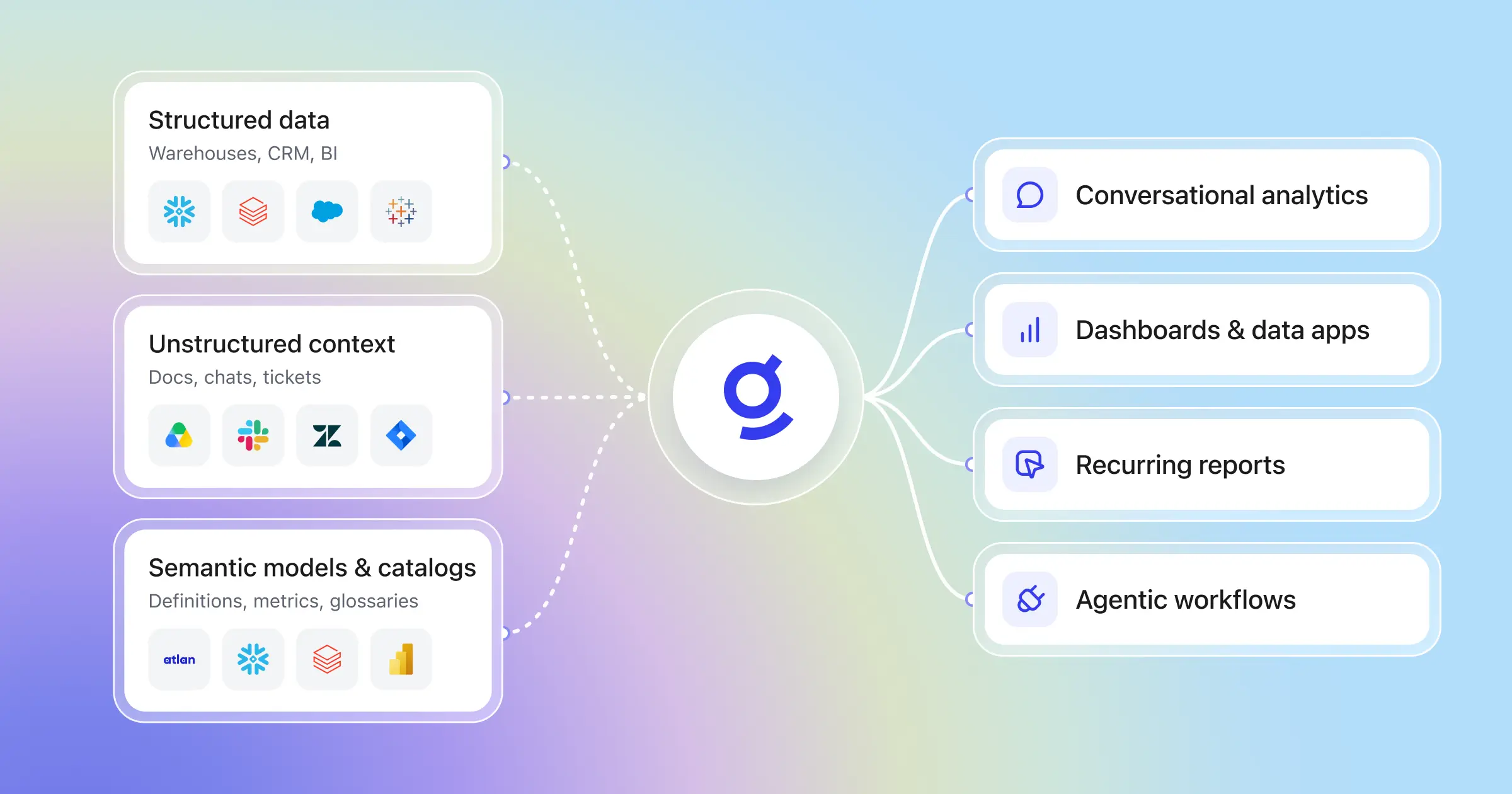
A context-aware system connects to existing tools (CRM, ticketing, messaging, document storage) through native connectors and understands relationships between people, content, and interactions. Glean's Agentic Engine uses the Enterprise Graph to map these connections, enabling agents to reason across applications rather than operating in isolated silos.
Consider new employee onboarding. An agent provisions access, surfaces relevant documentation, schedules introductions, and tracks completion. A single event triggers the workflow, and existing permissions govern every step. Each step adapts based on the employee's role, team, and location. No one monitors each task; the agent orchestrates the full workflow.
The real advantage emerges when systems maintain full context across connected tools and route work intelligently based on complexity, not just speed. Enterprise-grade agents enforce security at every step: users only see and trigger actions they are permissioned for, with audit trails for compliance.
How to identify and prioritize tasks for automation
Audit your team's recurring work
Survey team members to surface the tasks that consume the most time but require the least decision-making. These offer the highest return on automation investment. Look for signals: work that bottlenecks at predictable points, errors that recur in manual data processing, and roles where hiring is driven primarily by routine volume rather than specialized judgment.
Evaluate automation potential
Assess each candidate task against five criteria: frequency, predictability, error rate, time consumed, and number of systems involved. Tasks that score high across multiple dimensions are strong starting points. The goal is maximizing efficiency without sacrificing human insight.
Start small, then scale
Begin with a pilot: automate one high-frequency, low-complexity workflow such as ticket triage or meeting summary generation to prove value and build team confidence. Measure baseline metrics before implementation so you can quantify impact in hours saved, error reduction, and throughput increase. An agent builder supports this incremental approach, letting teams create and test workflows before rolling them out broadly.
How to measure the effectiveness of AI task automation
Track time saved by comparing hours spent on specific tasks before and after automation. Establish a clear baseline: if your team logs 15 hours weekly on a manual process today, you can measure exactly how much capacity automation returns.
Measure error reduction by comparing mistake frequency in manual processes versus automated ones. AI systems execute with precision and consistency, reducing costly rework. In a field study of more than 5,000 customer-support agents, generative AI raised productivity by 14% on average, and by up to 34% for the least experienced workers, according to research from Brynjolfsson, Li, and Raymond.
Monitor employee satisfaction by surveying teams on whether automation has shifted their focus toward more strategic, fulfilling work. Higher satisfaction often correlates with lower turnover and better output quality.
Assess productivity gains through changes in overall output, throughput, and cycle times for automated processes; a 2025 St. Louis Fed analysis found generative AI users save about 5.4% of their working hours. Calculate cost efficiency by factoring in direct labor savings, reduced rework, faster time-to-resolution, and the indirect value of reallocating skilled employees to revenue-generating activities. Review adoption and usage to measure how frequently teams engage with automated workflows. Low adoption signals a training or trust gap that needs to be addressed.
Choosing the right approach to AI automation in your workplace
Prioritize platforms that connect to your existing tool stack through native integrations. Automation that requires ripping out current systems creates more friction than it solves. The strongest platforms connect to hundreds of applications out of the box, preserving existing workflows while adding automation capabilities.
Look for permission-aware, enterprise-grade governance. The system should respect existing access controls, provide audit trails, and enforce data security upstream of any AI model. Users should only see and trigger actions they are already permissioned for in source systems.
Evaluate whether the platform understands your organization's context: the relationships between people, teams, content, and workflows, not just keywords. Accuracy depends on context depth. A system that indexes documents but ignores who created them, who reads them, and how they relate to other content misses the information that makes answers trustworthy.
Favor solutions that deliver value at every stage of maturity: from unified search (find what you need) to conversational AI (get trusted answers) to agentic automation (automate end-to-end processes). Scalability matters just as much. The right approach handles increasing workload without compromising speed, accuracy, or security, and adapts as your processes evolve.
Frequently asked questions
What specific tasks can be automated using AI?
Rule-based, high-volume tasks like data entry, document processing, email triage, report generation, scheduling, ticket routing, and knowledge retrieval are strong candidates. Any task that follows predictable patterns and requires minimal judgment once the logic is defined can benefit from AI automation.
How do I implement AI automation in my team?
Start by auditing recurring work across your team. Prioritize tasks by frequency and impact. Select a platform that integrates with your existing tools and respects your security requirements. Run a small pilot on one workflow, measure results against baseline metrics, and scale based on evidence.
What are the benefits of automating tasks with AI?
Organizations see measurable time savings, reduced error rates, and lower operational costs, and controlled studies have found double-digit productivity gains from AI assistance, and an IBM study found roughly two-thirds of EMEA enterprises report significant productivity gains from AI. Employee satisfaction increases when teams shift focus from repetitive work to strategic projects. Automation also enables scaling operations without proportional headcount increases.
How can I measure the effectiveness of AI task automation?
Track time saved per task, error reduction rates, employee satisfaction scores, throughput and cycle time improvements, and cost savings. Establish baselines before implementation so you can quantify impact accurately. Monitor adoption rates to identify training gaps or workflow friction.
The teams that pull ahead are the ones that stop treating repetitive work as a fixed cost and start handing it to AI that understands their context and permissions. Start with one high-volume workflow, measure the hours you win back, and expand from there as trust grows. When you are ready to see permission-aware automation running across your own tools, request a demo and we will show you how we can put it to work.

.jpg)

.png)



.jpg)
.webp)