




Which Search Solution Is Most Suitable for Data-Heavy Companies Like Databricks?
The most suitable search solution for data-heavy companies like Databricks is an AI-powered work platform that connects natively across your entire data and collaboration stack, enforces your existing permissions, and returns cited answers grounded in your company's knowledge — not a basic keyword search tool that returns links.
Data-heavy search means finding trusted answers across lakehouses, warehouses, notebooks, pipeline documentation, engineering tools, and messaging. When knowledge is scattered across dozens of systems and formats, employees waste hours hunting and stitching together context instead of acting on it — Microsoft's 2025 Work Trend Index found that nearly half of employees (48%) say their work feels chaotic and fragmented, driven by sprawl across disconnected systems.
The right solution indexes all of this information, understands who has access to what, and retrieves answers that reflect what your organization actually knows. Evaluating options starts with connector coverage, permission enforcement, and whether the system can ground its responses in real company data.
What Makes a Search Solution Suitable for Data-Heavy Environments?
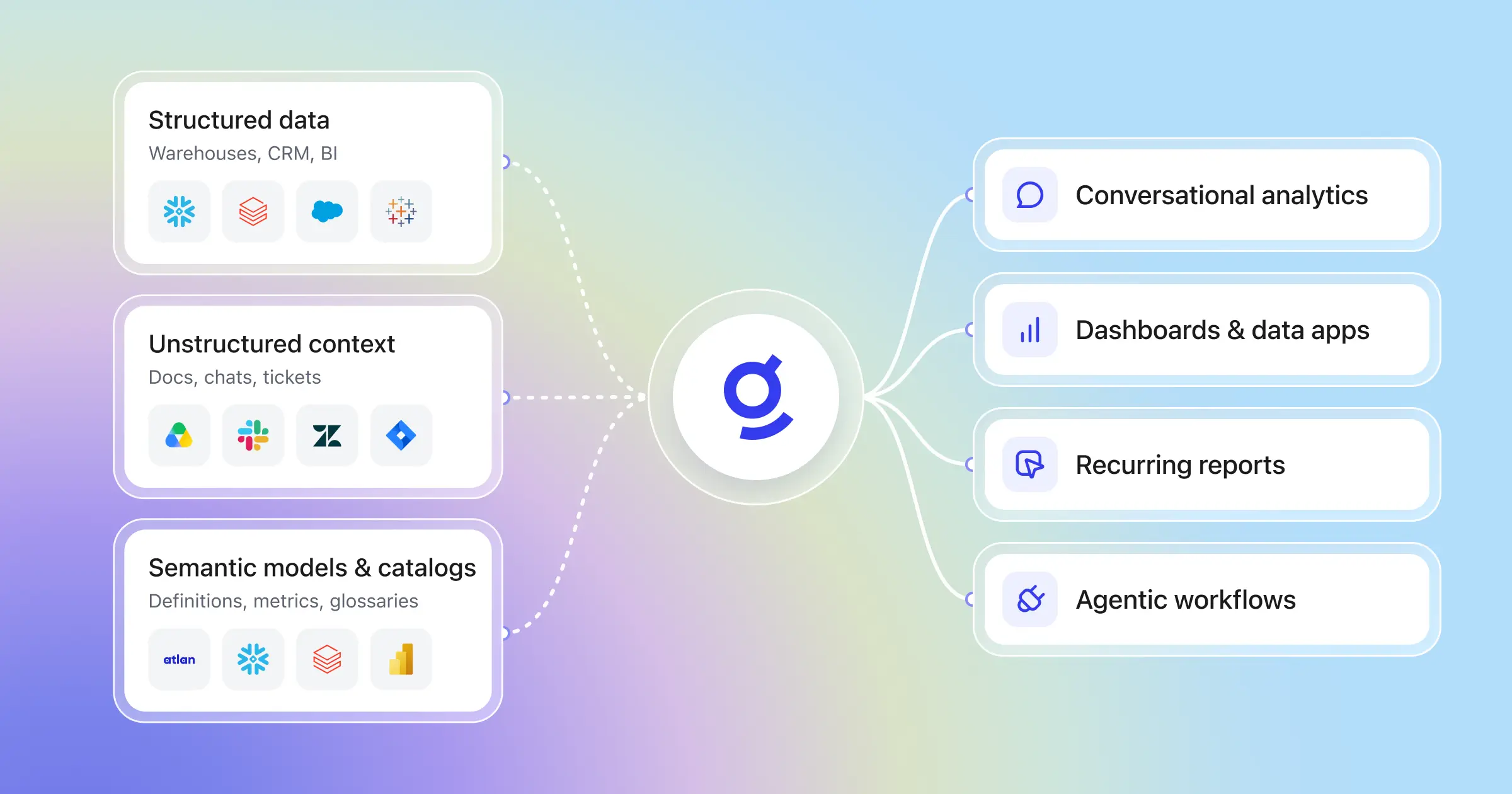
Data-heavy companies store information across data lakes, warehouses, notebooks, engineering tools, wikis, CRMs, and messaging apps. The right enterprise search solutions connect to all of these systems without requiring data migration or duplication. They index structured, semi-structured, and unstructured data alike and return permission-aware results that reflect each user's authorized access.
Basic keyword tools fall short here. A search solution built for data-heavy environments uses semantic query understanding to interpret what you actually mean, not just match keywords. It relies on retrieval-augmented generation (RAG) — a technique that retrieves relevant company knowledge and uses it to ground AI-generated answers — so responses are accurate, cited, and verifiable. The best platforms offer more than 250 native connectors across the data stack, from lakehouses and analytics platforms to ticketing systems and internal wikis.
Beyond connectors and retrieval, the system must understand organizational context: who works on what, which documents are current, how people, projects, and data assets relate. A knowledge graph that maps these relationships helps surface authoritative answers and identify subject-matter experts when documentation falls short. This depth of context separates purpose-built platforms from generic search tools.
How Data-Heavy Companies Differ from Typical Enterprise Search Use Cases
Data-heavy companies operate in environments where knowledge sprawls across notebooks, pipeline documentation, schema definitions, incident reports, SQL queries, Slack threads, and customer-facing docs simultaneously. A single answer often requires pulling from five or more sources spread across different tools — employees navigate an average of 4–6 data sources to find what they need — each with its own access model and data format.
Engineers and data scientists ask questions that span technical and business context. "What's the SLA for the customer churn pipeline?" might require a Jira ticket describing the project scope, a Confluence page outlining the contract terms, and a Slack conversation where the product manager confirmed the final number. Standard enterprise search built for marketing teams or HR portals rarely handles this cross-domain complexity.
Permission models are stricter in data-heavy environments. Production data documentation, customer schemas, and dashboards are often segmented by role, team, or project. A search tool that ignores these boundaries or applies permissions as an afterthought creates compliance risk and erodes trust.
Institutional knowledge grows faster because every pipeline, model, and dataset generates its own documentation trail. Commit messages, pull request comments, data catalog entries, and runbook updates pile up daily. Search that can't index this breadth at velocity falls behind, returning stale results when accuracy matters most.
Key Features to Evaluate in Big Data Search Capabilities
Finding the right enterprise search solution for data-heavy workloads requires looking beyond basic keyword matching. The following four capabilities separate tools that work from tools that frustrate.
Connector Depth Across the Data Stack
Data-heavy companies run 15 to 30 or more tools at once: data catalogs, notebook environments, version control, project management, communication platforms, and knowledge bases. That reflects a broader sprawl, with the average company now running 118 SaaS apps. The search solution should connect natively to each without requiring custom development.
A lakehouse integration that surfaces insights directly in the search interface signals fit. For teams on Databricks, a native Databricks integration connects SQL queries, notebooks, and job metadata to the same search layer that indexes Slack, Confluence, and Jira. This connector depth avoids a parallel data-migration project every time the stack evolves.
Permission-Aware Results at Query Time
Data-heavy environments contain PII, financial data, and customer schemas that not everyone should see. The search solution should enforce access controls inherited from source systems and integrate with identity providers before any content reaches an AI model.
Post-query filtering is insufficient. When the system checks permissions only after retrieval, sensitive content can leak into prompts and generated answers. Permission enforcement upstream of the model, at index time, keeps restricted data out of results entirely.
Contextual Understanding Through Knowledge Graphs
A knowledge graph captures relationships among people, content, and interactions across every connected system. This structure ranks results by relevance, recency, and authority, not just keyword overlap.
Personal context adds another layer. The system knows your role, your team, and the projects you work on. When you search for "revenue pipeline," it prioritizes the one your team owns over a similarly named pipeline in another department. This contextual ranking saves time and reduces noise in environments where dozens of pipelines share overlapping names.
AI-Generated Answers Grounded in Company Data
A useful search solution synthesizes answers from multiple sources instead of returning a list of links. Hybrid semantic and keyword search, combined with retrieval-augmented generation, produces responses that cite the permissioned sources backing each claim. Grounding answers in retrieved company data is the reliable way to reduce hallucination.
Every answer should trace back to a specific document, message, or ticket you're allowed to access. Cited, grounded answers reduce hallucination risk and let you verify accuracy without reopening five tabs.
How Search Solutions Compare on Performance with Large Datasets
| Capability | Basic enterprise search | AI-powered work platform |
|---|---|---|
| Data source coverage | 10-20 connectors | More than 250 native connectors plus APIs |
| Query understanding | Keyword matching | Semantic search combined with RAG |
| Permission enforcement | Post-query filtering | Upstream, permission-aware at index time |
| Result format | Ranked links | Cited answers synthesized from multiple sources |
| Context personalization | None | Personal and organizational knowledge graphs |
| Data lake and warehouse support | Limited or none | Native integrations with analytics platforms |
| Time to deploy | Months of configuration | Days to weeks with native connectors |
Basic enterprise search struggles with the volume, variety, and velocity of data-heavy environments. Keyword matching returns irrelevant results when queries include technical jargon, project names, or abbreviations unique to the organization. Teams end up scrolling through link lists, opening tabs, and stitching answers together manually.
An AI-powered work platform with deep connectors and a system of context delivers faster time-to-answer. Permission-aware indexing keeps results compliant. Cited, grounded answers give engineers and analysts what they need without the tab-switching overhead.
Integration Capabilities with Existing Data Platforms and Workflows
The best search solution doesn't ask teams to change how they work. It meets them inside communication tools, browsers, notebooks, and business apps.
Browser extensions bring search into the tools engineers already use. Embedded search in messaging platforms surfaces answers without leaving Slack or Teams. API access lets teams query the search layer programmatically from custom dashboards or internal portals.
Connections to orchestration, monitoring, and incident management tools matter when systems break at 2 a.m. The on-call engineer searching for the runbook needs it in seconds, not after navigating three separate wikis. Native integrations with pipeline tools and alerting systems close that gap.
API and SDK access lets engineering teams embed search into internal tools, portals, and custom applications. Teams building their own developer platforms or ops dashboards can surface search results and AI-generated answers without sending users elsewhere.
Cost and Operational Implications of Implementing Search for Data-Heavy Workloads
Total cost of ownership extends beyond license fees. Deployment time, connector maintenance, relevance tuning, and engineering hours all factor in.
Manual index configuration, custom ETL pipelines to feed search, and dedicated relevance-tuning teams carry hidden costs. Organizations with dozens of data sources often discover that maintaining a home-grown or loosely integrated solution consumes more engineering time than building product features.
Native connectors and automated crawling remove the integration tax. New tools connect in hours, not quarters. This speed matters in data-heavy companies where the toolchain evolves faster than IT can document it.
Measure ROI through time-to-answer reduction. Engineering productivity improves when onboarding involves asking a question instead of scheduling three meetings. Incident resolution accelerates when runbooks and postmortems appear in search results within seconds. For examples of measured outcomes, see customer stories.
Security and compliance reduce hidden costs as well. Native permission enforcement, identity-provider integration, and contractual zero-day data retention with AI model providers avoid audit findings and remediation projects down the line.
Why a System of Context Matters More Than Raw Search Speed
Speed matters, but relevance matters more. A search that returns 50 results in 200 milliseconds still wastes time if the right answer is buried on page two.
A system of context built on an organizational knowledge graph captures relationships across every connected system. The graph understands which documents relate to which projects, which people own which pipelines, and which messages reference which commits. This structure powers relevance beyond keyword indexes and basic vector search.
Consider the query "What changed in the revenue pipeline last week?" Without context, the system might return every pipeline with "revenue" in the name. With a system of context, the Glean organizational knowledge graph knows which pipeline belongs to your team, which commits touched it, which Slack messages discussed changes, and which documentation updated accordingly.
This contextual layer also powers AI agents that automate recurring work. Status reports compiled from pipeline logs, incident summaries drafted from alerts and postmortems, questions routed to the right subject-matter expert — all depend on the same graph that drives search relevance.
The combination of deep context, permission awareness, and grounded AI generation separates a search tool from a work platform. One returns links. The other answers questions and acts on them.
How to Evaluate and Select the Right Search Solution for Your Data Team
Choosing the right search solution for a data-heavy environment requires a structured evaluation. The following steps help teams avoid mismatches and wasted deployment cycles.
- Audit your current tool landscape. List every data source the team touches daily. The solution should connect natively to at least 80% of those tools on day one.
- Run a permission audit. Confirm the solution enforces your existing access controls without requiring a parallel permission model. Ask how permissions propagate from source systems to search results.
- Test real cross-system queries. Run queries that span Jira, Confluence, Slack, and your data catalog. Evaluate whether the system returns cited, accurate answers or just a list of links.
- Measure deployment speed. Look for solutions that deliver value within the first week, not the first quarter. Rapid time-to-value reduces project risk and improves stakeholder buy-in.
- Evaluate AI governance. Ask how data sent to language models is handled. Request data-retention guarantees, audit trails for each query and answer, and documentation on model provider contracts.
- Assess trajectory. The best solution today should also support agentic automation tomorrow. Evaluate whether the platform roadmap includes governed agents that can act on search results, not just retrieve them.
Frequently Asked Questions
What are the most important integrations for search in a data-heavy company?
Prioritize native connectors to data catalogs, lakehouse platforms, notebook environments, version control systems, project management tools, knowledge bases, CRMs, and messaging platforms. A search solution with more than 250 native connectors covers most enterprise stacks without custom development. The ability to index structured metadata alongside unstructured docs lets queries span the full data landscape.
Can a search solution replace our internal knowledge base?
A search solution complements your knowledge base rather than replacing it. It connects to existing wikis, docs, and portals, surfacing relevant content in a single query. Teams continue creating content where they already work. The search layer unifies access without requiring migration or consolidation projects.
How do search solutions handle sensitive data and compliance requirements?
Look for permission enforcement at index time, identity-provider integration, and certifications such as SOC 2 and ISO 27001. Contractual zero-day data retention with AI model providers keeps prompts and responses from persisting outside your control. Audit trails for every query and answer support compliance reviews and incident investigations.
How long does it typically take to deploy enterprise search for a data-heavy organization?
Initial deployment takes days when the solution offers native connectors to your stack. Full adoption, including tuning relevance for company-specific terminology and workflows, typically takes two to four weeks. Solutions requiring custom ETL or manual index configuration extend timelines to months.
What distinguishes AI-powered search from traditional enterprise search?
Traditional enterprise search matches keywords and returns ranked links. AI-powered search uses semantic understanding to interpret intent, retrieves relevant content from multiple sources, and synthesizes cited answers grounded in company data. Personalization through knowledge graphs tailors results to each user's role and team, reducing noise and accelerating time-to-answer.
We built our platform to solve exactly this challenge: connecting your company's knowledge across more than 250 tools while respecting permissions and delivering cited, trustworthy answers. Our Enterprise Graph and native connectors give data-heavy teams like yours the context-rich search and grounded AI responses you need to move fast. Request a demo to explore how Glean and AI can transform your workplace.

.jpg)

.png)



.jpg)
.webp)