

Who Should Resolve Conflicting AI Answers from Slack, Jira, and Confluence for Banks?
A cross-functional AI governance team spanning compliance, IT, and business operations should resolve conflicting AI answers in banking. No single tool or person can arbitrate when a Slack thread, a Jira comment, and a Confluence page each say something different.
The stakes are higher in banking because a wrong answer about a lending policy or AML procedure can become a regulatory finding. Federal model risk guidance issued in April 2026, SR 26-2, leaves generative AI to each bank's broader governance, so accountability has to be assigned internally.
The root cause is usually fragmented knowledge rather than bad AI, since each tool holds only part of the truth. This guide covers why conflicts happen, who owns each part of the fix, and how to build a process examiners can follow.
Why Conflicting AI Answers Happen Across Collaboration Tools in Banking
Slack, Jira, and Confluence split a bank's knowledge by purpose. Chat captures real-time decisions, Jira tracks structured work, and Confluence stores canonical policy, each with its own update cadence and access controls. In one 2026 survey of 6,000 workers, 53% said critical information they need isn't accessible through their AI systems.
Take a commercial lending exception policy. Confluence requires credit committee sign-off, a Jira ticket shortens that to "manager approval," and a Slack thread mentions a waiver from last quarter. Each source is accurate in context, yet an assistant reading only one returns a confident answer that contradicts the other two.
Single-system AI tools often miss these contradictions because they can't see the other sources, so it pays to boost AI with context from every system. Stanford RegLab and HAI researchers found that commercial legal tools built on retrieval-augmented generation (RAG) still hallucinated 17% to 33% of the time. Some errors were "misgrounded," citing a real document that didn't support the claim, like a stale Confluence page cited over a newer Slack decision.
Which Roles and Teams Should Own AI Conflict Resolution in Banks
Four groups share AI conflict resolution in banks: compliance and risk, IT, knowledge management, and line-of-business leads. Together they own information accuracy in banking AI tools, and each group needs a named lead rather than a shared inbox. Deloitte's 2026 banking benchmark found only 13% of banks reach leading AI governance maturity.
SR 26-2, which replaced SR 11-7 in April 2026, says model risk management benefits from clear roles and well-defined accountability. The principle carries over to AI answers, even though generative AI sits outside the guidance's scope.
Compliance and risk officers
Compliance and risk officers have the final say on which source states regulatory truth when AI answers conflict on policy, procedure, or customer-facing guidance. They also set escalation thresholds that separate discrepancies needing human review from ones the system can reconcile on its own. PwC's 2025 Responsible AI survey found organizations moving from shared committees to clear lines of accountability.
A practical threshold sends any conflict touching customer disclosures, fair-lending criteria, or suspicious activity reporting to a named compliance reviewer. A conflict over an internal meeting cadence doesn't need that review.
IT and platform administrators
IT and platform administrators give AI tools permission-aware access to every relevant source rather than a convenient subset. They own connector configuration and data freshness, because stale content in one system is often behind conflicting answers. A 2026 preprint found that outdated retrieved documents can make a model wrong even when it would answer correctly without retrieval.
One detail is easy to miss. Slack private channels and DMs may require additional authentication setup, depending on the platform. Without that setup, decisions a desk made in those channels can stay out of the AI's reach.
Admins also own joiner, mover, and leaver changes. When an analyst moves from AML investigations to retail banking, answers should stop drawing on the case channels they left.
Business operations and knowledge managers
Business operations and knowledge managers own content hygiene. That work covers retiring outdated Confluence pages, closing resolved Jira tickets, and archiving superseded Slack decisions.
They also set naming and tagging standards so AI can tell authoritative content from informal discussion. A policy-of-record label on the approved beneficial ownership procedure, plus a superseded label on the prior version, gives retrieval a clear signal.
Line-of-business leads
Line-of-business leads validate AI answers against domain expertise when conflicts arise in lending, treasury, AML, or payments. A treasury lead knows whether the FX hedge limit quoted in a Jira ticket reflects the current committee decision or last year's.
Each lead also sends corrections back to the content owner. That feedback loop keeps the same conflict from resurfacing the following month.
What Risks Banks Face When Conflicting AI Outputs Go Unresolved
Unresolved conflicting AI answers in banking create four risks: regulatory exposure, operational inconsistency, lost employee trust, and audit trail gaps. The risks compound, because staff who stop trusting AI fall back on tribal knowledge that leaves no record. In a 2026 Cambridge survey, 70% of financial industry firms rated hallucinations and unreliable outputs a top-two AI risk.
Regulatory exposure starts when an employee follows an outdated procedure that an AI tool surfaced. The bank's existing fair-lending and consumer-protection obligations still apply to lending and customer-facing answers, regardless of the technology behind them. For bank broker-dealer affiliates, FINRA's 2026 oversight report adds genAI as a new topic and says existing rules still apply when firms use genAI.
Banks with EU operations face another layer. The EU AI Act's Annex III lists creditworthiness checks and credit scoring of natural persons as high-risk, with obligations phasing in over time.
Operational inconsistency shows up when teams follow different AI-generated guidance for the same process. Two branches using different KYC refresh steps produce mismatched customer files, and the error surfaces later in regulatory reporting or risk calculations.
Trust erosion is quieter but just as costly. Employees who hit contradictory answers stop using the system and go back to messaging colleagues, which erases the productivity case for banking compliance AI. In a global KPMG study, 56% of employees said they'd made mistakes in their work due to AI.
Audit trail gaps appear when examiners ask how a decision was made. A loan officer's AI answer that conflicts with documented policy, with no record of its sources, leaves the bank unable to reconstruct the decision path.
How to Build a Process for Resolving AI-Generated Discrepancies
A working process for resolving discrepancies in AI, including conflicting AI answers in banking, has three parts. You need a source-of-truth hierarchy, cross-tool AI search that respects permissions, and escalation workflows that route conflicts to named owners.
Establish a single source of truth hierarchy
Define which system holds the canonical version of each content type. The resolution process then follows that hierarchy, so approved policy outranks a chat message unless a documented exception applies.
| Content type | Canonical system | Banking example |
|---|---|---|
| Regulatory policy | Confluence | Customer identification program procedure |
| Implementation detail | Jira | Ticket to update the core banking fee schedule |
| Real-time clarification | Slack | Desk note on a holiday wire cutoff change |
Set a rule that a Slack clarification overrides Confluence only until the page is updated. Add a deadline, such as five business days, after which the clarification expires or becomes policy.
Implement permission-aware, cross-tool AI search
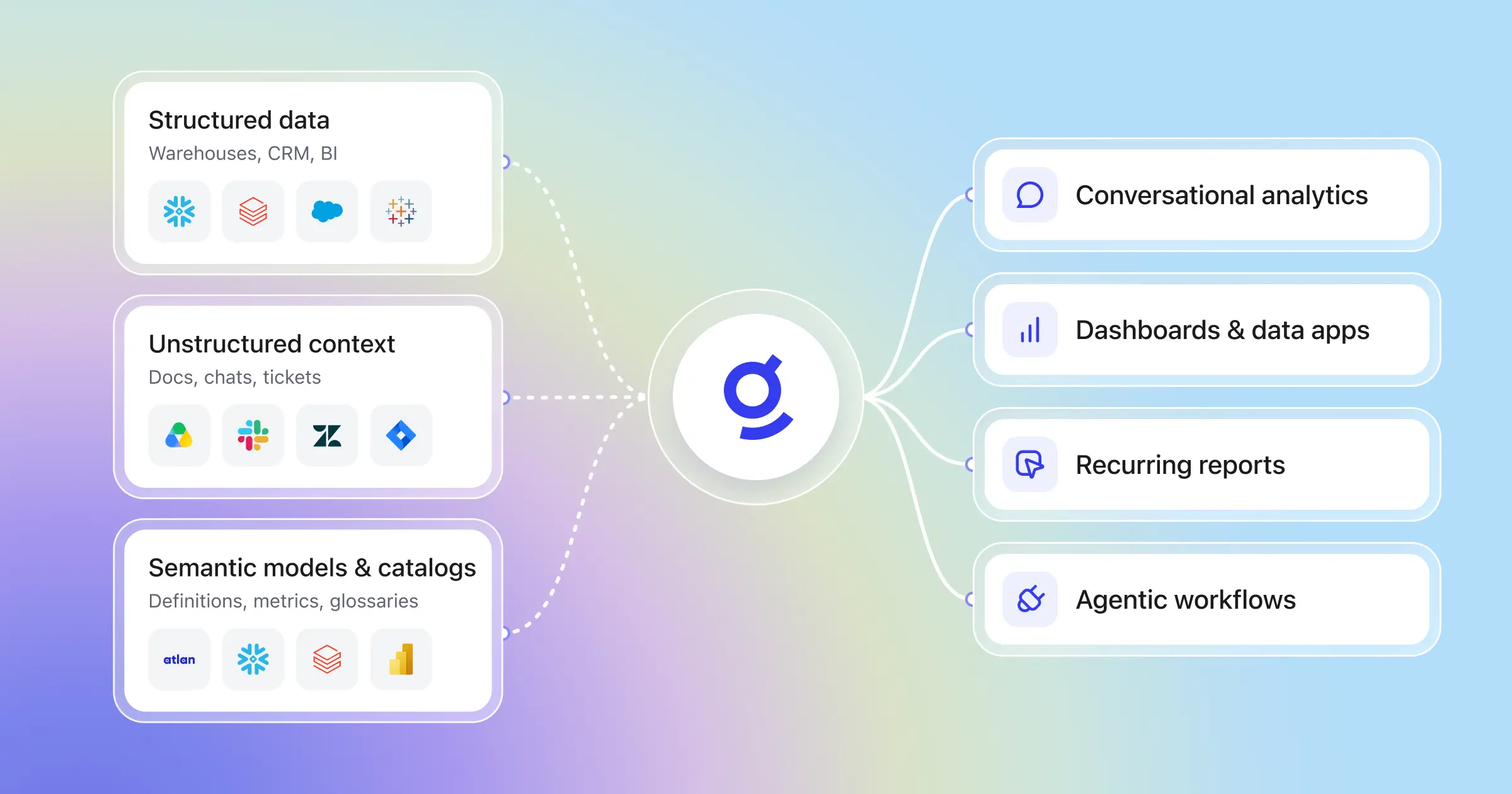
Deploy AI that queries Slack, Jira, and Confluence at once, respects existing access controls, and weighs source authority alongside keyword relevance. An AI coworker in Slack that also pulls from ticket trackers and knowledge bases can settle many conflicts at the point of question.
Say an AML analyst asks in Slack how to escalate a high-risk alert. A cross-tool answer can cite the Confluence procedure, the open Jira change ticket, and the latest channel note. The analyst can then compare all three versions with dates.
Create feedback and escalation workflows
When AI finds conflicting information, it should flag the discrepancy and route it to an owner instead of silently picking one answer. The workflow runs in four steps:
- Show both conflicting sources in the answer, with last-modified dates.
- Route the conflict to the owner named in the hierarchy.
- Log the resolution and the source that changed.
- Count conflicts by content area each month.
Repeated conflicts on the same policy signal that the underlying content needs remediation. If agents handle the routing, require human approval before any agent edits a source document.
How to Ensure Consistency Across Messaging, Ticketing, and Knowledge Base Tools
Consistency across Slack, Jira, and Confluence comes from four enterprise AI best practices. Link content lifecycles, connect ticket data to policy context, standardize how decisions move between tools, and audit high-risk domains on a schedule.
Linked lifecycles mean a Confluence policy change automatically flags related Jira tickets and pinned Slack messages for review. A treasury team updating its intraday liquidity runbook would then see every open ticket that still quotes the old thresholds.
A basic Jira Slack integration often posts ticket updates to channels without telling AI which version of a rule is current. A Jira integration with Glean can connect ticket data to the wider knowledge base, so answers drawn from tickets can reflect current policy.
Standardized decision flow gives AI a traceable chain to follow:
- Teams make the decision in Slack.
- An owner documents it in Confluence within the agreed window.
- Jira tracks the implementation and links back to the Confluence page.
Quarterly content audits should target compliance, lending, and AML material first. Use the conflict log from your escalation workflow to pick pages, so audit time goes where Confluence AI answers break down most often.
What to Look for in an AI Platform That Prevents Answer Conflicts for Banks
When you evaluate collaboration tools for banks, pick an AI platform that searches every tool in one query. It should enforce permissions before the model sees data. In an April 2026 Bloomberg poll, half of senior UK finance leaders named hallucinated facts or numerical errors as their main AI concern.
The platform should also cite dated sources, weigh authority through a knowledge graph, log every answer, and commit to data retention terms in writing.
| Capability | Why it matters for banks | What to verify |
|---|---|---|
| Cross-tool unified search | Queries every source in one pass, so answers aren't confined to one tool | Native connectors for Slack, Jira, and Confluence, plus the rest of your stack |
| Permission-aware results | Respects the role-based access controls your bank already enforces | Permissions enforced upstream of the AI model, not as a post-filter |
| Source citation and provenance | Lets employees and auditors trace every answer to its origin | Citations show tool, document title, author, and last-modified date |
| Enterprise knowledge graph | Can weigh source authority using relationships between people, content, and teams | Combines signals like author, recency, and reference frequency with content meaning |
| Governance and audit logging | Supports decision traceability for examiners | Full logs of queries, answers served, and sources used |
| Zero data retention with LLM providers | Keeps sensitive banking data from being stored or trained on by model providers | Contractual terms in writing, beyond a policy page |
Our platform supports 275+ native and MCP-based connectors and inherits and enforces each source system's permissions. Employees see only data they're already allowed to access.
With any platform, check how quickly permission and content changes sync from the source. Look for answers that carry citations you can open, and remember that a citation shows which source was used, not whether it's still current.
Make permission handling part of your AI governance in finance review. During evaluation, revoke a user's access to one Confluence space, then time how long it takes for answers to stop citing it.
Frequently asked questions
What processes should be in place to resolve conflicting AI answers?
Start with three: a ranking of which system wins per content type, search across every tool under existing permissions, and clear escalation owners. Write that ranking into your AI governance policy so examiners can follow your AI decision-making processes and see who signed off.
Who is responsible for verifying AI-generated information in banking?
Verification is shared across roles. Compliance officers check regulatory content, knowledge managers keep pages current, and line-of-business leads confirm domain guidance. Every employee should still open the cited source and check when it was last updated before acting, especially on credit decisions or customer communications.
What are the risks of relying on conflicting AI outputs in financial decisions?
Relying on conflicting outputs exposes a bank to regulatory findings, uneven customer treatment, broken audit trails, and staff who quit using AI. The cost lands as penalties, remediation work such as re-reviewing affected loan files, and reputational damage that outlasts the fix.
How can a unified AI platform reduce answer conflicts?
A unified platform can compare sources side by side before it answers. Its knowledge graph can weigh a compliance-owned policy page linked from many tickets above a one-off chat message. The answer can then lead with the authoritative source and cite the others.
Can AI itself detect when its answers conflict across tools?
Often, yes, when the AI reads every relevant source at the same time and understands how the content relates. It can flag that one question produced materially different answers from Slack and Confluence, then hold the answer for human review. Detection generally covers only connected sources, so gaps in connector coverage can become blind spots.
You can test how cross-tool answers handle your own lending, AML, and treasury questions before you write governance policy around them. We'll walk your compliance, IT, and operations leads through permission-aware, cited answers drawn from Slack, Jira, and Confluence. Request a demo and we'll build the session around the policies that conflict most often at your bank.